
Grading Data Center Sites in Hilly Terrain
A guide to the civil engineering challenges of grading data center sites in hilly terrain, covering mass earthwork, slope stability, stormwater management, and rock excavation for mission-critical fac
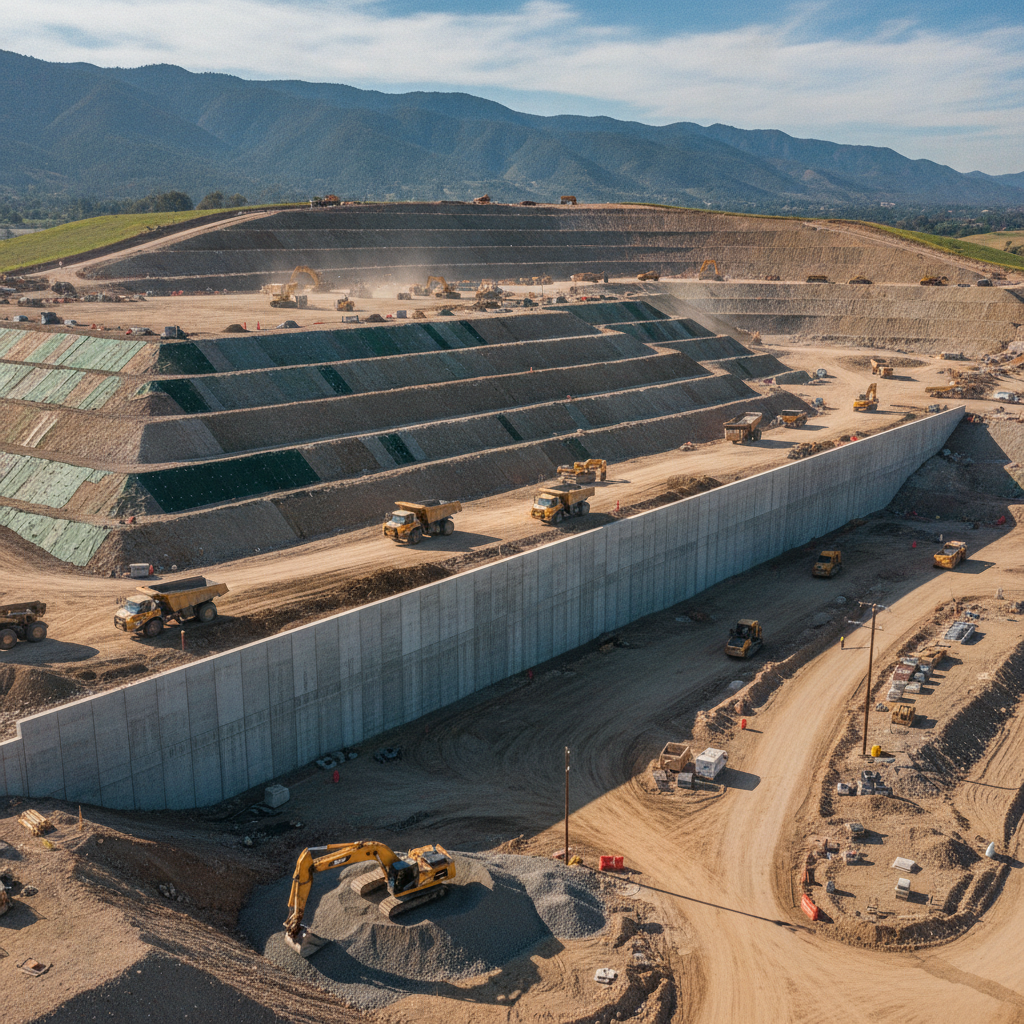
The Unique Demands of Data Center Site Grading
Unlike typical commercial developments, data centers have exceptionally stringent requirements for their physical sites. The building pads must be expansive and almost perfectly flat to support the precise foundations of server halls and heavy-duty cooling equipment. Any differential settlement can compromise sensitive equipment and structural integrity, making foundation stability a paramount concern for these mission-critical facilities. The grading plan must accommodate not only the main building footprint but also extensive ancillary infrastructure, including electrical substations, generator yards, cooling towers, and fuel storage tanks. These elements also require stable, level ground. The overall site grading strategy, therefore, involves creating a complex, multi-level campus on what was once a single, continuous slope. This level of transformation requires a sophisticated civil engineering approach to ensure long-term performance and safety.
Mastering Earthwork: Cut and Fill Strategies for Hilly Terrain
Comparison of Slope Stabilization Techniques
| Technique | Primary Application | Key Engineering Considerations | Relative Cost |
|---|---|---|---|
| Benching / Terracing | Stabilizing tall cut or fill slopes (typically > 20-30 ft) by breaking them into shorter segments. | Bench width, drainage design for each bench, slope angle, long-term maintenance access. | Low to Moderate |
| Geogrid Reinforced Slopes | Constructing steep fill slopes (up to 1H:1V or steeper) where space is limited. | Geogrid strength and spacing, soil type, compaction quality control, facing type (e.g., vegetated). | Moderate |
| Soil Nailing | Stabilizing existing or excavated cut slopes in competent soil or weak rock. | Nail length and spacing, grout strength, soil-nail interaction, requires specialized contractors. | Moderate to High |
| Cantilever Retaining Walls | Supporting cut or fill conditions where a vertical face is required and space is highly constrained. | Foundation design (footing size), structural reinforcement, drainage behind the wall. | High |
| Mechanically Stabilized Earth (MSE) Walls | Creating tall, vertical grade separations for fill conditions, common for bridge abutments and major roadways. | Reinforcing strap length, backfill material quality, foundation bearing capacity. | High |
The core of grading in hilly terrain is the process of cut and fill, where soil and rock are excavated from high areas (cut) and used to build up low areas (fill). For data centers, this can involve moving millions of cubic yards of material. The primary goal is to achieve an earthwork balance, minimizing the need to import or export soil, which significantly impacts project costs and timelines. Advanced civil engineering software is used to create 3D models of the existing topography and proposed design, allowing engineers to optimize the grading plan for maximum efficiency. A critical component of this process is a thorough geotechnical analysis of the site’s soil and rock. Engineers must determine if the excavated material is suitable for use as structural fill. Factors like soil type, moisture content, and rock composition dictate the methods for excavation and the requirements for soil compaction. Unsuitable materials must be removed and replaced, adding another layer of complexity to the mass grading operation.
Ensuring Slope Stability and Structural Integrity
Creating large, flat pads on a hillside inevitably results in the creation of tall, steep cut-and-fill slopes. Ensuring the long-term slope stability of these manufactured landforms is a critical safety and operational requirement. A slope failure could undermine the data center foundation or block critical access roads. The design must account for soil mechanics, groundwater conditions, and seismic factors identified during the geotechnical investigation. Several techniques are used to stabilize these slopes. Benching, or creating step-like terraces in a tall slope, breaks up the slope length and helps manage surface water runoff. In many cases, engineered structures are necessary. These can range from geogrid-reinforced slopes to massive retaining walls, such as soil nail walls or mechanically stabilized earth (MSE) walls. The selection of the appropriate stabilization method depends on the slope height, soil properties, and project budget, requiring a specialized analysis by a Geotechnical engineer.
Stormwater Management and Erosion Control on Steep Grades
Grading a hilly site drastically alters its natural hydrology. Removing vegetation and creating vast impervious surfaces and long, steep slopes concentrates stormwater runoff, increasing its velocity and erosive power. A robust stormwater management system is essential to prevent site erosion, protect downstream properties, and comply with environmental regulations like the federal Clean Water Act’s National Pollutant Discharge Elimination System (NPDES) program. The drainage design for these sites must incorporate features to safely collect, convey, and treat this high-energy runoff. This often includes armored channels, collection benches with dedicated pipes, energy dissipator structures at outfalls, and large detention or retention basins to manage peak flow rates. An effective erosion and sediment control plan is also required during construction to prevent soil from leaving the site. Permitting requirements for stormwater and grading vary by jurisdiction, and every project team should confirm the applicable standards with the local, state, regional, and federal authorities that hold review authority over the site. This early coordination is crucial for avoiding costly delays.
Navigating Rock Excavation and Blasting
Hilly and mountainous regions frequently have bedrock at or near the surface. When this is encountered within the grading footprint, rock excavation becomes a major cost and schedule driver. Depending on the rock’s hardness and structure, it may be possible to rip it with heavy bulldozers. However, for massive quantities of hard rock, blasting is often the only feasible method. This introduces significant complexity to the site development process. A blasting operation requires specialized contractors, detailed blasting plans, and often, separate permits. Pre-blast surveys of nearby structures are necessary to establish a baseline, and vibration monitoring is conducted during blasting to ensure compliance with regulatory limits and prevent damage to off-site property. The cost and time associated with rock excavation must be factored into the project’s pro forma from the outset.
Designing Functional and Safe Access Roads
A data center requires reliable access for heavy vehicles, both during construction for material delivery and during operation for fuel trucks and equipment replacement. Designing access road design on a steep site is a challenge. The road’s vertical alignment must adhere to a maximum grade that large trucks can safely navigate, and its horizontal alignment must provide adequate turning radii. This often requires carving the road into the hillside with its own set of cut-and-fill slopes. Furthermore, site access must meet local fire code requirements and provide ADA compliance for personnel. The transportation engineering component of the site plan must balance functional needs with the topographical constraints, often resulting in long, winding access routes that add to the overall development footprint and cost.
The RSP Engineers Approach to Complex Site Grading
At RSP Engineers, we approach complex data center grading with a comprehensive, data-driven methodology. Our process begins with a detailed site feasibility study, including an early-stage geotechnical investigation and topographic analysis. We use advanced 3D modeling software to perform iterative site plan design and earthwork optimization, striving to balance cut and fill volumes to control costs. Our integrated team of civil and drainage engineers develops a cohesive stormwater management strategy from day one, ensuring the design is both compliant and resilient. Throughout construction, we provide rigorous construction administration and quality assurance services to ensure the grading, compaction, and slope stabilization measures are executed precisely according to plan.
Common Challenges in Hilly Site Development
Even with meticulous planning, developing data centers on hilly terrain can present unforeseen challenges. A primary risk is encountering unexpected subsurface conditions, such as a higher-than-anticipated rock shelf or pockets of unstable soil not identified in initial borings. Underestimating the velocity and volume of stormwater runoff can lead to severe erosion and system failures. The permitting process can also be complex, with many jurisdictions having specific ordinances for steep slopes or hillside development that require additional review cycles. Finally, utility coordination is more difficult, as gravity-dependent systems like sewer and storm drains must navigate significant grade changes, and pressurized systems may require booster pumps or pressure-reducing valves.
Partner with RSP Engineers for Your Mission-Critical Project
Transforming a challenging hillside into a state-of-the-art data center campus requires a civil engineering firm near me with proven experience in large-scale land development and complex site grading. RSP Engineers provides the expert site engineering services needed to navigate these projects from initial due diligence and permitting to final construction. Our team leverages advanced technology and a deep understanding of earthwork, drainage, and geotechnical principles to deliver stable, cost-effective, and resilient sites for our clients nationwide. Contact us to discuss how we can support your next mission-critical facility development.
Conclusion
While grading data center sites in hilly terrain presents formidable challenges, they are not insurmountable. Success hinges on a proactive, engineering-led approach that begins with thorough upfront analysis and continues through diligent construction oversight. By integrating expert geotechnical analysis, sophisticated earthwork modeling, and robust stormwater management design, developers can unlock the potential of these complex sites. With the right technical team, a challenging hillside can be transformed into a secure and highly valuable asset for critical digital infrastructure.
FAQs
-
Hilly terrain significantly increases project costs compared to a flat site. The primary drivers are mass earthwork (cut and fill), the potential for expensive rock excavation, the necessity for retaining walls and other slope stability measures, and the implementation of a more complex drainage design to manage high-velocity runoff.
-
The first step is a comprehensive due diligence or feasibility study. This must include a detailed topographic survey and a preliminary geotechnical investigation, including Soil boring test work. This initial study helps identify potential fatal flaws, estimate earthwork volumes, and develop a conceptual site plan design and budget.
-
Utility routing requires careful planning. Gravity-fed utilities like sanitary sewer and stormwater pipes must maintain minimum slopes, which can be challenging across terraced pads. This may require deep excavations or multiple networks. Water mains and fire protection lines are pressurized, but significant elevation changes can necessitate different pressure zones, requiring specialized valves or pumps to ensure proper operational pressure throughout the site. This level of utility coordination is critical.