
Grading Data Center Sites in Flat Terrain
Explore the unique civil engineering challenges of grading data center sites in flat terrain, including positive drainage, shallow utilities, and stormwater management. Learn how expert site developme
The Challenge of Achieving Positive Drainage on Flat Sites
The fundamental goal of site grading is to achieve positive drainage—the condition where water flows away from buildings, pavement, and critical infrastructure towards a designated collection system. On a site with natural topography, engineers can work with existing slopes. On a flat site, every fraction of a percent of slope must be artificially created through precise cutting and filling. For a sprawling data center campus, this is a monumental task. The minimum slopes required for effective stormwater conveyance in pipes and swales are difficult to achieve without creating deep excavations or tall berms. Without adequate slope, water is prone to ponding in parking lots, around loading docks, and against foundation walls, leading to saturated subgrades and potential water intrusion. The phenomenon of sheet flow across vast, nearly-level paved surfaces can overwhelm drainage inlets if not properly managed. The engineering design must create a subtle but effective network of slopes, swales, and inlets to ensure that even during intense storm events, water is collected and routed efficiently, protecting billions of dollars in IT infrastructure.
Shallow Stormwater Systems and Gravity Outfall Limitations
Comparison of Grading Strategies for Flat Data Center Sites
| Strategy | Key Engineering Considerations | Potential Risks |
|---|---|---|
| Mass Fill Pad Elevation | Sourcing and quality control of imported fill; compaction testing; haul route logistics; overall site water balance. | High cost of materials and transport; potential for differential settlement if not compacted properly; significant truck traffic impact. |
| Cut-and-Fill with On-site Ponds | Requires large areas for stormwater ponds; balancing cut/fill volumes to minimize import/export; pond liner and depth requirements. | Reduces usable land area; potential for high groundwater interaction with ponds; long-term maintenance of pond slopes and vegetation. |
| Subsurface Drainage Network | Extensive use of underdrains and perforated pipes; requires a positive gravity outfall or a pump system; careful filter fabric specification. | Higher installation cost; potential for clogging over time if not maintained; difficult to inspect and repair. |
| Shallow Swale and Berm System | Utilizes wide, shallow vegetated channels instead of pipes; requires precise grading to maintain minimum slopes; land-intensive. | Lower hydraulic capacity than pipes; can be challenging to mow and maintain; may not be permitted by all jurisdictions for primary conveyance. |
| Pumped / Forced Main Outfall | Design of a wet well and duplex pump system; electrical and control system integration; emergency power backup; discharge permitting. | Mechanical point of failure; ongoing energy and maintenance costs; requires specialized design and construction. |
Flat topography directly translates to a shallow installation depth for the entire stormwater management system. Storm sewers, which rely on gravity to function, must be installed with a continuous downward slope. On a flat site, maintaining this slope over long distances means the pipe gets progressively deeper. However, the starting point is already near the surface, and a suitable gravity outfall—a ditch, stream, or municipal storm sewer to discharge into—may be at a similar elevation to the site itself. This severely limits the available vertical drop for the system to work. This constraint forces engineers to design very shallow storm sewer networks, which increases the risk of conflicts with other underground utilities like power, water, and fiber optic conduits. In some cases, a gravity system is simply not feasible, necessitating the design and permitting of a stormwater lift station to pump water from a collection point to the outfall. This adds mechanical complexity, long-term maintenance costs, and another potential point of failure to a mission-critical facility’s site development plan.
Managing High Groundwater and Dewatering Requirements
Low-lying, flat areas frequently coincide with a high groundwater table. When the water table is just a few feet below the surface, any excavation for building foundations, utility trenches, or stormwater ponds will immediately fill with water. This requires extensive and costly dewatering operations, where pumps run continuously to lower the water level so construction can proceed. Dewatering can affect the soil stability of surrounding areas and requires specific permits for the discharge of the pumped water. A thorough Geotechnical Engineering investigation is non-negotiable in these environments. The geotechnical engineer will perform soil boring tests to determine the depth of groundwater, soil composition, and load-bearing capacity. This data is crucial for the civil engineering team to design appropriate foundation systems, specify dewatering methods, and plan for potential soil-related construction challenges. Ignoring these subsurface conditions can lead to foundation settlement and structural integrity problems down the line.
The Critical Role of Imported Fill and Pad Elevation
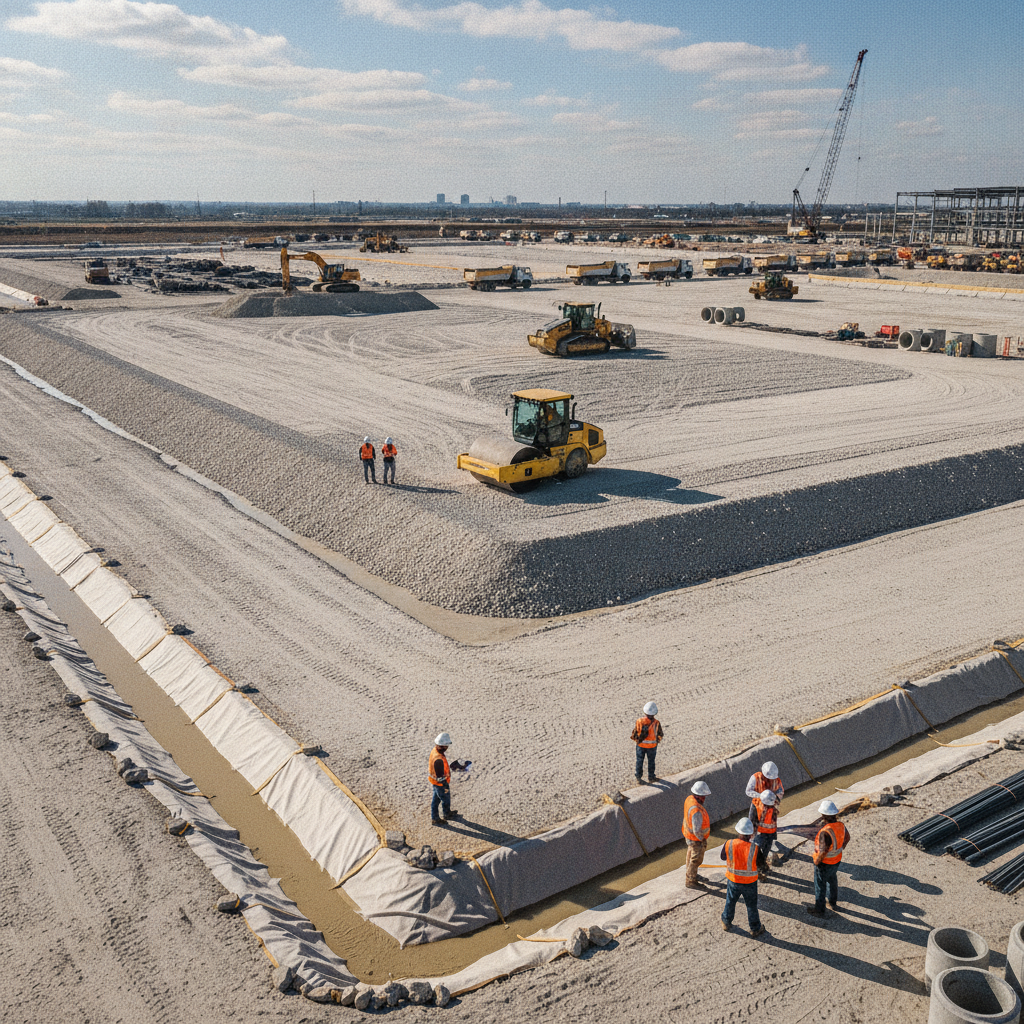
To guarantee positive drainage away from the data center structure, the finished floor elevation must be significantly higher than the surrounding grade. On a flat site, this is achieved by constructing an elevated building pad elevation using massive quantities of imported fill material. The process involves trucking in, placing, and compacting tens or even hundreds of thousands of cubic yards of soil or aggregate to create a stable, elevated base for the facility. This aspect of site development has major logistical and cost implications. The availability and quality of fill material, hauling routes, and the on-site compaction testing process must be meticulously managed. The structural engineer relies on the civil engineer and geotechnical engineer to ensure the fill provides a uniform, stable base capable of supporting the immense weight of the data center. An improperly constructed pad can lead to differential settlement, which is catastrophic for a building filled with sensitive, interconnected equipment.
Regulatory Compliance and Permitting for Large-Scale Earthwork
Moving vast quantities of earth triggers a host of regulatory requirements. The primary federal concern is managing stormwater runoff during construction, which is governed by the National Pollutant Discharge Elimination System (NPDES) program. A project of this scale requires a comprehensive Stormwater Pollution Prevention Plan (SWPPP) and an NPDES construction general permit. This plan details the specific erosion and sediment control measures, such as silt fences, construction entrances, and sediment basins, that will be used to prevent soil from leaving the site and polluting nearby waterways. Beyond federal requirements, local and state agencies have their own rules governing grading, drainage, and land disturbance. Grading and stormwater management regulations vary by jurisdiction, and it is essential to confirm all design criteria with the local, state, regional, and federal authorities that hold review authority over the project. The permitting process involves detailed plan submittals and rigorous agency review to ensure the project’s design complies with all applicable codes for public safety and environmental protection.
Our Process: A Strategic Approach to Flat Site Grading
At RSP Engineers, we approach flat site grading for data centers with a multi-phase, data-driven strategy. Our process begins with comprehensive due diligence, including a detailed topographic survey, a thorough geotechnical investigation, and an environmental constraints analysis. This upfront data collection allows our civil engineering team to identify potential challenges like high groundwater or poor soils early in the design process. Next, we develop a conceptual design that balances the project’s programmatic needs with the site’s physical realities. We model various grading and drainage design scenarios to optimize earthwork volumes, minimize the need for imported fill, and establish a robust stormwater management system. Once a concept is approved, we proceed with detailed engineering, producing construction documents that provide clear, actionable instructions for the contractor. We manage the entire permitting process and provide construction administration services to ensure the design is implemented correctly in the field.
Common Issues and How to Mitigate Them
Even with careful planning, grading flat data center sites can encounter several common issues. Differential settlement, where parts of the building pad settle more than others, can be mitigated by using uniform, high-quality fill and adhering to a strict compaction testing schedule. Last-minute utility conflicts are another frequent problem; we mitigate this through early and continuous utility coordination with all franchise utility providers, using subsurface utility engineering (SUE) where necessary. Value engineering proposals from contractors, such as substituting specified fill material, must be carefully reviewed by the civil engineering team to ensure they don’t compromise the long-term stability of the site. Finally, inadequate implementation of erosion control measures can lead to stop-work orders and fines. We mitigate this risk by conducting regular site inspections during construction and working proactively with the contractor to maintain compliance with the SWPPP.
Partner with RSP Engineers for Your Data Center Site Development
Navigating the complexities of grading and developing data center sites on flat terrain requires specialized expertise. The team at RSP Engineers has a proven track record of delivering successful mission-critical projects nationwide. We provide comprehensive site engineering services, from initial due diligence and master planning to final permitting and construction oversight. Our integrated approach to civil engineering, stormwater management, and utility coordination ensures your project is built on a resilient, reliable, and compliant foundation. Contact us today to discuss your project needs.
Conclusion: Building a Resilient Foundation on Challenging Terrain
While a flat site may appear to be a blank slate, it is a highly constrained environment that demands a sophisticated engineering response. The success of a multi-billion dollar data center hinges on the foundational work of site grading and drainage. Achieving positive drainage, managing shallow utilities, and creating a stable, elevated building pad are non-negotiable requirements. Through diligent investigation, innovative drainage design, and proactive utility coordination, the challenges of flat terrain can be overcome, resulting in a secure and resilient site ready to support the digital infrastructure of the future.
FAQs
-
The volume of imported fill can be immense, often ranging from 50,000 to over 200,000 cubic yards, depending on the size of the facility and the required finished floor elevation. The goal is to raise the building pad several feet above the surrounding grade to ensure positive drainage.
-
The biggest risks are localized flooding, foundation and slab movement due to differential settlement, and pavement failure. For a data center, any water intrusion or structural instability can lead to catastrophic equipment failure and downtime, making proper site development and grading absolutely critical.
-
A high groundwater table necessitates dewatering, which adds a significant cost for pumps, piping, and discharge permits. It can also slow down excavation and foundation work, potentially extending the overall construction schedule. The project budget and timeline must account for these activities from the outset.