
Florida Data Center Geotechnical Challenges
Explore the key geotechnical challenges for data center development in Florida, from sinkhole risk and high water tables to soil improvement. Learn how expert civil engineering mitigates these risks.
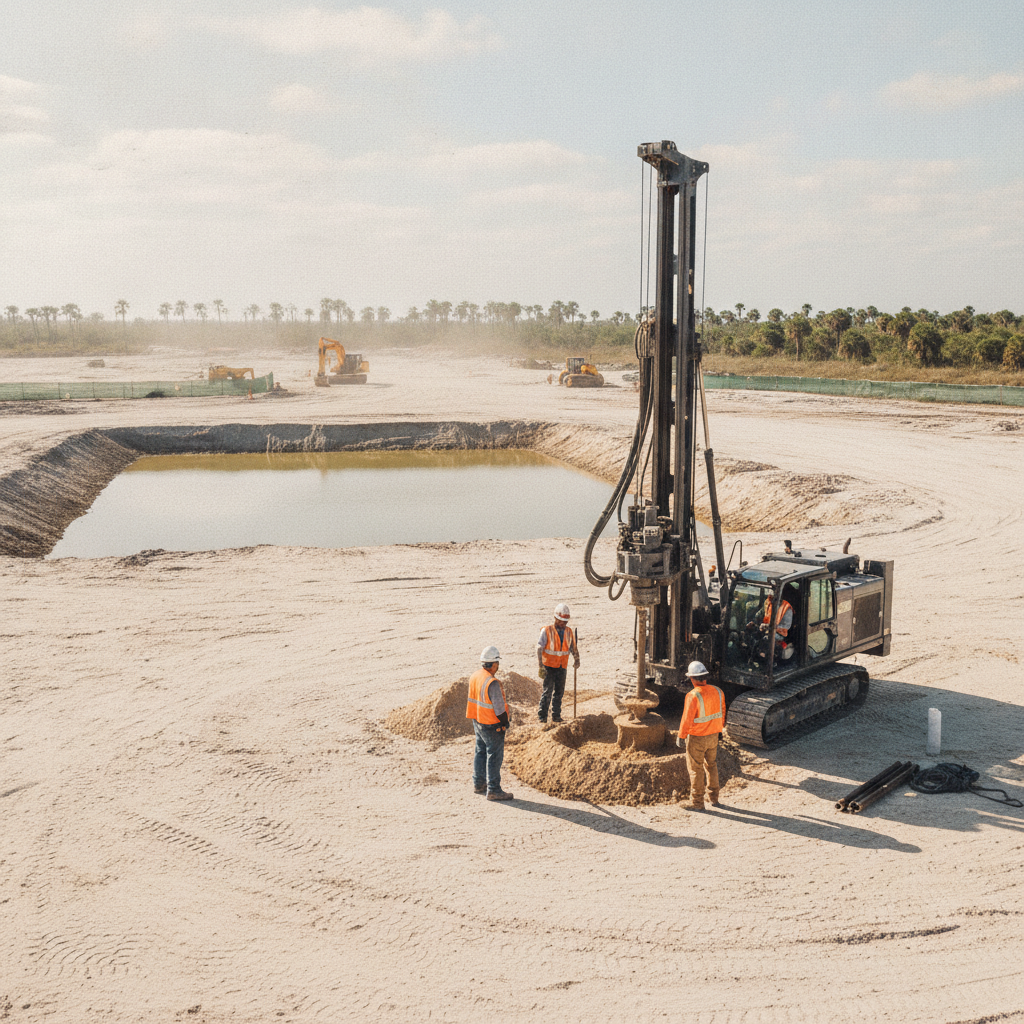
Karst Topography and Sinkhole Risk Mitigation
Much of Florida is underlain by limestone, a soluble rock that dissolves over time to create voids, caverns, and conduits—a geological condition known as karst topography. The primary risk associated with this is the potential for sinkholes, a catastrophic event for a data center that demands absolute structural stability. A sudden ground collapse can sever critical power and fiber connections, compromise cooling systems, and damage sensitive server equipment beyond repair. Therefore, a thorough Geotechnical Engineering investigation is non-negotiable. The investigation process begins with identifying the site’s location relative to known karst features. We then employ advanced subsurface imaging techniques, such as Ground Penetrating Radar (GPR) and Electrical Resistivity Tomography (ERT), to detect potential voids or anomalies. These are followed by targeted soil boring test procedures to confirm the subsurface conditions. If significant risks are identified, mitigation strategies like compaction grouting or pressure grouting are designed by a qualified Geotechnical engineer to fill voids and stabilize the ground before any foundation work begins, ensuring long-term site integrity.
Managing the High Water Table and Dewatering Demands
Geotechnical Investigation and Mitigation Strategy Comparison
| Geotechnical Challenge | Primary Investigation Method | Common Mitigation Strategy | Key Permitting Consideration |
|---|---|---|---|
| Karst / Sinkhole Risk | Ground Penetrating Radar (GPR), Electrical Resistivity, targeted soil boring test | Compaction Grouting, Micropiles, Void Filling | Local building department review of geotechnical report and foundation design. |
| High Water Table | Piezometer Installation, Seasonal High Water Table (SHWT) Analysis | Construction Dewatering, Waterproofing, Hydrostatic Slab Design | Water Management District (WMD) dewatering and consumptive use permits. |
| Compressible Organic Soils | Cone Penetration Testing (CPT), Laboratory Consolidation Tests | Over-excavation and Replacement, Deep Soil Mixing, Surcharging | Environmental Resource Permit (ERP) for impacts to wetlands or surface waters. |
| Loose Sandy Soils / Liquefaction | Standard Penetration Test (SPT), Seismic CPT | Vibro-compaction, Dynamic Compaction, Stone Columns | Enhanced structural and foundation plan review by the municipality. |
| Poor Bearing Capacity | Laboratory Strength Tests, Plate Load Tests | Deep Foundations (Piles/Shafts), Aggregate Piers, Rammed Aggregate Piers® | Foundation permit requires detailed plans sealed by a Professional Engineer. |
Florida’s shallow water table poses a persistent challenge for any significant construction project, especially for data centers requiring deep foundations and extensive underground utility networks. Excavations can quickly fill with water, destabilizing trench walls and complicating concrete pours. A comprehensive dewatering plan is essential to control groundwater intrusion during construction. This often involves a system of well points or deep wells, pumps, and discharge piping, all of which must be carefully designed and permitted. The challenges extend beyond construction. The permanent interaction between the high water table and the facility’s infrastructure requires careful design considerations. For example, underground conduits must be waterproofed, and foundation designs must account for hydrostatic pressure. Furthermore, discharging the collected groundwater is a regulated activity requiring permits from local water management districts, which scrutinize potential impacts on nearby wetlands and water bodies. This process involves detailed hydrogeological analysis and close agency review coordination.
Addressing Soft Organic and Compressible Soils
Many areas in Florida, particularly near coastal or wetland regions, contain layers of soft, compressible soils like peat, muck, and organic silts. These materials have very low bearing capacity and are prone to significant, long-term settlement under load. For a data center, where floor slabs must remain perfectly level to support heavy equipment racks, even minor differential settlement is unacceptable. Identifying the depth and extent of these unsuitable soils is a primary objective of the initial soil boring test program. Once identified, these poor soils must be addressed. The most common solution is over-excavation and replacement, where the unsuitable material is removed and replaced with engineered fill. In cases where the organic layers are too deep, ground improvement techniques such as deep soil mixing, aggregate piers, or vibro-compaction may be required. The selection of the appropriate method depends on a cost-benefit analysis and the specific recommendations within the Geotechnical soil report, which serves as the foundational document for the entire site development plan.
Loose Sands and Seismic Liquefaction Potential
While Florida is not considered a high-risk seismic zone, its geology is dominated by loose, sandy soils that can be susceptible to liquefaction. Liquefaction occurs when saturated or partially saturated soil substantially loses strength and stiffness in response to an applied stress, such as an earthquake tremor or even vibrations from heavy construction equipment, causing it to behave like a liquid. For a data center, the consequences of soil liquefaction beneath a foundation could be catastrophic, leading to severe settlement and structural failure. A Geotechnical engineer will evaluate the liquefaction potential as part of the site investigation, analyzing soil density, grain size, and the depth of the water table. If the risk is deemed significant, ground improvement is necessary to densify the loose sands before construction. Methods like dynamic compaction, vibro-compaction, or stone columns are effective at increasing the soil’s relative density, thereby mitigating the liquefaction risk and improving the overall bearing capacity for the proposed site plan design.
Deep Foundations vs. Ground Improvement Strategies
When the subsurface investigation reveals that shallow foundations are not feasible due to poor soil conditions, engineers and developers face a critical decision: implement a deep foundation system or invest in ground improvement. Deep foundations, such as driven piles or drilled shafts, transfer the building’s load through the weak upper soil layers to a deeper, more competent bearing stratum. This is a proven, reliable method but can be costly and time-consuming. Alternatively, ground improvement techniques aim to strengthen the existing soils in-situ, allowing for the use of conventional shallow foundations. This can often be a more economical and faster solution. The choice between these two paths requires a detailed analysis considering the specific soil profile from the Geotechnical soil report, the structural loads of the data center, project schedule constraints, and overall budget. A Professional Engineer specializing in geotechnical design is essential to guide this critical decision-making process.
Stormwater Management and Groundwater Interaction
Data centers create vast impervious areas, including massive rooftops and extensive parking lots, which generate significant stormwater runoff. In Florida, managing this runoff is complicated by the high groundwater table. Traditional infiltration-based systems, like exfiltration trenches or dry retention ponds, may be ineffective if groundwater levels are too high. This necessitates specialized drainage design solutions that account for this interaction. Engineers often design wet detention or retention ponds with permanent pools of water that reflect the natural water table. These systems require careful design of control structures to meet stringent water quality and flood control regulations set by Florida’s water management districts and local municipalities. The permitting process for these systems is rigorous, requiring detailed hydraulic and hydrologic modeling to demonstrate no adverse impact on surrounding properties or the environment. Effective stormwater management is a cornerstone of successful land development in Florida.
The RSP Engineers Geotechnical Approach
At RSP Engineers, our approach to data center site development is proactive and data-driven. We begin every project with a thorough desktop analysis, reviewing geological maps, historical aerials, and existing soil data to identify potential red flags. This informs a phased field investigation plan, starting with a comprehensive soil boring test program and laboratory analysis to characterize the subsurface conditions accurately. The findings are synthesized into a detailed Geotechnical soil report that provides clear, actionable recommendations. This report is not a standalone document; it is the foundation of our integrated site plan design process. Our geotechnical and civil engineers collaborate closely with the structural design team and the client to select the most effective and economical foundation and ground improvement strategies. We guide the project through the complex web of agency review and permitting, ensuring that our designs for drainage, utilities, and site grading are fully aligned with the geotechnical realities of the site, minimizing surprises during construction.
Common Pitfalls in Florida Data Center Site Selection
One of the most common mistakes we see is underestimating the scope and cost of geotechnical challenges during the due diligence phase. A developer might be attracted to a parcel of land due to its price or location, only to discover late in the process that extensive ground improvement or deep foundations are required, drastically altering the project’s pro forma. Another pitfall is relying on incomplete or outdated geotechnical data, which can lead to flawed design assumptions. Failing to budget adequately for dewatering and stormwater management is another frequent issue. These are not minor line items in Florida; they are critical infrastructure components with significant design, permitting, and construction costs. Engaging experienced Civil Engineers early in the site selection process allows for a realistic assessment of these risks, enabling developers to make informed decisions and avoid costly delays and change orders down the line. Frequently Asked Questions How early should we perform a geotechnical investigation for a data center site? A preliminary geotechnical investigation should be conducted during the due diligence or site selection phase, before closing on the property. This initial study, often called a Phase I Geotechnical Assessment, identifies major risks like deep organic soils or potential for sinkholes. A more detailed design-level Geotechnical Engineering investigation should be performed immediately upon site acquisition to inform the site plan design. What is the difference between a Geotechnical soil report and a standard soil test? A standard Soil Test might only provide basic soil classifications. A comprehensive Geotechnical soil report, however, is a detailed engineering document. It includes boring logs, laboratory test results, analysis of soil strength and compressibility, groundwater conditions, and specific engineering recommendations for foundation design, earthwork, and pavement sections, all sealed by a licensed Geotechnical engineer. Can ground improvement techniques guarantee no settlement? No technique can guarantee zero settlement, but ground improvement is designed to reduce post-construction settlement to within acceptable tolerances for the structure. For a data center, these tolerances are extremely strict. The goal of ground improvement is to create a uniform and stable foundation base that minimizes both total and differential settlement to protect sensitive equipment and structural integrity. How does Florida’s high water table affect utility installation? The high water table requires extensive dewatering for any deep utility trenching, such as for sewer or large electrical duct banks. It also necessitates the use of trench boxes or shoring to prevent collapse. Furthermore, it can require specialized pipe bedding and backfill materials, and all underground vaults and structures must be designed to resist buoyant forces to prevent them from ‘floating’ out of the ground. What are the key permits related to dewatering and stormwater? In Florida, the primary permits are the Environmental Resource Permit (ERP) from the state’s Water Management Districts (e.g., SFWMD, SWFWMD), which governs both stormwater management and impacts to wetlands. Additionally, a Water Use Permit or Consumptive Use Permit may be required for large-scale dewatering operations. Local municipalities will also have their own drainage and site development permit requirements. Are sinkholes a risk everywhere in Florida? While the risk is higher in certain regions known as ‘Sinkhole Alley’ in Central Florida, the underlying limestone geology makes sinkholes a potential concern throughout much of the state. No area is entirely without risk. A site-specific Geotechnical Engineering investigation is the only way to properly assess the risk for a particular property and design appropriate mitigation measures.
Your Foundation for Success in Florida
Developing a mission-critical data center in Florida demands a civil engineering partner with deep expertise in the state’s unique geotechnical landscape. At RSP Engineers, we provide the comprehensive site engineering services needed to navigate these challenges. From initial due diligence and Geotechnical Engineering investigations to final permitting and construction administration, our team ensures your project is built on a solid foundation. We specialize in integrated site development, utility coordination, and stormwater design for complex projects. Contact us to discuss how we can mitigate ground-level risks for your next mission-critical facility.
Conclusion
The geotechnical challenges of developing data centers in Florida are substantial, but they are not insurmountable. By prioritizing a thorough, upfront Geotechnical Engineering investigation, developers can identify and quantify risks related to sinkholes, high water tables, and poor soil conditions early in the process. This allows for the integration of effective mitigation strategies—whether deep foundations or ground improvement—into the core site plan design. Ultimately, a successful project depends on a proactive partnership with an experienced civil engineering firm that understands how to transform Florida’s geological challenges into a stable, secure, and resilient foundation for the future of digital infrastructure.
FAQs
-
Florida Data Center Geotechnical Challenges requires careful planning, qualified engineering, and compliance with the applicable codes and permits.
-
Getting Florida Data Center Geotechnical Challenges right protects safety, supports regulatory compliance, and avoids costly redesigns or delays.
-
RSP Engineers provides licensed expertise and end-to-end support for Florida Data Center Geotechnical Challenges, from early planning through permitting.