
Evaluating Municipal Water Capacity for Data Center Projects
A guide for data center developers on evaluating municipal water capacity. Learn about will-serve letters, hydraulic modeling, flow testing, and utility coordination from RSP Engineers.
The Critical Role of Water in Data Center Operations
Understanding the specific water demands of a data center is the first step in any capacity analysis. The demand profile is typically dominated by three primary uses, each with unique volume and pressure requirements. The largest consumer is often the cooling system, where evaporative cooling towers use water to efficiently manage the heat generated by servers. This creates a massive, constant demand that can amount to millions of gallons per day for a large campus. A robust civil engineering design must account for this baseline load in all calculations. The second critical use is fire suppression. Data center fire protection systems are designed for high-hazard environments and require significant water flow at high pressure to be effective. These systems must meet stringent national standards, and their performance is directly tied to the capabilities of the municipal water main. Finally, there is the domestic water demand for restrooms, kitchens, and other building services. While smaller in volume, this potable water supply is essential for facility operations and must be factored into the overall utility coordination and demand calculations during the site development process.
Initial Due Diligence: Capacity Inquiry and Will-Serve Letters
Key Metrics for Water Capacity Verification
| Verification Method | Key Data Points Analyzed | Potential Red Flags |
|---|---|---|
| Capacity Inquiry / Will-Serve Letter | Stated available capacity (GPD/MGD), confirmation of service area, initial pressure zone information. | Vague language, lack of specific pressure/flow data, disclaimers about system performance. |
| Hydraulic System Model | System pressures under peak demand, fire flow availability, water main velocities, water age. | Low residual pressures (<20 psi) during fire flow, undersized mains leading to the site, significant pressure drops. |
| Hydrant Flow Test | Static pressure, residual pressure, flow rate (GPM), calculated C-factor (pipe roughness). | Low static pressure, a large drop between static and residual pressure, results that don't match the hydraulic model. |
| Treatment Plant Analysis | Permitted plant capacity (MGD), current average and peak production, planned upgrades. | Plant operating near its permitted capacity, no planned expansions to accommodate new growth. |
| Utility Master Plan Review | Long-term supply strategy, capital improvement projects (CIP), other large-scale developments in the pipeline. | No CIP for the project area, overallocated capacity to other planned projects, source water vulnerability. |
The initial phase of water supply investigation typically involves formal communication with the local utility provider. This starts with a capacity inquiry letter, where the project’s engineer outlines the anticipated water demands, including average daily use, peak cooling demand, and required fire flow. The utility responds with a preliminary assessment of its ability to serve the project, which may culminate in a “will-serve” letter. While this document is a crucial early checkpoint, it is not a guarantee of service under all conditions. It often confirms that the utility has enough allocated capacity on paper but may not account for the real-world hydraulic limitations of the distribution network. It is critical to understand that the requirements for obtaining these letters and the level of detail they provide vary by jurisdiction, and every project team should confirm the applicable standards with the local, state, regional, and federal authorities that hold review authority over the site. A will-serve letter is the beginning of the conversation, not the end. A qualified Professional Engineer must dig deeper to validate the utility’s claims through detailed analysis and modeling, ensuring the required pressure and flow can be delivered to the property line during peak demand scenarios. This step is a foundational part of the permitting process.
Beyond the Letter: The Necessity of Hydraulic Modeling
A will-serve letter confirms theoretical capacity; a hydraulic model confirms practical deliverability. Sophisticated data center projects demand a detailed hydraulic analysis of the municipal water distribution system to simulate real-world performance. This computer model acts as a digital twin of the utility’s network, incorporating data on pipe sizes, materials, age, pump curves, tank levels, and existing customer demands. The project’s proposed connection and demand load are then added to the model to evaluate its impact. The analysis simulates various critical scenarios, such as peak daily demand on a hot day combined with a fire event at the facility. The model predicts resulting pressures and flows throughout the system, identifying potential weaknesses like undersized mains, pressure drops, or velocity issues. This analysis is fundamental to proper drainage design and overall site viability. Without a hydraulic model, developers are essentially guessing whether the infrastructure can support their mission-critical operations, a risk that is unacceptable in the data center industry. This modeling is a core service offered by leading Civil Engineering firms.
Verifying System Performance with Pressure and Flow Testing
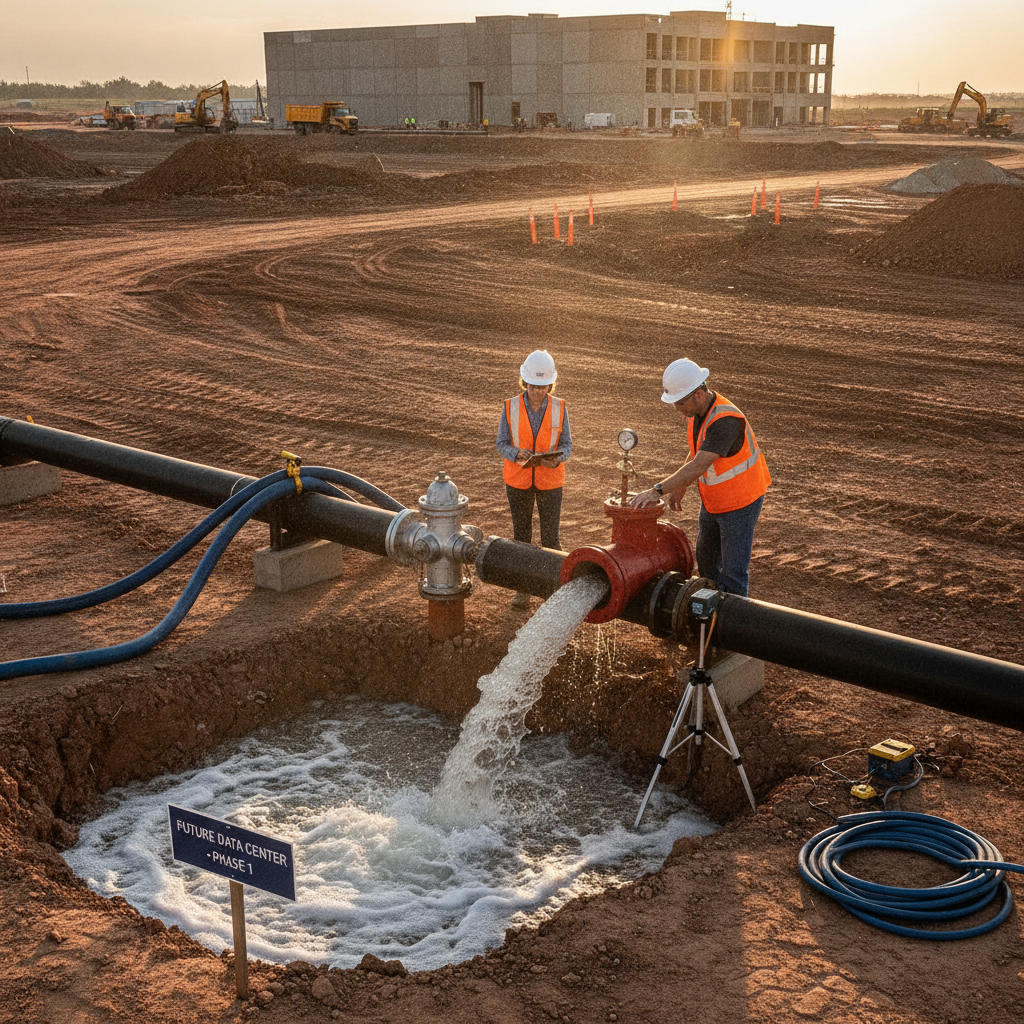
While hydraulic models are powerful, they are only as good as the data they are built on. To calibrate the model and confirm its predictions, engineers perform physical hydrant flow tests near the proposed project site. This field test provides a real-world snapshot of the water system’s performance at a specific time and location. The procedure involves measuring the static pressure (pressure with no flow), then opening a nearby hydrant and measuring the residual pressure (pressure during flow) and the flow rate in gallons per minute (GPM). The data from a hydrant flow test is invaluable. It helps validate the assumptions within the hydraulic model, such as pipe friction coefficients (C-factors), and provides a baseline for the available fire flow. If the field results differ significantly from the model’s predictions, it signals a need for further investigation and model refinement. This crucial step in site engineering services bridges the gap between theoretical calculations and on-the-ground reality, providing the project team with a high degree of confidence in the water supply’s capabilities before committing to major construction investments.
Assessing Upstream Constraints: Treatment Plant and Source Water Limits
A robust distribution network is meaningless if the source of the water is constrained. A comprehensive due diligence effort must look beyond the pipes in the ground to the water treatment plant (WTP) and the raw water sources that supply it. The WTP has a permitted treatment capacity that cannot be exceeded. Engineers must verify that the data center’s projected demand, when added to the system’s existing and future planned demands, does not surpass this limit. This involves reviewing the utility’s master plan and understanding its long-term water resource management strategy. Furthermore, the availability of raw water—from rivers, lakes, or groundwater aquifers—can be a significant constraint, particularly in water-scarce regions. The utility’s water rights and withdrawal permits may limit how much water can be sourced, regardless of treatment capacity. Evaluating these upstream factors is a critical component of risk assessment in land development. Ignoring potential source water limitations or regulatory restrictions can jeopardize a project’s long-term operational viability.
Navigating Utility Improvements and Impact Fees
What happens when the analysis reveals that the existing system is inadequate? In many cases, the data center developer must fund or contribute to the necessary infrastructure upgrades. This could range from a simple main extension to the construction of new booster pump stations, storage tanks, or miles of large-diameter transmission mains. The design and permitting of these improvements become a critical path item in the project schedule, requiring extensive utility coordination and agency review. Alongside the cost of construction, developers must account for impact fees or system development charges. These are fees levied by utilities on new development to help pay for the impact that the new demand has on the overall system. The calculation of these fees can be complex, often based on the size of the water meter or the projected demand. A thorough civil engineering due diligence report will include an estimate of these fees and an analysis of the timeline and cost associated with any required off-site utility improvements, providing the developer with a clear picture of the total investment required.
How RSP Engineers Approaches Water Capacity Analysis
At RSP Engineers, we employ a systematic, multi-layered approach to de-risk water supply for mission-critical facilities. Our process ensures that our clients have a comprehensive understanding of the opportunities and constraints of a potential site. We begin with initial utility outreach to gather system maps, master plans, and available hydraulic models. Our team then performs a detailed desktop analysis, reviewing the provided data to identify potential red flags before committing to field activities. The next step is conducting physical hydrant flow tests to establish a real-world performance baseline and calibrate the utility’s model. We then integrate the project’s specific demands into the calibrated model to run multiple scenarios, stress-testing the system under worst-case conditions. This analysis culminates in a comprehensive Water Capacity Report that clearly outlines available capacity, required system improvements, estimated costs, and a clear path forward for design and permitting.
Common Issues and Pitfalls in Water Supply Evaluation
Even with a structured process, several common pitfalls can derail a data center project’s water supply strategy. The most frequent mistake is placing absolute trust in a preliminary will-serve letter without conducting independent engineering verification. Another common issue is failing to model a true worst-case scenario, such as a fire event occurring simultaneously with peak cooling demand on the hottest day of the year. Developers may also underestimate the lengthy timelines required for the design, permitting, and construction of major utility upgrades, which can take years. It’s also critical to investigate what other projects are in the utility’s pipeline; the capacity available today may already be allocated to another development. Finally, a project team can become so focused on water supply that they neglect to confirm adequate wastewater capacity for discharging cooling tower blowdown and sanitary sewer flows, creating a new set of problems downstream.
Partner with RSP Engineers for Mission-Critical Site Development
Verifying water capacity for a data center is a complex, high-stakes engineering challenge. Don’t leave your project’s success to chance. The team at RSP Engineers provides the in-depth analysis and expert guidance needed to navigate these complexities. We specialize in comprehensive site engineering services, from initial due diligence and utility coordination to the final design and permitting of all necessary infrastructure. Our experience with large-scale land development ensures that your mission-critical facility is built on a foundation of reliable and resilient utility service. Contact us today to discuss how we can support your next data center project.
Conclusion
Securing a viable water supply for a data center project extends far beyond a simple handshake with the local utility. It requires a rigorous, data-driven civil engineering investigation that includes hydraulic modeling, physical testing, and a thorough understanding of upstream constraints. By treating the will-serve letter as the starting point for due diligence, not the conclusion, developers can mitigate significant risks. A proactive approach to utility coordination and a realistic assessment of infrastructure needs are fundamental to successful site development and the long-term operational certainty of these critical facilities.
FAQs
-
A capacity inquiry is the initial request for information sent to a utility, detailing the project’s expected demand. The utility’s response is often a preliminary finding. A will-serve letter is a more formal, though often non-binding, statement from the utility indicating it has the allocated capacity and intends to serve the project. However, it rarely guarantees specific pressures or flows, which requires further civil engineering analysis.
-
A thorough study, including utility data requests, hydraulic modeling, and field flow testing, can take anywhere from four to twelve weeks. The timeline is highly dependent on the utility’s responsiveness in providing data and the complexity of their water system. It’s a critical due diligence step that should be completed before a site acquisition is finalized.
-
Poor flow test results, indicating low pressure or volume, are a major red flag. Our engineers would first use the data to calibrate the hydraulic model to understand the root cause—whether it’s an undersized main, a closed valve somewhere in the system, or a larger system-wide issue. The results then inform the design of necessary upgrades, such as a new water main or a booster pump station.