
Developing a Stormwater Strategy for Data Center Campuses
A guide for data center developers on creating a robust stormwater management strategy. Learn about master planning, permitting, flood protection, and phased construction from the civil engineers.
Establishing the Regulatory Framework and Design Criteria
The first step in any site development project is to define the rules of the game. For data center campuses, this means a thorough investigation of all applicable stormwater regulations at the federal, state, and local levels. This includes requirements under the National Pollutant Discharge Elimination System (NPDES) program, which governs stormwater discharges from construction activities and developed sites. The engineering team must identify the specific design storm events (e.g., 25-year, 100-year storm) that the system must be designed to handle, along with criteria for peak discharge rates, total runoff volume control, and water quality treatment. These permitting requirements dictate the fundamental size and features of the entire drainage system. Because these facilities are often located in diverse geographic areas, the specific requirements can differ significantly. Permitting requirements vary by jurisdiction, and every project team should confirm the applicable standards with the local, state, regional, and federal authorities that hold review authority over the site. A civil engineering team with nationwide experience is crucial for navigating this complex landscape, ensuring the drainage design meets or exceeds all mandated performance standards for both water quantity and quality from day one.
Master Planning for Ultimate Campus Build-Out
Comparison of Stormwater Management Approaches for Data Centers
| Feature | Centralized Regional Pond | Distributed BMPs / LID |
|---|---|---|
| Land Footprint | Consumes a large, single parcel of land; can be a significant portion of the site. | Integrated into smaller, unused spaces like medians and setbacks; preserves larger developable pads. |
| Maintenance Complexity | Simpler to access and maintain one or two large facilities. Mowing and structure inspection is consolidated. | More complex, requiring inspection and maintenance of numerous smaller systems across the entire campus. |
| Phasing Flexibility | Excellent. The ultimate pond can be built during Phase 1, simplifying permitting for all future phases. | Can be more complex to phase. May require temporary facilities or careful sequencing of construction. |
| Initial Construction Cost | Higher upfront cost due to large-scale earthwork, but can be more cost-effective per gallon of storage. | Initial cost may be lower for a single phase, but overall campus cost can be higher due to system complexity. |
| Flood Risk Mitigation | Provides a large, predictable volume for containing major storm events. Easier to model and design robust emergency overflows. | Effective for smaller, more frequent storms. Performance in extreme events depends on the robust interconnection of all systems. |
| Water Quality Treatment | Wet detention ponds offer excellent and reliable pollutant removal through settling and biological uptake. | Bioretention and other LID features provide superior filtration and pollutant removal at the source. |
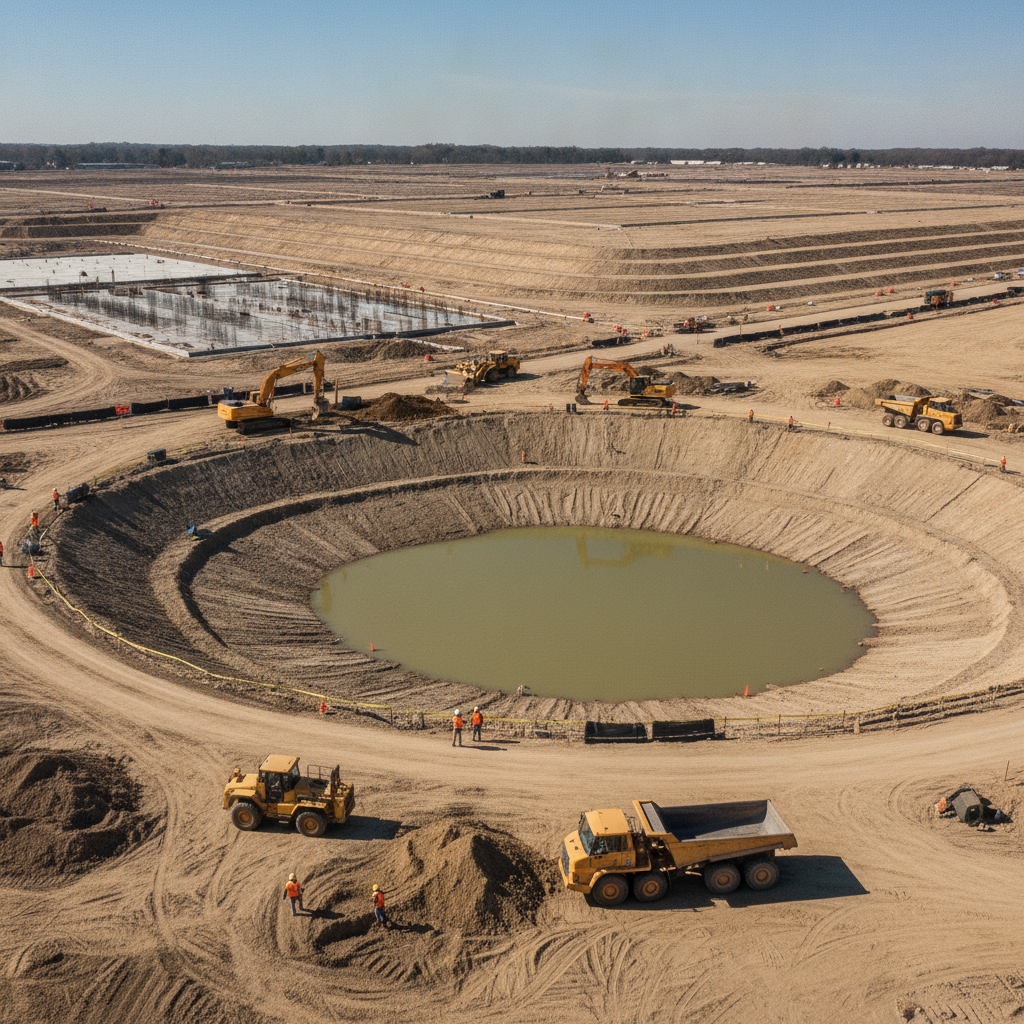
Data center campuses are rarely built all at once. They are typically phased over many years, with new buildings and infrastructure added as demand grows. A critical error is designing a stormwater system that only serves Phase 1. A forward-looking strategy involves creating a stormwater master plan that accommodates the ultimate build-out of the entire campus. This means calculating the total impervious area for all future buildings, parking, and roadways and sizing the primary conveyance systems and regional ponds accordingly. This master planning approach provides several advantages. It prevents the need for costly and disruptive retrofits of the drainage infrastructure as the campus expands. It also allows for the strategic reservation of land for future stormwater facilities. By constructing the ultimate pond and outfall structures during the initial mass grading, developers can achieve significant cost savings and streamline future permit submittals. This ensures that the phased construction of subsequent data halls does not trigger a major redesign of the site’s core infrastructure.
Siting and Configuration of Stormwater Management Facilities
The physical placement of stormwater ponds and other Best Management Practices (BMPs) is a critical decision impacting land use efficiency and construction costs. The two primary approaches are a centralized system (one or two large regional ponds) or a distributed system (multiple smaller facilities integrated throughout the site). The optimal choice depends on site-specific factors like topography, soil conditions, and the location of the legal positive outfall. A centralized stormwater facility is often more efficient to construct and maintain, but it consumes a large, contiguous block of land. Distributed BMPs, such as bioretention areas or underground detention systems, can be integrated into landscape islands and other unused spaces, preserving more developable area. However, they can be more complex to maintain over the long term. The site grading plan is intrinsically linked to this decision, as engineers must work with the natural contours of the land where possible to promote gravity flow and minimize earthwork. A thorough outfall analysis is also required to ensure the discharge point has adequate capacity to receive the treated runoff without causing downstream impacts.
Protecting Mission-Critical Infrastructure from Flooding
For a data center, any form of flooding is a catastrophic failure. The stormwater strategy must be designed with an extreme focus on critical infrastructure protection. This begins with establishing a conservative finished floor elevation (FFE) for all buildings, placing them well above the projected 100-year and even 500-year flood elevations. The civil engineering design must also incorporate redundant and safe overflow paths. An emergency overflow spillway for the main pond is essential to ensure that in a storm event exceeding the design capacity, excess water is routed safely away from buildings, electrical substations, generator yards, and fuel storage areas. This often involves detailed hydraulic and hydrologic modeling to simulate extreme weather scenarios and verify the performance of the system. A comprehensive floodplain analysis, referencing FEMA maps and detailed site-specific studies, informs these decisions. The goal is to create a resilient site where stormwater is managed predictably, even under worst-case conditions, ensuring the operational continuity of the facility is never compromised by a weather event.
Integrating Water Quality and Low Impact Development (LID) Techniques
Modern stormwater regulations increasingly focus on not just the quantity of runoff, but also its quality. Runoff from parking lots and rooftops can carry pollutants like hydrocarbons, heavy metals, and sediment. A comprehensive strategy must incorporate features for water quality treatment to meet regulatory standards. This is often achieved through features within a wet detention pond, which allows sediment to settle and nutrients to be absorbed by aquatic vegetation. However, there is a growing emphasis on using Low Impact Development (LID) techniques. Low Impact Development (LID) is an approach that seeks to manage stormwater as close to its source as possible by mimicking natural hydrology. For data center campuses, this can include incorporating bioretention areas (rain gardens) in parking lot islands, using permeable pavers for low-traffic areas, or even exploring green roof applications. These techniques can help reduce the overall volume of runoff that needs to be managed in a central pond and provide significant pollutant load reduction, often simplifying the path to environmental permit approval.
Utility Coordination and Easement Planning
A data center campus is a dense network of critical infrastructure, both above and below ground. The stormwater system—with its large pipes, inlets, and control structures—is a major utility that must be carefully integrated with all others. Effective utility coordination is paramount to prevent conflicts between storm drains and other critical services like fiber optic ducts, power conduits, and water and sewer lines. This process should begin early in the design phase and leverage tools like subsurface utility engineering (SUE) to identify existing infrastructure. Furthermore, the long-term functionality of the drainage system depends on securing the proper legal mechanisms for access and maintenance. This involves the dedication of formal drainage easements over all conveyance pipes and facilities. These easements ensure that future development on adjacent parcels or changes within the campus itself do not obstruct the system. They also guarantee that facility operators have permanent maintenance access to inspect, clean, and repair every component of the stormwater network, ensuring its performance for decades to come.
The RSP Engineers Approach to Data Center Stormwater Strategy
At RSP Engineers, we treat stormwater management as a core component of mission-critical facility design. Our process is built on a foundation of proactive planning and rigorous engineering analysis. We begin with comprehensive due diligence, identifying all regulatory constraints and site opportunities. From there, we develop a conceptual stormwater master plan that aligns with the client’s long-term development goals and budget. This informs the detailed civil engineering design, where we use advanced modeling software to optimize the system for performance and cost-efficiency. Our team manages the entire permitting process, preparing detailed calculations and drawings for submittal and coordinating with review agencies to secure timely approvals. During construction, we provide construction administration services, reviewing submittals, responding to contractor inquiries, and performing site inspections to ensure the system is built precisely according to the approved plans. This end-to-end involvement ensures the final product is a resilient, compliant, and maintainable system that protects our client’s critical investment.
Common Challenges in Data Center Stormwater Design
Even with careful planning, developing stormwater systems for large campuses can present challenges. Unforeseen geotechnical conditions, such as a high water table or unsuitable soils, can complicate pond construction and require costly solutions like liners or underdrains. Dense, conflicting underground utility corridors can force complex and expensive rerouting of large-diameter storm pipes. Additionally, navigating the agency review process for a large, multi-phase project can be complex, sometimes involving multiple jurisdictions with overlapping authority. Overcoming these hurdles requires an experienced engineering team capable of creative problem-solving and effective communication with all project stakeholders.
Partner with RSP Engineers for Your Mission-Critical Project
Developing a resilient and compliant stormwater strategy is fundamental to the success of any data center campus. It requires a deep understanding of hydrology, regulatory nuances, and the operational demands of mission-critical facilities. The team at RSP Engineers has the nationwide experience to guide your project from initial feasibility to final construction. Contact us today to discuss your site development, stormwater management, and utility coordination needs and learn how we can help protect your investment.
Conclusion
In conclusion, the stormwater strategy for a data center campus is a foundational element of its design, as critical as its power and fiber infrastructure. A successful approach is proactive, master-planned for the ultimate build-out, and focused on the unwavering protection of mission-critical assets. By integrating expert civil engineering and drainage design from the earliest stages of planning, developers can create a site that is not only compliant with all regulations but is also resilient, efficient, and prepared for future growth. This strategic investment in zoning compliance and infrastructure ensures the long-term viability and operational continuity of the facility.
FAQs
-
We design the core infrastructure—the main ponds, outfall structures, and trunk lines—to accommodate the stormwater runoff from the entire campus at its ultimate, fully-developed state. This is based on a master plan that shows all future buildings and impervious surfaces. This prevents the need for major system retrofits during later construction phases.
-
The biggest risk is catastrophic flooding that leads to downtime. An undersized system can result in water overtopping the pond and inundating buildings, generator pads, or electrical substations. This can cause equipment damage, power loss, and data interruption, leading to severe financial and reputational consequences. Proper drainage design is a form of insurance.
-
Yes, underground detention systems, typically using large pipes or modular chambers, are an excellent option for sites where surface space is at a premium. They can be installed under parking lots or other paved areas. While they have a higher initial cost than open ponds, they can free up valuable land for more buildings or equipment, making the overall site development more efficient.