
Common Earthwork Cost Drivers on Data Center Projects
Explore the primary earthwork cost drivers for data center projects, from soil conditions and rock excavation to dewatering and compaction. Learn how expert civil engineering mitigates risks.
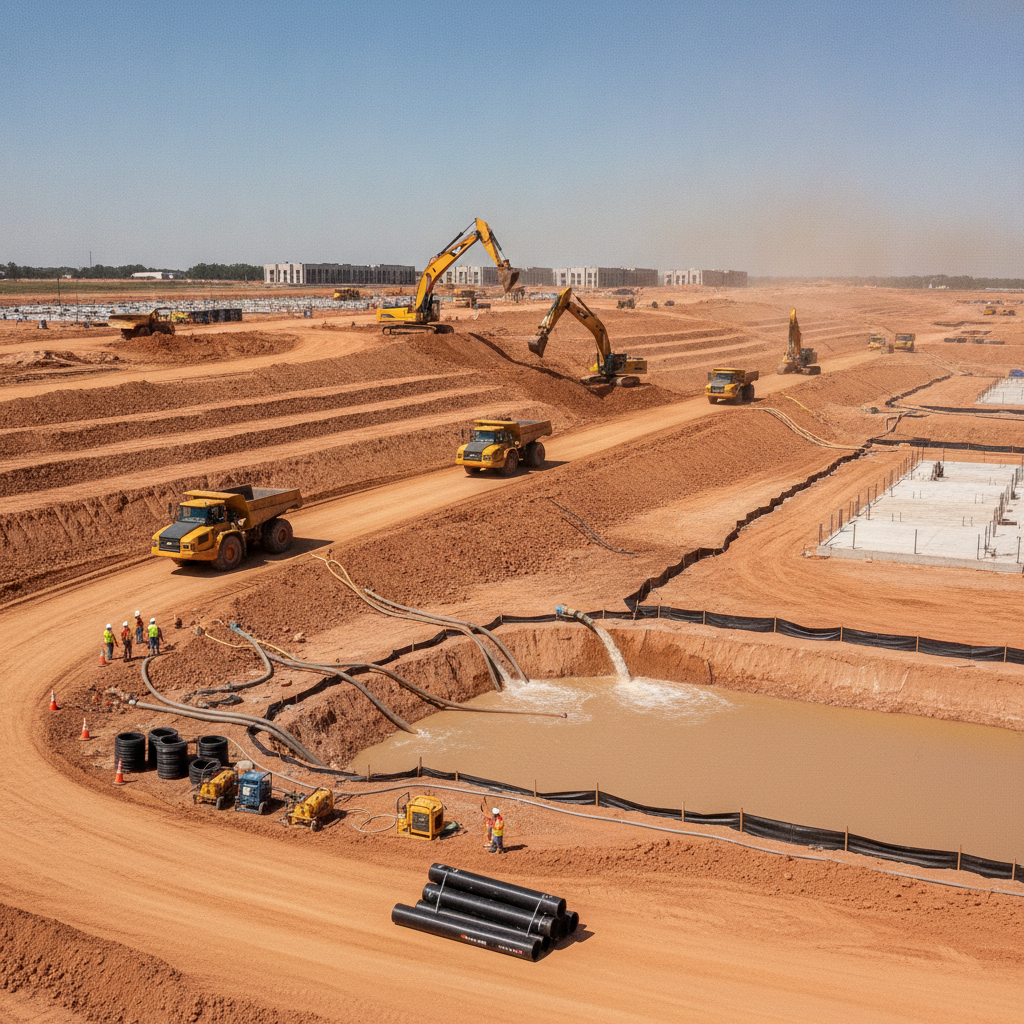
The Impact of Subsurface Conditions: Rock and Unsuitable Soils
The most significant unknown on any project lies beneath the ground. A comprehensive geotechnical investigation is the single most important investment for de-risking a site. When rock is encountered at or near the proposed building pad elevation, costs escalate rapidly. Standard excavation equipment is ineffective, necessitating specialized techniques like blasting or hydraulic hammering. These methods are not only expensive in terms of equipment and labor but also introduce vibration concerns and significant schedule delays. The volume and hardness of the rock are primary factors that dictate the final cost. Equally problematic are unsuitable soils, such as highly organic materials, undocumented fill, or expansive clays. These soils lack the structural capacity to support the massive, vibration-sensitive foundations of a data center. The standard solution is undercut and replacement, which involves excavating the poor-quality material and replacing it with structurally sound, engineered fill. This process creates a double cost: the expense of removing and disposing of the unsuitable soil, plus the cost of importing, placing, and compacting the new fill material. The depth and extent of the required undercut, identified in the Geotechnical soil report, directly drive these costs.
Mass Grading Strategy: Balancing Cut, Fill, and Haul Distances
Earthwork Cost Mitigation Strategies
| Cost Driver | Primary Risk | Geotechnical Mitigation Strategy | Civil Design Mitigation Strategy |
|---|---|---|---|
| Rock or Unsuitable Soils | Massive cost overruns from blasting or undercut/replacement. | Perform comprehensive borings, rock coring, and seismic surveys during due diligence. Provide clear recommendations for rock removal and soil remediation. | Adjust building pad elevation and location where possible to avoid known rock formations or deep pockets of unsuitable soil. |
| Mass Grading Imbalance | High cost of importing or exporting large volumes of soil. | Characterize on-site soils for their suitability as structural fill, maximizing the use of existing materials. | Develop an optimized grading plan using 3D modeling to balance cut/fill volumes and minimize on-site haul distances. |
| High Groundwater | Schedule delays and high cost of dewatering systems. | Install piezometers to monitor seasonal groundwater levels. Provide data to inform dewatering system design. | Incorporate permanent underdrain systems into the design. Grade the site to divert surface water away from deep excavations. |
| Moisture & Weather | Lost time and added cost for drying or wetting soil; schedule delays. | Test soils for their natural moisture content and sensitivity to moisture changes. | Develop a detailed phasing plan to minimize the area of open excavation at any given time. Specify all-weather access roads. |
| Compaction Failure | Costly rework (scarify, re-condition, re-compact) and schedule delays. | Define clear, achievable compaction specifications based on soil type and intended use (e.g., building pad vs. landscape area). | Provide clear specifications in construction documents. Sequence work to avoid trafficking over freshly compacted areas. |
| Erosion Control Non-Compliance | Fines, stop-work orders, and environmental remediation costs. | Assess soil erodibility to inform the selection of appropriate ESC measures. | Design a robust, maintainable ESC plan that complies with all local and federal requirements. Specify clear maintenance actions. |
The goal of any efficient mass grading operation is to achieve a “balanced site,” where the volume of soil excavated (cut) equals the volume of soil needed for embankments (fill). A balanced site minimizes the need for costly import or export of materials. Importing structural fill requires paying for the material itself, the trucking to the site, and the labor to place it. Exporting excess soil involves excavation, loading, and transportation costs to a disposal site, which may also charge tipping fees. For data center campuses that can span hundreds of acres, these volumes can be immense. Beyond the simple cut/fill balance, the haul distance on-site is a major operational cost driver. A grading plan that requires moving soil over long distances increases fuel consumption, equipment hours, and cycle times for scrapers and haul trucks. An experienced civil engineering firm uses sophisticated 3D modeling software to optimize the grading plan, minimizing haul distances and strategically locating temporary stockpiles. This optimization, part of a well-developed site plan design, can save hundreds of thousands of dollars on large-scale projects.
Groundwater and Dewatering Challenges
Encountering a high water table can bring earthwork operations to a standstill. Saturated soils are unstable and cannot be properly compacted, making it impossible to build foundations or place fill. Managing this requires dewatering systems, which can range from simple sump pumps in trenches to complex well point or deep well systems that lower the groundwater table across a large area. The cost of dewatering includes system installation, continuous operation (often 24/7), maintenance, and eventual removal. These systems require power and create a new challenge: water disposal. Water pumped from the ground must be discharged in compliance with environmental regulations. This often requires an NPDES permit and may involve routing the water to sediment traps or basins to remove suspended solids before it leaves the site. Dewatering and discharge permitting requirements vary by jurisdiction, and it is critical to confirm the applicable standards with the local, state, regional, and federal authorities that hold review authority over the site. Failure to plan for groundwater management can lead to significant unforeseen costs and regulatory violations.
Moisture Conditioning and Weather-Related Delays
For soil to achieve its required density, it must be compacted at or near its optimum moisture content. Soil that is too wet becomes unstable and cannot be compacted; soil that is too dry will not densify properly. The process of adjusting the water content is called moisture conditioning. If soils are too wet, the contractor must spread and turn the material with discs or harrows to air-dry it. If soils are too dry, water trucks must be used to add moisture. Both processes require equipment, fuel, water, and labor, adding to the overall cost. Weather is the ultimate variable. A single significant rain event can saturate a site, halting all earthwork and requiring days of drying before operations can resume. These weather delays have a cascading effect on the project schedule and can be particularly costly in regions with distinct rainy seasons. While weather cannot be controlled, a good site development plan includes strategies for managing stormwater on an active construction site and phasing work to minimize exposure during predictably wet periods. Effective compaction testing is essential to verify that specifications are met once conditions are suitable.
Stringent Compaction and Quality Control Requirements
Data centers house sensitive equipment and have extremely low tolerance for differential settlement. Consequently, the compaction specifications for building pads and utility trenches are far more stringent than for typical commercial projects. Specifications often require compaction to 95% or even 98% of the soil’s maximum dry density (as determined by a Standard or Modified Proctor test). Achieving these high levels of compaction requires placing soil in thin, controlled lifts and using the appropriate compaction equipment. Verifying these standards necessitates a robust quality control testing program. A third-party materials testing firm is typically on-site full-time during major earthwork operations, performing hundreds of nuclear density tests. The process also includes observation of proof-rolling, where a fully loaded piece of heavy equipment is driven over the subgrade to detect any soft or unstable areas. The costs of this intensive testing, along with the potential for rework if an area fails a test, are a significant component of the earthwork budget.
Erosion and Sediment Control Compliance and Maintenance
Large-scale data center projects involve disturbing vast areas of land, which triggers requirements under the federal Clean Water Act. A Stormwater Pollution Prevention Plan (SWPPP) must be developed and implemented, which includes a system of erosion and sediment control (ESC) measures. These commonly include silt fences, construction entrances, inlet protection, and temporary sediment basins. The initial installation of these measures represents a notable upfront cost. However, a frequently underestimated cost is the ongoing maintenance of the ESC system. Silt fences must be repaired after storm events, sediment must be cleaned out of traps, and disturbed areas may need to be temporarily stabilized. Agency inspections from local or state environmental authorities are common, and failure to maintain ESC measures can result in fines or even a stop-work order. A proactive maintenance plan is essential for ensuring continuous NPDES permit compliance and avoiding costly disruptions.
RSP Engineers’ Proactive Approach to Earthwork Management
At RSP Engineers, we believe that controlling earthwork costs begins with a strategy of proactive investigation and intelligent design. Our process for mission-critical projects focuses on identifying and mitigating risks long before construction begins. We start by guiding the development of a comprehensive geotechnical investigation, ensuring borings are placed strategically to characterize the entire building envelope and infrastructure corridors. This allows us to build a detailed subsurface model that informs every design decision. Using this data, our Civil Engineers employ advanced 3D grading and earthwork analysis software to optimize the site. We balance cut and fill volumes, minimize haul distances, and integrate stormwater management features seamlessly into the grading plan. We work collaboratively with the project team to position facilities in a way that minimizes encounters with rock or unsuitable soils. Our detailed construction plans provide clear specifications for compaction, moisture conditioning, and erosion control, giving the contractor a clear roadmap for success and providing the owner with cost certainty.
Common Pitfalls in Data Center Site Development
Even with a solid plan, several common issues can derail a project’s earthwork phase. A primary pitfall is an insufficient geotechnical investigation, where a developer attempts to save money on borings only to face costly surprises during construction. Another is value-engineering the site plan design in a way that creates an imbalanced site, shifting costs from one line item to another. Underestimating the scope and duration of dewatering is a frequent mistake, as is failing to budget for the crucial, ongoing maintenance of erosion control measures. Finally, inefficient phasing can lead to remobilization costs and lost productivity as earthwork crews have to work around other trades.
Partner with RSP Engineers for Your Next Mission-Critical Project
Controlling the significant costs and risks associated with data center earthwork requires a deep understanding of soil mechanics, grading strategy, and regulatory compliance. The team at RSP Engineers brings decades of nationwide experience to every mission-critical project. We specialize in comprehensive site development services, from initial due diligence and geotechnical coordination to optimized grading design and construction administration. Let our experts help you navigate the complexities of permitting and site engineering to deliver a stable, cost-effective foundation for your facility. Contact us today to discuss how we can de-risk your next project.
Conclusion: Strategic Engineering for Predictable Earthwork Outcomes
Earthwork will always be a major component of a data center construction budget, but it does not have to be an unpredictable one. The key to managing costs and schedules lies in replacing assumptions with data. A strategic investment in a thorough geotechnical investigation, coupled with an intelligent and optimized civil engineering design, provides the foundation for success. By identifying risks like rock, groundwater, and unsuitable soils early, project teams can develop effective mitigation strategies. Diligent construction administration and quality control ensure that the design is executed properly in the field, resulting in a predictable outcome and a site that is ready to support the critical infrastructure of the future.
FAQs
-
A Geotechnical investigation should be initiated as early as possible, ideally during the due diligence or site selection phase. A preliminary investigation can identify major flaws like shallow rock or deep unsuitable soils before the land is even acquired. A more detailed design-level investigation should be completed before any significant civil engineering design work begins.
-
A balanced site is one where the volume of soil excavated (cut) is equal to the volume of soil needed for engineered fill. This is the most cost-effective scenario because it eliminates the significant expense associated with either importing structural fill from off-site or hauling away and disposing of excess soil. Achieving a balanced site is a primary goal of effective mass grading design.
-
Yes. While no investigation is 100% foolproof, a thorough Geotechnical soil report, which includes soil borings that are advanced to refusal (the point where the drill can no longer penetrate), rock coring, and sometimes geophysical methods like seismic refraction, can provide a very reliable picture of the depth, extent, and hardness of subsurface rock formations.