
Developing a Grading Strategy for Data Center Sites
A comprehensive guide for data center developers on creating an effective site grading strategy. Learn how civil engineering balances earthwork, drainage, and utility needs.
The Foundation: Integrating Geotechnical and Topographic Data
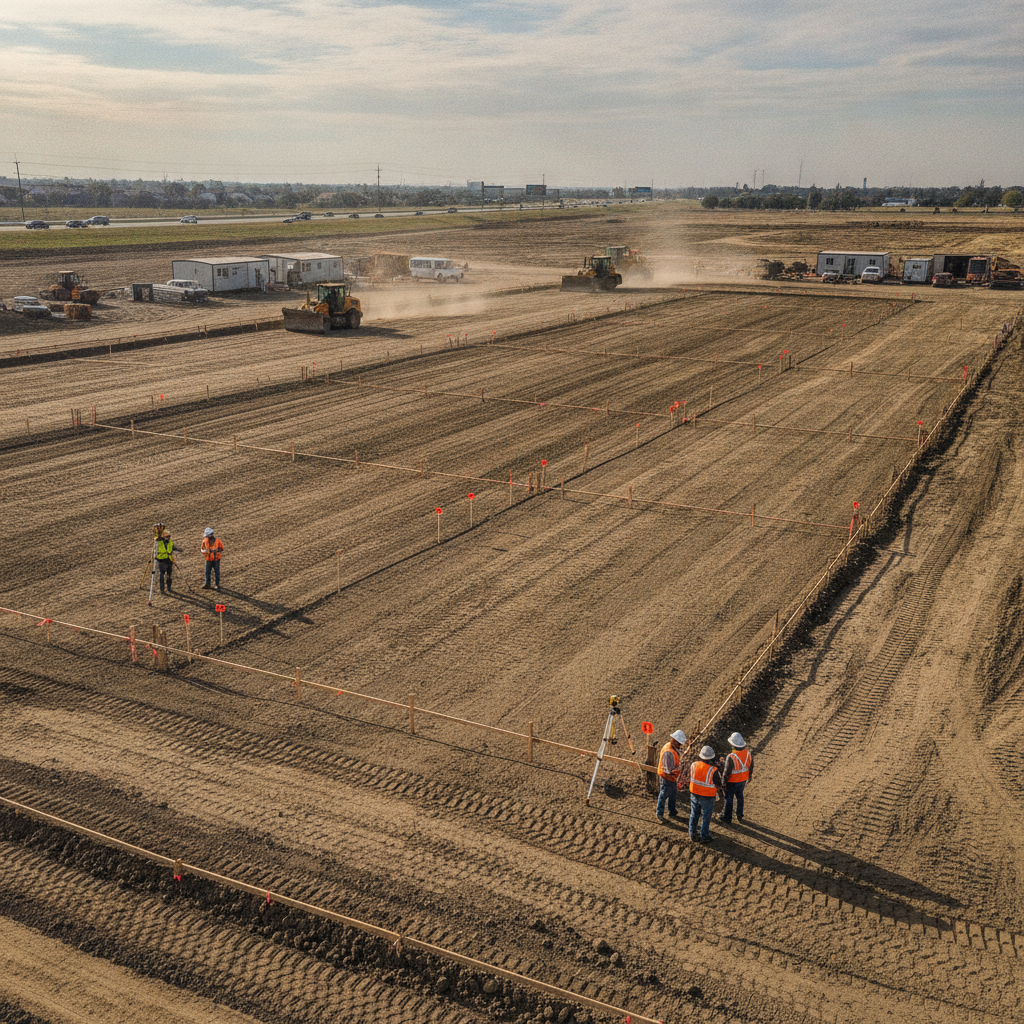
Every successful grading strategy begins with data. The two most critical inputs are a detailed topographic survey and a comprehensive Geotechnical soil report. The topographic survey provides a precise three-dimensional map of the existing ground surface, identifying high points, low points, and existing drainage patterns. This data forms the baseline for all earthwork calculations. Simultaneously, Geotechnical Engineering investigations reveal what lies beneath the surface. Through methods like the soil boring test, engineers analyze soil composition, strength, permeability, and the presence of rock or groundwater. This Soil Test data is crucial for determining the suitability of on-site soils for use as structural fill, assessing potential settlement issues, and estimating the effort required for excavation. Ignoring or underestimating the findings of the geotechnical report is a common and costly mistake in large-scale site development.
Establishing Critical Elevations and Site Control
Key Grading Strategy Decision Factors
| Factor | Engineering Consideration | Impact on Project |
|---|---|---|
| Finished Floor Elevation (FFE) | Floodplain elevation, site drainage, earthwork balance, utility service depth. | Directly impacts fill quantity, flood risk, and gravity-fed utility connections. |
| Earthwork Balance | Minimizing import/export of soil by balancing cut and fill volumes across the site. | Major driver of site work cost and construction schedule. An unbalanced site is a budget risk. |
| Stormwater Outfall | Location and elevation of the legal point of discharge for stormwater runoff. | Controls the entire site's drainage system design, including pipe slopes and pond depths. |
| Utility Corridors | Required depths and separation for power, fiber, water, and sewer lines. | Influences overall site grading to ensure minimum cover and gravity flow where needed. |
| Geotechnical Conditions | Soil stability, rock presence, groundwater levels, and suitability for fill. | Determines excavation methods, need for soil amendments, and potential dewatering costs. |
| Phasing & Expansion | Master planning for future building pads, roads, and utilities. | Ensures initial grading work supports long-term campus growth without costly rework. |
With reliable data in hand, the next step is to establish the critical elevations that will govern the entire site. The most important of these is the Finished Floor Elevation (FFE) of the data center building pad. Setting the FFE is a balancing act influenced by several factors: it must be high enough to provide protection from flooding based on FEMA maps and local drainage analysis, yet low enough to minimize the need for imported fill material. The FFE also influences the entire network of supporting infrastructure. From the primary building pad, the civil engineering team establishes elevations for access roads, parking areas, equipment yards, and utility corridors. These elevations must ensure positive drainage away from all structures and meet ADA compliance standards for pedestrian pathways. A precise site control network, established by professional surveyors, is essential to transfer these design elevations to the field, guiding the construction team with accuracy.
The Earthwork Balancing Act: Minimizing Costs and Schedule Impacts
The primary economic driver of any grading plan is the earthwork balance. The goal is to balance the volume of soil cut from high areas with the volume of fill needed in low areas, minimizing the costly process of hauling material off-site or importing fill from off-site borrow pits. An unbalanced site can add millions of dollars and weeks, or even months, to a project schedule. The grading strategy is iteratively refined to bring the cut and fill volumes as close to equilibrium as possible. This process involves strategic decisions about building elevation, roadway profiles, and the slopes of stormwater basins. The plan must also account for soil shrinkage and swell factors and identify areas for temporary stockpiling of topsoil and excess material. Site grading and erosion control permitting requirements vary by jurisdiction, and every project team must confirm the applicable standards with the local, state, regional, and federal authorities that hold review authority over the site. This includes securing necessary permits like the NPDES permit for stormwater discharges associated with construction activity.
Engineering Drainage and Stormwater Management Systems
A data center grading plan is fundamentally a drainage design plan. The entire site must be sculpted to meticulously control the flow of stormwater, protecting the mission-critical facility from water intrusion. The grading directs surface flow away from the building pad and equipment yards into a network of swales, inlets, and underground pipes. This conveyance system routes water to specially designed stormwater management facilities, such as detention or retention ponds. These facilities are designed to manage the rate and quality of stormwater runoff before it leaves the site, ensuring compliance with local and federal regulations like the Clean Water Act. The location, size, and depth of these ponds are integral to the overall grading strategy and earthwork balance. The grading plan must ensure that all parts of the site, from the highest point of the building pad to the lowest point of the outfall pipe, function as a cohesive and resilient drainage system.
Accommodating Mission-Critical Infrastructure
Data centers are not typical industrial buildings. They require massive outdoor infrastructure, and the grading plan must accommodate these unique elements. This includes creating level, stable pads for colossal backup generators, cooling towers, and bulk fuel storage tanks. These areas often have specific slope requirements and demand extensive utility coordination for underground fuel lines, electrical conduits, and water pipes. The grading must also carve out corridors for the immense underground duct banks that carry power and fiber optic cables into the facility. The depth and slope of these utility trenches are dictated by the grading plan. A failure to integrate these mission-critical needs into the initial grading strategy can lead to costly redesigns, construction conflicts, and operational vulnerabilities. Proper site plan design ensures these elements are seamlessly incorporated from day one.
Planning for Phased Construction and Future Expansion
Many data center campuses are developed in phases over several years. A forward-thinking grading strategy must account for this future growth. The initial mass grading effort should be executed with the master plan in mind, establishing primary infrastructure and grading future building pads to a rough, stable elevation. This prevents the need to re-grade large portions of the site for subsequent phases, saving significant time and money. The strategy must consider how interim phases will function, including temporary access roads, temporary stormwater controls, and stable slopes between developed and undeveloped areas. By planning for the full build-out from the start, the civil engineering team ensures that the initial site development work facilitates, rather than complicates, future expansion. This long-range view is a hallmark of effective mission-critical project planning.
RSP’s Approach to Data Center Grading Strategy
At RSP Engineers, we treat the grading strategy as a foundational element of mission-critical success. Our process begins with a deep dive into the project’s specific operational needs, collaborating closely with the owner, architects, and the geotechnical team. We utilize advanced 3D modeling software to create a dynamic digital twin of the site, allowing us to visualize and optimize the grading plan in real-time. This iterative process enables us to test multiple scenarios for building placement and elevation to achieve the most efficient earthwork balance. Our approach emphasizes proactive problem-solving and value engineering. We identify potential challenges like unsuitable soils or rock early, developing strategies to mitigate their impact on the budget and schedule. By integrating stormwater management, utility routing, and phasing requirements from the outset, we deliver a holistic and cost-effective grading plan. Our expertise in site engineering services ensures that the final design is not only compliant and efficient but also constructible and ready for the demands of a world-class data center.
Common Challenges in Data Center Site Grading
Even with careful planning, large-scale grading projects can encounter challenges. Unforeseen subsurface conditions, such as encountering a massive rock ledge or a pocket of unsuitable, wet soil not identified in the initial Geotechnical soil report, can halt progress and require significant redesign. High groundwater tables may necessitate complex and costly dewatering operations to stabilize the site for construction. Permitting can also present hurdles. Navigating the review process for earthwork, erosion control, and stormwater permits requires deep familiarity with regulatory expectations and the ability to respond effectively to agency review comments. Another common issue is managing complex logistics on-site, including coordinating haul routes for earthmoving equipment to avoid conflict with other construction activities. A seasoned civil engineering team anticipates these risks and builds contingencies into the plan.
Partner with RSP for Your Mission-Critical Site Development
Developing a successful grading strategy for a data center requires a specialized blend of technical expertise, practical experience, and strategic foresight. The team at RSP Engineers provides the expert civil engineering and land development services needed to navigate this complex process. We partner with our clients to deliver optimized site plan design, navigate the complexities of permitting, and provide crucial support through construction administration. Let us help you lay the groundwork for your next mission-critical facility.
Conclusion
The grading strategy is the invisible foundation upon which every successful data center is built. It is a critical discipline of civil engineering that directly influences project cost, schedule, and long-term resilience. By integrating detailed site data, balancing earthwork, and meticulously planning for drainage design and infrastructure, developers can create a site that is optimized for performance. A proactive, data-driven approach to grading is not an expense—it is an essential investment in the success of any mission-critical site development project.
FAQs
-
The grading strategy should be developed during the due diligence or conceptual design phase, immediately after obtaining reliable topographic and geotechnical data. An early, well-defined strategy is essential for accurate budgeting, site selection, and master planning.
-
A poorly balanced site that requires significant import or export of soil can be one of the largest and most unpredictable costs in site development. Each cubic yard of dirt moved has a cost, and hauling material on public roads adds substantial trucking expenses, fuel costs, and potential tipping fees.
-
The grading plan is critical for utilities. It establishes the ground slope needed for gravity-dependent systems like sanitary sewer and stormwater pipes. It also ensures that underground electrical and communications duct banks can be installed with the required minimum cover below the final finished grade, protecting them from damage.