
Determining Boring Depths for Data Center Buildings
A guide for data center developers on determining the correct geotechnical soil boring depth. Learn about stress influence, foundation types, and stormwater system needs.
The Principle of Significant Stress Influence
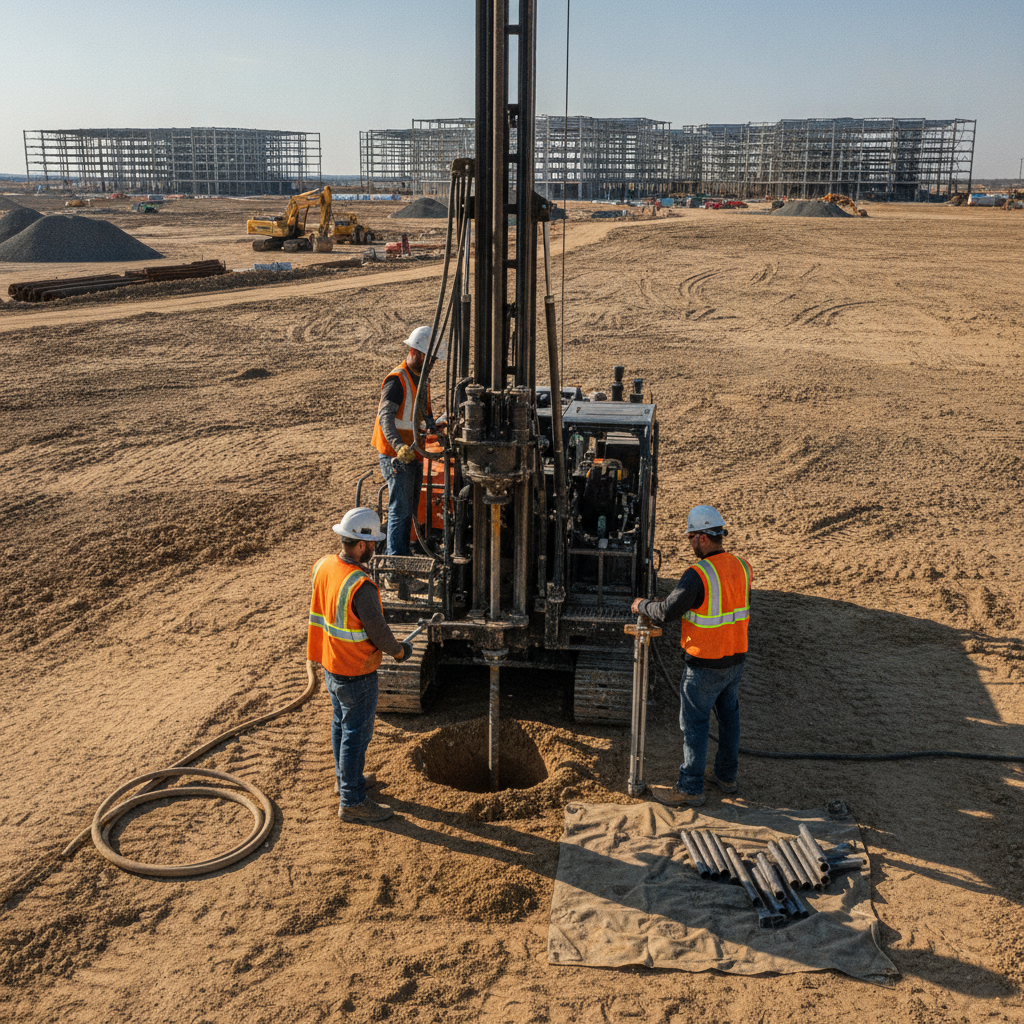
The fundamental principle guiding boring depth is the zone of significant stress influence. Every foundation imparts stress onto the underlying soil, creating a pressure bulb that extends downwards and outwards. For a geotechnical analysis to be valid, soil borings must extend deep enough to characterize all soil strata within this pressure bulb. If a weak or compressible layer exists just below the termination depth of a boring, its presence will be unknown, and its potential to cause harmful settlement will be missed. This is a primary cause of foundation failures. Data centers, with their heavy, vibration-sensitive equipment, have an extremely low tolerance for differential settlement. The massive weight of the structure and its equipment creates a much deeper zone of stress influence than a standard office or warehouse building. A proper geotechnical investigation must therefore plan for borings that extend well beyond the depths considered adequate for conventional commercial projects to ensure all potentially problematic soil layers are identified and accounted for in the foundation design.
Correlating Boring Depth with Foundation Type and Building Footprint
Factors Influencing Geotechnical Boring Depth for Data Centers
| Influencing Factor | Implication for Boring Depth | Common Geotechnical Concern |
|---|---|---|
| Foundation Load Intensity | Higher column and equipment loads create a deeper zone of significant stress influence, requiring deeper borings to characterize underlying soils. | Missing a deep, compressible clay layer that could cause long-term settlement under heavy, sustained loads. |
| Building Footprint Size | Larger building footprints, especially mat foundations, influence soils at a much greater depth than smaller foundations. | Underestimating total and differential settlement across a large mat slab, leading to equipment malfunction or structural distress. |
| Anticipated Foundation Type | Deep foundations (piles, shafts) require borings to extend significantly below the pile tips to verify the end-bearing stratum. | Terminating piles in a dense sand layer that is underlain by a soft clay, leading to bearing capacity failure. |
| Subsurface Variability | Sites with known geologic hazards (e.g., karst terrain, liquefiable sands) require a more intensive and deeper investigation to map the extent of the issue. | Failing to identify a solution feature or a liquefiable soil lens that could compromise foundation support during a seismic event. |
| Stormwater System Design | Infiltration basins require borings to confirm separation from the seasonal high water table and identify restrictive layers. | Designing an infiltration system that fails to function due to an undiscovered aquitard or high groundwater, requiring costly redesign. |
| Seismic Design Category | Sites in higher seismic zones require deeper soil data to properly classify the site and perform liquefaction analysis. | Incorrectly classifying the site, leading to an under-designed lateral force-resisting system for the structure. |
The anticipated foundation system is a major driver of the required boring depth. For data centers utilizing shallow foundations, such as large mat slabs, borings must extend to a depth of at least 1.5 to 2.0 times the smallest dimension of the building footprint. This ensures that the long-term consolidation settlement of deep soil layers is accurately predicted. The larger the footprint, the deeper the stress influence, and therefore the deeper the required borings. If subsurface conditions or extremely heavy loads suggest the need for deep foundations like drilled shafts or piles, the boring plan changes significantly. In this scenario, borings must extend well below the anticipated pile tip elevation—often 20 feet or more—to verify the capacity and consistency of the bearing stratum. It is also critical to ensure that a dense layer identified for pile support is not underlain by a weaker, compressible material. A Professional Engineer specializing in geotechnical design uses this deep data to confirm the suitability of the entire soil profile for supporting the mission-critical facility.
Geotechnical Exploration for Stormwater Management Systems
A data center campus includes vast impervious surfaces like rooftops and parking lots, necessitating robust stormwater management systems. The geotechnical requirements for these features are just as important as those for the main building. For large detention or retention ponds, borings are needed to analyze slope stability, potential for seepage, and the suitability of excavated soils for use as structural fill elsewhere on site. The borings should extend a sufficient depth below the proposed bottom of the pond to identify the groundwater table and any permeable or impermeable layers that could affect performance. If the drainage design incorporates infiltration-based solutions like basins or permeable pavement to meet environmental regulations, the geotechnical exploration is even more critical. Borings in these areas must be deep enough to confirm the absence of a high water table or restrictive layers that would prevent infiltration. Permitting requirements for these systems often vary by jurisdiction, and every project team should confirm the applicable standards with the local, state, regional, and federal authorities that hold review authority over the site. This often includes in-situ permeability testing to provide the data needed for both design and agency review.
Identifying Competent Material and Rock Refusal
The objective of any soil boring is to advance until a competent bearing stratum is confirmed. This is typically defined as a material of sufficient strength and stiffness to support the foundation loads without excessive settlement. This is often verified in the field using methods like the Standard Penetration Test (SPT), which measures the resistance of the soil to a standardized sampler. A common challenge is interpreting “refusal,” where the drill can no longer advance. It is critical to differentiate between refusal on a large boulder or isolated obstruction versus refusal on solid, continuous bedrock. Mistaking a boulder for bedrock is a catastrophic error that can lead to a completely inadequate foundation design. When bedrock is the intended bearing layer, refusal should be followed by rock coring to confirm the quality, strength, and integrity of the rock mass. Stopping a boring too shallow is a false economy that exposes the project to immense technical and financial risk.
The High Cost of Insufficient Geotechnical Data
Skimping on the geotechnical investigation is one of the most dangerous forms of “value engineering” in site development. The cost of extending borings by an additional 10, 20, or even 50 feet is a negligible fraction of a data center’s total project cost. In contrast, the cost of an inadequate investigation can be astronomical. Discovering an unforeseen soil problem during construction can lead to extensive delays, expensive change orders, and a complete foundation redesign. Worse yet, a latent foundation issue that manifests after the facility is operational can cause service interruptions, data loss, and irreparable damage to a company’s reputation. For mission-critical facilities, where uptime is measured in fractions of a percent, the risk is simply not worth the perceived savings. A comprehensive geotechnical investigation, with appropriately deep borings, is a fundamental component of risk management and project assurance.
Our Geotechnical Investigation Process for Mission-Critical Sites
At RSP Engineers, we approach every data center project with a rigorous, phased process to eliminate subsurface uncertainty. Our methodology ensures that the foundation design is built on a solid base of reliable data. The process begins with a thorough desktop study, reviewing published geological data and any available historical records for the site. This informs the creation of a site-specific boring plan that strategically locates borings at high-stress areas like building corners, column lines, and under heavy equipment pads. During the field exploration, our experienced field staff work with qualified drillers to meticulously log the subsurface conditions and obtain high-quality soil and rock samples. These samples are then transported to a certified laboratory for a battery of tests to determine their engineering properties, such as strength, compressibility, and permeability. All of this information is synthesized by a senior Geotechnical engineer into a comprehensive Geotechnical soil report. This report provides not just the data, but clear, actionable recommendations for foundation design, earthwork, and construction administration.
Common Challenges in Data Center Site Investigations
Even with a robust plan, geotechnical investigations for large-scale data center sites can present unique challenges. Site access can be a major hurdle, with difficult terrain, dense vegetation, or existing utilities limiting where a large drill rig can operate. This requires careful planning and sometimes the use of specialized, smaller equipment to access critical locations. Unforeseen subsurface conditions are a constant risk. A site may appear straightforward from the surface, but borings can reveal complex geology, such as buried debris, undocumented fill, or the presence of geologic hazards like karst (sinkhole) terrain in some regions. An experienced geotechnical engineering team knows how to adapt the exploration program in real-time to these discoveries, authorizing additional borings or in-situ testing to fully delineate the problem and develop a reliable engineering solution.
Partner with RSP Engineers for Your Geotechnical Needs
Ensuring the long-term stability of your mission-critical facility starts from the ground down. The experienced team at RSP Engineers provides comprehensive geotechnical engineering and civil engineering services tailored to the unique demands of data center development. We manage the entire process, from initial site assessment and planning the geotechnical investigation to providing practical foundation recommendations and crucial construction administration support. Our nationwide experience allows us to navigate complex subsurface challenges and deliver reliable solutions that protect your investment.
Conclusion: A Foundation for Success
For data center developers and owners, determining the correct geotechnical boring depth is not a minor detail—it is a foundational decision that impacts project risk, cost, and long-term performance. A thorough geotechnical investigation, guided by the principles of stress influence and tailored to the specific facility loads and foundation type, is the only way to build with confidence. Investing in a comprehensive subsurface exploration is a critical act of risk mitigation that provides the essential data needed for a safe, reliable, and successful mission-critical facility.
FAQs
-
There is no single answer, as the number depends on the building size, structural system, and expected soil variability. A general guideline is one boring at each building corner and additional borings at interior column locations, with spacing typically not exceeding 100-150 feet. More borings are required for sites with complex geology or for very large facilities.
-
A soil boring test uses a drill rig to advance a small-diameter hole deep into the ground to collect samples and perform in-place tests. A test pit is a large excavation dug by a backhoe, typically to a shallower depth (10-15 feet), which allows for direct visual inspection of the soil strata but is limited in depth.
-
No. Subsurface conditions can change dramatically over very short distances. While data from a nearby site can be useful for preliminary planning, it is never a substitute for a site-specific geotechnical investigation. Relying on old or off-site data is a significant and unacceptable risk for a mission-critical facility.