
Designing Secure Vehicle Screening Areas for Data Centers
A guide to the civil engineering design of secure vehicle screening and inspection areas for data centers, covering pavement design, traffic flow, security barriers, and stormwater management.
Foundational Principles of Vehicle Access Control
The design of a vehicle screening area begins with a clear understanding of security principles, primarily the concept of layered defense and standoff distance. Standoff distance is the physical space maintained between a potential threat and a critical asset—in this case, the data hall itself. The screening area is strategically located at the perimeter to maximize this distance, ensuring that any potential threat can be identified and neutralized far from the main facility. This approach requires a comprehensive threat assessment, which informs the level of security and the types of barriers required. A civil engineering firm works alongside security consultants to translate these principles into a functional site layout. The goal is to create a sequence of controlled zones, starting from the public right-of-way and progressing through the access control point. This sequence is designed to slow down vehicles, provide clear lines of sight for security personnel, and allow for thorough inspection without impeding authorized traffic flow. The design must balance stringent security requirements with the operational need for efficient ingress and egress of staff, vendors, and critical supply deliveries.
Site Layout and Traffic Circulation Planning
Key Design Features of a Vehicle Screening Area
| Component | Primary Design Objective | Key Civil Engineering Specification |
|---|---|---|
| Inspection Pad | Provide a stable, durable surface for static and dynamic heavy vehicle loads during security checks. | Reinforced concrete slab (e.g., 10-12 inches thick) over a prepared aggregate base; design based on geotechnical analysis. |
| Queueing Lane | Accommodate waiting vehicles without impacting public roads or internal circulation. | Length determined by queueing analysis of peak delivery traffic; width to accommodate oversized loads. |
| Bypass / Rejection Lane | Allow authorized vehicles to bypass inspection or provide a path for rejected vehicles to exit. | Clearly marked lane with separate gate control, designed to prevent security breaches. |
| Security Barriers | Prevent unauthorized vehicle access and withstand deliberate impact. | Engineered footings for K-rated or M-rated bollards, wedges, or gates; precise placement for standoff distance. |
| Lighting & Surveillance | Ensure 24/7 visibility for security personnel and cameras. | High-mast, high-intensity LED lighting; photometric plan to ensure minimum foot-candle levels without glare. |
| Stormwater Containment | Manage runoff and contain potential hazardous material spills from vehicles. | Trench drains, catch basins, and piping routed to an oil-water separator or a containment system before discharge. |
Effective traffic circulation is paramount to the success of a vehicle screening area. The design must accommodate the largest anticipated vehicle, typically a full-sized semi-trailer, ensuring adequate truck turning radii (e.g., WB-67 design vehicle) for safe maneuvering without encroaching on curbs, barriers, or other infrastructure. A critical component is the queueing analysis, which calculates the required length of the approach lane to prevent delivery trucks from backing up onto public roads, a major safety and traffic concern that can draw unwanted attention from local authorities. The overall Site plan design must also consider the segregation of different traffic types. Ideally, employee and visitor passenger vehicles are routed through a separate, less intensive screening process than delivery and service trucks. This often involves dedicated lanes, separate access gates, and different screening technologies. All aspects of the site layout, from lane widths to signage and pavement markings, are governed by a combination of security protocols and local development codes. It is important to note that permitting requirements for site modifications, including traffic patterns and access points, vary by jurisdiction, and every project team should confirm the applicable standards with the local, state, regional, and federal authorities that hold review authority over the site.
Pavement Design for Heavy-Duty Loads
The inspection pad at a vehicle screening area is subjected to extreme stress. It must support the static weight of fully loaded trucks (up to 80,000 pounds or more) for extended periods during inspection, as well as the dynamic forces of braking and acceleration. Standard-duty asphalt or concrete used in parking lots will fail quickly under these conditions. The solution is a specialized heavy-duty pavement design, typically involving a significantly thicker, steel-reinforced concrete slab. The design process begins with a Geotechnical soil report to understand the underlying soil conditions. Poor subgrade requires stabilization or replacement to provide a solid foundation. The concrete mix itself is often a specialized, high-strength formula, and the slab is designed with appropriate jointing to control cracking and manage thermal expansion. The pavement design must account for both the load and the frequency of traffic, ensuring a service life that matches the 24/7 operational demands of a modern data center. This is a critical area where under-engineering can lead to costly and disruptive repairs.
Integration of Physical Security Barriers
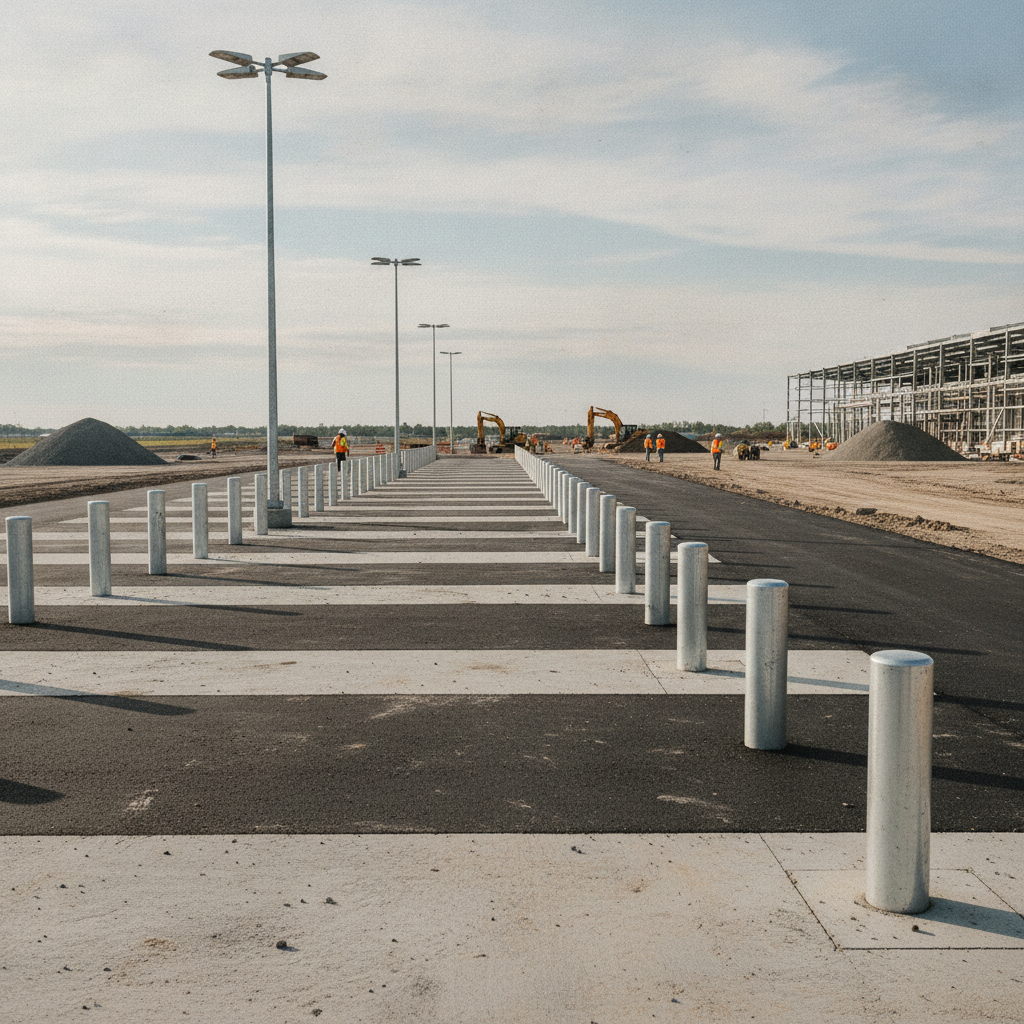
Physical barriers are the most visible component of the screening area’s security posture. These are not merely decorative; they are engineered systems designed to stop a vehicle intent on breaching the perimeter. The selection and placement of these barriers are dictated by the facility’s threat assessment. Common elements include fixed and retractable security bollards, wedge barriers, drop-arm gates, and heavy-duty sliding gates. These systems often carry specific impact ratings (e.g., ASTM F2656 M-ratings or legacy K-ratings) that certify their ability to stop a vehicle of a certain weight traveling at a specific speed. The role of the civil engineer is to integrate these anti-ram barriers into the site itself. This includes designing the massive concrete footings required to anchor them, ensuring they can withstand the tremendous forces of an impact. The layout must be precise, preventing any gaps that a vehicle could bypass while still allowing for the passage of authorized traffic once cleared. The design also includes coordinating the power and control conduit needed for automated barriers, integrating them seamlessly with the overall vehicle access control system.
Critical Infrastructure: Lighting, Power, and Communications
A vehicle screening area must be fully operational 24/7/365, which necessitates robust supporting infrastructure. High-intensity security lighting is essential for clear visibility during nighttime inspections and to ensure that security cameras can capture high-quality images. Lighting design must eliminate shadows and blind spots around the inspection pad, queueing lanes, and guardhouse. Photometric analysis is often used to model lighting levels and ensure they meet strict security standards without causing glare or light pollution issues for adjacent properties. Equally important are redundant power and communications. All security systems—including gates, barriers, cameras, and intercoms—must be connected to the data center’s uninterruptible power supply (UPS) and backup generator systems. The civil engineering plans must include detailed layouts for underground duct banks to protect power and fiber optic cables. This communications infrastructure ensures that security personnel maintain constant contact with the central security operations center and that all access events are logged and recorded without interruption.
Stormwater Management and Containment at the Screening Point
While security is the primary driver, environmental compliance is a close second. The large, impervious concrete surfaces of a screening area generate significant stormwater runoff. A comprehensive drainage design is required to collect this runoff and route it to the site’s overall stormwater management system, which may include detention or retention ponds, underground storage, or infiltration systems. The design must prevent localized flooding, especially around the inspection pad and security booth where personnel are stationed. Furthermore, the inspection area presents a unique risk for spills. A leaking fuel tank or a hydraulic fluid line break from a truck could release contaminants. To mitigate this, designs often incorporate specialized spill containment measures. This can include trench drains routed through an oil-water separator or a system with a shut-off valve that allows security to contain a spill on the pad itself before it enters the main drainage network. This proactive approach is crucial for maintaining environmental compliance and protecting against violations of federal programs like the Clean Water Act and associated NPDES permit requirements.
The RSP Engineers Design and Permitting Process
At RSP Engineers, our approach to designing data center vehicle screening areas is systematic and collaborative. We begin with a thorough site assessment and work closely with the client’s development team and security consultants to define the project’s specific threat profile and operational requirements. This initial phase informs every subsequent decision, from traffic flow to barrier selection. Our team develops a complete set of construction documents, including grading and drainage design, utility plans, pavement details, and erosion control measures. We create a comprehensive Site plan design package that integrates all security hardware, lighting, and supporting infrastructure. A significant part of our role is navigating the complex agency review and permitting process. We prepare and submit all necessary applications to local and state authorities, addressing comments and ensuring the design complies with all applicable zoning, building, and environmental codes to secure timely approvals.
Common Challenges and Design Oversights
Even with careful planning, several common issues can arise. One of the most frequent is underestimating queueing space, leading to traffic congestion on public streets. Another is specifying inadequate pavement design, resulting in cracking, spalling, and costly repairs that disrupt security operations. Poor lighting design can create blind spots for surveillance systems, creating vulnerabilities that can be exploited. Another challenge is failing to properly coordinate with utility providers early in the design process. The power and communication needs of a modern screening area are substantial, and ensuring service is available and properly routed is a critical path item. Finally, overlooking the details of stormwater management and spill containment can lead to permitting delays and potential environmental liability down the road. A seasoned civil engineering team anticipates these challenges and addresses them proactively in the design.
Partner with RSP for Mission-Critical Site Design
Designing a secure and efficient vehicle screening area for a data center requires specialized expertise that goes beyond standard commercial site development. The stakes are higher, the loads are heavier, and the integration of security systems is far more complex. The team at RSP Engineers has the nationwide experience to deliver robust civil engineering, land development, and permitting solutions for the most demanding mission-critical projects. We provide the detailed site engineering services needed to ensure your first line of defense is built on a solid foundation. Contact us today to discuss your data center project needs.
Conclusion
The vehicle screening area is a data center’s first and most important physical checkpoint. Its design is a multi-faceted civil engineering challenge that balances security imperatives with operational efficiency and regulatory compliance. From robust pavement design capable of handling immense loads to sophisticated stormwater management systems that protect the environment, every detail matters. Investing in expert engineering for this critical access point is fundamental to safeguarding the invaluable digital assets housed within.
FAQs
-
There is no single standard, as the ideal standoff distance is determined by a site-specific threat and risk assessment. It depends on the facility’s criticality, the surrounding environment, and the types of threats being mitigated. However, distances are generally maximized as much as the site allows to provide a buffer between the screening point and the main building.
-
Designing for such heavy loads requires a geotechnical analysis of the subgrade soils and a structural design of the pavement section. This typically involves a thick, steel-reinforced concrete slab (often 10-12 inches or more) over a well-compacted aggregate base. The concrete mix design and jointing plan are also critical components of a durable heavy-duty pavement design.
-
Yes, beyond standard stormwater management, inspection areas often require spill containment capabilities. Because of the potential for vehicle fluid leaks (oil, fuel, coolant), the drainage design may incorporate features like oil-water separators or containment valves to prevent hazardous materials from entering the primary drainage system or leaving the site, which is crucial for NPDES permit compliance.