
Data Center Phase II Environmental Site Assessment (ESA)
A guide for data center developers on the Phase II Environmental Site Assessment (ESA) process in Florida. Learn when it’s triggered, what’s involved, and how results impact your project.
When a Phase I ESA Triggers a Deeper Investigation
A Phase I ESA is a non-intrusive review of property records and a site visit to identify potential environmental contamination. If this process uncovers a Recognized Environmental Condition (REC), it signals a potential risk that must be quantified. For data center sites, common RECs include historical use as an industrial facility, proximity to gas stations with leaking underground storage tanks, or past agricultural use where pesticides and herbicides were heavily applied. The presence of a REC doesn’t automatically disqualify a site, but it makes a Phase II ESA a non-negotiable step in the due diligence process. This next phase is essential for lenders, investors, and insurers who require certainty before committing capital. The goal is to confirm or deny the presence of hazardous substances in the soil, groundwater, or soil vapor. Without this physical data, the potential for costly remediation and long-term liability remains an unknown variable that is unacceptable for a mission-critical site development project. A qualified Professional Engineer is crucial for interpreting the Phase I findings and determining if a Phase II is warranted to protect the developer’s interests.
Scoping the Investigation: The Phase II Work Plan
Phase II ESA Findings and Potential Data Center Development Impacts
| Finding / Contaminant Type | Typical Source (REC) | Potential Impact on Site Development | Example Remediation Strategy |
|---|---|---|---|
| Petroleum Hydrocarbons (VOCs/SVOCs) | Leaking Underground Storage Tanks (USTs) from former gas stations or fleet maintenance. | May require soil excavation in planned utility corridors or building footprints. Potential for groundwater contamination. | Targeted soil excavation and disposal; in-situ chemical oxidation (ISCO) for groundwater. |
| Chlorinated Solvents (PCE, TCE) | Former dry cleaners, metal degreasing operations, or electronics manufacturing. | High risk of vapor intrusion into buildings. Can create a persistent, difficult-to-treat groundwater plume. | Sub-slab depressurization system (vapor barrier); enhanced reductive dechlorination for groundwater. |
| Heavy Metals (Lead, Arsenic) | Historical industrial fill material, former orchards (lead arsenate pesticides), or battery recycling. | Contaminated soil may need to be capped or removed. Can impact stormwater pond design and disposal of excavated soils. | Soil excavation and off-site disposal at a licensed facility; soil stabilization to reduce leachability. |
| Pesticides / Herbicides | Former agricultural land (farms, groves). | Widespread, shallow soil contamination can complicate grading and utility installation. Requires careful management of excavated soil. | Excavation and disposal; capping with clean fill in landscaped areas. |
| Methane Gas | Proximity to historical or active landfills. | Explosion hazard. Requires specialized vapor barriers and venting systems integrated into foundation design. | Installation of a methane barrier and passive or active sub-slab venting system. |
Once a Phase II ESA is deemed necessary, the first step is to develop a comprehensive Sampling and Analysis Plan (SAP). This is not a one-size-fits-all document; it is a highly customized strategy based on the specific RECs identified in the Phase I report. The SAP outlines the scientific approach to the investigation, detailing the proposed locations for soil borings, the depths of sampling, and the specific contaminants of potential concern (COPCs) to be analyzed. For example, if the REC is a former dry cleaner, the SAP will focus on testing for chlorinated solvents. If it’s a former gas station, the focus will be on petroleum hydrocarbons. The plan also specifies the drilling methods, sample collection procedures, and quality assurance/quality control (QA/QC) protocols to ensure the data is legally defensible. This meticulous planning, often involving geophysical surveys to identify buried objects, is critical for conducting a cost-effective subsurface investigation that provides clear answers without unnecessary expense.
Subsurface Sampling Techniques for Data Center Sites
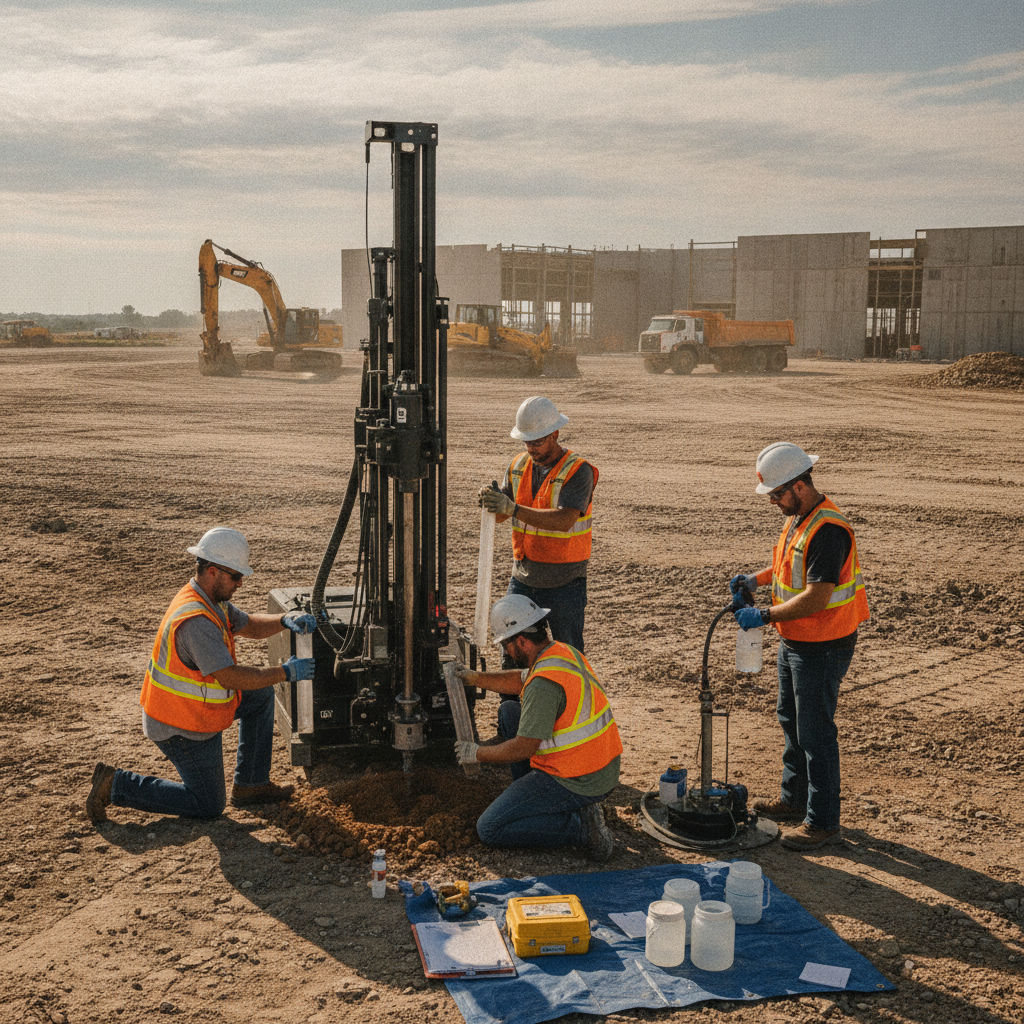
The core of the Phase II ESA is the physical collection of environmental media. Field technicians, under the supervision of an experienced geologist or engineer, use specialized equipment to access the subsurface. The most common method is direct-push technology (e.g., Geoprobe), which advances small-diameter rods into the ground to collect continuous soil cores and grab groundwater samples. This method is fast, efficient, and minimizes site disturbance, which is ideal for active properties. For deeper investigations or in challenging geological formations, hollow-stem auger drilling may be used to install temporary or permanent groundwater monitoring wells. These wells allow for repeated sampling over time to assess contaminant plume stability. Additionally, soil vapor intrusion (SVI) assessment is becoming increasingly important. This involves collecting soil gas samples from just below the ground surface or a future building slab to evaluate the risk of harmful vapors migrating into indoor air—a critical consideration for the health and safety of facility personnel.
Laboratory Analysis and Regulatory Screening Levels
After collection, samples are meticulously labeled, preserved on ice, and shipped under a strict chain-of-custody protocol to a state-certified environmental laboratory. At the lab, sophisticated analytical chemistry techniques are used to test for the specific COPCs identified in the work plan. The results are reported in concentrations (e.g., milligrams per kilogram for soil, micrograms per liter for water) and are then compared against established regulatory standards. In Florida, these standards are typically the Florida Department of Environmental Protection’s (FDEP) Cleanup Target Levels (CTLs). These CTLs are risk-based concentrations for various chemicals in soil, groundwater, and soil vapor. If a contaminant is detected at a concentration exceeding its respective CTL, it indicates a potential risk to human health or the environment and may trigger a requirement for further action. This comparison is a pivotal moment in the risk-based corrective action (RBCA) framework, determining the project’s next steps.
Delineating Contamination: Mapping the Extent of the Problem
Discovering contamination above CTLs is not the end of the investigation; it’s the beginning of the next phase: delineation. If the initial sampling confirms a problem, the primary goal becomes determining the full horizontal and vertical extent of the contamination. This process, known as contaminant delineation, involves a systematic expansion of the sampling grid, with additional soil borings and monitoring wells installed to map the boundaries of the impacted area, often referred to as a plume. Accurate plume mapping is essential for several reasons. First, it is required by regulatory agencies to fully understand the scope of the issue. Second, it is the only way to develop an accurate cost estimate for remediation. Without knowing the volume of contaminated soil or groundwater, any cleanup budget is pure speculation. This comprehensive site characterization provides the hard data needed to develop a targeted and effective Remedial Action Plan.
Interpreting Results: Go/No-Go Decisions and Remediation Pathways
The final Phase II ESA report synthesizes all field observations, laboratory data, and regulatory comparisons into a clear, actionable document. The findings directly inform the developer’s go/no-go decision and shape the path forward for site development. If contamination is minor and localized, the solution might be a simple soil excavation. If it’s more widespread, options could include in-situ chemical oxidation, bioremediation, or the implementation of long-term monitoring. In some cases, the contamination can be managed on-site using engineering controls, such as a vapor barrier beneath the building foundation, or institutional controls, like a deed restriction that prohibits the use of groundwater for drinking. The chosen strategy is formalized in a Remedial Action Plan (RAP), which must often be approved by regulatory agencies. The cost and timeline associated with the RAP are critical inputs for the overall project pro forma, determining if the site remains financially viable.
The RSP Engineers Approach to Phase II ESAs
At RSP Engineers, our approach to a Phase II ESA is rooted in a clear understanding of our client’s ultimate goal: to develop a successful project. We begin with a meticulous review of the Phase I ESA to ensure no detail is overlooked. Our team of experienced engineers and geologists then develops a targeted, cost-effective Sampling and Analysis Plan designed to answer the critical questions without excessive or redundant testing. We manage all aspects of the fieldwork, coordinating with drillers and certified laboratories to ensure the highest data quality. Our final report goes beyond just presenting data. We translate complex technical findings into clear business terms, outlining the risks, potential costs, and schedule implications for your data center project. We provide pragmatic recommendations and guide you through the process of agency negotiation and regulatory compliance. Our goal is to provide the certainty you need to make informed decisions, whether that involves proceeding with a remedial design, negotiating a purchase price reduction, or walking away from a site with unacceptable liabilities. We are a key partner in your risk assessment and site characterization efforts.
Common Pitfalls in Data Center Phase II Investigations
Even with a solid plan, Phase II ESAs can encounter challenges. A common pitfall is an inadequate Phase I report that leads to a poorly scoped Phase II, missing key areas of concern. Unforeseen subsurface conditions, such as shallow bedrock or a high water table, can complicate drilling and increase costs, sometimes requiring unexpected dewatering activities. Gaining access to neighboring properties for off-site delineation can be delayed by difficult negotiations over access agreements. Furthermore, the discovery of emerging contaminants like per- and poly-fluoroalkyl substances (PFAS) can introduce significant regulatory uncertainty, as cleanup standards for these compounds are still evolving. A developer might also find that the contamination is co-mingled with a plume from an adjacent property, creating complex legal and financial liability questions. Partnering with an experienced engineering firm helps anticipate and navigate these potential roadblocks effectively.
Partner with RSP Engineers for Your Mission-Critical Site Assessment
The success of your data center hinges on the land beneath it. A thorough Phase II ESA is an indispensable tool for mitigating risk and ensuring a smooth development process. The team at RSP Engineers provides the technical expertise and regulatory insight needed to navigate this complex process. We specialize in comprehensive due diligence, from initial site screening to full site characterization and remedial design. As a leading civil engineering firm near me, we integrate environmental findings directly into our site engineering services, providing a holistic approach to land development. Contact us today to discuss how we can secure your next mission-critical investment.
Conclusion: Securing Your Investment with Thorough Environmental Diligence
A Phase II Environmental Site Assessment should not be viewed as a potential obstacle, but as a fundamental component of sound investment strategy. It transforms unknown environmental risks into known, manageable variables. For data center developers, where reliability and uptime are non-negotiable, starting with a clean, well-understood site is the first step toward long-term operational success. By investing in thorough environmental due diligence, you are not just complying with regulations; you are protecting your capital, your timeline, and the ultimate viability of your mission-critical site development project.
FAQs
-
A straightforward Phase II ESA, from work plan approval to final report, can often be completed in 4 to 8 weeks. However, this timeline can be significantly extended if widespread contamination is found, requiring multiple rounds of delineation sampling, or if laboratory turnaround times are long. The complexity of the site characterization is the primary driver of the schedule.
-
While it’s rare for contamination to be a complete deal-killer, it can make a project financially unviable. The decision depends on the type and extent of contamination versus the overall project budget and timeline. A comprehensive remedial action plan with a reliable cost estimate is necessary to determine if the cleanup costs are prohibitive. In most cases, an engineering solution can be found.
-
This is a critical distinction. A Phase II ESA investigates for chemical contamination in soil and groundwater to assess environmental liability. A Geotechnical soil report, which often involves a soil boring test, investigates the physical and mechanical properties of the soil (e. g. , strength, density, composition) to provide design recommendations for foundations, pavements, and earthwork. While both involve drilling, they answer very different questions, and for large projects, they are often performed concurrently by specialized teams.