
Designing Data Center Drainage for Extreme Rainfall
Learn how civil engineering for data centers goes beyond code minimums to protect mission-critical assets from extreme rainfall through resilient stormwater management and drainage design.
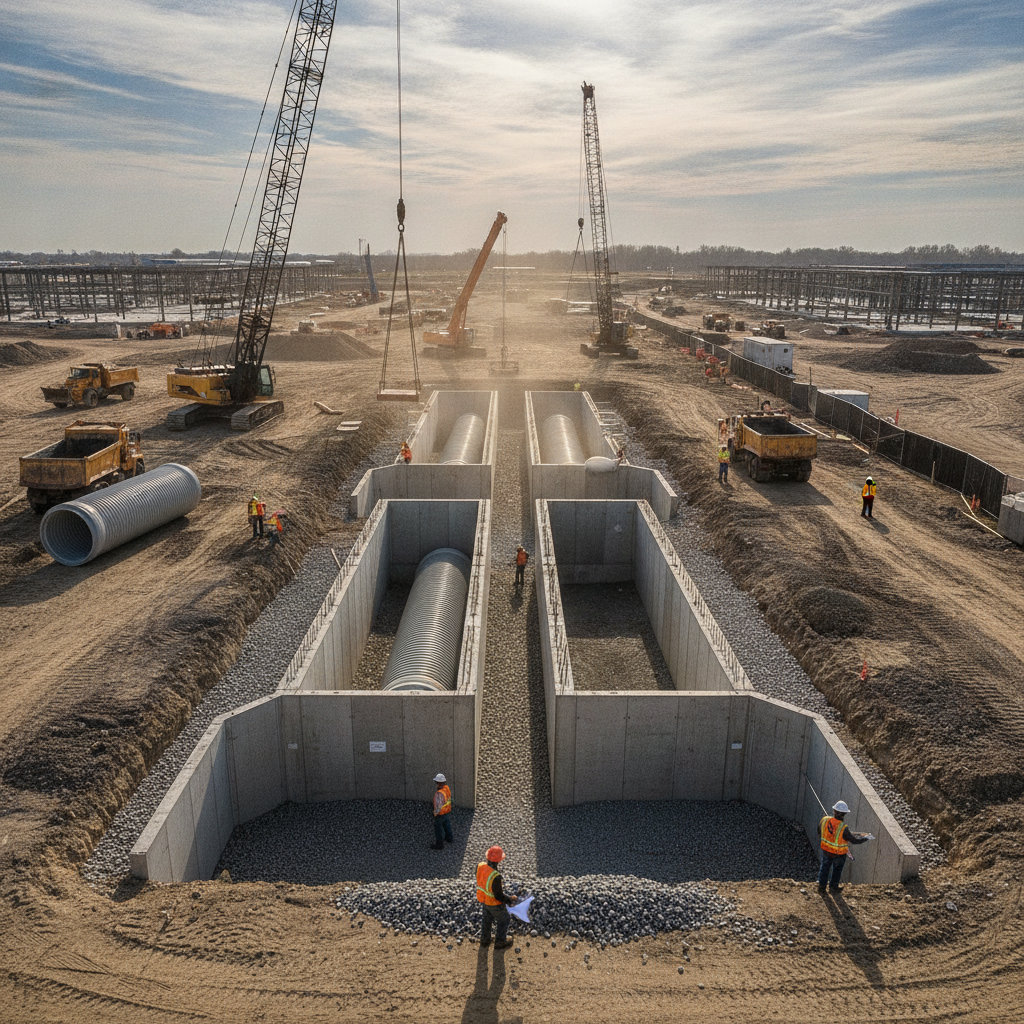
Beyond Minimum Code: Defining the Design Storm for Mission-Critical Facilities
Most commercial developments are designed to manage a specific storm event, such as a 25-year, 24-hour storm, as mandated by local ordinances. This means the system is designed to handle a rainfall event that has a 4% chance of occurring in any given year. For a standard warehouse or office building, this level of risk is often acceptable. For a data center, where a single hour of downtime can cost millions, the risk calculation is entirely different. The design must account for much rarer, higher-intensity events, such as the 100-year (1% annual chance) or even the 500-year (0.2% annual chance) storm to ensure facility resilience. The process begins with a risk assessment in collaboration with the owner to define the acceptable level of risk and establish a project-specific design storm. This decision impacts every aspect of the civil engineering design, from pipe sizing and pond volumes to finished floor elevations. It’s critical to understand that permitting requirements vary by jurisdiction, and every project team should confirm the applicable standards with the local, state, regional, and federal authorities that hold review authority over the site. However, for a mission-critical facility, the goal is to design a system that significantly exceeds these minimums, treating the code as the starting point, not the finish line. This proactive approach to drainage design is essential for long-term asset protection.
Leveraging Advanced Rainfall Data and Climate Projections
Comparison of Standard vs. Resilient Drainage Design Approaches
| Feature | Standard Design (Code Minimum) | Resilient Design (Mission-Critical) |
|---|---|---|
| Design Storm Frequency | Typically a 10-year or 25-year storm event, based on local ordinance. | 100-year, 500-year, or even a Probable Maximum Precipitation (PMP) event, based on owner risk tolerance. |
| Rainfall Data Source | Standard historical data (e.g., NOAA Atlas 14). | Historical data supplemented with forward-looking climate models and updated precipitation studies. |
| Primary System Capacity | Sized to convey the code-mandated design storm without surcharging. | Significantly oversized to handle a much larger design storm with capacity to spare. |
| Redundancy Measures | Minimal to none; often relies on a single conveyance path and outfall. | Parallel pipe networks, multiple inlets in critical areas, and dual outfall structures. |
| Overland Flow Plan | Often an afterthought; may result in unpredictable or damaging flow paths. | Engineered, dedicated overland flow paths (spillways, swales) to safely convey water exceeding system capacity. |
| Equipment Pad Elevation | Set based on standard freeboard above the 100-year floodplain, if applicable. | Elevated well above the 500-year flood elevation with conservative freeboard. |
Traditional drainage design often relies on historical rainfall data, such as the precipitation frequency estimates published by the National Oceanic and Atmospheric Administration (NOAA). While this data is the standard for regulatory compliance, it is based on past events and may not accurately reflect future conditions in a changing climate. For mission-critical projects, engineers should incorporate forward-looking climate projections and updated precipitation studies to model more intense future rainfall scenarios. This ensures the stormwater management system is not obsolete the day it’s built. Using this advanced data allows engineers to perform more accurate and conservative hydrologic and hydraulic modeling. By simulating how a site will respond to future, more intense storm events, we can better size conveyance systems, design more effective storage solutions, and establish safer building elevations. This data-driven approach to civil engineering provides a higher degree of confidence that the facility will remain secure and operational during the extreme weather events that are becoming more frequent and severe across the country.
Protecting Critical Infrastructure: Site Grading and Equipment Pad Elevation
The most effective drainage design strategy begins with smart site grading. The first line of defense against flooding is gravity. A well-designed grading plan directs surface water away from buildings, electrical yards, and critical infrastructure areas through a network of swales and gentle slopes. The goal is to create a landscape that naturally sheds water towards designated collection points, minimizing the potential for ponding near sensitive areas. This foundational element of site development is crucial before a single pipe is installed. Equally important is establishing appropriate elevations for critical equipment. All exterior infrastructure—including generators, transformers, cooling units, and fuel tanks—must be placed on concrete pads elevated above the projected flood elevation of the design storm (e.g., the 500-year storm). This includes setting the facility’s finished floor elevation with a conservative freeboard above this water surface elevation. This simple but critical step in the site plan design provides a robust buffer, ensuring that even if surrounding areas are inundated, the core operational assets of the data center remain dry and functional.
Redundancy and Resilience in Stormwater Conveyance Systems
In mission-critical design, a single point of failure is unacceptable. This principle extends directly to stormwater management. A resilient drainage system incorporates redundancy at multiple levels to ensure functionality even if one component is compromised. For example, instead of relying on a single large-diameter trunk line to convey stormwater, a redundant design might use two or more parallel pipes. If one line becomes clogged with debris or fails, the others can continue to function, preventing a catastrophic backup. Redundancy also applies to inlets, outfalls, and storage systems. Key areas should be served by multiple storm drains to ensure that the failure of a single inlet does not lead to localized flooding. Similarly, having multiple discharge points or emergency spillways for a detention pond provides alternative paths for water to exit the site if the primary outfall structure is overwhelmed. This multi-layered approach to drainage design and conveyance is a hallmark of sophisticated civil engineering for critical infrastructure.
Planning for Surcharge: Safe Overland Flow Paths
Even the most robustly designed underground pipe system has a capacity limit. A truly resilient site plan anticipates the moment when the primary drainage system is overwhelmed and provides a safe path for the excess water. This is known as planning for surcharge and designing safe overland flow paths. Instead of allowing floodwater to find its own destructive path toward buildings and equipment, engineers intentionally design and grade specific routes, such as vegetated swales or emergency spillways, to channel this excess flow to a safe discharge location. These engineered flow paths are a critical component of the site’s emergency response system. They must be designed to handle significant volumes of water at non-erosive velocities. The design process involves detailed hydraulic modeling to predict where water will go and how deep it will be during an extreme event that exceeds the capacity of the piped system. This proactive approach to stormwater management ensures that a surcharge event is a manageable condition, not a facility-threatening disaster. This level of planning is a key differentiator for high-quality site engineering services.
Our Process: Engineering Drainage Resilience for Data Centers
At RSP Engineers, our approach to designing drainage for mission-critical facilities is collaborative and data-driven. We begin with an in-depth risk and resilience workshop with the client to establish the project’s specific performance criteria and design storm basis. This informs every subsequent step of our process. Our team utilizes advanced hydrologic and hydraulic modeling software, incorporating both historical and forward-looking climate data to simulate a range of storm scenarios. This allows us to optimize the site development plan, creating a multi-layered defense system that integrates subsurface and surface drainage. We design for redundancy and safe failure, ensuring that predictable overland flow paths protect critical assets when the system is pushed beyond its limits. Throughout the permitting process, we clearly document the design’s intent and performance basis, demonstrating to regulatory agencies how our enhanced design provides superior environmental protection while meeting all compliance requirements.
Common Challenges in Data Center Drainage Design
Designing and implementing a resilient drainage system for a data center is not without its challenges. One common issue is underestimating the volume and velocity of off-site flows that may impact the property during a regional flood event. Another challenge is navigating the permitting process, as designs that exceed code minimums can sometimes require additional justification for review agencies. Value engineering can also pose a risk, as critical redundancy features or conservative freeboard elevations may be targeted for cost savings without a full understanding of the long-term risk. Finally, intense underground utility congestion on data center sites can create significant conflicts with large-diameter storm pipes. Careful utility coordination is essential from the earliest stages of design to ensure that all systems can coexist without compromising the integrity of the drainage network. Overcoming these challenges requires an experienced civil engineering team with a deep understanding of mission-critical facility requirements.
Partner with RSP Engineers for Mission-Critical Site Development
Protecting your data center from extreme weather requires specialized expertise that goes beyond standard practice. The team at RSP Engineers has a proven track record in designing and permitting resilient sites for mission-critical facilities nationwide. We provide comprehensive civil engineering, stormwater management, and site development services tailored to the unique risk profile of your project. From initial due diligence and risk assessment to final construction administration, we are your trusted partner in building infrastructure that lasts. Contact us today to discuss how we can secure your next project against the threat of extreme rainfall.
Conclusion: Securing Digital Infrastructure Through Superior Drainage Engineering
In the world of data centers, resilience is paramount. While much focus is placed on power and connectivity, the physical security of the site against environmental threats like extreme rainfall is a foundational requirement for ensuring uptime. A proactive, risk-based approach to drainage design—one that leverages forward-looking data, incorporates redundancy, and plans for safe failure—is no longer an option, but a necessity. By investing in a superior stormwater management system, data center developers and operators are making a direct investment in the long-term operational continuity and protection of their critical digital assets.
FAQs
-
A 100-year storm is a rainfall event that has a 1% chance of being equaled or exceeded in any given year. A 500-year storm is a more intense event with only a 0. 2% chance of occurring in any given year. Designing for a 500-year storm provides a much higher level of protection against extreme rainfall and flooding, which is appropriate for high-value, mission-critical infrastructure.
-
An enhanced drainage system with larger pipes, redundant lines, and more extensive earthwork will have a higher initial construction cost than a standard, code-minimum system. However, this upfront investment is a fraction of the potential cost of downtime, equipment replacement, and reputational damage from a flooding event. It should be viewed as a critical component of the facility’s overall risk management and insurance strategy.
-
Yes, retrofitting is possible, though it can be more complex and costly than incorporating resilience into a new build. Common retrofits include adding new inlets, constructing diversion berms or floodwalls, regrading portions of the site to create safe overland flow paths, and enhancing on-site water storage capacity. A thorough site assessment by a qualified Professional Engineer is the first step.