
Data Center Wetland Mitigation Strategies
A guide for data center developers on navigating Florida’s wetland mitigation process. Learn about the avoid-minimize-mitigate sequence, mitigation banks, UMAM, and permitting from RSP’s civil enginee
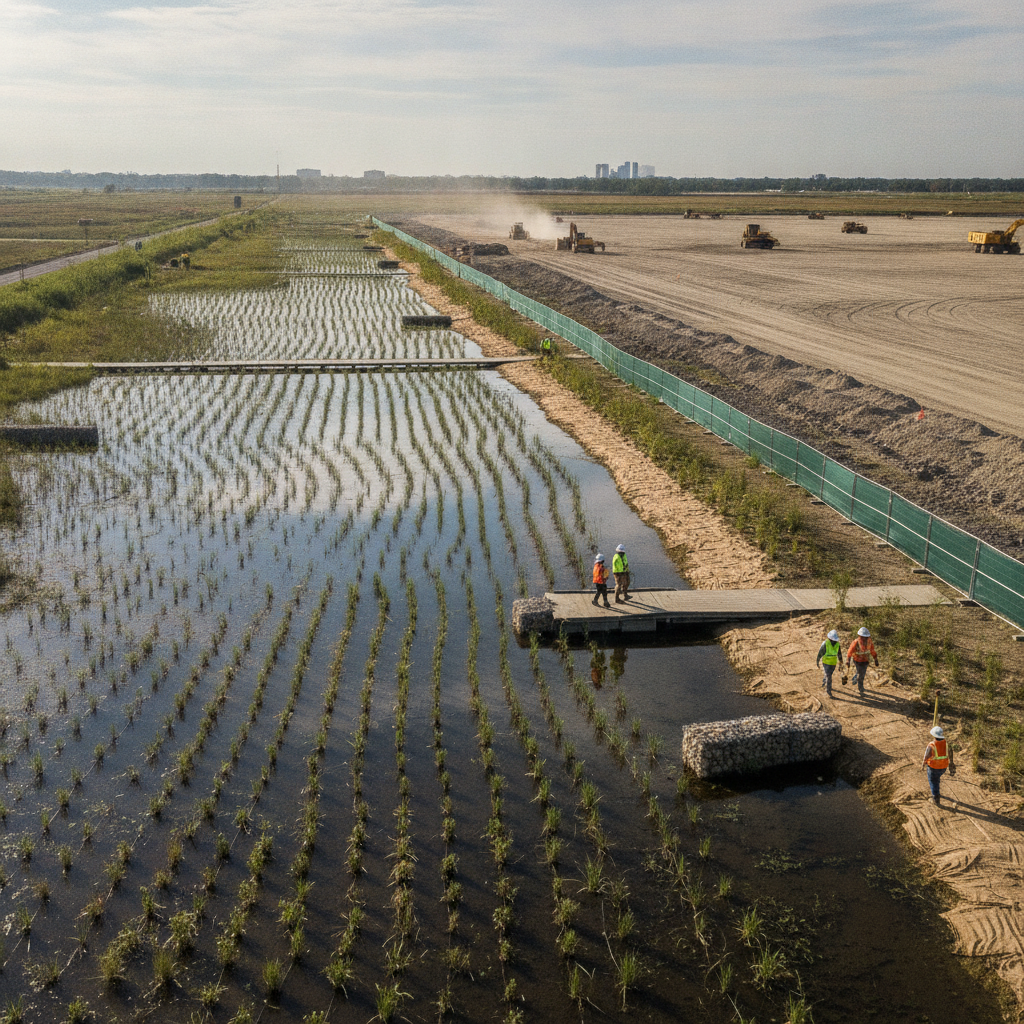
The Avoid-Minimize-Mitigate Sequence: A Foundational Principle
Before any discussion of mitigation can begin, regulatory agencies like the Florida Department of Environmental Protection (FDEP), Water Management Districts (WMDs), and the U.S. Army Corps of Engineers (USACE) require developers to follow a strict hierarchical process known as the avoid-minimize-mitigate sequence. This is the cornerstone of wetland permitting. The primary goal is to demonstrate that all practicable measures have been taken to prevent and reduce impacts before compensatory mitigation is considered. Avoidance is the first and most critical step. This involves meticulous site selection and layout design to steer clear of wetland boundaries altogether. A thorough wetland delineation, performed by an environmental scientist and surveyed by a professional land surveyor, is non-negotiable during due diligence. Minimization is the next step, where the project footprint is strategically adjusted to reduce the acreage and severity of unavoidable impacts. This can involve reconfiguring building layouts, access roads, and utility corridors. Only after all avoidance and minimization efforts are exhausted and documented can a developer proceed to the final step: proposing a plan for compensatory mitigation to offset the remaining functional loss.
On-Site vs. Off-Site Mitigation: Strategic Project Decisions
Comparison of Florida Wetland Mitigation Strategies
| Strategy | Key Considerations | Typical Timeline Impact | Cost & Liability Profile |
|---|---|---|---|
| Avoidance & Minimization | Requires early-stage site planning and flexibility in layout. Highest regulatory preference. | Adds time to due diligence and design phase but significantly reduces permit complexity. | Low direct cost, but may increase land acquisition or design costs. No long-term liability. |
| On-Site Creation/Restoration | Requires available and suitable land on-site. Developer retains all liability for success. | Adds significant time for design, permitting, construction, and 5+ years of monitoring. | High variability. Includes design, construction, and long-term maintenance costs. High risk if success criteria are not met. |
| Mitigation Bank Credit Purchase | Project must be within the bank's approved service area. Credits must be available for the specific wetland type. | Fastest mitigation solution. Obligation is met upon credit purchase and agency approval. | High upfront cost per credit, but predictable and fixed. Liability is transferred to the bank operator. |
| In-Lieu Fee (ILF) Program Payment | Used when mitigation bank credits are not available. Requires agency approval. | Relatively fast. Slower than banking if ILF project is not yet identified. | Predictable fee structure. Liability is transferred to the ILF program sponsor. |
| Permittee-Responsible Off-Site | Developer acquires and restores/creates a wetland on a separate property. | Very long timeline. Involves a separate land acquisition, design, and permitting process. | Very high cost and liability. Combines real estate transaction costs with full mitigation risk. |
When compensatory mitigation is required, developers face a key decision: perform mitigation on-site or purchase credits from an off-site entity. On-site mitigation involves creating, restoring, or enhancing wetlands within the boundaries of the data center development parcel. This approach can be beneficial if sufficient suitable land is available, as it keeps the ecological lift tied directly to the project site. However, it also saddles the developer with long-term construction, monitoring, and maintenance responsibilities, along with the associated financial and ecological risks if the mitigation area fails to meet its success criteria. Conversely, off-site mitigation offers a more streamlined path by transferring this liability. The two primary off-site options are purchasing credits from a permitted mitigation bank or making a payment to an In-Lieu Fee (ILF) program. This approach provides cost and schedule certainty, as the developer’s obligation is typically fulfilled upon payment. For data center projects on tight timelines with a focus on core infrastructure, off-site mitigation is often the preferred strategy, freeing the project team from the complexities of ecological restoration and long-term liability.
Primary Mitigation Methods: Restoration, Creation, and Enhancement
If a developer chooses a permittee-responsible mitigation path (typically on-site), the work will fall into one of three categories. Wetland restoration involves re-establishing the natural hydrology and vegetation of a former wetland area that has been degraded or drained. This is often the most ecologically valuable method. Wetland creation is the process of constructing a new wetland on an upland site, which requires significant earthwork, hydrologic modeling, and planting. It is often considered the most difficult to execute successfully. Wetland enhancement focuses on improving the ecological functions of an existing but degraded wetland. This might involve removing invasive species, re-establishing native vegetation, or modifying water control structures to improve hydroperiod. The choice of method depends entirely on site-specific conditions, regulatory preference, and the type of wetland functions being impacted. Each requires a detailed design plan prepared by qualified engineers and scientists, outlining grading, planting, and the specific ecological success criteria that must be met over a multi-year monitoring period.
Leveraging Mitigation Banks and In-Lieu Fee Programs
For many data center projects, the most efficient path forward is utilizing established third-party mitigation solutions. A mitigation bank is a large-scale wetland restoration or creation project that has been approved by regulatory agencies to sell “credits” to developers. These credits represent a specific quantity of ecological value, or “functional gain,” calculated using the Uniform Mitigation Assessment Method (UMAM). When a developer purchases credits, they transfer their legal responsibility for mitigation to the bank operator. The key is ensuring the project site is located within the bank’s designated service area. In-Lieu Fee (ILF) programs are a similar off-site option, typically managed by non-profit or government agencies. A developer pays a fee to the program, which then pools funds from multiple projects to implement larger, more strategic mitigation projects. While both options provide liability transfer, mitigation banking is often preferred by agencies because the ecological uplift is typically established before credits are sold, reducing temporal loss of wetland function. Both are powerful tools for de-risking a project’s environmental compliance and schedule.
Functional Assessment and Credit Calculation (UMAM)
In Florida, the currency of wetland impacts and mitigation is not simply acreage; it is functional value. The Uniform Mitigation Assessment Method (UMAM) is the standardized procedure used by state and federal agencies to quantify this value. UMAM evaluates three main categories: Location and Landscape Support, Water Environment, and Community Structure. Each is scored on a scale of 0 to 10. The resulting score represents the wetland’s current condition relative to its optimal condition. A civil engineering consultant works with an environmental scientist to calculate the “functional loss” caused by the project’s impacts. This is the amount of mitigation, or “functional gain,” that must be provided. For example, impacting one acre of a high-quality forested wetland (high UMAM score) will require significantly more mitigation credits than impacting one acre of a low-quality, disturbed marsh (low UMAM score). A precise and defensible UMAM analysis is critical for negotiating permit requirements and accurately budgeting for mitigation costs.
RSP Engineers’ Approach to Wetland Mitigation Strategy
At RSP Engineers, we integrate wetland mitigation strategy into the earliest stages of site development. Our process is designed to provide clarity and mitigate risk for our data center clients. We begin with comprehensive due diligence and site feasibility studies, including coordinating wetland delineations to identify constraints upfront. Our team then focuses on creative site layout and grading design to avoid and minimize impacts wherever possible, preserving project budget and simplifying the regulatory path. When impacts are unavoidable, we conduct a detailed mitigation options analysis, comparing the costs, timelines, and risks of on-site mitigation versus purchasing credits from available mitigation banks. We prepare all necessary application materials, including robust UMAM calculations and impact exhibits, and lead negotiations with FDEP, WMD, and USACE reviewers. Through proactive agency negotiation and diligent project management, we guide our clients through the complex permitting process to secure timely approvals and keep the project on track.
Common Pitfalls in Data Center Wetland Permitting
Even with a solid plan, several common issues can derail a data center’s wetland permitting process. A primary pitfall is underestimating the extent of wetlands during initial site selection, leading to costly redesigns or a non-viable project. Another is failing to adequately document the avoidance and minimization sequence, which can lead to significant permit delays and requests for additional information from regulatory agencies. Miscalculating UMAM scores or failing to account for secondary impacts, such as those from utility extensions or temporary construction access, can also result in an insufficient mitigation plan. Finally, many developers new to Florida do not adequately budget for the long-term costs and obligations associated with permittee-responsible mitigation. These can include expenses for maintenance, invasive species control, and annual monitoring reports for five years or more, along with the financial assurances required by the permit. Engaging an experienced civil engineering firm near me early in the process is the best way to avoid these common and costly mistakes.
Partner with RSP Engineers for Your Data Center Development
Navigating the complexities of wetland mitigation for data center development in Florida requires specialized expertise. The team at RSP Engineers provides the strategic guidance and technical skill needed to move your project from concept to construction. We specialize in large-scale site development, comprehensive stormwater management design, and navigating complex environmental permitting for mission-critical facilities. Let our experience work for you. Contact us today to discuss your project’s unique challenges and how we can develop a clear, efficient path to approval.
Conclusion: A Strategic Approach to Mitigation is Key to Project Success
For data center developers in Florida, wetland mitigation should be viewed as an integral part of the site engineering and development strategy, not an afterthought. A proactive approach that prioritizes the avoid-minimize-mitigate sequence, carefully evaluates mitigation options, and relies on precise technical analysis like UMAM is essential. By partnering with an experienced civil engineering firm, developers can navigate the regulatory landscape efficiently, manage risk, and ensure their critical infrastructure projects are built on a foundation of sound environmental compliance and successful land development. This strategic planning is the key to unlocking a project’s full potential while meeting Florida’s rigorous standards for wetland protection.
FAQs
-
In Florida, wetlands are typically regulated by both state and federal agencies. The FDEP and regional Water Management Districts manage the Environmental Resource Permit (ERP) program, which governs impacts to wetlands and surface waters. The U. S. Army Corps of Engineers regulates impacts to “Waters of the United States” under the Clean Water Act. While their jurisdictions often overlap, they can differ, and a project may require separate permits from each. A comprehensive permitting strategy must address the requirements of all applicable agencies.
-
The timeline varies significantly based on the complexity of the impacts and the mitigation approach. A project that qualifies for a general permit with minor impacts and uses a mitigation bank might be permitted in 3-6 months. A project requiring an Individual Permit with significant impacts and a permittee-responsible mitigation plan could take 12-18 months or longer, especially if it involves extensive agency review and public comment periods.
-
Yes, phasing is often a viable strategy for large, multi-phase data center campuses. The permit can be structured to align mitigation requirements with the specific phases of construction. For example, you would only need to provide mitigation for the wetland impacts associated with Phase 1 before starting that phase of construction. This requires careful documentation in the permit submittals and a clear master plan for the ultimate site build-out.