
Data Center Mitigation Banking Explained
Learn how mitigation banking accelerates data center development in Florida by satisfying wetland and species impact permits. A guide for developers from RSP Engineers.
Understanding Mitigation Banking Fundamentals
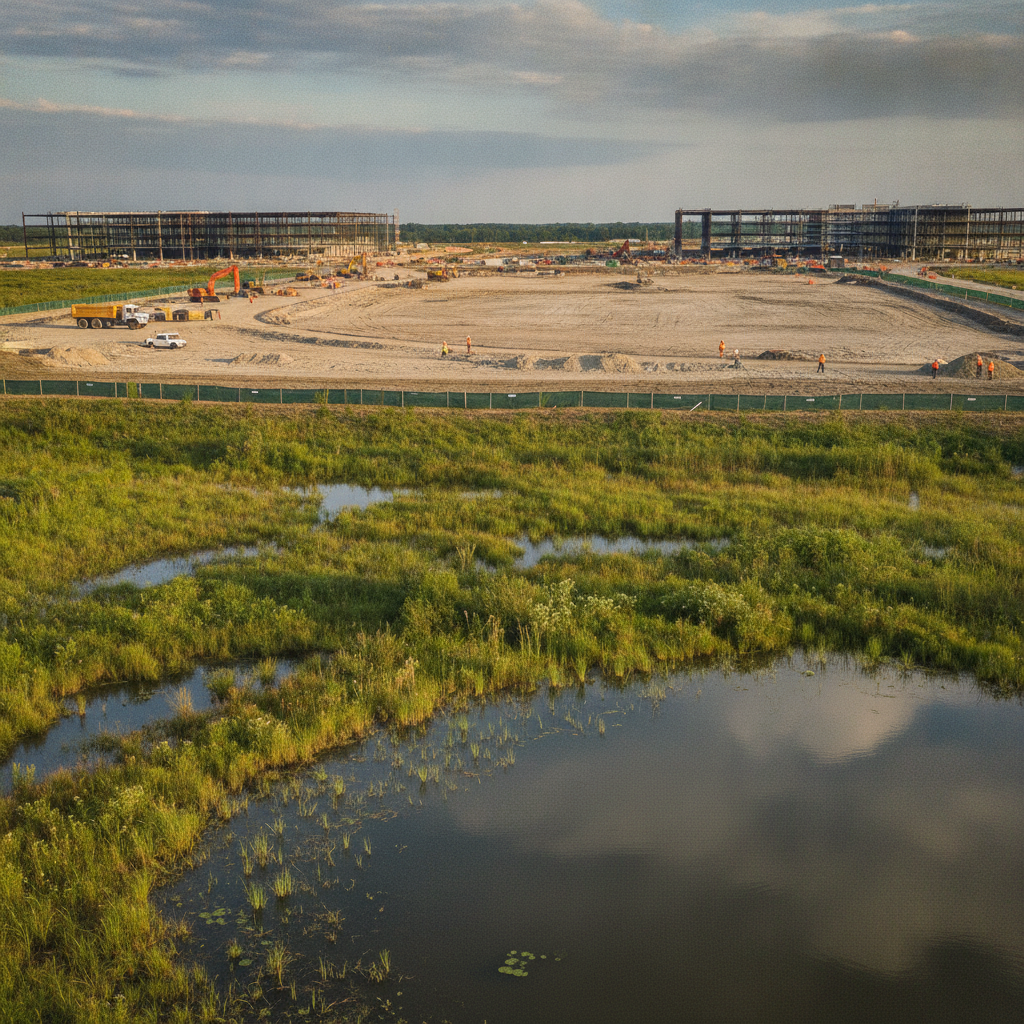
A mitigation bank is a parcel of land where wetlands, streams, or other aquatic resources have been restored, established, enhanced, or preserved. This land is specifically managed for the purpose of providing compensatory mitigation for unavoidable impacts to similar resources elsewhere. The bank is approved and regulated by state and federal agencies, which certify that the ecological improvements generate quantifiable environmental value. The owner of the mitigation bank can then sell this value in the form of “credits” to developers whose projects will result in ecological impacts. The core principle is consolidating environmental mitigation into large, ecologically viable sites that are managed in perpetuity. This is often more effective than having numerous small, isolated mitigation projects scattered across a region. For a data center developer, purchasing credits effectively transfers the legal responsibility for successfully mitigating environmental impacts to the bank owner. This transfer of liability is a crucial benefit, as it removes the long-term monitoring and maintenance obligations from the developer. Leading Civil Engineering firms recognize this as a primary tool for managing project risk.
The Role of Credits and Service Areas in Florida
Mitigation Banking vs. Permittee-Responsible Mitigation (PRM) for Data Centers
| Factor | Mitigation Banking | Permittee-Responsible Mitigation (PRM) |
|---|---|---|
| Timeline Certainty | High. Credits can be purchased quickly, providing a clear path for permit approval. | Low. Requires separate design, permitting, and construction, adding 1-3+ years to the schedule. |
| Cost Structure | High upfront cost, but fixed and predictable. No long-term expenses. | Lower initial cash outlay, but high long-term costs (monitoring, maintenance, bonding) and risk of cost overruns. |
| Long-Term Liability | Liability is transferred to the bank owner upon credit purchase. | Developer retains all legal and financial liability for the success of the mitigation site for many years. |
| Land Requirement | None. The developer does not need to acquire additional land for mitigation. | Requires acquisition or use of a suitable parcel of land for the mitigation project itself. |
| Agency Review Complexity | Streamlined. Agencies review a simple transaction with a pre-approved bank. | Complex. Agencies must conduct a detailed review of a new, unproven mitigation design. |
| Ideal Project Type | Projects with aggressive timelines and a low appetite for long-term environmental risk, like data centers. | Projects with very large, unique impacts where no suitable bank credits are available, or for entities with land holdings and long-term management capabilities. |
Mitigation credits are the currency of the banking system. A single credit represents a unit of restored or protected ecological function. In Florida, the value of both the impacted wetland and the mitigation bank site is typically calculated using the Uniform Mitigation Assessment Method (UMAM). This methodology provides a standardized procedure for assessing the ecological functions of wetlands and surface waters, resulting in a score that determines how many credits are required to offset a specific impact. The analysis considers factors like location, hydrology, and community structure. A critical concept in this process is the service area. A mitigation bank is only authorized to sell credits for projects located within a specific, geographically defined service area. This ensures that the mitigation is occurring within the same watershed or ecoregion as the impact, maintaining local ecological balance. Your civil engineering consultant must verify that your project site falls within the service area of any bank you intend to use. This is a key step in the initial due diligence phase of any large-scale land development project.
Satisfying Permit Requirements for Wetland and Species Impacts
When a site plan design for a data center identifies unavoidable wetland impacts, regulatory agencies require compensatory mitigation. The permitting process involves demonstrating that you have first avoided and minimized impacts to the greatest extent practicable. Once all avoidance and minimization options are exhausted, mitigation banking provides a straightforward path to compensation. The developer enters into a binding agreement to purchase the required number of credits from an approved bank. Proof of this transaction, such as a reservation letter or a fully executed purchase agreement, is included in the permit application submitted to the FDEP, local Water Management District, and/or the USACE. This documentation demonstrates to the agency that the environmental impacts will be fully offset by a pre-approved, ecologically successful project. This same mechanism can also be used to offset impacts to habitats for listed species, with credits often available from banks specifically designed for listed species mitigation.
The Strategic Advantage: Accelerating Data Center Timelines
For mission-critical facilities like data centers, time is money. The primary advantage of mitigation banking is the certainty and speed it adds to the permitting schedule. The alternative, known as permittee-responsible mitigation (PRM), requires the developer to design, permit, construct, and monitor their own mitigation project. This process can add years to a project timeline and introduces significant uncertainty. The PRM site itself requires extensive design, separate permitting, and faces the risk of ecological failure, which could lead to non-compliance issues. By using a mitigation bank, a developer can secure their mitigation solution in a matter of weeks. This allows the civil engineering and permitting team to present a complete package to the agencies, dramatically shortening the agency review period for the environmental components of the project. This predictability is invaluable for maintaining a tight construction timeline and meeting investor expectations.
Financial Analysis: The True Cost of Mitigation Options
While the upfront cost of mitigation credits can seem substantial, a thorough financial analysis often reveals it to be the more cost-effective option. Purchasing credits is a fixed, one-time expense that can be clearly incorporated into the project budget. This eliminates the financial uncertainty associated with PRM, which includes a long list of variable and ongoing costs. The hidden costs of PRM include land acquisition for the mitigation site, extensive engineering and design fees, construction costs for earthwork and plantings, and, most significantly, expenses for long-term monitoring and maintenance, which can last for years or even decades. Furthermore, agencies typically require developers to post financial assurances (like bonds or letters of credit) to guarantee the success of the PRM project. Mitigation banking consolidates all these potential costs and risks into a single, predictable transaction.
Navigating the Agency Approval and Documentation Process
A successful mitigation banking strategy relies on meticulous documentation and clear communication with regulatory agencies. Your engineering consultant, acting as your agent, will prepare a comprehensive permit submittal that includes the wetland impact assessment (e.g., UMAM scores), the mitigation plan, and the legal documentation from the mitigation bank. This typically involves a credit reservation agreement followed by a bill of sale and a formal request to the bank to debit the credits from their ledger. Our team of Florida Licensed Engineers ensures that all agency coordination is handled proactively. We verify the bank’s legal standing, confirm the availability of the correct type of credits, and ensure the service area boundaries are appropriate for the project. This rigorous due diligence at the start of the project prevents last-minute surprises during the agency review and ensures a smooth path to permit issuance.
RSP Engineers’ Mitigation Strategy and Permitting Process
At RSP Engineers, we integrate mitigation planning into the earliest stages of site development. Our approach is designed to provide clarity and confidence to our clients. As a team led by a licensed Professional Engineer, we understand the critical path for development. Initial Site Assessment: We begin with a thorough site assessment to delineate all jurisdictional wetlands and habitats, quantifying potential impacts before the design is finalized. Mitigation Options Analysis: We identify all available and approved mitigation banks within the project’s service area and conduct a cost-benefit analysis comparing banking to other potential options. Agency Pre-Application Meetings: We engage with regulatory agencies early to discuss the proposed mitigation strategy, ensuring alignment and reducing the potential for review comments later in the process. Permit Application Package: We prepare and submit a complete and defensible environmental permit application, including all necessary calculations, forms, and mitigation bank documentation. Transaction Coordination: We act as a liaison between your team and the mitigation bank operator to ensure a smooth and timely credit transaction that aligns with your permitting and construction schedule.
Common Pitfalls and Challenges in Mitigation Banking
While highly advantageous, mitigation banking is not without potential challenges. A primary issue can be credit availability. In some regions, the demand for credits may outstrip the supply, or the available credits may not be the correct type (e.g., you need forested wetland credits, but only herbaceous are available). This can lead to significant price increases or the need to seek alternative solutions. Another challenge involves complex service area boundaries. A project site may straddle two different service areas, complicating the mitigation plan. Finally, developers must budget appropriately. Waiting too long to investigate credit costs can lead to sticker shock that impacts the overall project pro forma. Proactive planning with an experienced engineering consultant is the best way to navigate these potential pitfalls.
Streamline Your Data Center Permitting with RSP Engineers
Navigating Florida’s complex environmental regulations requires deep expertise and strategic foresight. The RSP Engineers team specializes in large-scale site development for mission-critical facilities. We provide the critical civil engineering and permitting services needed to get your data center project off the ground. From initial due diligence and environmental permitting to final construction administration, we are your trusted partner. Don’t let permitting uncertainties delay your project. Contact us today to discuss how a strategic mitigation banking plan can provide the certainty and speed your data center development demands.
Conclusion: Mitigation Banking as a Strategic Development Tool
For data center developers in Florida, mitigation banking is more than just a regulatory requirement—it is a strategic business tool. It transforms the unpredictable and lengthy process of environmental mitigation into a predictable, fixed-cost transaction. By providing permitting certainty and transferring long-term liability, it allows developers to manage risk and adhere to the aggressive timelines that are standard in the industry. Integrating a well-planned mitigation strategy early in the site development process is a critical step toward a successful and timely project launch.
Related Civil Engineering Insights
Navigating Florida’s Environmental Resource Permitting (ERP) Process Key Due Diligence Steps for Large-Scale Land Development in Florida Stormwater Management Design for Mission-Critical Facilities
FAQs
-
A mitigation bank is primarily for offsetting impacts to wetlands and aquatic resources (governed by the Clean Water Act), while a conservation bank is for offsetting impacts to endangered or threatened species habitat (governed by the Endangered Species Act). Many banks in Florida are approved to provide both types of credits.
-
You should consider mitigation banking during the initial due diligence and site selection phase. Understanding the potential mitigation costs and credit availability is critical for determining a site’s financial viability and development timeline before you acquire the property.
-
No. Mitigation banking is exclusively for offsetting unavoidable impacts to natural habitats like wetlands and species habitats. Your project will still require a separate, engineered stormwater management system designed to meet state and local water quality and quantity standards. This is a distinct part of the civil engineering design.