
Data Center Utility Construction
Explore the complex utility construction requirements for data centers, from high-voltage duct banks and fiber diversity to water mains and stormwater management. A guide for developers of mission-critical projects.
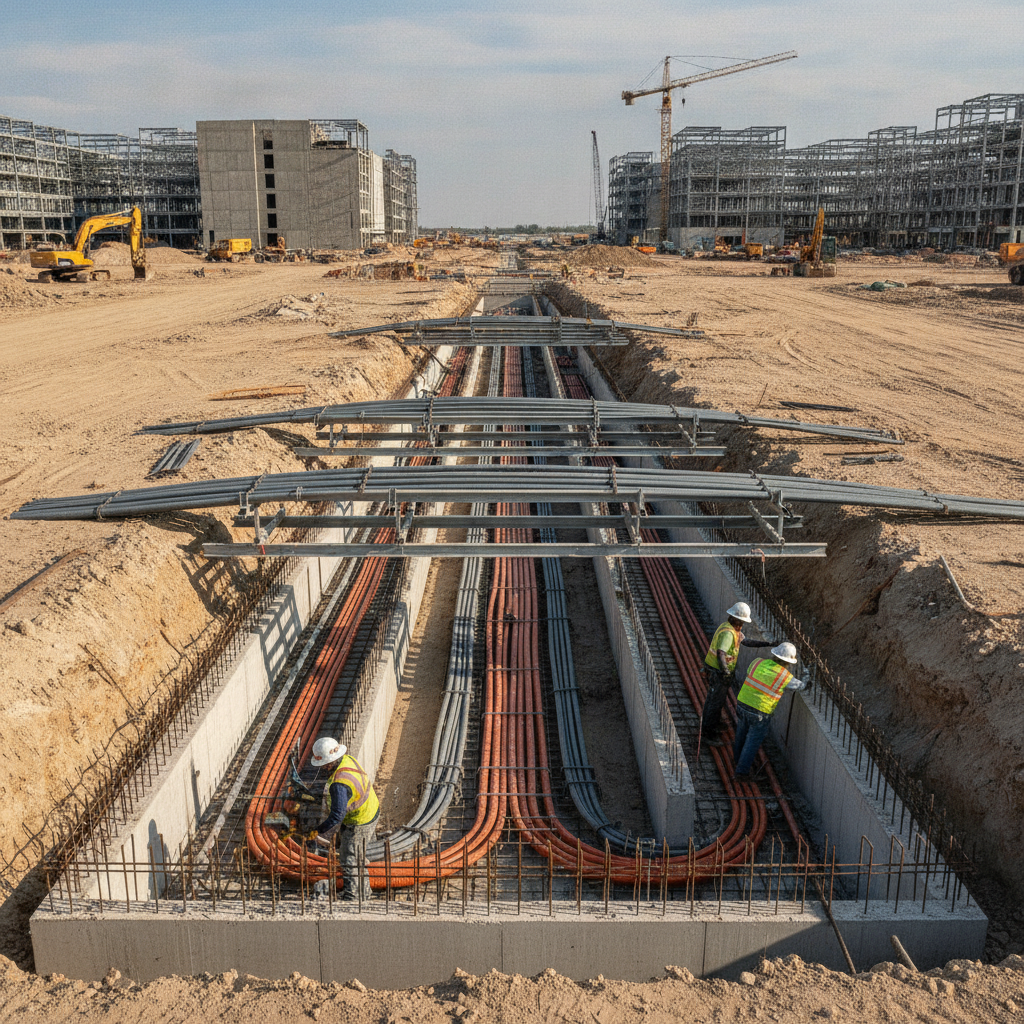
High-Voltage Power Delivery: Duct Banks and Substation Interconnection
A data center’s primary need is a massive, uninterrupted supply of power. The civil engineering work to support this begins far outside the building, with the design and construction of the electrical feeder pathways. This infrastructure is typically housed in a concrete-encased duct bank, a fortified underground structure containing multiple conduits. The design must account for conduit spacing to manage heat dissipation, sufficient structural integrity to withstand surface loads, and precise alignment to meet the utility provider’s stringent standards. These duct banks form the critical link between the public grid’s substation and the facility’s own electrical yard. The coordination for these high-voltage feeders is one of the most complex aspects of site development. It involves extensive collaboration between the civil engineer, the electrical engineer, and the power company. Permitting requirements for utility corridors and substation tie-ins vary by jurisdiction, and every project team should confirm the applicable standards with the local, state, regional, and federal authorities that hold review authority over the site. The design must adhere to the utility’s specific construction standards, which dictate everything from trench depth and backfill material to the type of rebar used in the concrete encasement.
Water and Wastewater Infrastructure for Mission-Critical Operations
Key Utility System Design and Construction Considerations
| Utility System | Key Design Factor | Critical Construction Checkpoint | Common Risk |
|---|---|---|---|
| High-Voltage Power | Conduit spacing for thermal dissipation and adherence to utility standards. | Proper rebar placement and concrete coverage in the duct bank. | Utility provider rejecting the installation due to non-compliance. |
| Potable/Fire Water | Looped main design for redundancy and hydraulic modeling for fire flow. | Successful pressure and bacteriological testing before connection. | Insufficient pressure for fire suppression systems. |
| Sanitary Sewer | Maintaining minimum pipe slope for gravity flow and proper manhole placement. | Low-pressure air testing or mandrel testing to confirm pipe integrity. | Line blockages or backups due to poor installation or grade. |
| Fiber Optic | Pathway diversity with physically separate routes into the facility. | Gentle sweeps in conduits and ensuring a clean, debris-free pathway. | A single excavation event severing all site connectivity. |
| Storm Drainage | Integration with site grading and compliance with NPDES permit requirements. | Correct installation of erosion control measures and proper inlet elevations. | Site flooding or regulatory fines due to uncontrolled runoff. |
While power is paramount, water is essential for both cooling and safety. Modern data centers often use advanced water-based cooling systems, requiring a significant and reliable supply of process water. This necessitates the design and installation of large-diameter water mains capable of delivering the required flow and pressure. For reliability, these systems are often designed as a looped network, ensuring that a single break in the line does not disrupt the entire supply. This same looped system is critical for the fire suppression system, which has its own demanding flow requirements mandated by building and fire codes. Alongside the water supply, a robust wastewater collection system is needed to handle both sanitary sewer flows from staff facilities and discharge from cooling systems. The design of sewer mains must account for proper slope, pipe material, and capacity to prevent backups and ensure efficient conveyance to the public sewer system. Both water and sewer systems require extensive utility coordination with the local provider, including detailed plans for connection points, metering vaults, and backflow prevention assemblies to protect the public water supply.
Fiber Optic Pathways and Carrier Diversity
A data center is useless without connectivity. Ensuring reliable, high-speed data transmission requires the installation of redundant fiber optic infrastructure. The civil engineer’s role is to design physically separate underground pathways for these critical cables. The primary goal is achieving pathway diversity, meaning fiber conduits enter the building from different directions and are routed through separate trenches. This prevents a single incident, like an accidental excavation, from severing all connectivity. Achieving this involves creating a network of conduits, manholes, and handholes that allow multiple telecommunication carriers to install their infrastructure. This is known as carrier diversity. The design must provide clear, accessible, and protected routes from the public right-of-way to the data center’s meet-me room. The construction of these fiber optic conduits demands careful handling and installation to avoid damage that could compromise signal integrity, making quality control during construction a top priority.
Trenching, Shoring, and Utility Conflict Management
The physical installation of underground utilities is a major construction effort involving extensive excavation. Safe and effective trenching is fundamental. Depending on the depth and soil conditions, shoring systems may be required to prevent trench collapse, ensuring worker safety and protecting adjacent structures. The project’s Geotechnical engineer provides critical data on soil stability, groundwater levels, and the presence of rock, which informs the means and methods for excavation. One of the greatest challenges in dense areas is navigating the web of existing underground infrastructure. A thorough utility conflict analysis is essential during the design phase. This process, often aided by Subsurface Utility Engineering (SUE), identifies the horizontal and vertical location of existing pipes and conduits. The civil engineer then designs the new utility profiles to weave through this congested environment, specifying vertical separations and horizontal clearances to avoid damaging existing lines. This proactive approach to utility coordination prevents costly delays and dangerous accidents during construction.
Stormwater Management and Site Drainage Integration
Utility construction significantly impacts a site’s hydrology. Extensive trenching and grading can alter natural drainage patterns and create potential pathways for erosion. A comprehensive stormwater management plan is a required component of any major site development project. The civil engineer must design a system of inlets, pipes, and basins to collect and treat stormwater runoff in compliance with local and federal regulations, such as the National Pollutant Discharge Elimination System (NPDES). The utility layout must be carefully integrated with the drainage design. For example, trench backfill must be properly compacted to prevent it from becoming a subterranean channel for groundwater, and surface grades must be restored to direct runoff toward designated collection points. During construction, robust erosion and sediment control measures are implemented around all disturbed areas, including trenches and stockpiles, to protect water quality in nearby water bodies.
How RSP Engineers Manages Complex Utility Coordination
At RSP Engineers, our approach to data center utility construction is proactive and collaborative. We initiate the utility coordination process at the earliest stages of project feasibility, engaging with power, water, sewer, and telecom providers to identify capacity, connection points, and design requirements. This early engagement allows us to develop a comprehensive utility master plan that informs the overall site plan design and minimizes surprises down the road. Our process involves creating detailed composite utility plans that overlay all proposed and existing infrastructure in 3D, allowing us to identify and resolve potential conflicts before a shovel ever hits the ground. We manage the complex web of permit submittals required by various agencies and utility companies, ensuring that all documentation is accurate and complete. During construction, our team provides dedicated construction administration, reviewing installations, addressing field issues, and ensuring that the final product meets the rigorous standards required for a mission-critical facility.
Common Challenges in Data Center Utility Construction
Even with meticulous planning, data center utility projects face inherent challenges. Unforeseen subsurface conditions, such as undocumented utilities, contaminated soil, or hard rock, can halt excavation and require costly redesigns. Long lead times for critical equipment like high-voltage transformers and switchgear can significantly impact the project schedule, demanding early procurement strategies. Furthermore, navigating the often-conflicting standards and review timelines of multiple utility providers and permitting agencies requires persistent and experienced project management. Another common issue is managing the interface between different construction trades in a congested utility corridor. Proper sequencing and clear communication are essential to prevent damage to newly installed infrastructure. A skilled Professional Engineer plays a vital role in resolving these field issues, providing timely solutions that keep the project moving forward without compromising design intent or safety.
Power Your Project with Expert Utility Engineering
Successfully navigating the complexities of data center utility construction requires a team with deep technical expertise and a proven track record. At RSP Engineers, we provide the comprehensive site engineering services needed to bring mission-critical facilities online. From initial due diligence and master planning to detailed utility coordination and construction-phase support, we manage the critical infrastructure that powers your investment. Our team is adept at securing approvals and managing the intricate permitting process with authorities across the nation.
Conclusion
The utility infrastructure for a data center is far more than just pipes and wires; it is the facility’s lifeline. A successful project depends on a civil engineering strategy that prioritizes redundancy, reliability, and meticulous planning. By focusing on early and continuous utility coordination, proactive conflict resolution, and robust design, developers can mitigate risks and ensure their facility is built on a solid foundation. Ultimately, expert management of the land development and utility construction process is a critical investment in the long-term operational success of any data center.
FAQs
-
While all are essential, redundant and reliable high-voltage power is typically the most critical and complex utility to secure. The entire facility’s operation depends on it, and the infrastructure, from the substation to the duct bank, requires the longest lead times for design, permitting, and construction.
-
You should engage a civil engineering firm during the site selection and due diligence phase. An early utility assessment can identify potential deal-breakers, such as a lack of power capacity or prohibitive connection costs, before you commit to a property.
-
Pathway diversity is a design strategy that ensures fiber optic cables enter a data center from physically separate routes. For example, one set of conduits may come from the north side of the property and another from the east. This prevents a single point of failure, such as a backhoe digging in the wrong place, from cutting off all the facility’s connectivity.