
Data Center SWMM Modeling Guide
A guide for developers on using SWMM for data center site drainage. Learn about dynamic-wave routing, HGL analysis, and permitting for mission-critical facilities.
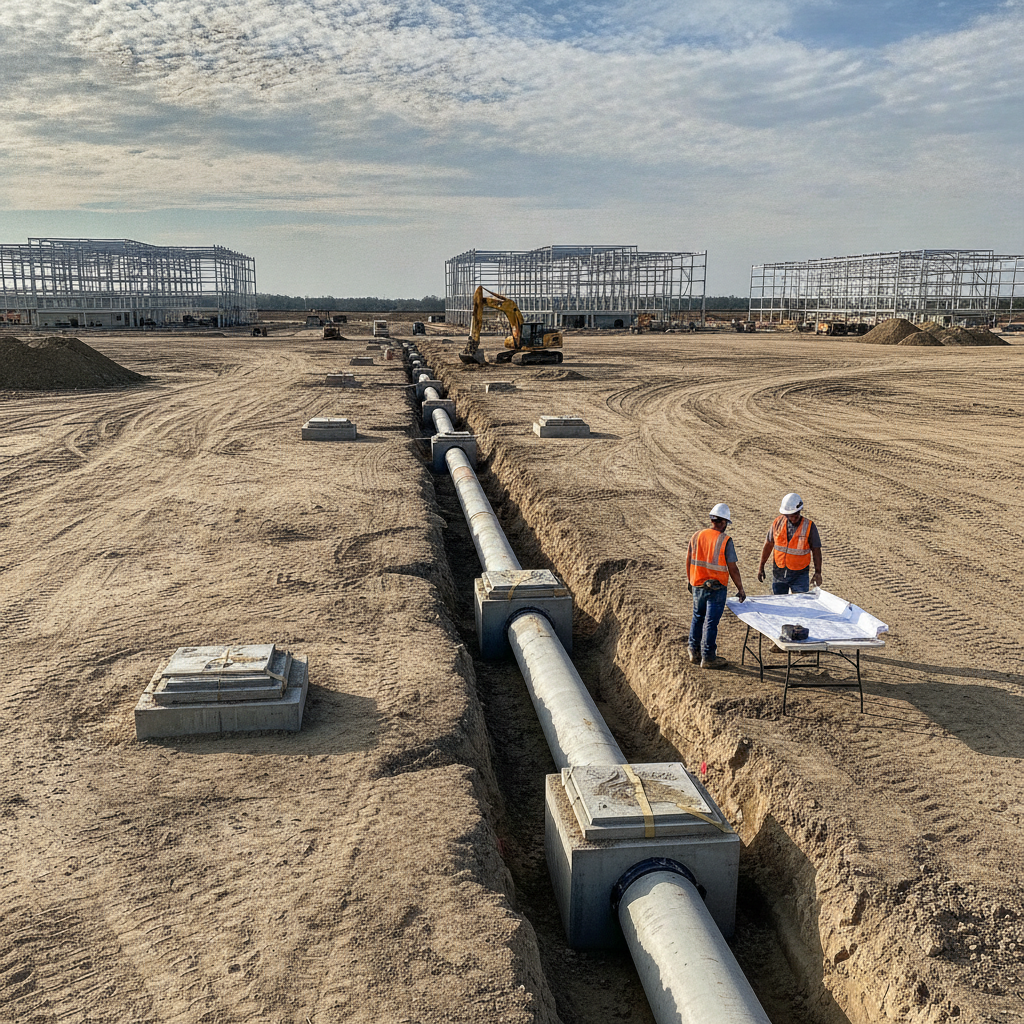
Defining Subcatchments and Impervious Cover for Data Center Sites
The first step in any SWMM analysis is to accurately represent the site’s hydrology by dividing it into subcatchments. For a data center, these are distinct drainage areas such as rooftops, parking lots, access roads, generator pads, and landscaped perimeters. Unlike typical commercial developments, data centers feature an extremely high percentage of impervious cover, often exceeding 80-90%. This drastically increases runoff volume and peak flow rates, placing immense pressure on the conveyance system. Our engineers meticulously delineate these areas based on the proposed site development plan, assigning specific parameters for slope, width, and roughness. Accurately calculating the time of concentration for these highly impervious, often hydraulically smooth surfaces is critical. A short time of concentration means that runoff reaches the drainage system very quickly, requiring a robust network of inlets and pipes to prevent localized flooding that could compromise critical equipment or building access.
Dynamic-Wave Routing for Complex Pipe Networks
SWMM Modeling Parameters: Data Center vs. Residential Site
| Parameter | Typical Single-Family Residential Site | Mission-Critical Data Center Site |
|---|---|---|
| Impervious Cover | 30-50% (roofs, driveways, sidewalks) | 80-95% (building, parking, equipment pads) |
| Primary Routing Method | Kinematic or Steady Flow (simpler models) | Dynamic-Wave Routing (accounts for backwater, surcharge) |
| Key Performance Metric | Preventing structure flooding, meeting pond attenuation goals. | Zero flooding at critical infrastructure, HGL below finished floor, no bypass flow at key inlets. |
| Simulation Type | Primarily single-event simulation for design storm compliance. | Single-event for compliance; continuous simulation for resiliency analysis. |
| Inlet/Pipe Analysis Focus | General capacity checks, often with spreadsheet tools. | Detailed inlet capacity analysis, HGL checks, and surcharge modeling within SWMM. |
| LID/Green Infrastructure Goal | Lot-level infiltration, meeting minimum water quality requirements. | Targeted volume/peak rate reduction to reduce downstream infrastructure size and meet strict water quality regulations. |
The core strength of SWMM lies in its advanced hydraulic routing capabilities, particularly dynamic-wave routing. This method solves the full one-dimensional Saint-Venant flow equations, allowing it to model complex hydraulic phenomena that simpler methods ignore. For the typically flat terrain, this is not a luxury—it’s a necessity. Dynamic-wave routing accurately simulates backwater effects, where downstream conditions (like a full detention pond or high tailwater) cause water levels to rise upstream within the pipe network. This analysis is crucial for verifying the performance of the proposed drainage design. It can model pressurized flow (surcharging), flow reversal, and looped pipe connections, all of which can occur in a complex data center site layout. By simulating these conditions, we can ensure the stormwater management system is designed to be resilient, preventing unexpected flooding during major storm events and providing a higher level of confidence during the permitting process.
Analyzing Inlet Capacity, Surcharging, and Hydraulic Grade Line (HGL)
A pipe is only as good as the inlet that feeds it. SWMM allows for a detailed analysis of each storm drain inlet to verify its inlet capacity. The model can predict how much flow enters an inlet and how much bypasses it during a peak storm, flowing overland to the next downstream inlet. This is critical for preventing sheet flow from overwhelming building entrances or generator yards. We analyze the system to minimize bypass flow and ensure the drainage network functions as designed. The model also calculates when pipes become pressurized, a condition known as surcharging. More importantly, it computes the Hydraulic Grade Line (HGL), which represents the water surface elevation throughout the pipe network. A key design goal is to ensure the HGL remains below critical elevations, such as the finished floor of the data hall, electrical rooms, or the ground surface in sensitive areas. This HGL analysis is a standard requirement for agency review and is fundamental to demonstrating a flood-free design.
Single-Event vs. Continuous Simulation for Resiliency Analysis
Most site designs are evaluated against a specific design storm, such as 25-year, 24-hour event. This is known as a single-event simulation. While useful for regulatory compliance, it doesn’t tell the whole story. For a mission-critical facility, we often recommend a continuous simulation, which uses a long-term historical rainfall record (often spanning several years) to model the system’s performance over a wide range of conditions. This advanced approach provides insights into the frequency of nuisance flooding, the long-term performance of Low-Impact Development (LID) features, and how antecedent moisture conditions affect system response. For a data center where any downtime is catastrophic, understanding the system’s behavior under a full spectrum of storm events provides a much higher degree of confidence in the resilience of the site development and its stormwater management infrastructure.
Integrating Low-Impact Development (LID) and Green Infrastructure
Modern stormwater management often incorporates Low-Impact Development (LID) or green infrastructure to reduce runoff and improve water quality. SWMM includes a robust suite of tools for modeling these features. We can integrate elements like bioretention cells, permeable pavement in parking areas, or even green roofs into the overall site model to quantify their hydrologic benefits. This is particularly important for meeting the stringent environmental permitting requirements. By modeling LID controls, we can demonstrate compliance with water quality treatment and runoff volume reduction goals. This integrated approach to drainage design not only aids in achieving zoning compliance but also creates a more sustainable and resilient site that can better manage stormwater at its source.
RSP’s Approach to Data Center SWMM Modeling
At RSP Engineers, our process begins with a deep understanding of the project’s operational and resiliency goals. We conduct a thorough review of the site development plan, geotechnical reports, and utility surveys to gather the necessary data. Our team then builds a detailed SWMM model, carefully parameterizing subcatchments, conduits, inlets, and storage nodes to reflect the proposed design accurately. We use this model as a design tool, not just a verification tool. By running multiple scenarios, we can optimize the drainage design, right-sizing pipes and inlets to provide the required level of protection without over-designing the system. The model outputs—including HGL profiles and inlet performance tables—become a core part of our permit submittals, providing clear and defensible evidence that the design meets or exceeds all agency requirements. This proactive and detailed approach facilitates smoother utility coordination and a more predictable construction phase.
Common Issues and Pitfalls in SWMM Modeling
While powerful, SWMM is a complex tool, and modeling errors can lead to significant design flaws. A common pitfall is using incorrect parameters, such as an overestimated time of concentration, which can lead to an undersized pipe network. Another issue is failing to properly model downstream boundary conditions, which can mask backwater effects that would otherwise cause upstream flooding. Inaccurate representation of impervious cover can also drastically skew runoff calculations. These errors can result in a system that fails during a real storm event, leading to costly damage and operational downtime. They can also cause significant delays during agency review if regulators identify inconsistencies or flaws in the model. This is why having an experienced Professional Engineer from one of the top Civil Engineering Firms who specializes in complex hydraulic and hydrologic modeling is essential for mission-critical projects. Frequently Asked Questions (FAQ) Why can’t we just use a standard pond routing model for a data center? Standard pond routing models are excellent for sizing detention or retention ponds, but they don’t analyze the conveyance system in detail. SWMM is required to model the dynamics within the pipe network itself, such as surcharging, backwater effects, and the Hydraulic Grade Line (HGL), which are critical for protecting a data center’s high-value infrastructure. How does SWMM modeling impact the permitting process? It provides a higher level of engineering proof to regulatory agencies like the Water Management Districts. A well-documented SWMM model demonstrates that the proposed drainage design has been rigorously analyzed for complex hydraulic conditions, which can streamline the agency review process and reduce requests for additional information, ultimately accelerating permit approval. What data is required to build an accurate SWMM model? To build a robust model, we need detailed topographic survey data, the final site plan design, utility plans showing existing and proposed infrastructure, local rainfall data from agencies like NOAA, and a geotechnical report that informs soil infiltration parameters. The more accurate the inputs, the more reliable the results. Can SWMM model both underground pipes and surface swales? Yes. SWMM is highly versatile and can model various conduit shapes, including circular pipes for storm drains, trapezoidal channels for swales or ditches, and even irregular natural channels. This allows us to create a comprehensive stormwater management model that accurately reflects the entire drainage system, both engineered and natural. How does the model account for future expansion of the data center? We can easily model future phases by creating scenarios within SWMM. By adjusting the impervious cover and adding the proposed future drainage network, we can ensure that the initial infrastructure is sized appropriately to accommodate long-term site development plans without requiring a complete system overhaul later.
Your Partner for Mission-Critical Site Engineering
Ensuring the resilience of a data center starts from the ground up. RSP Engineers provides the expert civil engineering services necessary to navigate the complexities of mission-critical projects. Our team specializes in advanced stormwater management modeling, comprehensive drainage design, and efficient permitting strategies to safeguard your investment. We partner with you from initial due diligence through construction to deliver a site that is secure, compliant, and built to last.
Conclusion
For data center developments, SWMM is more than just a modeling software; it is a fundamental risk management tool. It provides the detailed analysis required to design a drainage system capable of protecting critical infrastructure from flooding. By accurately modeling everything from subcatchments to the final outfall, SWMM enables engineers to deliver a resilient drainage design that satisfies stringent regulatory requirements. A proactive and thorough SWMM analysis is a key component of successful permitting, efficient construction, and the long-term operational integrity of any mission-critical facility.
FAQs
-
Data Center SWMM Modeling Guide requires careful planning, qualified engineering, and compliance with the applicable codes and permits.
-
Getting Data Center SWMM Modeling Guide right protects safety, supports regulatory compliance, and avoids costly redesigns or delays.
-
RSP Engineers provides licensed expertise and end-to-end support for Data Center SWMM Modeling Guide, from early planning through permitting.