
Data Center Dry Ponds vs. Wet Ponds
A technical comparison of dry detention and wet retention ponds for data center development. Explore land use, permitting, maintenance, and design criteria.
Core Functionality: Peak Rate Control vs. Water Quality Treatment
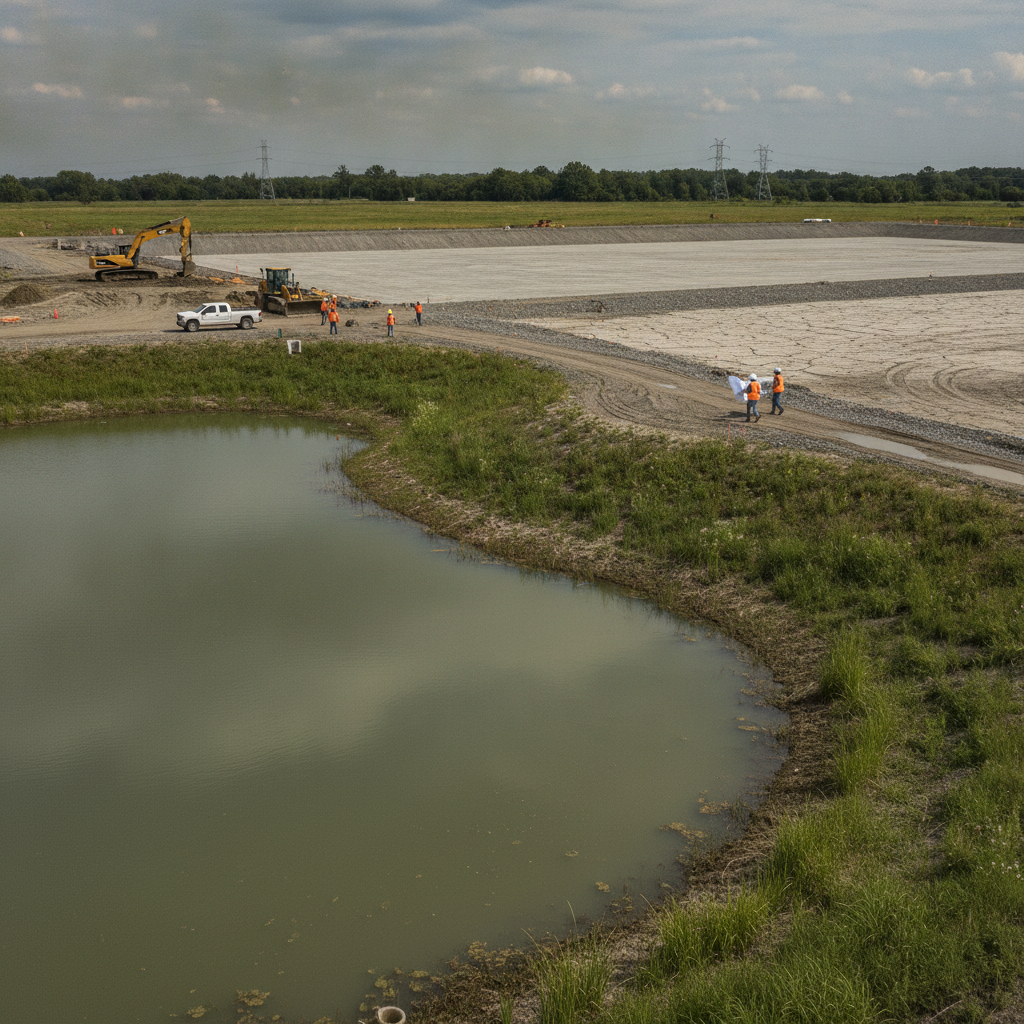
The primary distinction between dry and wet ponds lies in their fundamental purpose and hydraulic behavior. A dry detention pond is engineered primarily for flood control. Its main function is to capture stormwater runoff from impervious surfaces (roofs, parking lots, roadways) and release it slowly over time through a carefully sized outlet control structure. This process, known as attenuation, reduces the peak discharge rate to pre-development levels, preventing downstream flooding and erosion. After a storm event, the basin is designed to drain completely, typically within 24 to 72 hours, leaving a dry, vegetated area. In contrast, a wet retention pond is designed for both flood control and water quality treatment. It maintains a permanent pool of water, which allows sediments and attached pollutants to settle out. Biological processes within the water column and the vegetated littoral shelf—a shallow, planted area around the pond’s edge—help remove dissolved nutrients like nitrogen and phosphorus. This treatment function is critical for meeting the stringent water quality requirements of Water Management Districts (WMDs) and protecting local water bodies from the impacts of land development.
Land Footprint and Site Layout Implications
Comparison: Dry Detention vs. Wet Retention for Data Centers
| Feature | Dry Detention Pond | Wet Retention Pond |
|---|---|---|
| Primary Function | Peak rate attenuation (flood control) | Water quality treatment and flood control |
| Typical Footprint | Moderate; can be smaller if steeper slopes are allowed. Land is single-purpose. | Larger; requires space for permanent pool, treatment volume, and littoral shelf. |
| Water Quality Efficiency | Lower by default; requires special design features (e.g., bio-retention) to meet WMD standards. | High; considered a preferred Best Management Practice (BMP) by agencies for nutrient removal. |
| SHWT Sensitivity | High; requires pond bottom to be well above the seasonal high water table to drain properly. May need underdrains. | Low; naturally compatible with high water tables as it is designed to hold water. |
| Maintenance Needs | Frequent mowing, outlet structure cleaning, periodic sediment removal. | Aquatic vegetation management, littoral shelf upkeep, eventual dredging of accumulated sediment. |
| Permitting Preference (WMD) | Acceptable, but may require more detailed calculations to prove water quality compliance. | Often a more straightforward path to permitting due to established treatment efficiency. |
| Aesthetic Potential | Low; typically functions as a large, open lawn or vegetated basin. | High; can be designed as a campus amenity with water features and landscaping. |
For a data center developer, maximizing the building footprint and area for cooling equipment is paramount. This makes the land consumption of the stormwater system a major design constraint. Dry detention ponds can sometimes be designed with a smaller overall footprint than wet ponds for the same storage volume, especially if steeper side slopes are permissible by local code. However, their utility is limited to stormwater management, and the land they occupy cannot typically be used for other purposes, though it may be integrated as open green space. Wet retention ponds generally require a larger surface area to accommodate the permanent pool, the treatment volume above it, and the gently sloped littoral shelf required by regulators. This larger footprint can significantly impact the developable area of a site. The challenge for the civil engineering team is to optimize the site plan design to integrate the required stormwater volume efficiently, often by shaping ponds to fit into residual or oddly shaped parcels. The higher land acquisition costs associated with data center sites make this optimization a critical financial exercise.
Navigating Groundwater and Soil Constraints
Hydrogeology presents unique challenges, most notably a high seasonal high water table (SHWT). The SHWT is the highest level that groundwater reaches during the wettest part of the year, and its elevation is a critical factor in pond design. A wet retention pond is naturally suited for areas with a high SHWT, as its permanent pool can sit at or near the water table. This makes excavation and construction more straightforward, as the pond is intended to hold water year-round. Dry detention ponds, however, can be problematic in high groundwater conditions. If the pond bottom is excavated too close to or below the SHWT, it will fail to drain completely, creating a soggy, undesirable condition that compromises its function and increases maintenance. In these scenarios, a dry pond may require costly underdrain systems and specialized geotechnical investigation to ensure its viability. This makes understanding the site’s specific soil and water table conditions through early due diligence an essential first step in the site development process.
Permitting and Regulatory Compliance with WMDs
Securing an Environmental Resource Permit (ERP) from the governing Water Management District is a critical milestone in any land development project. The WMDs have specific criteria for both water quantity (flood control) and water quality (pollutant removal). Wet retention systems are often viewed favorably by regulators because they provide reliable and well-documented water quality treatment. The design standards for wet ponds, including the permanent pool volume and littoral zone management requirements, are well-established and generally offer a clear path to permitting approval. Dry detention systems can also meet regulatory requirements, but they may require more complex design and justification. To achieve water quality treatment in a dry pond, designers may incorporate features like a vegetated forebay or a bio-retention media layer in the pond bottom. Demonstrating that these systems meet the required nutrient and sediment removal efficiencies can involve more detailed modeling and a more rigorous agency review process. The choice of system can therefore impact the complexity and timeline of the permit submittals.
Long-Term Maintenance and Operational Burden
The long-term operational cost of a stormwater system should not be underestimated. Dry detention ponds require regular landscape maintenance, including frequent mowing of the bottom and side slopes to prevent woody vegetation from taking root. The outlet control structure must be inspected and cleared of debris to ensure it functions correctly, and periodic sediment accumulation removal is necessary to maintain the required storage volume. Wet retention ponds have a different set of maintenance demands. The primary focus is on managing the health of the aquatic ecosystem. This includes controlling invasive aquatic plants, managing algae blooms, and ensuring the vegetated littoral shelf remains healthy and functional. Over many years, sediment will accumulate at the bottom of the permanent pool, eventually requiring expensive dredging to restore the pond’s treatment and storage capacity. Both systems require a dedicated long-term maintenance plan and budget to remain compliant and effective.
Aesthetics, Nuisance Control, and Campus Integration
For a high-tech data center campus, aesthetics and employee environment can be important considerations. A well-designed wet retention pond can serve as a significant campus amenity, providing water views and habitat for wildlife. It can be integrated into the landscape design as a central feature, enhancing the overall aesthetic value of the property. However, a poorly maintained wet pond can become a liability, creating issues with algae, unpleasant odors, and mosquito control. Dry detention basins are typically less of an aesthetic feature and more of a utilitarian green space. When dry, they appear as a large, open lawn area. While they do not offer the visual appeal of a water body, they also avoid the potential nuisance issues associated with standing water. The choice often depends on the developer’s vision for the campus and whether the stormwater system is intended to be a purely functional element or an integrated part of the site’s campus design and landscape.
RSP Engineers’ Approach to Data Center Stormwater Strategy
At RSP Engineers, our process begins with a comprehensive site feasibility analysis. We conduct thorough due diligence, including a detailed geotechnical investigation to determine soil characteristics and the precise elevation of the seasonal high water table. This data informs our initial stormwater management modeling, where we evaluate multiple design scenarios—including dry detention, wet retention, and even underground options—to find the optimal balance between land use, construction cost, and long-term maintenance. Our team of experienced Licensed Engineers manages the entire design and permitting process. We prepare detailed construction plans and supporting calculations for the chosen system, ensuring full compliance with local and state regulations. We handle all agency review coordination and respond to comments efficiently to keep the project on schedule. Our goal is to deliver a resilient, compliant, and cost-effective stormwater solution that protects our client’s critical infrastructure investment.
Common Pitfalls in Data Center Pond Design
Several common issues can arise in the design and implementation of stormwater ponds for large-scale developments. One of the most frequent is underestimating the true elevation of the seasonal high water table (SHWT), leading to a dry pond that won’t drain. Another is failing to properly account for all contributing drainage areas, resulting in an undersized system that cannot meet peak discharge rate requirements. Poorly designed maintenance access ramps and perimeters can make long-term upkeep difficult and expensive. Finally, a critical oversight is not planning the ultimate stormwater management system to accommodate future phases of campus expansion, which can trigger costly retrofits down the road.
Partner with RSP Engineers for Your Mission-Critical Site Development
Choosing the right stormwater strategy is a critical decision with long-term consequences for your data center’s reliability and budget. The expert team at RSP Engineers specializes in civil engineering for complex, mission-critical projects. We provide the detailed analysis and robust design needed to navigate challenging regulatory environment. From initial site selection and due diligence to final permitting and construction administration, we are your trusted partner. Contact us today to discuss how our expertise in stormwater management and site design can optimize your next data center development.
Conclusion: Making the Right Choice for Your Data Center Investment
The decision between a dry detention and a wet retention pond is not merely a technical choice; it is a strategic business decision. It involves a careful balancing of land cost, upfront construction expenses, long-term maintenance burden, and regulatory risk. While wet retention ponds are often favored in for their superior water quality treatment and compatibility with high groundwater, dry detention can be a viable option on sites with favorable soil and water table conditions. Ultimately, the optimal solution requires a site-specific analysis performed by an experienced civil engineering team. A well-designed drainage design is a cornerstone of a successful site development project, ensuring your data center is protected from flooding and compliant with environmental regulations for decades to come.
FAQs
-
Yes, a dry detention pond can be designed to provide water quality treatment, but it requires specific enhancements. These often include a bio-retention layer of engineered soil media at the bottom, a forebay for initial sediment capture, or integration with other Low Impact Development (LID) features. However, achieving the same level of nutrient removal as a wet retention pond is often more complex from a design and permitting standpoint.
-
The SHWT is often the deciding factor. If the water table is very high (e. g. , less than 4-5 feet below the surface), a dry pond becomes impractical without expensive underdrain systems and continuous dewatering during construction. In such cases, a wet retention pond is almost always the more feasible and cost-effective solution, as its permanent pool can be designed to intersect with the natural groundwater level.
-
The main challenge is demonstrating, with verifiable engineering calculations, that the proposed system meets all criteria of the governing agency. For a wet pond, this includes proving the littoral shelf is correctly sized and the permanent pool provides sufficient residence time for treatment. For a dry pond, the challenge is proving it meets both peak discharge rate limits and, if applicable, water quality treatment requirements, all while ensuring it will dewater properly given the site’s soil and groundwater conditions.