
Data Center Stormwater Pipe Network Design
A technical guide to designing stormwater pipe networks for data centers in Florida. Learn about pipe sizing, material selection (RCP vs. HDPE), utility conflicts, and permitting.
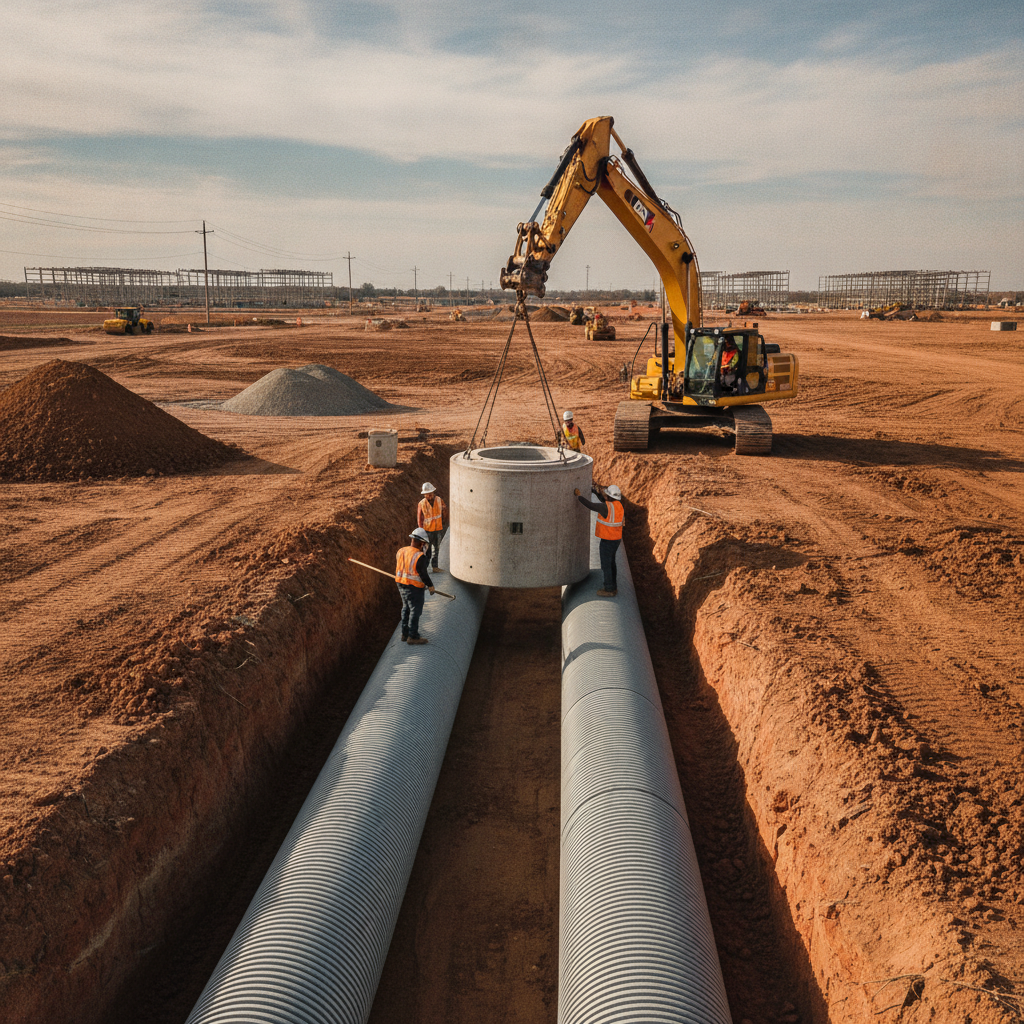
Core Hydraulic Principles: Sizing, Slope, and Velocity
The foundation of any storm pipe network is its hydraulic design. The goal is to convey a specified design storm’s runoff without causing surface flooding or system surcharging. This begins with applying Manning’s equation to determine the required pipe size and slope. For data center sites, which are often graded to be very flat to accommodate large building pads, achieving adequate pipe slope is a primary challenge. A flatter slope requires a larger pipe diameter to convey the same flow, which has cascading impacts on cost, burial depth, and potential utility conflicts. We perform detailed hydraulic modeling to analyze the system’s performance under various storm events. A critical factor is flow velocity. We design for a minimum velocity (typically 2.5 feet per second) to ensure the system is self-cleaning, preventing sediment and debris from accumulating and reducing capacity. Conversely, maximum velocities must be controlled (often below 10-12 fps) to prevent pipe scour and erosion, especially at outfalls. The drainage design must balance these parameters across the entire network, from the smallest collection pipes to the largest trunk lines discharging into a stormwater pond or master system. This requires a comprehensive understanding of the site’s topography and the proposed stormwater management strategy.
Material Selection: RCP vs. HDPE for Mission-Critical Sites
Storm Pipe Material Comparison for Data Center Applications
| Feature | Reinforced Concrete Pipe (RCP) | High-Density Polyethylene (HDPE) |
|---|---|---|
| Structural Rigidity & Load Capacity | High. A rigid pipe that provides its own structural strength. Excellent for deep burial and under heavy traffic loads without relying on soil support. | Low. A flexible pipe that relies on the surrounding soil envelope (embedment) for its structural strength. Requires careful backfill and compaction. |
| Joint Type & Watertightness | Bell and spigot with rubber gaskets. Provides a very reliable, watertight seal when installed correctly. Less prone to infiltration. | Bell and spigot with gaskets or heat-fused joints. Fused joints are monolithic and leak-proof, but require specialized equipment and certified technicians. |
| Installation Complexity & Equipment | Heavy material requires larger excavators and rigging for placement. Installation is generally straightforward for experienced crews. | Lightweight and easier to handle manually or with smaller equipment. Requires more attention to proper backfill and compaction procedures to avoid deflection. |
| Handling Deep Cover & Surcharge | Excellent. Higher classes (III, IV, V) are specifically designed to withstand immense soil and hydrostatic loads in deep installations. | Can be used in deep applications, but requires more extensive engineering analysis of the soil-pipe interaction and potential for wall buckling or deflection. |
| Resistance to Utility Conflicts | High. Its rigidity makes it less susceptible to damage or deflection from nearby excavation activities for other utilities post-installation. | Moderate. More susceptible to being deflected or damaged by adjacent construction if not properly protected or bedded. |
| Cost Considerations (Material vs. Labor) | Higher material cost per linear foot. Installation labor can be efficient due to its structural simplicity. | Lower material cost per linear foot. Can have higher labor costs associated with specialized jointing and meticulous compaction requirements. |
Choosing the right pipe material is a decision with long-term consequences for durability and maintenance. The two most common options for large-scale site development are Reinforced Concrete Pipe (RCP) and High-Density Polyethylene (HDPE). RCP is a rigid pipe known for its immense structural strength and load-bearing capacity. This makes it ideal for areas with heavy traffic loads (like access roads and equipment yards) and for deep burial applications where it must withstand significant soil pressure. Its robust bell-and-spigot joints, when properly installed with gaskets, provide excellent long-term joint integrity. HDPE, a flexible pipe, offers advantages in its light weight, corrosion resistance, and long stick lengths, which reduce the number of joints. However, its structural integrity is dependent on the quality of the surrounding soil embedment and compaction. For data center projects, where the risk of future excavations for other utilities is high, the rigidity of RCP is often preferred as it is less susceptible to deflection or damage from nearby construction activities. The final decision on HDPE versus RCP depends on a detailed analysis of cover depths, anticipated surface loads, soil conditions, and the client’s risk tolerance for this critical infrastructure.
Navigating Subsurface Conflicts: Duct Banks and Utility Corridors
Perhaps the single greatest challenge in data center site engineering services is managing subsurface utility conflicts. Data centers require a staggering density of underground infrastructure, including massive electrical duct banks, fiber optic conduits, domestic water lines, fire mains, and chilled water loops. The storm drainage system must be carefully threaded through this complex web. Proactive and exhaustive utility coordination is not optional; it is essential to project success. This process begins in the earliest design phases, using 3D modeling and BIM to visualize potential clashes. We establish clear vertical and horizontal separation standards between the storm pipe network and other utilities, adhering to both local codes and the specific requirements of the utility providers. For example, crossing a high-voltage duct bank requires careful planning to ensure the storm pipe can be installed at a sufficient depth below it without compromising either system’s structural integrity. This often forces storm pipes to be installed at significant depths, which introduces constructability challenges. A failure in subsurface utility engineering (SUE) can lead to costly redesigns and construction delays, making it a focal point of our design process.
Structure Spacing and Hydraulic Losses
Stormwater structures like manholes, junction boxes, and inlets are critical nodes in the pipe network. Their spacing is governed by several factors, including maintenance access, changes in pipe alignment or size, and hydraulic efficiency. Industry standards and local regulations often dictate maximum spacing (e.g., 400-500 feet) to allow for cleaning and inspection. On a data center campus, we strategically place structures to align with access roads and avoid sensitive equipment areas, ensuring long-term serviceability without disrupting operations. This requires careful coordination with the overall site plan design. From a hydraulic perspective, every time water flows through a structure or changes direction, it loses energy. These junction losses and deflection losses must be meticulously calculated and accounted for in the system’s hydraulic model. Underestimating these losses can lead to the hydraulic grade line (HGL) rising higher than anticipated, potentially causing manholes to surcharge or the system to back up during a major storm. Accurate calculation of the energy grade line (EGL) and HGL ensures the system has adequate capacity and freeboard to function as designed.
Minimum Cover and Deep System Constructability
Storm pipes require a minimum amount of soil cover to protect them from surface loads and potential damage. However, as discussed, navigating utility conflicts often forces storm pipes to be installed far deeper than this minimum. These deep installations present significant constructability challenges. The design must account for the immense soil and groundwater pressures at depth, often requiring higher-strength materials like Class IV or V RCP. A thorough constructability review is essential. Deep excavations require extensive safety measures, such as trench shoring or benching, which increases the construction footprint and cost. If the excavation encounters the water table, significant dewatering operations will be necessary, further complicating the process and timeline. The civil engineering plans must include detailed notes and profiles that clearly communicate these deep burial requirements to the contractor, ensuring they can plan for the necessary equipment, materials, and safety protocols. Ignoring these constructability issues during design is a recipe for budget overruns and schedule delays.
Permitting and Agency Review for Large-Scale Drainage Systems
In Florida, any significant site development project requires an Environmental Resource Permit (ERP) from the governing Water Management District (WMD). For a data center campus, the permitting process is rigorous. The permit submittals must include a comprehensive engineering report with detailed hydraulic calculations, construction plans, and a stormwater pollution prevention plan (SWPPP). The design must demonstrate compliance with state and local criteria for water quality (treatment) and water quantity (peak discharge attenuation). The agency review process involves close scrutiny of the proposed stormwater management system’s capacity, resilience, and long-term maintenance plan. Reviewers will focus on the outfall conditions, flood protection, and the interaction between the proposed system and any existing regional drainage features. A well-prepared submittal package, with clear and defensible engineering, is key to a smooth review cycle. Proactive communication with agency staff can help clarify expectations and resolve potential comments before they become a source of delay.
RSP Engineers’ Approach to Data Center Stormwater Design
At RSP Engineers, we approach data center stormwater design with a mission-critical mindset. Our process is built on collaboration and proactive problem-solving. It begins with a detailed site assessment and feasibility study to identify major constraints, including topography, soil conditions, and existing utilities. We then develop a preliminary hydraulic model to establish the core drainage strategy and pipe sizing, which informs the overall site layout. The most intensive phase is our multi-disciplinary utility coordination effort, where we work closely with electrical, mechanical, and communications engineers to create a clash-free subsurface design. This informs the final drainage design, which is documented in a comprehensive set of construction plans and specifications. We manage the permitting process with state and local agencies and provide robust construction administration services to ensure the system is built exactly as designed, protecting the client’s investment for decades to come.
Common Issues and Mitigation Strategies
Even with careful planning, data center site projects can encounter challenges. One common issue is the discovery of undocumented utilities during construction, which can halt progress. Mitigation involves commissioning a thorough Subsurface Utility Engineering (SUE) investigation early in the design phase. Another challenge is pressure to value-engineer the stormwater system by reducing pipe sizes or using lower-grade materials. We mitigate this by clearly communicating the long-term risks of such changes, emphasizing that short-term savings can lead to long-term operational vulnerabilities. Finally, complex phasing of a campus build-out can complicate stormwater design. The system must function for Phase 1 while accommodating tie-ins for future phases without requiring major rework. Our mitigation strategy is to design the ultimate master drainage system from day one, stubbing out connections and sizing trunk lines appropriately to ensure seamless future expansion. This foresight is a hallmark of experienced Civil Engineers.
Partner with Florida’s Data Center Civil Engineering Experts
Designing and permitting a data center campus in Florida requires a specialized skill set that goes beyond conventional site design. The success of your project depends on an engineering partner who understands the unique intersection of mission-critical requirements and complex site constraints. RSP Engineers provides the expert site engineering services needed to navigate these challenges. Our team excels at complex utility coordination, robust stormwater management design, and efficient agency permitting. We deliver resilient, constructible designs that protect your investment and ensure your facility is built on a solid foundation. Contact us to discuss your next mission-critical project.
Conclusion: Building a Foundation for Digital Infrastructure
The storm pipe network beneath a data center is an unseen but vital asset. Its proper design is fundamental to the operational integrity and longevity of the entire campus. A successful design hinges on a deep understanding of hydraulic principles, careful material selection, exhaustive utility coordination, and a proactive approach to permitting and constructability. By prioritizing a resilient and well-engineered drainage design, developers can mitigate risks, avoid costly delays, and ensure their critical digital infrastructure is protected from the ground up.
FAQs
-
The electrical infrastructure, particularly the large underground duct banks, creates significant vertical constraints. Storm pipes must typically cross deep underneath these duct banks, which forces the drainage design to be much deeper than on a typical commercial site. This increases excavation complexity, requires higher-strength pipe, and necessitates careful utility coordination to maintain required separations.
-
A minimum full-flow velocity of 2. 5 feet per second is a widely accepted industry standard. This velocity is necessary to create a self-scouring effect that prevents sand, silt, and other debris from settling in the pipe, which could reduce its hydraulic capacity over time. Maintaining this velocity is a key goal of the hydraulic modeling process.
-
For deep installations, RCP’s inherent structural rigidity is a major advantage. It can support massive earth loads without relying on the quality of the surrounding soil backfill for its strength. This makes it a more robust and predictable choice when dealing with the significant pressures found in deep trenches, a common condition in data center site development.