
Data Center Culvert Design Best Practices
A technical guide to data center culvert design by RSP Engineers. Learn best practices for hydraulic analysis, material selection, permitting, and scour protection in Florida.
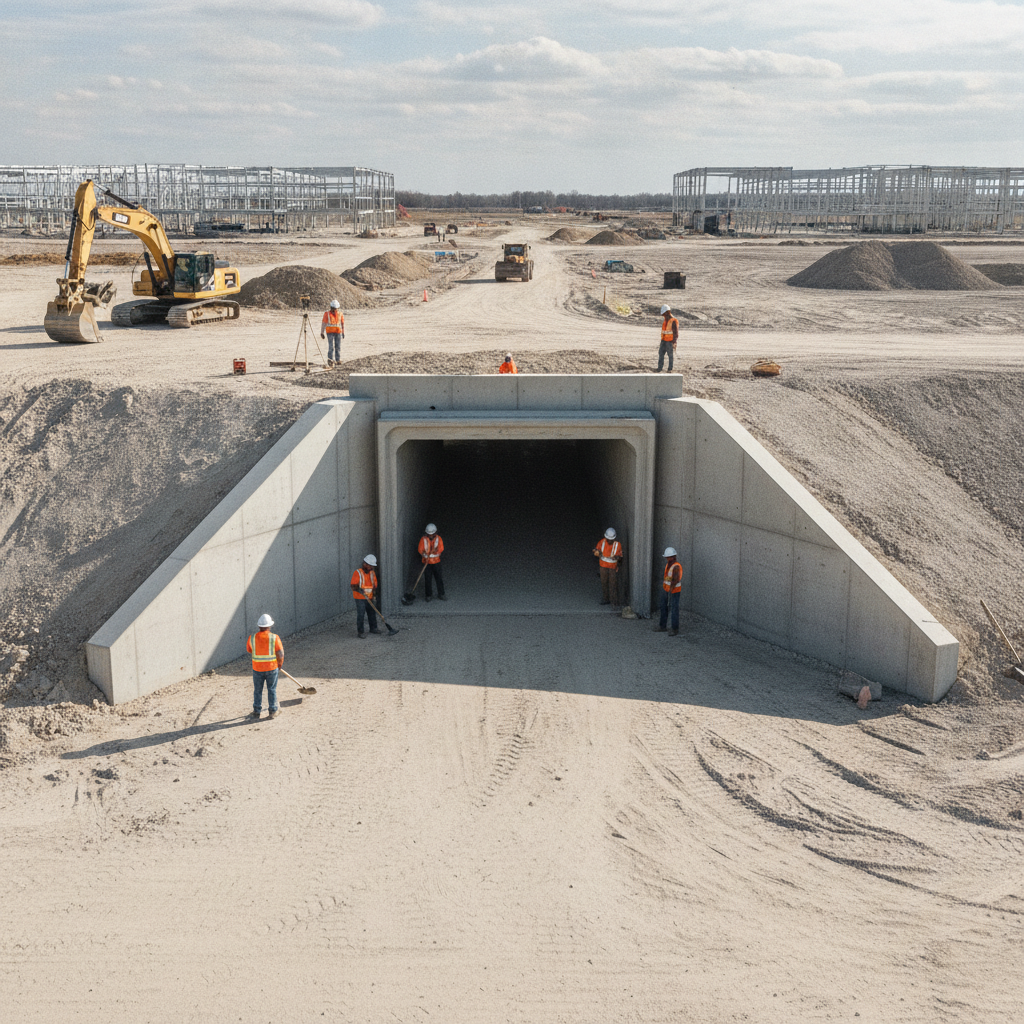
Hydraulic Analysis: Inlet vs. Outlet Control
The foundation of any culvert design is a thorough hydraulic analysis to understand how water will behave as it passes through the structure. The flow is primarily governed by two conditions: inlet control and outlet control. In inlet control, the flow is limited by the capacity of the culvert’s entrance geometry; the barrel has more capacity than the inlet can accept. Conversely, outlet control occurs when downstream conditions, such as the tailwater elevation in the downstream channel, dictate the hydraulic performance and limit the flow through the entire culvert barrel. Determining the controlling condition is critical because it dictates the resulting headwater elevation—the depth of water ponded at the culvert’s entrance. We use industry-standard software like HEC-RAS or HY-8 to model both scenarios across a range of storm events. For data center projects, this analysis must be precise. An incorrect assumption can lead to under-sizing the culvert, resulting in a higher-than-anticipated headwater that threatens site access and integrity. This modeling is a core component of our stormwater management and site engineering services.
Establishing Headwater Limits and Preventing Roadway Overtopping
Culvert Design Parameter Comparison for Data Center Sites
| Parameter | Standard Commercial Access Road | Mission-Critical Data Center Access | Design Rationale & Considerations |
|---|---|---|---|
| Design Storm Event | 25-year or 50-year storm | 100-year storm (minimum) | Ensures access and site integrity during extreme weather events, protecting a high-value asset. |
| Allowable Headwater | Below edge of pavement | Well below pavement with significant freeboard (e.g., 1-2 ft) | Prevents any risk of roadway overtopping, which is unacceptable for a 24/7 operational facility. |
| Minimum Freeboard | Typically 0.5 to 1 foot | 1.5 to 2 feet or more | Provides a critical safety factor against model inaccuracies or storms exceeding design predictions. |
| Scour Protection Level | Standard riprap apron | Engineered scour countermeasures (e.g., articulating blocks, extended aprons) | Protects against high-velocity flows to prevent undermining of the structure, ensuring long-term stability. |
| Material Durability Spec | 50-year design life | 75- to 100-year design life | Aligns the infrastructure lifespan with the long-term operational horizon of the data center. |
| Construction Redundancy | Standard installation | Phased construction, potential for temporary bypass culverts | Minimizes site access disruption during construction, a key factor in aggressive site development schedules. |
For a mission-critical facility, the primary access road cannot be compromised. The most significant risk associated with an undersized culvert is roadway overtopping, where floodwaters rise above the road surface, rendering it impassable and potentially causing severe erosion. To prevent this, engineers must design the culvert to maintain the calculated headwater elevation below a specific limit during a design storm event, typically the 100-year storm in Florida. Regulatory agencies, such as Florida’s Water Management Districts, often impose strict allowable headwater elevations to prevent adverse flooding impacts on upstream properties. Beyond regulatory compliance, we design with additional freeboard—a critical safety margin between the maximum water surface elevation and the road’s low point. For data centers, this freeboard is often more conservative than for typical commercial projects. This rigorous approach to drainage design ensures that even during extreme weather, facility access for staff, security, and fuel deliveries remains secure, a key consideration in any site development plan.
Material Selection: Concrete Box Culverts vs. Reinforced Concrete Pipe (RCP)
The choice of culvert material directly impacts the project’s longevity, cost, and construction timeline. For most data center applications, the primary options are precast concrete box culverts and Reinforced Concrete Pipe (RCP). Box culverts offer significant structural capacity and hydraulic efficiency, making them ideal for larger crossings and situations with shallow cover under heavy-duty pavement sections designed for frequent truck traffic. Their flat bottom can also be advantageous for accommodating low-flow channels or maintenance access. RCP is a versatile and cost-effective option, often used for smaller drainage crossings or where deeper burial depths are feasible. The selection process involves evaluating the required hydraulic opening, structural loads (including live loads from construction equipment and delivery vehicles), and long-term durability in the local soil and water environment. For mission-critical sites, we prioritize materials with a 75- to 100-year design life, ensuring the infrastructure’s resilience aligns with the facility’s operational expectations. This is a key decision point in the civil engineering design phase.
Geometric Considerations: Skew, Alignment, and Slope
A culvert’s performance is highly sensitive to its geometry. Ideally, a culvert should be aligned with the natural stream channel and perpendicular to the roadway. However, site constraints often require a culvert skew, where the culvert barrel is angled to the roadway centerline. While necessary, skewed alignments reduce hydraulic efficiency and can create complex forces on the headwalls and end treatments, requiring more detailed structural and drainage design. The culvert’s slope is another critical factor. It must be steep enough to maintain self-cleansing velocities to prevent sedimentation but not so steep that it causes excessive outlet velocities and downstream scour. Proper alignment and slope are fundamental to a low-maintenance, high-performance system. Misalignment can lead to embankment erosion at the inlet and outlet, threatening the stability of the roadway and requiring costly repairs. Careful consideration of these factors during the initial site plan design phase prevents long-term operational headaches.
End Treatments and Scour Protection Measures
The culvert’s inlet and outlet are its most vulnerable points. End treatments, such as concrete headwalls, wingwalls, and mitered end sections, are essential for stabilizing the embankment and improving hydraulic performance. Wingwalls are particularly effective at funneling flow into the culvert and preventing erosion of the surrounding fill. The choice of end treatment depends on the culvert size, flow velocities, and soil conditions, forming a key part of the stormwater management plan. Equally important is robust scour protection. As water accelerates into and out of a culvert, it can erode the channel bed and banks, a process known as scour. If left unchecked, scour can undermine the culvert’s foundation and end treatments, leading to structural failure. Common countermeasures include riprap aprons, articulating concrete blocks, and geotextile fabrics. For data center projects, where failure is not an option, we design conservative scour protection systems to withstand velocities from major storm events, ensuring the long-term integrity of the crossing.
Permitting and Environmental Considerations
Culvert installations in Florida almost always require permits from one or more regulatory agencies, including the local Water Management District (WMD) and the Florida Department of Environmental Protection (FDEP). The permitting process involves submitting detailed hydraulic calculations, construction plans, and an environmental impact assessment. The goal is to demonstrate that the project will not cause adverse water quality or quantity impacts upstream or downstream. In many cases, environmental factors such as fish and wildlife passage must be considered. This may involve designing the culvert with a natural bottom or incorporating features that maintain low-flow connectivity for aquatic species. A successful project requires early agency review and a comprehensive permit submittal package. Proactive communication and a thorough understanding of regulatory requirements are essential to navigate the permitting process efficiently and keep the land development project on schedule.
Our Approach to Data Center Culvert Design
At RSP Engineers, our process for designing culverts for mission-critical facilities is built on a foundation of risk mitigation. We begin with a comprehensive site assessment and detailed hydrologic and hydraulic modeling to define the project’s constraints and performance requirements. This includes a sensitivity analysis to understand how variables like tailwater and rainfall intensity affect the design. We believe in a collaborative approach, working closely with the client, architects, and other consultants to ensure our drainage design integrates seamlessly with the overall site development plan. Our team of Florida Licensed Engineers manages the entire permitting process, from initial agency consultations to final permit acquisition. We prepare meticulous permit submittals that anticipate reviewer comments and streamline the approval process. During construction, we provide construction administration services to verify that the culvert and associated scour countermeasures are installed exactly as designed. This hands-on approach ensures the final product is resilient, compliant, and ready to support a mission-critical operation.
Common Pitfalls in Culvert Design and Construction
Even with a solid plan, several issues can compromise a culvert installation. A common pitfall is relying on outdated or inaccurate topographic data, leading to flawed hydraulic models. Another is underestimating tailwater conditions, which can cause a culvert designed for inlet control to unexpectedly operate under outlet control, increasing headwater elevations. During construction, improper compaction of backfill around the culvert is a frequent cause of pavement failure and structural distress. Inadequate erosion and sediment control during the construction phase can lead to clogged culverts and environmental compliance violations. Furthermore, failing to account for future utility crossings near the culvert can create significant conflicts and costly relocations down the road. Experienced Civil Engineers anticipate these issues, incorporating solutions into the design and providing diligent oversight during construction to avoid these preventable mistakes.
Partner with RSP Engineers for Your Mission-Critical Site Development
Your data center’s resilience depends on expert engineering from the ground up. Don’t let a preventable issue like a failed culvert compromise your investment. The team at RSP Engineers has the specialized expertise to deliver robust stormwater management solutions for the most demanding projects. We navigate complex permitting, execute precise drainage design, and provide the diligent oversight needed for mission-critical site development. Contact us today to discuss how we can ensure your facility is built on a foundation of security and resilience.
Ensuring Resilient Infrastructure for Digital Foundations
In conclusion, designing a culvert for a data center is far more than a simple drainage calculation; it is an exercise in risk management. Every decision, from the initial hydraulic analysis to the specification of scour protection, must be made with the goal of ensuring uninterrupted site access and operational continuity. By prioritizing conservative design standards, durable material selection, and proactive agency coordination, developers can build the resilient infrastructure necessary to support the digital world’s most critical assets. A well-designed culvert is silent, unseen, and perfectly reliable—exactly what a mission-critical facility demands.
FAQs
-
For mission-critical facilities like data centers in Florida, the culvert should be designed to pass the 100-year storm event without overtopping the access road. We also analyze more extreme events, like the 500-year storm, to understand the ultimate failure point and ensure a graceful, predictable response. This standard often exceeds the minimum requirements of the Florida Building Code or local ordinances.
-
A skewed alignment reduces the hydraulic efficiency of the culvert opening, meaning a larger culvert size is often required to pass the same flow as a non-skewed culvert. It also creates more complex structural loads on the end treatments. The design must account for these inefficiencies in the headwater calculations to ensure the roadway remains protected.
-
Yes, precast concrete box culverts are an excellent choice. They offer superior quality control since they are manufactured in a controlled environment and can be installed much faster than cast-in-place structures. This speed is a major advantage in accelerating the overall site development schedule, which is often a primary driver for data center projects.