
Data Center Soil Stabilization Methods
Explore key soil stabilization methods for data center construction. Compare mechanical, chemical, and geosynthetic solutions for mission-critical site development.
The High Stakes of Subgrade Performance for Data Centers
Unlike typical commercial buildings, data centers impose immense and uniform loads on their foundations. The combination of heavy server racks, cooling infrastructure, and massive concrete slabs demands a subgrade with exceptional strength and uniformity. Any weakness or inconsistency in the underlying soils can lead to costly and disruptive failures. The consequences of inadequate subgrade support extend far beyond simple cracks; they can compromise sensitive fiber optic connections, damage expensive equipment, and violate strict service-level agreements. The process begins with a comprehensive Geotechnical soil report. This investigation is the most critical early-stage activity, identifying problematic soil strata such as highly plastic clays, organic silts, or loose sands. The report provides the essential data for the civil engineering team to design a strategy that mitigates risk. The goal is to create a uniformly strong and stable platform that can support the entire site development plan, from the building pad to access roadways and utility trenches, ensuring long-term performance under heavy, constant loads.
Mechanical Stabilization and Geosynthetics: The First Line of Defense
Comparison of Soil Stabilization Methods
| Method | Best For (Soil Type) | Key Advantage | Primary Constraint | Typical Cost/Schedule Impact |
|---|---|---|---|---|
| Mechanical w/ Geogrid | Granular soils, low-plasticity clays | Improved bearing capacity, reduced aggregate thickness | Less effective in very weak or saturated soils | Low to moderate cost; minimal schedule impact |
| Lime Stabilization | High-plasticity clays (PI > 10) | Reduces plasticity, controls shrink-swell | Requires mellowing period; ineffective with sulfates/organics | Moderate cost; can add 24-72 hours to schedule for mellowing |
| Cement Stabilization | Sands, silts, low-plasticity clays | High ultimate strength, creates rigid base | Can become too rigid and crack; sensitive to moisture control | Moderate cost; fast curing allows rapid construction progress |
| Fly Ash Blending | Used with lime or cement | Enhances strength, often lower cost than cement alone | Requires reliable source of quality-controlled fly ash | Can be lower cost than cement-only stabilization |
| Undercut & Replace | Shallow pockets of very poor soil (organics, debris) | Complete removal of unsuitable material | Very expensive for deep or widespread issues; requires off-site disposal and import of fill | High cost; significant schedule impact due to hauling |
Before considering chemical additives, engineers often look to mechanical methods and geosynthetics. Mechanical stabilization involves the physical improvement of soil properties through compaction and, in some cases, blending with better-quality aggregate. This process increases soil density and shear strength. However, on sites with consistently poor soils, compaction alone is often insufficient to meet the stringent performance criteria for a data center pad. This is where geosynthetics provide a significant engineering advantage. Geosynthetics, such as geogrids and geotextiles, are synthetic materials used to enhance soil performance. Geotextiles act as a separator, preventing the contamination of clean aggregate base layers by the underlying subgrade soils. Geogrids provide reinforcement by interlocking with aggregate, creating a mechanically stabilized layer with significantly improved load-bearing capacity. This composite system distributes loads over a wider area, reducing stress on the subgrade and often allowing for a reduction in the required thickness of the aggregate base course. This approach integrates seamlessly with the overall drainage design by maintaining the integrity of permeable base layers.
Chemical Stabilization: Lime, Cement, and Fly Ash Treatment
When native soils are highly plastic or require a substantial increase in strength, chemical stabilization becomes the preferred solution. This process involves mixing chemical binders into the soil to induce reactions that create a semi-rigid, improved material. The choice of binder depends entirely on the soil chemistry identified in the Geotechnical Engineering analysis. For high-plasticity clays, lime is highly effective. It works through cation exchange to reduce the soil’s plasticity index and shrink-swell potential, making it more workable and stable. For a broader range of soils, including silts and sands, cement is the common choice. Cement stabilization creates a soil-cement base through hydration, binding soil particles together to form a strong, durable layer with high compressive strength. Fly ash, a byproduct of coal combustion, can be used in conjunction with lime or cement as a pozzolanic additive to enhance the reaction and improve long-term strength. A successful project hinges on a precise mix design developed in a lab to determine the optimal percentage of binder needed to achieve the target strength, a critical step before full-scale site development begins.
Critical Site Considerations: Moisture, Sulfates, and Organics
Executing a successful chemical stabilization program requires careful management of site-specific conditions. Moisture content is paramount; the chemical reactions for both lime and cement require a specific amount of water, and the soil must be near its optimum moisture content for proper compaction. High water table and frequent, intense rainfall events complicate this process, demanding robust stormwater management and dewatering plans during construction. The civil engineering design must account for these environmental factors. A thorough Soil Test is also required to check for the presence of sulfates and organics. High concentrations of sulfates in the soil or groundwater can react with lime and cement stabilizers to form ettringite, a mineral that expands and can cause catastrophic structural heave. Similarly, organic material in the soil can inhibit or halt the cementitious reactions, rendering the stabilization ineffective. Identifying these conditions in the initial Geotechnical Engineering investigation is non-negotiable, as they may preclude chemical stabilization altogether and force a costly undercut-and-replace strategy.
Construction Sequencing, Curing, and Verification
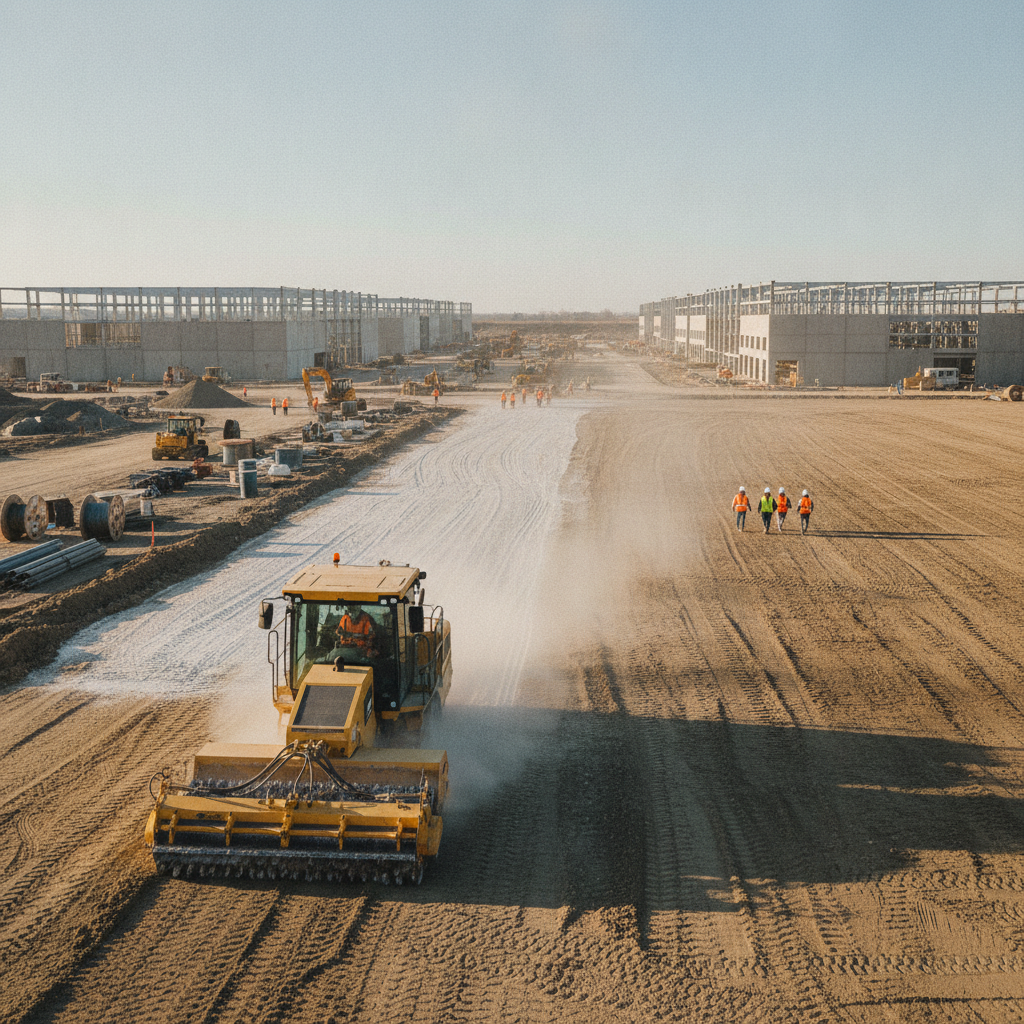
The field execution of soil stabilization is a highly controlled process that requires experienced contractors and diligent oversight. The sequence typically involves pulverizing the native soil to the specified depth, applying the chemical binder (either as a dry powder or a slurry), and thoroughly mixing it with a specialized machine like a reclaimer. The mixed material is then graded to the design elevations and compacted to the required density. This process must be carefully managed as part of the overall construction administration services. Curing is a critical phase that cannot be rushed. Cement-treated soils require moisture to achieve proper hydration and gain strength, often necessitating a light spray of water (fog coat) for several days. This curing period directly impacts the overall site development schedule and must be factored into the project timeline. Verification is the final step. Quality control testing, such as Dynamic Cone Penetrometer (DCP) tests, proof-rolling with a loaded dump truck, and laboratory testing of field-cured cores for unconfined compressive strength (UCS), provides the necessary assurance that the stabilized subgrade meets the stringent engineering specifications before foundation construction can begin.
RSP’s Integrated Approach to Soil Stabilization
At RSP Engineers, we manage soil stabilization as an integrated part of the overall site design and construction process. Our approach begins with a deep dive into the findings of the Geotechnical Engineering investigation and Soil boring test. We collaborate closely with the geotechnical engineer and the development team to analyze the options, weighing the performance benefits of each stabilization method against its cost and schedule implications. This early-stage analysis is crucial for establishing a realistic budget and timeline. Once a strategy is selected, our civil engineering team develops detailed construction plans and specifications that govern every aspect of the work, from the binder application rate to compaction requirements and QC/QA testing frequency. During the permitting phase, we provide the necessary documentation to satisfy agency reviewers. Throughout construction, our team provides robust construction administration, overseeing the contractor’s work, reviewing daily field reports and lab tests, and ensuring strict adherence to the design. This hands-on approach mitigates risk and ensures the final product provides the unwavering support a mission-critical facility demands.
Common Issues and How to Mitigate Them
Even with a solid design, field challenges can arise during soil stabilization. One common issue is inconsistent mixing, which creates pockets of untreated or over-treated soil, leading to non-uniform performance. This is mitigated by specifying minimum equipment horsepower and a required number of mixing passes in the construction documents. Another frequent problem is improper curing, especially under the hot sun, which can halt the chemical reaction and compromise final strength. Mitigation involves clear specifications for moisture curing and protection from adverse weather. Unexpected soil conditions that differ from the initial Geotechnical soil report can also derail a project. We mitigate this by recommending a sufficient number of soil borings during the investigation phase to create a more complete picture of the subsurface. Finally, conflicts with underground utilities can be a major headache. Effective utility coordination and phasing the stabilization work around utility installation are critical to avoid having to re-excavate and repair an already-cured soil-cement base, which is both costly and time-consuming. Frequently Asked Questions How deep does soil stabilization typically go for a data center pad? For a data center, treatment depths typically range from 12 to 24 inches. The exact depth is determined by the Geotechnical Engineering analysis and is based on the native soil properties, the anticipated structural loads, and the required load-bearing capacity of the building pad. Can soil stabilization be done during rainy season? Yes, but it requires meticulous planning and active stormwater management. Contractors must be prepared to manage surface water and protect the treatment area from saturation. The project schedule must include contingencies for weather delays, as work typically must pause during heavy rainfall to maintain control over the soil’s moisture content. Is soil stabilization more expensive than undercutting and replacing bad soil? It depends on the depth and extent of the unsuitable soils. For shallow pockets of poor soil (2-3 feet deep), undercut-and-replace can be cost-effective. However, when unsuitable soils extend deeper or across a large area, in—place stabilization is almost always significantly cheaper and faster than the massive logistical effort of hauling material off-site and importing engineered fill. What kind of permits are needed for soil stabilization activities? Generally, soil stabilization is covered under the main site work or land development permit issued by the local municipality or county. The process may require submittal of a mix design and a quality control plan for review. If lime or cement dust is a concern, a dust control plan may also be required by environmental agencies. How does soil stabilization affect the site’s stormwater management plan? Chemical stabilization creates a less permeable layer, which can increase stormwater runoff. The civil engineering design for the site’s drainage design and stormwater ponds must account for this change in surface characteristics to ensure the project complies with all local and state stormwater regulations.
Your Foundation for Success in Mission-Critical Development
Building a data center on a solid foundation is non-negotiable. RSP Engineers provides the expert guidance needed to navigate the complexities of soil stabilization and challenging subsurface conditions. Our team excels at integrating Geotechnical Engineering findings into a cohesive and cost-effective site development plan. From initial feasibility studies and permitting to hands-on construction administration, we ensure your mission-critical facility is built to last from the ground up. Connect with our team to discuss your project’s unique challenges and how we can engineer a resilient foundation for your investment.
Conclusion
Choosing the right soil stabilization method is a critical decision in the site development lifecycle of a data center. It is an engineering solution that transforms a potential liability—poor soil—into a high-performance asset. A successful outcome depends on a comprehensive Geotechnical soil report, a carefully engineered mix design, and rigorous quality control during construction. By investing in a proper stabilization strategy, developers can mitigate long-term risks, control project costs, and ensure the structural integrity required for mission-critical operations.
FAQs
-
Data Center Soil Stabilization Methods requires careful planning, qualified engineering, and compliance with the applicable codes and permits.
-
Getting Data Center Soil Stabilization Methods right protects safety, supports regulatory compliance, and avoids costly redesigns or delays.
-
RSP Engineers provides licensed expertise and end-to-end support for Data Center Soil Stabilization Methods, from early planning through permitting.