
Data Center Compaction Testing Guide
A technical guide for data center developers on soil compaction testing. Learn about Proctor tests, nuclear density gauges, testing frequency, and achieving structural acceptance.
The Geotechnical Baseline: Maximum Dry Density and Optimum Moisture
Before any field testing can occur, a baseline must be established in a controlled laboratory setting. This is accomplished through a Proctor test (typically ASTM D698 for Standard Proctor or ASTM D1557 for Modified Proctor). The test determines a specific soil type’s maximum dry density (MDD) and optimum moisture content (OMC). The MDD is the densest state the soil can achieve, while the OMC is the ideal water content needed to reach that density with a given compactive effort. For the heavy slab loads and equipment vibrations characteristic of data centers, the Modified Proctor test is almost always specified in the Geotechnical soil report. This test uses a higher compactive energy, better simulating the heavy rollers used on site and providing a more appropriate benchmark for mission-critical structural fill. Understanding this laboratory-derived curve is essential, as all subsequent field tests will be measured against it. A qualified Geotechnical engineer is essential for this phase.
Field Verification Methods: Nuclear Density Gauge vs. Sand Cone Test
Comparison of Compaction Control Tests
| Parameter | Nuclear Density Gauge (ASTM D7759) | Sand Cone Test (ASTM D1556) | Data Center Project Application |
|---|---|---|---|
| Test Duration | 1-2 minutes per location | 20-30 minutes per location | Nuclear gauge is preferred for high-volume earthwork to maintain schedule. |
| Principle of Operation | Measures gamma ray dispersion to determine density and moisture. | Measures physical volume and weight of excavated soil. | Nuclear gauge provides immediate feedback for the earthwork contractor. |
| Required Skill Level | Certified and trained technician required for safe operation. | Requires careful, methodical execution to ensure accuracy. | Both require qualified personnel, but nuclear gauge training includes radiation safety. |
| Destructive Nature | Minimally invasive (small rod driven into soil). | Destructive (requires excavating a 6-inch diameter hole). | The non-destructive nature of the nuclear gauge is ideal for finished lifts. |
| Typical Use Case | Primary method for production testing of structural fill and backfill. | Used for calibration, dispute resolution, or on sites with restrictions. | 99% of data center compaction testing relies on the nuclear density gauge. |
| Regulatory Oversight | Requires licensing and safety protocols for radioactive materials. | No special regulatory requirements beyond standard ASTM procedures. | The benefits of speed and efficiency outweigh the regulatory burden of the gauge. |
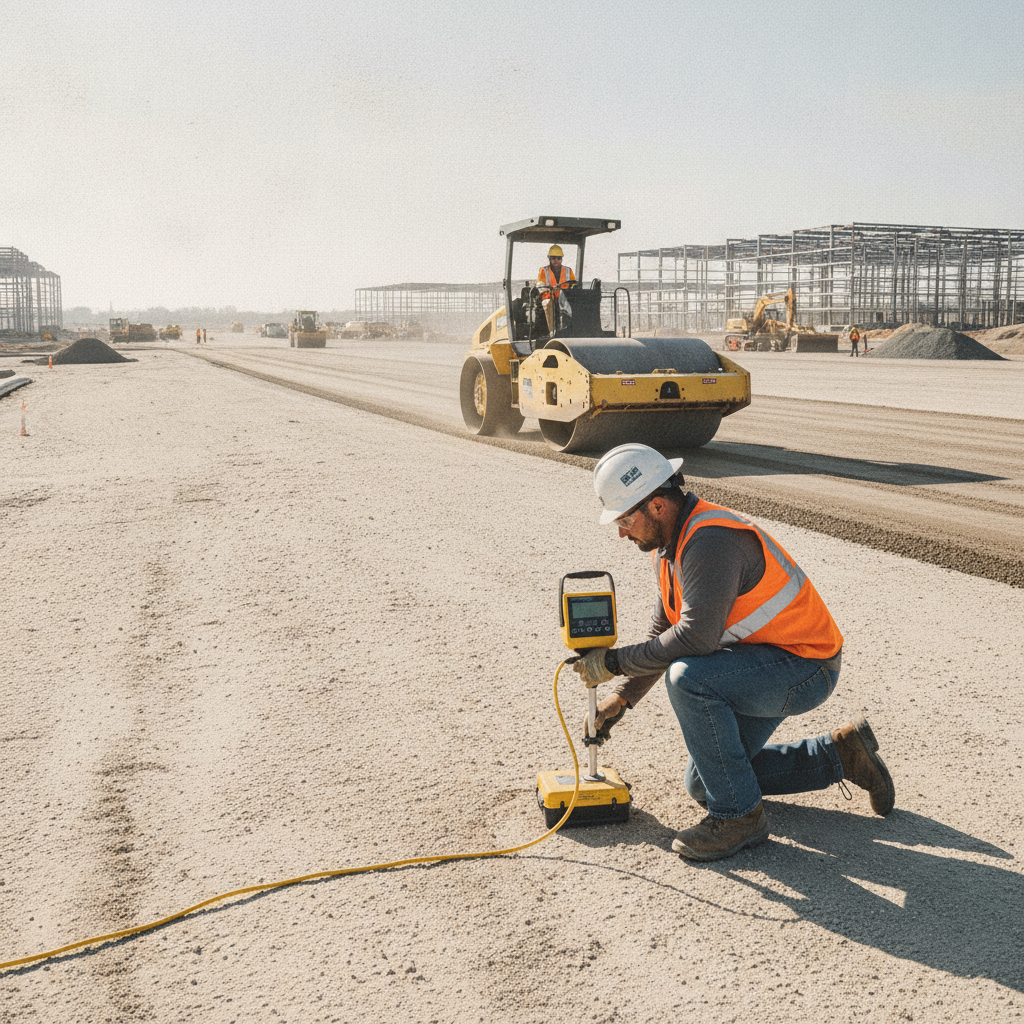
Once earthwork begins, technicians must verify that the contractor is achieving the specified density in the field. The most common method is the nuclear density gauge, a device that provides rapid, real-time measurements of in-place soil density and moisture content. It works by emitting gamma rays into the soil and measuring their return to a detector, which correlates to the soil’s density. This speed is critical for maintaining construction schedules, allowing for quick verification of each soil lift. The alternative, more traditional method is the sand cone test (ASTM D1556). This involves excavating a small hole, weighing the removed soil, and measuring the hole’s volume by filling it with calibrated sand. While highly accurate, it is slow and destructive, making it impractical for the high-volume earthwork of a data center site. It is now primarily used for calibrating nuclear density gauges or for resolving disputes. For data center projects, the nuclear density gauge is the industry standard for efficient and reliable quality control during the site development phase.
Establishing a Robust Testing Frequency and Protocol
A successful compaction program depends on a clearly defined testing frequency. This protocol is established by the Geotechnical engineer and is a critical component of the project specifications. A typical frequency for a data center building pad is one test per 2,500 square feet per 12-inch lift of fill. For utility trenches, which require stable backfill to prevent pipe sagging and pavement settlement, the frequency might be one test per 200 linear feet per lift. The testing locations should be randomized to provide a statistically valid representation of the entire work area. This rigorous approach ensures that no pockets of insufficient compaction are missed, which could later become points of failure under heavy structural loads. Adherence to this protocol is a key part of the construction administration process.
The Critical Role of Proofrolling in Subgrade Acceptance
While density tests verify specific points, proofrolling assesses the stability of the entire subgrade surface. This process involves driving a heavy, fully-loaded piece of equipment—such as a tandem-axle dump truck or a water truck—in a systematic pattern across the compacted subgrade. The Geotechnical engineer or their representative observes the surface for any rutting, pumping, or weaving that indicates soft, unstable areas. These localized failures, which might be missed by the random pattern of density tests, must be identified and remediated. Proofrolling is the final acceptance step before foundation work can begin, serving as a practical, large-scale validation of the entire compaction effort and ensuring uniformity across the building pad.
Managing Moisture Content: The Key to Achieving Compaction
Achieving the required percentage of maximum dry density is impossible if the soil’s moisture content is not near its optimum level. In climate, this presents a constant challenge. Soil that is too wet becomes unstable and cannot be compacted; the water pressure in the soil’s pores prevents the particles from densifying. Soil that is too dry lacks the lubrication needed for particles to slide into a dense arrangement. The earthwork contractor must actively manage moisture conditioning. This may involve discing and aerating overly wet soils to dry them out or using a water truck to add moisture to dry soils. This process requires constant monitoring and is a frequent source of delays if not managed proactively as part of the site engineering services.
Protocol for Failing Tests and Required Remediation
A failing compaction test is not a disaster; it is a data point that requires action. When a test result falls below the specified percentage (e.g., 95% of Modified Proctor), a standard remediation protocol is initiated. The failing area is delineated, and the contractor must rework the material. This typically involves scarifying the lift, adjusting the moisture content to bring it closer to optimum, and re-compacting the soil with the roller. A new test is then performed in the same location to verify that the remediation was successful. A clear, documented process for handling failures is essential for maintaining quality control and providing a clear record for the project’s structural engineer and permitting agencies.
RSP Engineers’ Approach to Compaction Oversight
At RSP Engineers, our role as the Civil Engineer near me of record extends beyond initial design into rigorous Construction Management Services. We work collaboratively with the project’s Geotechnical engineer to ensure the specifications are clear, practical, and appropriate for a mission-critical facility. During construction, we review all compaction test reports and field logs, tracking results against the specified frequency and density requirements. We actively participate in pre-construction meetings to align the owner, contractor, and testing agency on the protocol for testing, moisture control, and remediation of failing tests. This proactive oversight ensures that the geotechnical recommendations are fully implemented, providing the owner with confidence in the long-term performance of their foundation system.
Common Issues in Data Center Compaction
Even with a solid plan, challenges arise. A common issue is dealing with highly variable on-site soils, which may require different compactive efforts or moisture adjustments from one area to another. intense rain events can saturate a site overnight, halting all earthwork and requiring significant drying time. Another challenge is contractor pressure to place lifts thicker than the specified 8 to 12 inches to speed up the schedule; this must be resisted, as it prevents compactive energy from reaching the bottom of the lift. Finally, ensuring proper compaction in tight, hard-to-reach areas like utility trenches and foundation corners requires the use of smaller, specialized compaction equipment and a more focused testing regimen.
Your Partner in Mission-Critical Site Development
Ensuring proper soil compaction is a complex but non-negotiable part of data center construction. It requires a deep understanding of Geotechnical Engineering, diligent quality control, and proactive management. If you are planning a mission-critical project, partner with a firm that understands the stakes. Contact RSP Engineers today to discuss how our site development and construction administration expertise can protect your investment from the ground up.
Conclusion
Ultimately, the quality of a data center’s foundation is only as good as the soil compaction beneath it. A robust program based on a proper Geotechnical soil report, executed with rigorous field testing, and validated through proofrolling is essential. By adhering to strict protocols for achieving maximum dry density, managing moisture, and documenting every step, developers can ensure a stable foundation that will perform for the life of the facility. This attention to detail during the initial site development phase is a critical investment in the long-term reliability of any mission-critical infrastructure.
FAQs
-
The percentage refers to the in-place dry density achieved in the field as a percentage of the laboratory-derived maximum dry density. While 3% may seem small, it represents a significant increase in soil strength and stiffness. For data center building pads directly supporting a slab-on-grade foundation, 98% compaction is often specified to minimize any potential for long-term settlement under heavy, constant loads.
-
Rain is a major schedule risk. Saturated soils cannot be compacted to the required density. After a significant rain event, the contractor must wait for the soil to dry, which may involve scarifying or turning the soil to accelerate evaporation. This can lead to days of delay, making effective stormwater management and site drainage during construction critically important.
-
It depends entirely on the quality of the existing fill. If the material is undocumented, it must be treated as unsuitable. The standard process involves undercutting (removing) the existing fill until native, suitable soils are reached or until the depth specified by the Geotechnical soil report. All new fill brought in must be a pre-approved material and placed and compacted in controlled lifts.