
Data Center Site Selection Near Existing Utility Corridors
A guide for data center developers on the civil engineering challenges and benefits of siting projects near existing utility corridors, including easement, permitting, and design issues.
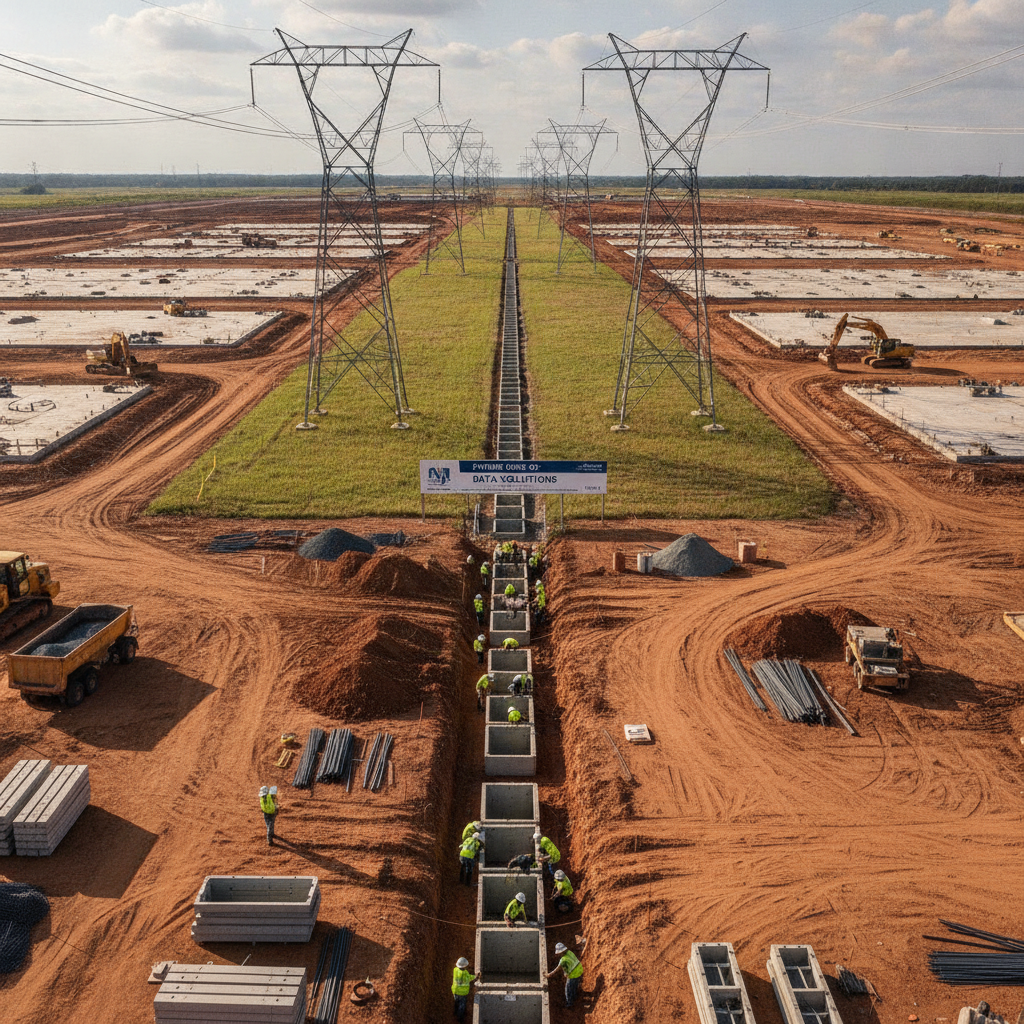
The Strategic Advantage of Proximity to Utility Infrastructure
The primary driver for selecting sites near utility corridors is the significant reduction in time and cost for establishing service. Extending high-voltage power lines or dense fiber optic cables over long distances can cost millions and add months or even years to a project schedule due to design, easement acquisition, and construction. Proximity minimizes these off-site improvement costs. Direct access to a substation or a network access point simplifies the utility coordination process and can lead to more favorable interconnection agreements. This proximity is especially critical for modern AI and hyperscale mission-critical facilities that require redundant power feeds from separate sources. A site located near a corridor with multiple, independent transmission circuits offers an inherent advantage for achieving the necessary levels of resiliency. This strategic positioning accelerates the path to an operational facility, a key competitive advantage in the fast-paced tech industry. A thorough feasibility study, however, is essential to confirm that the existing infrastructure has sufficient capacity for the proposed site development.
Analyzing Easement Encumbrances and Buildable Area
Comparison of Siting Scenarios: Adjacent vs. Remote Utility Corridors
| Factor | Site Adjacent to Utility Corridor | Site Remote from Utility Corridor |
|---|---|---|
| Utility Interconnection Cost | Lower; minimal off-site extension required. | Higher; significant cost for extending power and fiber infrastructure. |
| Permitting Complexity | High; requires encroachment agreements and intensive utility owner review. | Lower; standard local, state, and federal permits apply. |
| Buildable Area Impact | Significant; easements and setbacks reduce usable land area. | Minimal; buildable area is primarily defined by zoning and environmental constraints. |
| Construction Risk | Higher; requires strict safety protocols for work near live utilities. | Lower; standard construction site risks apply. |
| Due Diligence Effort | Intensive; requires detailed easement analysis and early utility coordination. | Standard; focuses on zoning, environmental, and geotechnical issues. |
| Project Schedule for Utilities | Shorter for interconnection; longer for on-site encroachment approvals. | Longer for interconnection; shorter for on-site development approvals. |
The most significant challenge posed by utility corridors is the impact of easements on the developable land. A utility easement is a legal right that grants a utility provider access to and control over a portion of a property for the purpose of installing, operating, and maintaining its infrastructure. These easements create no-build zones, impose height restrictions, and dictate what activities can occur within their boundaries. A 200-foot-wide transmission line easement running through the center of a 50-acre parcel can render a significant portion of the property unusable for the main data center building, effectively sterilizing valuable real estate. During due diligence, a civil engineering team must meticulously review the title report and ALTA/NSPS Land Title Survey to identify all recorded easements. The specific language of the easement documents dictates the exact restrictions, which can include prohibitions on buildings, storage of materials, changes in grade, and even certain types of landscaping. These development restrictions and permitting requirements vary by jurisdiction, and it is critical to confirm all applicable standards with the utility owner and the local, state, regional, and federal authorities that hold review authority over the site. This analysis directly impacts the site’s zoning compliance and the ultimate viability of the proposed site plan design.
Navigating Utility Crossing and Encroachment Approvals
Developing a site encumbered by an easement almost always requires crossing it with new infrastructure, such as access roads, water lines, sewer mains, or stormwater management pipes. Any work within the easement is considered an encroachment and requires explicit approval from the utility owner. This is not a simple permitting process; it is a detailed engineering review where the utility provider acts as its own authority having jurisdiction. Each utility provider has a unique, and often lengthy, application and review process for granting encroachment agreements. The permit submittals for an encroachment typically require detailed engineering plans, signed and sealed by a Professional Engineer, showing precise horizontal and vertical clearances, construction methodologies, and material specifications. For example, a proposed water main crossing under a high-voltage transmission line may require non-conductive carrier pipes and specific burial depths to prevent electrical induction. The drainage design may be scrutinized to ensure it does not cause erosion or ponding around the utility’s structures. Securing these approvals requires proactive and persistent utility coordination and can be a critical path item on the project schedule.
Design Constraints: Clearances, Access, and Safety Protocols
Designing a data center campus around a utility corridor involves more than just avoiding the easement area. The presence of high-voltage lines imposes strict vertical and horizontal clearance requirements for all proposed structures, including buildings, light poles, and fences, to prevent electrical arcing. These clearance zones often extend well beyond the easement boundaries. Furthermore, the utility owner will require perpetual, unobstructed access to their infrastructure for maintenance and emergency repairs, which can dictate the layout of internal roadways and security fencing. Construction near live electrical or gas lines also introduces significant safety risks. A comprehensive construction administration plan must include strict safety protocols, such as equipment grounding and restricted crane operations. Specialized studies, such as an electromagnetic field (EMF) or induction analysis, may be required to ensure the proposed development does not interfere with the utility’s operations or create unsafe conditions. These factors must be integrated into the site plan design from the outset to avoid costly redesigns and ensure regulatory and safety compliance.
Stormwater Management and Drainage Design Challenges
Utility corridors can significantly complicate stormwater management and drainage design. The compacted soil of access roads and the presence of foundations for transmission towers can alter historical drainage patterns across a site. Furthermore, easement restrictions often prohibit or limit the construction of surface water features like retention or detention ponds within the corridor. This can force designers to place stormwater facilities in otherwise prime development areas, further reducing the usable land. Routing storm sewer pipes across an easement is a common necessity that requires an encroachment permit. The design must accommodate the existing underground and overhead utilities, often requiring deeper burial depths or rerouting of pipes, which increases construction costs. The civil engineering team must perform detailed hydrologic and hydraulic modeling to demonstrate that the proposed drainage design will not cause adverse impacts, such as erosion or flooding, within the utility corridor. Compliance with federal programs like the National Pollutant Discharge Elimination System (NPDES) must be achieved while respecting the physical and legal constraints of the easement.
The RSP Engineers Approach to Utility Corridor Site Evaluation
At RSP Engineers, we provide comprehensive site engineering services to help clients navigate the complexities of data center development. Our approach to sites with utility corridors is rooted in proactive due diligence and risk mitigation. We begin with a thorough investigation of all recorded easements and a constructability review to identify potential conflicts early. Our process involves initiating utility coordination with the infrastructure owners at the project’s inception to understand their specific requirements and review timelines. Our team of Civil engineers develops preliminary site plan design concepts that maximize the buildable area while respecting all easement restrictions and clearance requirements. We model stormwater and grading scenarios to create efficient and compliant designs. By identifying critical path items like encroachment agreements and specialized engineering studies upfront, we help our clients make informed acquisition decisions and develop realistic project schedules. Our goal is to de-risk the land development process and provide a clear path from site selection to construction.
Common Issues and Costly Oversights
Developing land with utility corridors is fraught with potential pitfalls. One of the most common oversights is underestimating the time required for a utility owner to review and approve an encroachment application, which can take many months. Another frequent issue is the discovery of unrecorded or prescriptive easements during the ALTA survey, which can derail a well-planned site layout. Developers may also fail to consider the utility’s future expansion plans; a corridor with one transmission line today could be planned for a second line in the future, adding further restrictions. Construction-phase conflicts are also common, such as equipment strikes on underground utilities or violations of overhead clearance zones, leading to work stoppages and safety incidents. A failure to properly analyze the title commitment can lead to missing crucial restrictions buried in legal documents. These oversights can lead to significant construction delays, budget overruns, and in worst-case scenarios, a determination that the site is not viable for the intended purpose after it has already been acquired. Frequently Asked Questions What is the first step in evaluating a site with a major utility easement? The absolute first step is to obtain the title commitment and a current ALTA/NSPS Land Title Survey. A qualified civil engineering firm should review these documents to identify all easements and their specific restrictions. This should be followed immediately by initiating contact with the utility owner to request their design and construction standards for work within or near their easement. How long does it take to get an encroachment agreement from a utility provider? Timelines vary significantly between utility providers and the complexity of the request. A simple utility pipe crossing might take three to six months, while a more complex request involving roadway construction or significant grading could take a year or more. It is crucial to treat the utility provider as a key stakeholder and build this timeline into the overall project schedule. Can we build parking lots or stormwater ponds within a transmission line easement? This depends entirely on the specific terms of the easement and the utility owner’s policies. Generally, permanent structures are prohibited. Some utilities may allow at-grade parking lots, but they often forbid any structures like light poles or guardrails within the easement. Stormwater management ponds are frequently disallowed due to concerns about soil saturation, erosion, and access for heavy maintenance equipment. What kind of specialized engineering studies are required for building near high-voltage lines? Depending on the proximity and nature of the proposed construction, several studies may be necessary. These can include an induction study to analyze electrical effects on metallic objects (like fences or pipelines), a grounding study to ensure electrical safety, and a structural analysis to confirm that construction vibrations will not impact tower foundations. These studies inform the civil engineering and structural design. How does a utility corridor affect the Geotechnical Engineering investigation? The Geotechnical Engineering investigation must be planned carefully around the easement. Access for drill rigs may be restricted. The investigation should include soil borings near proposed structures both inside and outside the corridor to assess soil conditions. Additionally, the Geotechnical engineer may need to assess the existing soil conditions around utility structures to ensure proposed site grading or nearby foundation work will not compromise their stability.
Your Partner in Complex Site Development
Navigating the challenges of a site encumbered by utility corridors requires specialized expertise and a proactive approach. The team at RSP Engineers has a proven track record of guiding data center developers through the entire lifecycle of a project, from initial due diligence to final construction. We excel at complex site development, detailed utility coordination, and securing critical permitting approvals. Don’t let easement complexities derail your next mission-critical project. Contact us today to discuss how our civil engineering expertise can unlock the full potential of your chosen site.
Conclusion
While siting a data center adjacent to a utility corridor presents a compelling opportunity to reduce costs and accelerate timelines, the associated constraints are significant and non-negotiable. Success hinges on a comprehensive understanding of the legal and physical limitations imposed by easements and a strategic approach to civil engineering design. Proactive utility coordination, meticulous due diligence, and a design that respects the utility’s operational and safety requirements are paramount. With the right expert team, developers can mitigate the risks and capitalize on the strategic advantages of a well-located site, ensuring the successful delivery of their next mission-critical facilities.
FAQs
-
Data Center Site Selection Near Existing Utility Corridors requires careful planning, qualified engineering, and compliance with the applicable codes and permits.
-
Getting Data Center Site Selection Near Existing Utility Corridors right protects safety, supports regulatory compliance, and avoids costly redesigns or delays.
-
RSP Engineers provides licensed expertise and end-to-end support for Data Center Site Selection Near Existing Utility Corridors, from early planning through permitting.