
Data Center Site Due Diligence Before Land Acquisition
A comprehensive guide to civil engineering due diligence for data center land acquisition, covering utility capacity, zoning, environmental risks, and geotechnical analysis.
Title, Survey, and Encumbrance Review
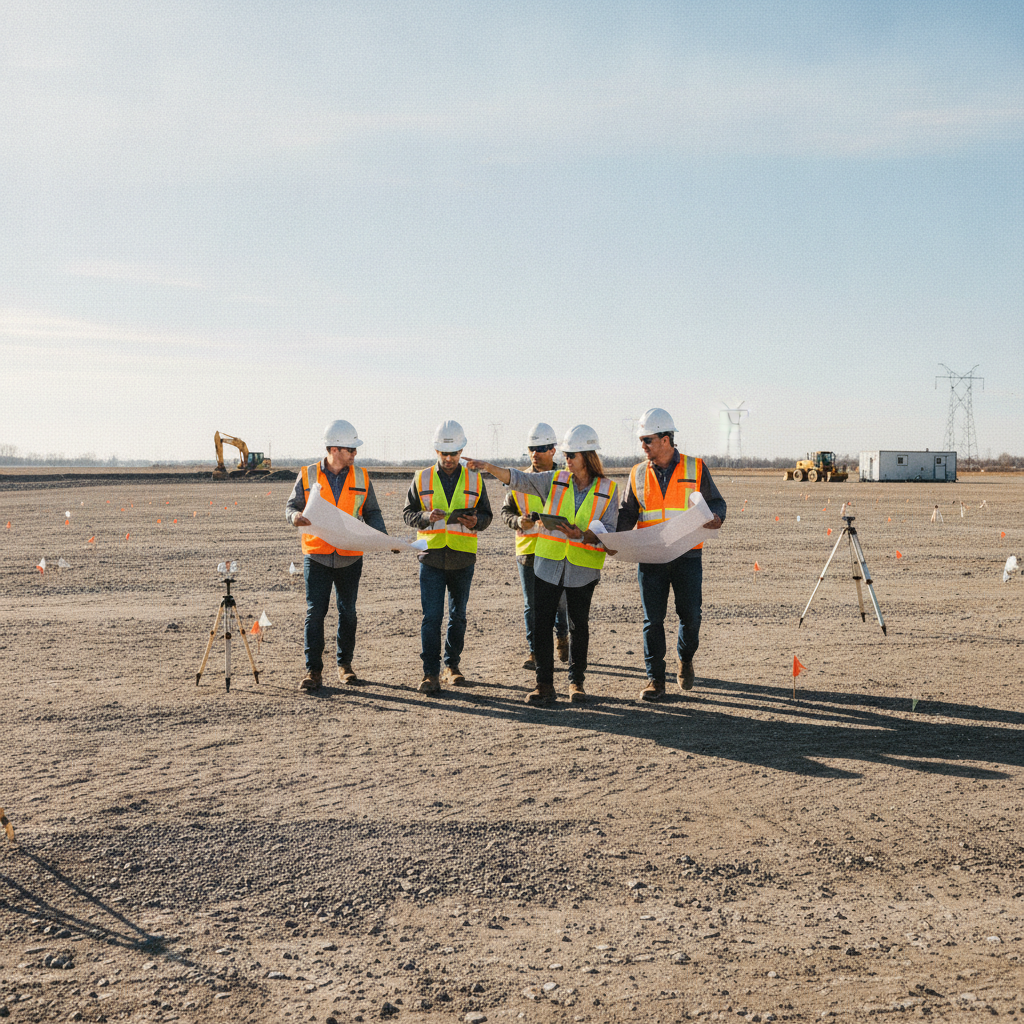
The foundation of any site investigation begins with a clear understanding of the property’s legal boundaries and limitations. A current ALTA/NSPS Land Title Survey is a critical document that maps the property and reveals crucial details that may not be apparent from a simple site visit. Our team meticulously reviews this survey in conjunction with the title commitment to identify any easements, covenants, and restrictions that could impact the project. For example, a large, buried utility easement running diagonally across a parcel could render an otherwise perfect site unusable for a large building footprint. Similarly, restrictive covenants might limit building height, operational noise, or the types of equipment that can be stored outdoors. Identifying these land development constraints early is paramount for creating a viable site plan design and avoiding costly redesigns or legal challenges down the line.
Zoning and Entitlement Analysis
Key Due Diligence Findings and Potential Deal Impacts
| Finding | Potential Impact on Project | Recommended Action |
|---|---|---|
| Undisclosed Major Utility Easement | Severely constrains building footprint and site layout, potentially making the planned facility unbuildable. | Negotiate a reduced purchase price, attempt to get the easement relocated (rare), or terminate the contract. |
| Insufficient Power Capacity | The site is not viable without a multi-year, multi-million dollar substation upgrade by the utility provider. | Terminate the contract. This is a fundamental deal-killer for most data center projects. |
| Recognized Environmental Condition (REC) | Potential for costly soil/groundwater remediation, long-term liability, and significant permitting delays. | Extend the due diligence period to conduct a Phase II ESA. Negotiate price based on estimated cleanup costs or require seller to remediate prior to closing. |
| Poor Subsurface Conditions (Low Bearing Capacity) | Foundation costs could increase by millions due to the need for deep foundations or extensive soil improvement. | Obtain preliminary cost estimates for foundation redesign. Use this data to negotiate a significant price reduction. |
| Significant FEMA Floodplain Encroachment | Reduces usable land area, increases insurance costs, and may prohibit critical infrastructure placement. | Redesign site layout to avoid the floodplain. If unavoidable, evaluate the cost and feasibility of mitigation (e.g., fill, flood-proofing) and negotiate price accordingly. |
| Zoning Requires Lengthy Rezoning Process | Adds 9-18+ months to the project timeline with no guarantee of approval. High entitlement risk. | Evaluate the likelihood of approval. If risk is too high, terminate the contract. If proceeding, negotiate a longer closing period contingent on zoning approval. |
Confirming that a data center is a permitted use is a primary objective of due diligence. Our analysis involves a deep dive into the local jurisdiction’s zoning ordinance and comprehensive plan to verify zoning compliance. We determine if the use is permitted by-right, requires a special or conditional use permit, or necessitates a full rezoning. Each path carries vastly different levels of entitlement risk, cost, and timeline uncertainty. Beyond the use itself, we scrutinize development standards such as setbacks, lot coverage, building height limitations, parking requirements, and landscaping buffers. These regulations directly influence the usable area of the site and the ultimate feasibility of the proposed design. Permitting requirements vary by jurisdiction, and every project team should confirm the applicable standards with the local, state, regional, and federal authorities that hold review authority over the site. Understanding the complete permitting pathway and potential for public opposition is a core component of assessing a site’s viability.
Utility Infrastructure Capacity Verification
Data centers are defined by their immense appetite for power, water, and connectivity. Assumptions about utility availability are a leading cause of project failure. A core due diligence task is to move beyond verbal assurances and secure formal utility capacity letters from all relevant providers. For power, this means confirming the availability of sufficient megawatts, the feasibility of redundant feeds from separate substations, and the timeline for service delivery. For water, we verify capacity for both cooling systems (if applicable) and fire suppression, which often requires significant flow rates and dedicated water main extensions. Wastewater capacity must also be confirmed. Finally, we investigate the availability of robust, redundant fiber connectivity from multiple carriers. The physical proximity and diversity of fiber routes are critical for ensuring the low latency and high reliability that data center tenants demand. This utility coordination is a non-negotiable step in the due diligence process.
Environmental Site Assessment and Constraints
Unforeseen environmental issues can halt a project indefinitely. The due diligence process must include, at a minimum, a Phase I Environmental Site Assessment (ESA) to identify any Recognized Environmental Conditions (RECs) from past or present land uses. If a REC is found, a Phase II ESA involving soil and groundwater sampling may be required, adding significant time and cost. Beyond contamination, we analyze the site for natural environmental constraints. This includes a review of federal floodplain maps (FEMA) to assess flood risk and identify potential building restrictions. We also conduct a preliminary wetland delineation screening to determine if federally protected wetlands are present, which could trigger a lengthy and complex Clean Water Act Section 404 permitting process. A review of federal and state databases for threatened or endangered species is also crucial to avoid conflicts with the Endangered Species Act.
Geotechnical and Subsurface Investigation
The ground beneath a data center is just as important as the infrastructure serving it. A preliminary Geotechnical Engineering investigation is essential for understanding subsurface conditions. This typically involves a review of existing geologic data and, in many cases, a limited number of soil borings to assess soil composition, strength, and groundwater levels. The findings directly impact foundation design and site development costs. Poor soil with low bearing capacity can necessitate expensive deep foundations (piles) or extensive soil improvement, dramatically increasing the construction budget. Encountering shallow rock can complicate utility trenching and grading, while a high water table can require costly dewatering systems. A preliminary Geotechnical soil report based on a soil boring test provides the data needed to make informed decisions about foundation costs and overall site suitability, preventing major surprises during construction.
Access, Circulation, and Transportation Impact
A data center needs reliable and safe access for construction, operations, and emergency services. Our due diligence includes an evaluation of the existing roadway network’s ability to handle construction traffic and long-term operational needs. We assess sight lines, intersection safety, and whether a formal traffic impact analysis will be required by the local jurisdiction. Required off-site improvements, such as new turn lanes, traffic signals, or road widening, can add significant costs and extend the project timeline. We also analyze on-site circulation to ensure adequate space for truck maneuvering, equipment delivery, and emergency vehicle access, all while meeting ADA compliance standards for pedestrian routes. Proper roadway engineering considerations are vital for a functional and permittable site.
The RSP Engineers Due Diligence Process
At RSP Engineers, we approach data center due diligence with a systematic, phased methodology designed to identify risks early and efficiently. Our process begins with a desktop analysis, reviewing publicly available data like zoning maps, floodplain data, and environmental records to quickly flag major issues. We then coordinate with a team of specialists, including surveyors, environmental scientists, and Geotechnical engineer professionals, to conduct detailed on-site investigations. Throughout the process, we maintain clear communication with the client, providing regular updates and a comprehensive final due diligence report. This report synthesizes all findings, quantifies risks, provides preliminary cost estimates for mitigation measures, and offers a clear recommendation on whether to proceed with the acquisition, renegotiate terms, or walk away. Our goal is to provide the technical clarity and confidence needed to make a sound investment decision.
Common Pitfalls in Data Center Site Acquisition
Even experienced developers can overlook critical details during the fast-paced due diligence period. Some common pitfalls include failing to verify fiber diversity and latency, underestimating the timeline for high-voltage power delivery, ignoring local noise ordinances that could restrict generator testing, and not considering the potential impact of future adjacent developments. Another frequent oversight is not fully investigating water rights in regions where water is a constrained resource. Engaging a comprehensive team of experts, including one of the top Civil Engineering firms, helps ensure these and other subtle but significant risks are identified and addressed before closing.
Secure Your Investment with RSP Engineers’ Due Diligence Services
Don’t let a hidden site issue derail your next mission-critical project. The site engineering services at RSP Engineers provide the technical rigor and strategic insight you need to navigate the complexities of land acquisition. Our nationwide experience in site development, utility coordination, and navigating complex permitting processes ensures that you have a complete picture of a property’s potential and its pitfalls. We act as your trusted partner, delivering the data-driven analysis required to protect your investment and set your project up for success from the ground up.
Informed Land Acquisition is the Foundation of Success
In conclusion, thorough civil engineering due diligence is the most effective risk mitigation tool in data center development. By systematically investigating title, zoning, utilities, environmental conditions, and subsurface characteristics, developers can avoid costly surprises and make informed acquisition decisions. This upfront investment in expert analysis pays for itself by preventing schedule delays, budget overruns, and the catastrophic failure of acquiring an undevelopable site. A successful project begins with a solid foundation, and that foundation is built on comprehensive due diligence.
Related Insights
The Critical Role of Utility Coordination in Land Development Navigating the Stormwater Permitting Process for Large-Scale Sites Integrating Geotechnical Findings into Your Civil Site Design
FAQs
-
A thorough due diligence period for a complex data center site typically ranges from 60 to 120 days. The timeline can be influenced by the complexity of the site, the responsiveness of local agencies and utility providers, and the need for detailed studies like a Phase II ESA or a full traffic impact analysis.
-
The most frequent and definitive deal killer is inadequate power availability. If the local utility cannot provide the required capacity and redundancy within the project’s timeline and budget, the site is simply not viable for a modern data center. Lack of diverse fiber connectivity is a close second.
-
Rezoning is often possible but represents a significant entitlement risk. The process can be lengthy (often 9-18 months or more), costly, and involves public hearings with no guarantee of approval. This path should only be considered for exceptionally strong sites where the developer has a high tolerance for risk and a long project horizon.