
Common Data Center Stormwater Design Mistakes
Discover the most common stormwater design mistakes in Florida data center development, from underestimating impervious cover to permitting delays. Learn how RSP Engineers’ civil engineering expertise
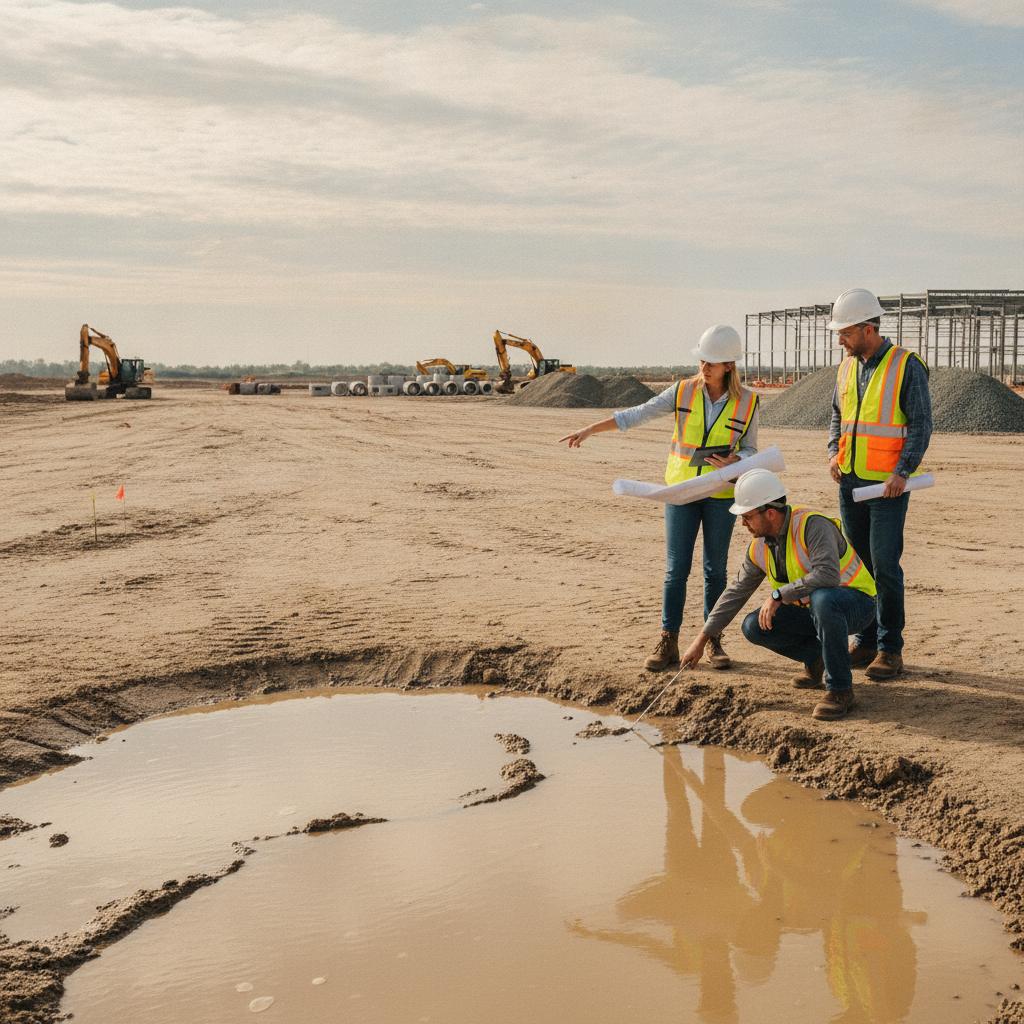
Underestimating Total Impervious Cover and Future Phases
One of the most significant errors in data center site development is designing the stormwater system for Day One operations only. Data centers are rarely static; they are built with expansion in mind. A design that only accounts for the initial building pad, access roads, and parking lots will be critically undersized when future phases, generator yards, or cooling infrastructure are added. This oversight forces costly and disruptive retrofits, including expanding ponds or installing complex underground systems on an already active site. The correct approach is to develop a master stormwater plan at the project’s inception. This involves modeling the hydraulic load for the entire site at full build-out, accounting for all potential impervious surfaces. By designing the primary stormwater infrastructure—like the main retention or detention pond—to accommodate the ultimate condition, future expansions become simpler tie-ins rather than complete system redesigns. This foresight is essential for securing a master permit and provides long-term cost certainty for phased development.
Ignoring Off-Site and Upstream Drainage Contributions
Stormwater Design Pitfall and Mitigation Strategy Matrix
| Common Mistake | Primary Impact | RSP Mitigation Strategy |
|---|---|---|
| Designing for Phase 1 Only | Costly retrofits, permit modifications, insufficient capacity for build-out. | Develop a master stormwater plan accounting for total impervious area at full build-out. |
| Ignoring Upstream Runoff | On-site flooding, undersized conveyance systems, erosion. | Conduct a detailed watershed analysis to quantify off-site flows and incorporate into hydraulic models. |
| Neglecting Tailwater | Failed pond discharge, localized flooding, non-compliance with permit. | Perform a downstream capacity analysis and design the outfall for peak tailwater conditions. |
| Generic Water Quality Plan | Permit delays (RAIs), environmental non-compliance, potential fines. | Incorporate site-specific Best Management Practices (BMPs) that target likely pollutants. |
| Siloed Utility Planning | Construction conflicts, utility strikes, costly site plan revisions. | Initiate comprehensive utility coordination and clash detection early in the design process. |
| No Maintenance Access | System degradation, failed inspections, long-term operational liability. | Integrate dedicated maintenance berms, access routes, and easements into the final site plan design. |
A project site is not an island. It is part of a larger watershed, and failing to account for water flowing onto the property from upstream areas is a recipe for failure. A design that only manages the rainfall landing directly on the site can be quickly overwhelmed by significant off-site flows, leading to localized flooding, erosion, and non-compliance. This is particularly critical in Florida’s flat terrain, where large, slow-moving sheets of water can be directed toward a development from adjacent properties. A thorough civil engineering due diligence process must include a comprehensive watershed analysis. This involves using topographic data, aerial imagery, and sometimes field reconnaissance to delineate the contributing off-site basin and quantify the volume and rate of runoff entering the property. This data is then incorporated into the hydraulic modeling for the on-site system, ensuring that culverts, swales, and ponds are sized to safely convey and manage both on-site and off-site water without causing adverse impacts.
Overlooking Tailwater Conditions and Downstream Capacity
In Florida, getting water into a pond is only half the battle; getting it out is often the greater challenge. Many project sites discharge into canals, municipal storm systems, or natural wetlands that have their own fluctuating water levels, known as tailwater elevation. A high tailwater condition can submerge a pond’s outfall pipe, severely restricting or even preventing discharge. A design that ignores tailwater will fail during the precise storm events it is meant to manage. An effective design requires a detailed analysis of the receiving system. This often involves a downstream capacity analysis to prove that the proposed discharge will not cause adverse impacts to downstream properties or infrastructure. The outfall design must be engineered to function under peak tailwater conditions, often requiring sophisticated outlet control structures. This is a common point of scrutiny during agency review, and a lack of thorough analysis is a frequent cause for permit delays.
Designing Inadequate Water Quality Treatment Systems
Modern stormwater regulations are not just about flood control; they are equally focused on protecting water quality. Data center sites, with their expansive parking lots, service yards, and potential for diesel spills in generator areas, can generate specific pollutants. Simply holding water in a pond is not enough; the system must provide adequate water quality treatment to meet the stringent requirements of Florida’s Water Management Districts (WMDs) and the National Pollutant Discharge Elimination System (NPDES). The design must incorporate specific Best Management Practices (BMPs) tailored to the site. This may include features like littoral shelves in wet detention ponds to promote biological uptake of nutrients, forebays to capture sediment, or specialized filter systems for high-risk areas. The environmental resource permitting (ERP) application must clearly demonstrate how the proposed system meets or exceeds all state and local water quality standards, a critical step for avoiding lengthy requests for additional information (RAIs) from regulators.
Creating Conflicts with Critical Utility and Equipment Layouts
Stormwater infrastructure is extensive and three-dimensional. Large diameter pipes, deep manholes, and sprawling ponds can easily conflict with the dense network of utilities required for a data center. Power conduits, fiber optic banks, water mains, and sanitary sewer lines all compete for limited space, both underground and at the surface. A stormwater design developed in a silo will inevitably lead to costly clash detection issues during construction. Integrated design is non-negotiable. The civil engineering team must engage in rigorous utility coordination from the earliest stages of site plan design. This involves creating a composite utility plan that maps out all proposed infrastructure, identifying potential conflicts, and adjusting alignments and elevations accordingly. For complex sites, investing in subsurface utility engineering (SUE) to locate existing utilities can prevent catastrophic strikes and redesigns during excavation.
Failing to Design for Long-Term Maintenance and Access
A stormwater system is a piece of infrastructure that requires regular maintenance to function as designed. Outlet structures can clog, pipes can fill with sediment, and swales can become overgrown. If the system is designed without considering how maintenance crews will access these components, its performance will degrade over time, leading to potential flooding and compliance violations. This oversight can create significant long-term operational liabilities for the facility owner. A forward-thinking design incorporates maintenance access from the start. This includes designing stable, vegetated access berms around ponds wide enough for mowing equipment and vactor trucks. It means ensuring manholes and the outlet control structure are located in accessible areas, not hidden behind security fences or other equipment. Providing clear, recorded easements for this access is a critical part of the asset management strategy and is often required by the permitting agency that will oversee the system’s long-term operation.
Our Approach to Mission-Critical Stormwater Design
At RSP Engineers, we treat stormwater management as a core component of mission-critical facility design, not an accessory to it. Our process begins with exhaustive due diligence, including a deep dive into local and state regulations, a thorough site investigation, and early engagement with a qualified Geotechnical engineer. We believe in proactive agency review, initiating pre-application meetings with regulators to identify critical design parameters and establish a clear path to approval. Our design philosophy is collaborative. We work in lockstep with architects, MEP engineers, and security consultants to ensure the stormwater system is seamlessly integrated with the facility’s complex operational needs. Using advanced stormwater modeling software, we simulate various storm events to optimize the system for performance, resilience, and cost-effectiveness. As one of the leading Civil Engineering Firms in Florida, our goal is to deliver a design that is not only compliant but also adds to the long-term value and reliability of the asset.
Navigating Common Project Hurdles
Even with a perfect design, challenges can arise. Unexpected soil conditions, revealed by a geotechnical soil report, may require pond liner systems or affect infiltration rates. Last-minute changes to the building footprint or equipment layout can have significant ripple effects on the drainage design. Furthermore, evolving environmental regulations can introduce new requirements mid-project. Our experience helps us anticipate these hurdles. We build flexibility into our designs and maintain open communication with the entire project team and regulatory agencies. This agile approach allows us to address issues quickly, evaluate options, and implement solutions that keep the project moving forward without compromising the integrity of the stormwater management system.
Partner with RSP Engineers for Your Florida Data Center Project
Navigating the complexities of Florida’s regulatory environment while meeting the aggressive timelines of data center development requires specialized expertise. The team at RSP Engineers brings decades of experience in mission-critical site development. We provide comprehensive civil engineering services, from initial due diligence and master planning to detailed stormwater management design and permitting. Our proactive approach to utility coordination and agency engagement is designed to mitigate risk and deliver a project that is resilient, compliant, and ready for operation. Contact us today to discuss how we can ensure the success of your next mission-critical facility.
Conclusion: Building Resilient Data Centers Starts with Smart Stormwater Design
In the world of data center development, uptime is everything. A facility’s resilience begins with a site that can withstand Florida’s most extreme weather. The common design mistakes outlined here are not just technical errors; they are business risks that can jeopardize project timelines and budgets. By prioritizing a comprehensive, forward-looking approach to stormwater management, developers can avoid these pitfalls. Investing in expert civil engineering and a robust drainage design from the outset is fundamental to achieving the certainty and reliability that mission-critical projects demand.
FAQs
-
Florida’s flat terrain presents a major challenge for drainage design because it provides very little natural gravity to move water. This requires careful grading and the use of larger pipes and shallower slopes to achieve positive flow. It also makes the system highly sensitive to tailwater elevation in receiving canals or wetlands, which can significantly impact a site’s ability to discharge stormwater.
-
The most frequent cause for comments or Requests for Additional Information (RAIs) from agencies like the Water Management Districts is an incomplete or inadequately supported downstream capacity analysis. Regulators need definitive proof that your project’s discharge will not cause flooding or environmental harm to downstream properties, and a generic or incomplete analysis is a major red flag during the permit submittals process.
-
Yes, underground detention systems, such as vaults or pipe arch systems, are a viable option for maximizing usable land on a constrained data center site. However, they come with trade-offs. They are significantly more expensive than surface ponds and require a more complex design for inspection and maintenance access. Their use must be carefully weighed against the project’s budget and the value of the land they preserve.