
Data Center Shallow Foundation Design
A technical guide for data center developers on shallow foundation design in Florida. Learn about geotechnical investigations, bearing pressure, settlement, and site preparation from RSP Engineers.
Applicability and Limitations of Shallow Foundations for Mission-Critical Facilities
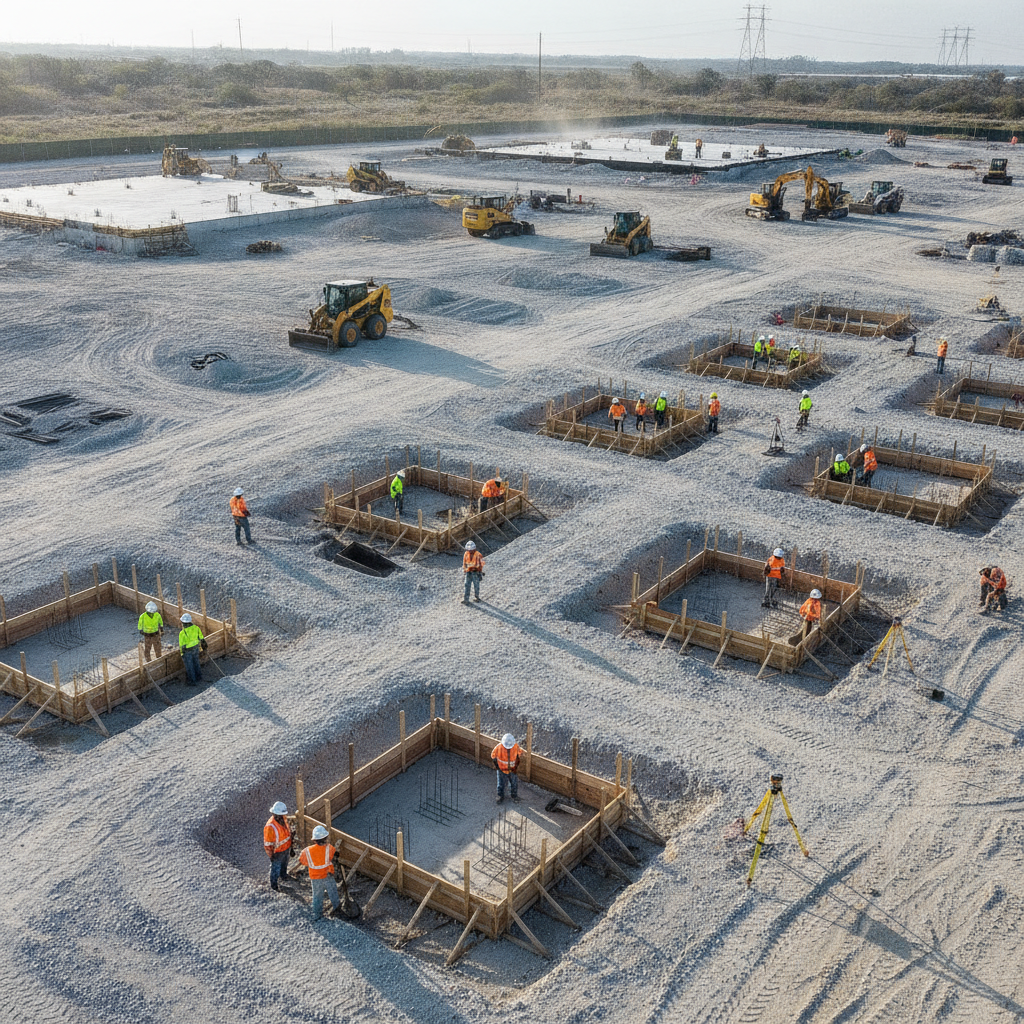
Shallow foundations transfer building loads to the earth at a relatively shallow depth, typically where the foundation’s depth is less than its width. Their suitability is entirely dependent on the subsurface conditions at the project site. For a data center, where even minor structural shifts can compromise sensitive equipment and operations, the decision to use a shallow foundation system is preceded by a rigorous analysis. The primary prerequisite is the presence of competent, stable soil strata near the surface capable of supporting significant loads without excessive settlement. The viability of shallow foundations is confirmed through a comprehensive geotechnical investigation. If the upper soil layers have sufficient bearing capacity and low compressibility, systems like spread footings or mat foundations can be an excellent choice. However, they have distinct limitations. Sites with weak, compressible soils like organic silts or clays, uncontrolled fill, or a very high water table may render shallow foundations unsuitable without significant ground improvement. Similarly, facilities with exceptionally heavy equipment or concentrated column loads may exceed the soil’s capacity, necessitating a deep foundation system to transfer loads to stronger, deeper strata. A thorough settlement analysis is crucial to ensure the chosen system meets the stringent performance requirements of a data center.
Geotechnical Investigation: The Foundation of Foundation Design
Shallow Foundation System Comparison for Data Centers
| Foundation Type | Ideal Soil Conditions | Typical Application | Key Design Consideration |
|---|---|---|---|
| Spread Footings | Medium to dense sands; stiff clays with low compressibility. | Steel-framed structures with distinct column loads. | Sizing for individual column loads and controlling differential settlement between adjacent footings. |
| Strip Footings | Competent soils capable of supporting linear loads. | Load-bearing CMU or concrete walls at the building perimeter or interior. | Ensuring uniform bearing support along the entire length to prevent cracking. |
| Mat Foundation | Soils with lower bearing capacity or variable conditions; where loads are very high. | Entire building footprint, especially when column footings would cover >50% of the area. | Minimizing overall settlement and controlling differential settlement across the entire slab. Requires careful analysis of slab stiffness. |
| Shallow Foundation with Ground Improvement | Sites with localized weak soils (e.g., loose sands, soft clays) at shallow depths. | Used with spread or strip footings to improve the underlying soil instead of opting for a deep foundation. | Verifying the effectiveness of the improvement (e.g., compaction, fill quality) through rigorous QA/QC testing. |
| Shallow Foundation with Underdrains | Sites with a high seasonal water table. | Any shallow foundation type where groundwater could compromise soil bearing capacity. | Proper design and installation of the drainage system to prevent clogging and ensure long-term performance. |
No foundation design should ever begin without a comprehensive Geotechnical soil report. This document, prepared by a qualified Geotechnical engineer, is the single most important tool for the design team. It provides the essential data needed to model soil behavior, calculate performance, and select the appropriate foundation type. The investigation process itself involves a carefully planned program of field exploration and laboratory testing. Field exploration typically includes performing a series of soil boring tests across the proposed building footprint. These borings allow the engineering team to classify the soil strata, determine the depth to groundwater, and collect samples for further analysis. In the laboratory, these samples undergo tests to determine key engineering properties such as shear strength, density, moisture content, and consolidation characteristics. The final report synthesizes this data to provide critical recommendations, including the allowable soil bearing pressure, estimated settlement, and requirements for subgrade preparation, which are then integrated into the overall site plan design by the civil engineer.
Types of Shallow Foundations for Data Center Structures
Once the geotechnical data confirms the suitability of a shallow system, the design team can select the most appropriate type based on the building’s structural layout, load distribution, and soil properties. Each type offers a different approach to distributing structural loads to the underlying soil. Spread Footings (Isolated Footings) Spread footings are one of the most common types of shallow foundations. They consist of individual concrete pads placed underneath each structural column. This approach is highly efficient for steel-framed data centers where loads are concentrated at specific points. The size of each footing is calculated based on the column load and the allowable soil bearing pressure to ensure that stress on the soil remains within safe limits. They are often connected by grade beams to provide additional stability and support for exterior walls. Strip Footings (Continuous Footings) Strip footings, or continuous footings, are linear concrete elements that run underneath load-bearing walls or lines of closely spaced columns. They are used to distribute a continuous load over a larger area. In data center design, they are frequently used for perimeter concrete masonry unit (CMU) walls or interior corridors that have a structural function. The design ensures uniform settlement along the length of the wall, preventing cracking and structural issues. Mat or Raft Foundations A mat foundation, also known as a raft foundation, is a large, thick concrete slab that supports the entire building. This type is typically employed when soil conditions are weaker or when column loads are so high and close together that individual spread footings would nearly merge. By creating one large foundation element, a mat foundation effectively distributes the total building load over the entire footprint, reducing the bearing pressure on the soil and minimizing the potential for damaging differential settlement—a critical consideration for facilities housing sensitive server racks and cooling equipment.
Critical Design Parameters: Bearing Pressure and Settlement Analysis
The two governing principles of shallow foundation design are ensuring the soil has adequate strength to prevent a shear failure (bearing capacity) and that the foundation will not settle excessively (settlement). For data centers, the settlement criteria are often more restrictive than the bearing capacity. The allowable bearing pressure is the maximum pressure that can be applied to the soil without risking a bearing capacity failure or causing excessive settlement; it is a key recommendation from the geotechnical report. While total settlement is important, differential settlement—the uneven settlement between different parts of the foundation—is the greater concern. Excessive differential settlement can induce stress in the building frame, crack walls and slabs, and, most critically for a data center, disrupt the precise alignment of server racks, cooling infrastructure, and power distribution units. The design must therefore analyze and limit both total and differential settlement to within the strict tolerances required for mission-critical operations, ensuring the long-term structural integrity of the facility. This often involves a more conservative approach than for a standard commercial warehouse.
Subgrade Preparation and Ground Improvement Techniques
Even with favorable soil conditions, the performance of a shallow foundation is highly dependent on the quality of the ground directly beneath it. Proper subgrade preparation is a non-negotiable step in the construction process. This typically begins with stripping away topsoil and any unsuitable surficial materials. If the geotechnical investigation identifies pockets of weak or compressible soil within the influence zone of the foundation, these areas must be addressed. A common solution is overexcavation, which involves removing the unsuitable material and replacing it with engineered or structural fill. This fill material, often a well-graded sand or crushed stone, is placed in controlled lifts and compacted to a specified density, typically 95% to 98% of its maximum dry density as determined by a Modified Proctor test. The civil engineering firm will specify rigorous quality control measures, including compaction testing and proof-rolling of the subgrade with heavy equipment, to verify that a uniform and stable building pad has been achieved before any concrete is poured.
Managing Groundwater and Drainage Around Foundations
Florida’s geology is characterized by porous limestone and a seasonally high water table, making water management a central theme in any construction project. The presence of a high groundwater level can significantly complicate foundation construction and impact long-term performance. A high water table reduces the effective stress in the soil, which in turn can lower its bearing capacity. It also creates practical challenges during excavation, often requiring active dewatering systems like well points or sump pumps to keep the work area dry. For the long-term health of the foundation, controlling both groundwater and surface water is essential. The overall site development plan must include a robust stormwater management system that directs runoff away from the building perimeter. This includes careful site grading and, in some cases, the installation of subsurface underdrain systems or perimeter foundation drains. By preventing water from saturating the soils supporting the foundation, the design preserves the soil’s strength and prevents issues like hydrostatic pressure on slabs and moisture intrusion.
RSP Engineers’ Integrated Approach to Foundation Design and Site Development
At RSP Engineers, we understand that foundation design is not an isolated discipline but an integral part of a comprehensive site development strategy. Our process begins with early-stage due diligence, where we help clients assess site viability by reviewing existing geological data and identifying potential geotechnical risks. We then collaborate closely with a trusted Geotechnical engineer to scope and oversee the necessary subsurface investigations. Once we receive the Geotechnical soil report, our team of Civil Engineers translates its recommendations into a practical and cost-effective design. This involves more than just sizing footings; we integrate the foundation plan with the overall site plan design, ensuring that site grading, drainage design, and utility coordination all work in concert to protect the building. During the construction phase, we provide Construction Management Services and administration support, observing critical activities like subgrade preparation and compaction testing to verify that the work is performed in accordance with the design specifications and industry best practices.
Common Challenges and Pitfalls in Shallow Foundation Projects
Even with a solid design, data center foundation projects can encounter challenges. A primary pitfall is an insufficient geotechnical investigation, which can lead to costly surprises during excavation, such as encountering rock or unsuitable soils not identified in the borings. Florida’s frequent and intense rainfall can also pose a significant risk; failure to manage surface water runoff during construction can saturate a carefully prepared subgrade, compromising its density and strength. Another common issue is poor quality control during the placement and compaction of structural fill, leading to future settlement problems. Finally, inadequate utility coordination can result in conflicts between new foundation elements and existing underground utilities, causing delays and redesigns. Proactive planning and diligent construction oversight are the best defenses against these common issues, ensuring the project stays on schedule and within budget.
Partner with RSP Engineers for Your Mission-Critical Facility
Successfully designing and constructing a data center foundation in Florida’s challenging environment requires a deep understanding of civil engineering, geotechnical principles, and local conditions. The RSP Engineers team specializes in comprehensive site development for complex commercial and industrial projects. We manage the entire process, from initial due diligence and permitting to detailed utility coordination and construction oversight. Our expertise ensures that your facility’s foundation is designed not in a vacuum, but as part of an integrated system that accounts for drainage, grading, and long-term performance. If you are planning a mission-critical facility, partner with a civil engineering firm that knows how to build a solid base for your investment. Contact us today to discuss your project’s unique requirements.
Conclusion: Building a Solid Foundation for Digital Infrastructure
For data center developers, a shallow foundation system can represent a significant cost and schedule advantage when site conditions are favorable. However, its success is not guaranteed. It hinges on a meticulous design process rooted in a thorough geotechnical investigation, a conservative approach to settlement analysis, and diligent execution of subgrade preparation and water management strategies. The integrity of a multi-million dollar facility and the digital assets it protects depends on the quality of the engineering that occurs before the first yard of concrete is ever placed. By integrating geotechnical data with a comprehensive site development plan, engineers can create a robust and reliable foundation that will support mission-critical operations for decades. This holistic approach is the key to building the resilient infrastructure our digital future demands.
FAQs
-
The absolute first step is commissioning a site-specific geotechnical investigation performed by a qualified geotechnical engineering firm. This investigation, which includes soil boring tests and lab analysis, provides the essential data on soil strength, compressibility, and groundwater levels needed to make an informed decision.
-
A high water table can reduce the soil’s effective bearing capacity and create significant construction challenges. The design must account for this by either lowering the foundation, implementing ground improvement, or incorporating permanent dewatering or underdrain systems. The site’s overall drainage design is critical for long-term performance.
-
Differential settlement is the uneven settlement of a building’s foundation. It is especially critical for data centers because it can twist the structural frame, crack slabs, and misalign sensitive and interconnected equipment like server racks, power distribution units, and cooling systems. Limiting differential settlement is often the governing factor in foundation design for these facilities.