
Data Center Deep Foundation Design
A technical guide for developers on deep foundation design for data centers. Learn about driven piles, drilled shafts, load testing, and geotechnical considerations in Florida.
When are Deep Foundations Necessary for Data Centers?
While shallow foundations are suitable for many structures, the specific demands of data centers often push the design toward deep foundation systems. The primary driver is the combination of heavy, concentrated loads and the stringent performance criteria required for mission-critical facilities. A thorough Geotechnical soil report, prepared by a qualified Geotechnical engineer, is the first and most crucial step in making this determination. This report analyzes soil stratigraphy, strength, and groundwater levels to inform the foundation design. Deep foundations are typically required under several conditions common in Florida. First, weak or compressible surficial soils, such as loose sands, organic silts, or soft clays, may lack the bearing capacity to support a massive data center without unacceptable settlement. Second, the immense structural loads from multi-story steel frames, concrete tilt-up walls, heavy electrical equipment, and backup generators often exceed the capacity of shallow footings. Finally, data centers have extremely low tolerance for differential settlement, where one part of the building settles more than another. Even minor shifts can damage sensitive fiber optic connections, misalign equipment, or compromise structural integrity, making a deep foundation system that transfers loads to deeper, more competent soil layers a necessity for long-term operational stability.
Driven Piles: Advantages and Limitations
Deep Foundation Comparison for Data Center Projects
| Foundation Type | Ideal Application | Key Constraints & Risks | Relative Cost / Schedule Impact |
|---|---|---|---|
| Driven Piles (Precast Concrete/Steel) | Undeveloped sites with consistent soil profiles; no adjacent sensitive structures. | High vibration and noise; risk of damage to nearby facilities; potential for pile damage in dense soils. | Low-to-Moderate Cost / Fast Schedule |
| Drilled Shafts (Caissons) | Sites with heavy, concentrated loads; expansions near live facilities; variable soil conditions. | Sensitive to groundwater; slower installation; requires specialized equipment and extensive quality control. | High Cost / Slow Schedule |
| Augercast (CFA) Piles | Sites with poor soil conditions (e.g., loose sands); projects requiring low vibration on a tighter schedule. | Requires stringent quality control to ensure pile integrity; capacity limited by equipment size. | Moderate Cost / Moderate Schedule |
| Micropiles | Retrofit projects; sites with very limited access or overhead constraints; underpinning existing structures. | Lower individual capacity (requires groups/caps); higher unit cost; specialized installation. | Very High Cost / Slow-to-Moderate Schedule |
| Helical Piles | Lighter structures on site (e.g., equipment pads, support buildings); tension/uplift applications. | Limited capacity for heavy data center loads; sensitive to subsurface obstructions like rock or debris. | Low Cost / Very Fast Schedule |
Driven piles are prefabricated structural elements, typically made of precast concrete or steel, that are driven into the ground using a large impact or vibratory hammer. This method is often favored for its relative speed and the high degree of quality control, as the piles are manufactured in a controlled environment. The driving process itself acts as a continuous proof test, with the pile’s resistance to driving (blow counts) providing real-time data on the soil’s bearing capacity. However, the significant drawbacks of driven piles often make them unsuitable for data center projects, especially those near existing facilities. The primary concern is vibration. The intense energy transmitted through the ground during driving can disrupt or damage sensitive electronics in adjacent, operational data halls. This makes them a non-starter for campus expansions. Furthermore, the noise generated can violate local ordinances. Careful utility coordination is also essential, as driving a pile through an unmarked utility line can be catastrophic. While effective in certain undeveloped sites with favorable soil conditions, the potential for disruption must be carefully weighed against the benefits.
Drilled Shafts (Caissons): Precision and High Capacity
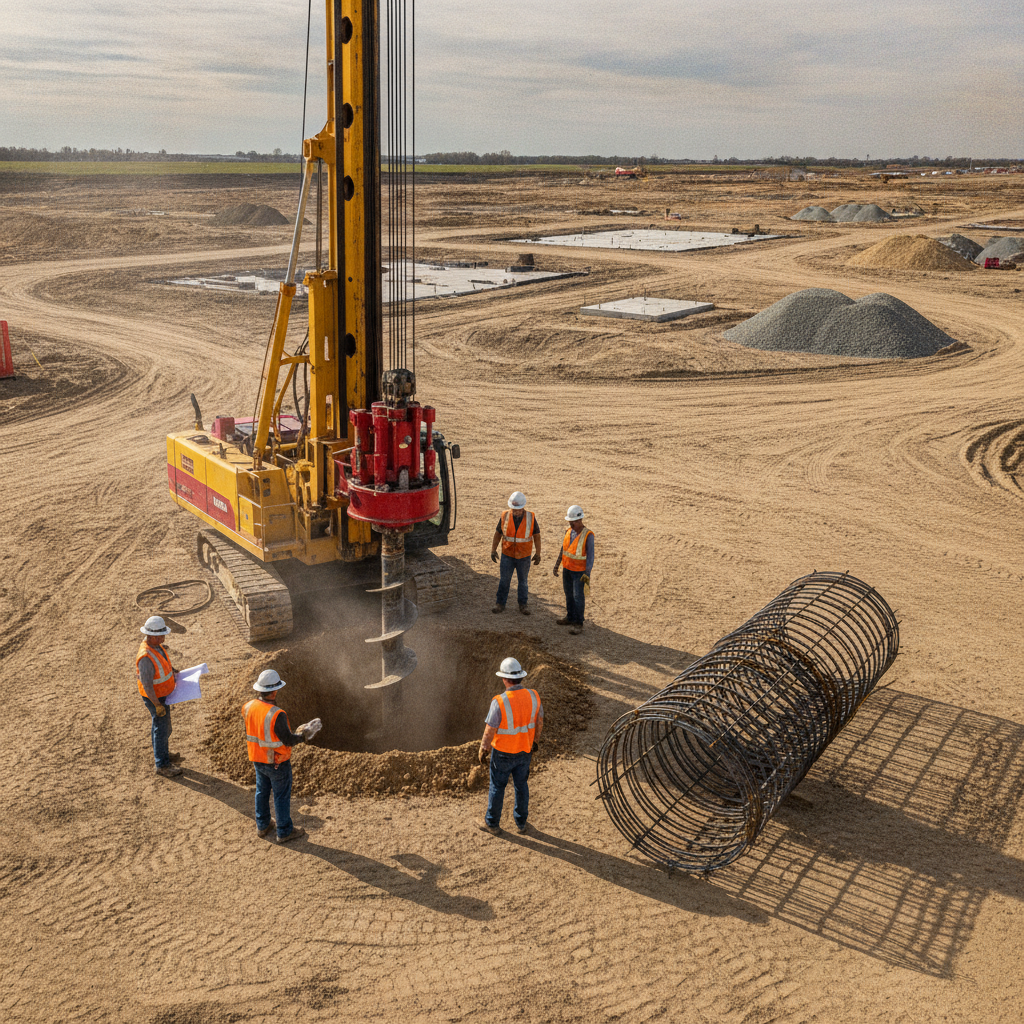
Drilled shafts, also known as caissons, are a type of cast-in-place deep foundation. The process involves excavating a cylindrical shaft to a specified depth, placing a reinforcing steel cage, and filling the excavation with high-strength concrete. This method offers several key advantages for data center construction. First and foremost, it is a low-vibration technique, making it the preferred solution for projects adjacent to live environments. The size and depth of drilled shafts can be tailored to meet immense axial and lateral load requirements, providing a robust solution for heavy structures. The flexibility of drilled shafts allows the design to be adapted in the field if unexpected subsurface conditions are encountered, a common occurrence in Florida’s variable geology. However, this method is generally slower and more expensive than driving piles. It requires specialized equipment and is highly sensitive to groundwater. In Florida’s high water table, temporary casing or drilling slurry (bentonite or polymer) is often required to maintain an open excavation before concrete placement. The success of a drilled shaft installation relies heavily on the contractor’s expertise and rigorous quality control during construction.
Augercast Piles (CFA): A Hybrid Approach
Augercast piles, or Continuous Flight Auger (CFA) piles, offer a balance between the speed of driven piles and the low-vibration characteristics of drilled shafts. The installation process involves a hollow-stem auger that drills to the required depth. High-pressure grout is then pumped through the hollow stem as the auger is slowly withdrawn, forming a continuous column of grout. A reinforcing cage is then lowered into the fluid grout. This method is particularly effective in sandy and soft soil profiles where an open excavation would be difficult to maintain. CFA piles generate minimal spoils and produce less vibration and noise than driven piles, making them a viable option for many sites. They are typically faster to install than drilled shafts, which can positively impact the project schedule. The primary challenge with augercast piles is construction quality assurance. It is critical to monitor grout pressure, volume, and the auger’s extraction rate to ensure there are no voids or discontinuities in the pile shaft. This method is a key part of many modern site plan design strategies for large commercial buildings, but requires a high level of contractor skill and engineering oversight.
Load Testing and Construction Verification
A deep foundation design is based on assumptions derived from the geotechnical soil report and engineering analysis. Load testing is the critical process of verifying these assumptions in the field to ensure the foundation will perform as designed. This is not an optional step; it is a fundamental part of risk management for a high-value facility. The results of a successful load test provide the owner and design team with confidence before proceeding with vertical construction. Several methods are used for verification. Static Load Tests involve applying a physical load to a test pile (often using a hydraulic jack pushing against a reaction frame) and measuring the resulting settlement. High-Strain Dynamic Testing, or PDA testing, uses sensors attached to the pile head to measure force and velocity during a hammer impact, allowing engineers to calculate capacity. For ensuring the structural integrity of the pile itself, Pile Integrity Testing (PIT) uses sound waves to detect potential defects or voids. These verification steps are a crucial component of professional Construction Management Services.
Our Process: Integrating Foundation Design into Site Development
At RSP Engineers, we approach deep foundation design not as an isolated task, but as an integral part of the overall site development strategy. Our process emphasizes early collaboration and proactive problem-solving to de-risk the project from the ground down. It begins with a thorough review of the client’s program and the initial geotechnical engineering data. We work alongside the geotechnical and structural engineers to select the most appropriate foundation system that balances performance, cost, and constructability. This foundation strategy is then woven into the comprehensive site plan design. We meticulously plan the layout of piles or shafts to avoid conflicts with underground utilities, stormwater management systems, and other critical infrastructure. Our team manages the complex permitting process, preparing detailed submittals and coordinating with review agencies to secure approvals efficiently. During construction, we provide robust construction administration, observing installation, reviewing test results, and ensuring the work conforms to the design specifications, safeguarding the project’s foundational integrity.
Common Issues and Mitigation Strategies
Even with careful planning, deep foundation projects can encounter challenges. One of the most common issues, particularly for campus expansions, is vibration control. When building near a live data center, we specify low-vibration methods like drilled shafts and require continuous vibration monitoring to ensure operational thresholds are never exceeded. Another frequent challenge in Florida is groundwater management. The high water table can cause instability in drilled shaft excavations. Mitigation involves using temporary steel casing or polymer slurry to support the borehole walls until concrete is placed. Finally, projects can encounter unexpected subsurface conditions not identified in the initial soil borings, such as buried debris, limestone pinnacles, or solution voids. A proactive mitigation strategy involves including contract contingencies for such discoveries and having pre-approved alternative installation methods ready. This prevents minor subsurface surprises from causing major schedule delays and cost overruns during the critical path of foundation construction. Frequently Asked Questions (FAQ) How early should we engage a civil and geotechnical engineer for a data center project? You should engage both as early as possible, ideally during the site selection and due diligence phase. An early geotechnical soil report can identify fatal flaws before you acquire the land, and preliminary civil engineering analysis can assess feasibility regarding zoning, utilities, and drainage. What is the most common deep foundation type for Florida data centers? For new construction near existing facilities, drilled shafts are often preferred due to their low-vibration installation and high capacity. For new, undeveloped sites, augercast piles are also very common as they offer a good balance of performance, cost, and schedule efficiency in Florida’s sandy soils. Can we use a shallow foundation if the geotechnical report is borderline? While technically possible, it is generally not recommended for mission-critical data centers. The risk of unacceptable differential settlement over the life of the facility is too high. The modest upfront savings on the foundation could be dwarfed by the cost of operational downtime or structural repairs later. How does foundation design impact the stormwater management system? The layout of deep foundations must be carefully coordinated with the drainage design. Pile caps and grade beams can conflict with the routing of underground storm pipes and exfiltration trenches. This requires close collaboration between the structural and civil engineering teams to avoid costly conflicts during construction. What kind of permits are required for deep foundation work? Typically, the foundation plan is part of the overall building permit submittal package. This package will be reviewed by the local municipality for compliance with the Florida Building Code. The review will scrutinize the design’s consistency with the approved geotechnical engineering report and the structural plans.
Your Partner for Mission-Critical Site Development
The success of a multi-million dollar data center rests on the ground beneath it. Choosing the right foundation system and ensuring its flawless execution requires specialized expertise that goes beyond standard commercial construction. At RSP Engineers, we provide the integrated site engineering services needed to navigate these complex challenges. From initial due diligence and geotechnical coordination to detailed utility coordination and navigating the intricacies of agency permitting, our team is equipped to support your mission-critical project. Contact us to discuss how we can help build your next data center on a foundation of confidence.
Conclusion
Deep foundation design for data centers is a highly specialized discipline where conservatism and precision are paramount. The choice between driven piles, drilled shafts, and augercast piles is a complex decision driven by soil conditions, site constraints, structural loads, and the acceptable level of risk. Ultimately, a successful project relies on a collaborative approach that integrates geotechnical engineering, structural design, and expert civil engineering from the earliest stages. By prioritizing a robust foundation, developers can protect their investment and ensure the long-term stability and reliability of their critical digital infrastructure.
FAQs
-
Data Center Deep Foundation Design requires careful planning, qualified engineering, and compliance with the applicable codes and permits.
-
Getting Data Center Deep Foundation Design right protects safety, supports regulatory compliance, and avoids costly redesigns or delays.
-
RSP Engineers provides licensed expertise and end-to-end support for Data Center Deep Foundation Design, from early planning through permitting.