
Data Center Settlement Analysis Guide
A comprehensive guide for data center developers on geotechnical settlement analysis in Florida. Learn about total vs. differential settlement, soil improvement, and monitoring.
Understanding the Three Phases of Soil Settlement
Soil settlement is not an instantaneous event. It occurs over time in three distinct phases, each driven by different physical mechanisms. A thorough geotechnical investigation must analyze all three to predict the full scope of ground movement. The first phase is immediate settlement, or elastic settlement, which occurs as the soil mass deforms under the initial application of a load without any change in water content. In sandy or gravelly soils, this can account for the majority of the total settlement and happens relatively quickly during construction. The second, and often most critical phase for Florida’s clayey and silty soils, is primary consolidation settlement. This process involves the gradual expulsion of pore water from the saturated soil matrix under the new load. Because fine-grained soils have low permeability, this can be a very slow process, sometimes taking years or even decades to complete. The final phase is secondary compression, or creep, which is a long-term reduction in soil volume due to the rearrangement of soil particles under a constant load after primary consolidation is complete. For data centers with a planned operational life of decades, accounting for this long-term creep is a crucial part of the site engineering services.
Total vs. Differential Settlement: The Critical Distinction
Data Center Settlement Tolerance Limits
| Component / Area | Typical Total Settlement Limit | Typical Differential Settlement Limit (Angular Distortion) | Key Considerations |
|---|---|---|---|
| Main Structural Slab (Data Hall) | 1 inch | 1/750 to 1/1000 | Must prevent tilting of server racks and stress on raised access flooring. Critical for equipment alignment and stability. |
| Raised Access Flooring System | 0.5 inches (relative to slab) | 1/1000 | Ensures floor panels remain level and secure. Prevents tripping hazards and ensures proper seating of equipment. |
| Utility Conduits & Piping | 0.5 - 1 inch | 1/500 | Movement can strain or break chilled water, power, and fiber optic connections, leading to catastrophic outages. Requires flexible connections. |
| Exterior Generator / UPS Pads | 1 - 2 inches | 1/400 | Less critical than the main hall, but excessive movement can still stress electrical conduit and fuel line connections. |
| Office / Admin Building Foundation | 1.5 inches | 1/500 | Standard commercial building tolerances. Movement is less critical to core operations but must be controlled to prevent structural damage. |
| Site Pavement and Hardscape | 2 - 3 inches | 1/200 | Movement can cause poor drainage design, ponding water, and tripping hazards, affecting site logistics and safety. |
It’s vital to distinguish between two types of settlement: total and differential. Total settlement is the uniform, downward movement of the entire structure. While a large total settlement is not ideal, it may be manageable if it occurs evenly across the entire foundation. The far greater threat to a data center is differential settlement, which is the uneven settlement between different parts of the structure. This is what causes slabs to tilt, cracks to form in walls, and precise alignments to be compromised. Differential settlement creates angular distortion, placing immense stress on structural frames, utility conduits, and, most importantly, the sensitive server racks and cooling equipment within the data hall. A slight tilt in a server rack can affect internal components, while strained chilled water pipes or fiber optic conduits can lead to catastrophic failures. Therefore, the primary goal of a data center’s foundation design and ground improvement plan is to minimize differential settlement to within extremely strict tolerances. This requires a detailed analysis by a Professional Engineer to ensure long-term stability.
Identifying and Characterizing Compressible Soils in Florida
Florida’s geology presents unique challenges for large-scale developments like data centers. Many areas contain layers of compressible soils, including organic silts, plastic clays, and loose sands, which are highly susceptible to settlement. A comprehensive Geotechnical soil report is the first step in any serious site development project. This investigation, led by a qualified Geotechnical engineer, involves a program of soil boring test procedures and laboratory analysis to classify the underlying soils and determine their engineering properties. Key laboratory tests, such as consolidation tests (oedometer tests), Atterberg limits, and moisture content analysis, provide the data needed to model soil behavior under the proposed building loads. The Soil Test results inform the settlement analysis and dictate whether the native soils can support the structure or if ground improvement is necessary. Ignoring this critical due diligence step can lead to selecting a site with insurmountable geotechnical challenges, resulting in massive cost overruns or project failure.
Predicting Settlement: The Time Rate of Consolidation
Once compressible soils are identified, the next question is: how long will it take for the settlement to occur? This is answered by analyzing the time rate of consolidation. Using data from laboratory tests, engineers can predict the time required for a certain percentage (typically 90% or more) of the primary consolidation settlement to take place. This prediction is fundamental to the project’s construction schedule and risk management strategy. If the analysis shows that significant settlement will occur over many years, building directly on the unprepared soil is not an option. The long-term movement would damage the facility. This is where the time rate of consolidation directly influences the design of ground improvement measures. For example, it helps determine how long a surcharge load must be in place to pre-compress the soils, effectively accelerating years of settlement into a manageable period of months before foundation construction begins. Accurate modeling is a hallmark of experienced Civil Engineering Firms.
Ground Improvement Techniques to Mitigate Settlement Risk
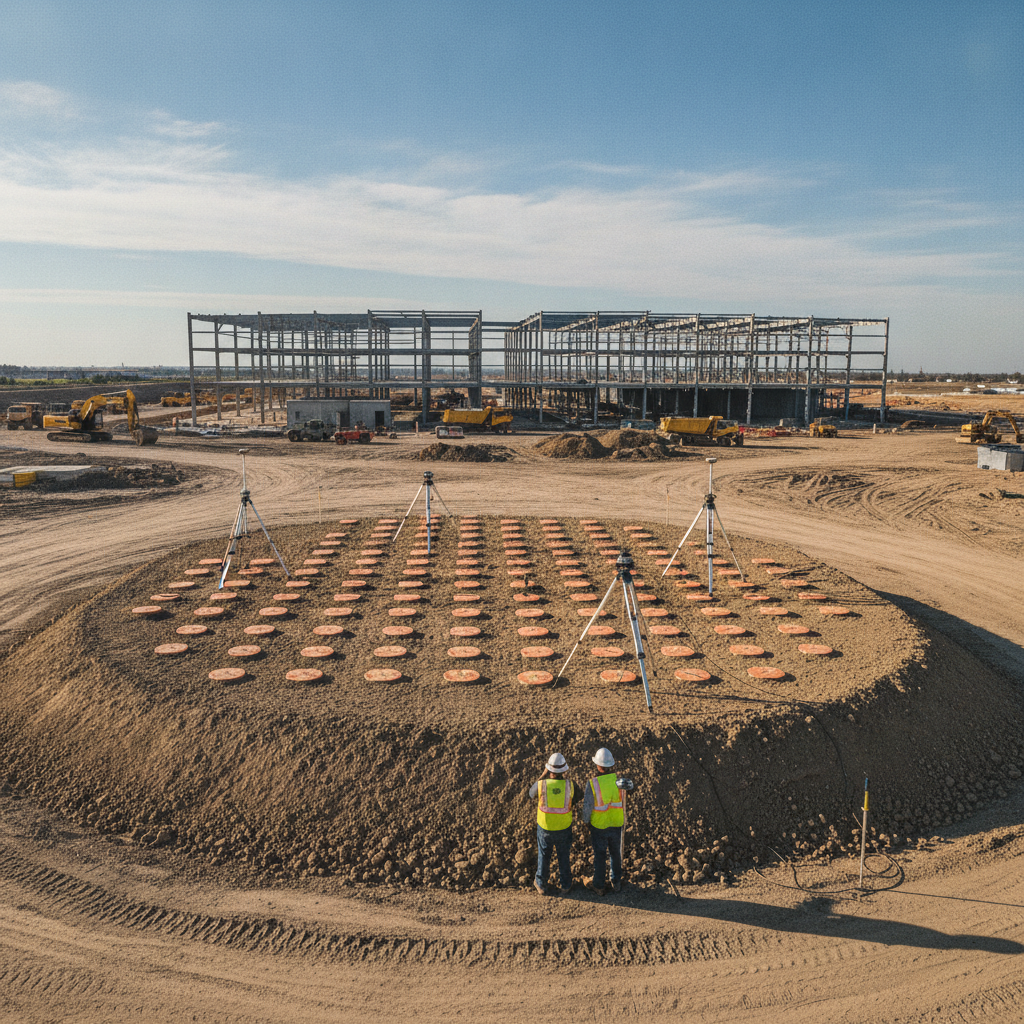
When a site has compressible soils, engineers must implement ground improvement techniques to create a stable foundation. The most common method for mitigating consolidation settlement is surcharge loading. This involves placing a large mound of temporary fill material over the building footprint that is heavier than the proposed structure. This heavy load squeezes the water out of the underlying clays and silts, inducing the majority of the settlement before the data center is ever built. The process is carefully monitored until the rate of settlement slows to an acceptable level. Other ground improvement methods may be considered depending on the soil type, project timeline, and budget. These can include deep dynamic compaction, which densifies loose granular soils, or the installation of stone columns or vibro-piers to transfer loads to deeper, more competent soil layers. The selection of the appropriate technique is a critical design decision that balances cost, schedule, and performance, requiring close collaboration between the geotechnical engineer and the civil design team as part of the overall site plan design.
The Role of Settlement Monitoring During and After Construction
A ground improvement program is incomplete without a robust settlement monitoring program. This is not a design-phase activity; it is a critical component of construction administration that verifies the geotechnical predictions and ensures the site is ready for construction. The most common monitoring tools are settlement plates, which are steel plates installed at the original ground surface before the surcharge fill is placed. Surveyors take regular elevation readings of riser pipes attached to these plates to track the magnitude and rate of settlement over time. In addition to settlement plates, piezometers may be installed to measure pore water pressure within the clay layers. As the soil consolidates, the excess pore water pressure dissipates. This data, combined with the settlement readings, gives engineers a clear picture of how the consolidation process is progressing. Monitoring continues until the data confirms that the rate of movement has slowed to a pre-determined, acceptable level, providing the green light to remove the surcharge and begin foundation work. This data-driven approach is essential for managing risk and the construction schedule.
Our Approach to Settlement Analysis and Mitigation
At RSP Engineers, we approach data center settlement with a rigorous, phased methodology designed to protect our clients’ investments. Our process begins with a comprehensive Geotechnical Investigation, including deep soil borings and advanced laboratory testing to fully characterize the site’s subsurface conditions. We leave no stone unturned in identifying potentially compressible soil layers. Next, our team of Florida Licensed Engineers performs a detailed settlement analysis using sophisticated modeling software to predict the magnitude and time rate of settlement under the proposed facility loads. Based on this analysis, we design a targeted ground improvement program, providing detailed plans and specifications for techniques like surcharge loading. Finally, during the build phase, we provide diligent Construction Management Services and monitoring, analyzing field data to verify that performance targets are met before critical foundation work commences. This integrated approach ensures that the foundation for your mission-critical facility is built on solid ground.
Common Pitfalls in Data Center Settlement Projects
Even with a plan, several common issues can derail a data center project. The most frequent is an inadequate initial geotechnical investigation, where a developer tries to save money by reducing the number of soil borings. This can lead to unforeseen soil conditions and costly change orders. Another pitfall is underestimating the time rate of consolidation, which can severely impact the project schedule if the surcharge program takes longer than anticipated. Other issues include failing to account for the variability of existing or imported fill materials, which can cause unpredictable settlement patterns. Poor coordination between the geotechnical, civil, and structural engineers can also lead to design conflicts and oversights. Finally, a lack of diligent monitoring during the surcharge period can result in removing the fill too early, leaving significant residual settlement to occur after the building is constructed, defeating the entire purpose of the ground improvement effort.
Partner with RSP Engineers for Mission-Critical Geotechnical Design
The success of your data center hinges on the stability of its foundation. Navigating the complexities of Florida’s soils requires specialized expertise and a proactive approach to risk management. The team at RSP Engineers provides comprehensive site engineering services, from initial due diligence and geotechnical investigation to the design and oversight of ground improvement programs. We ensure your facility’s design is optimized for long-term performance, protecting your critical infrastructure from the ground up. Don’t leave your multi-million dollar investment to chance. Contact us today to discuss your project’s settlement analysis, foundation design, and construction administration needs.
Ensuring Long-Term Stability for Your Digital Infrastructure
In conclusion, a meticulous and data-driven settlement analysis is a non-negotiable component of data center development in Florida. Understanding the risks posed by compressible soils and proactively mitigating them through sound geotechnical engineering and ground improvement is essential for ensuring the long-term integrity and operational uptime of these vital facilities. The primary goal is always to control differential settlement, protecting the structure, utilities, and sensitive equipment from damaging movement. Partnering with an experienced civil engineering firm that specializes in mission-critical projects is the surest way to build a resilient and stable foundation for the future.
FAQs
-
This depends on the type of settlement. While total settlement of an inch or more might be acceptable if it’s uniform, the key metric is differential settlement. For a data hall slab, angular distortion should typically be limited to around 1/750 (1 inch of differential movement over 750 inches of distance) or stricter to prevent damage to sensitive equipment and raised flooring systems.
-
Yes, it is often possible, but it requires comprehensive geotechnical engineering and ground improvement. Techniques like surcharge loading, deep dynamic compaction, or deep foundations can be used to mitigate the risks posed by compressible soils. The feasibility depends on a cost-benefit analysis of the required ground improvement versus choosing an alternative site.
-
The duration of a surcharge program is highly site-specific and depends on the thickness and permeability of the compressible soil layers. It can range from a few months to over a year. The time rate of consolidation analysis performed during the design phase provides the estimated duration, which is then verified by the settlement monitoring program during construction.