
Data Center Property Access and Development Rights
A guide for data center developers on navigating property access, easements, right-of-way dedication, and development rights. Learn how civil engineering secures project success.
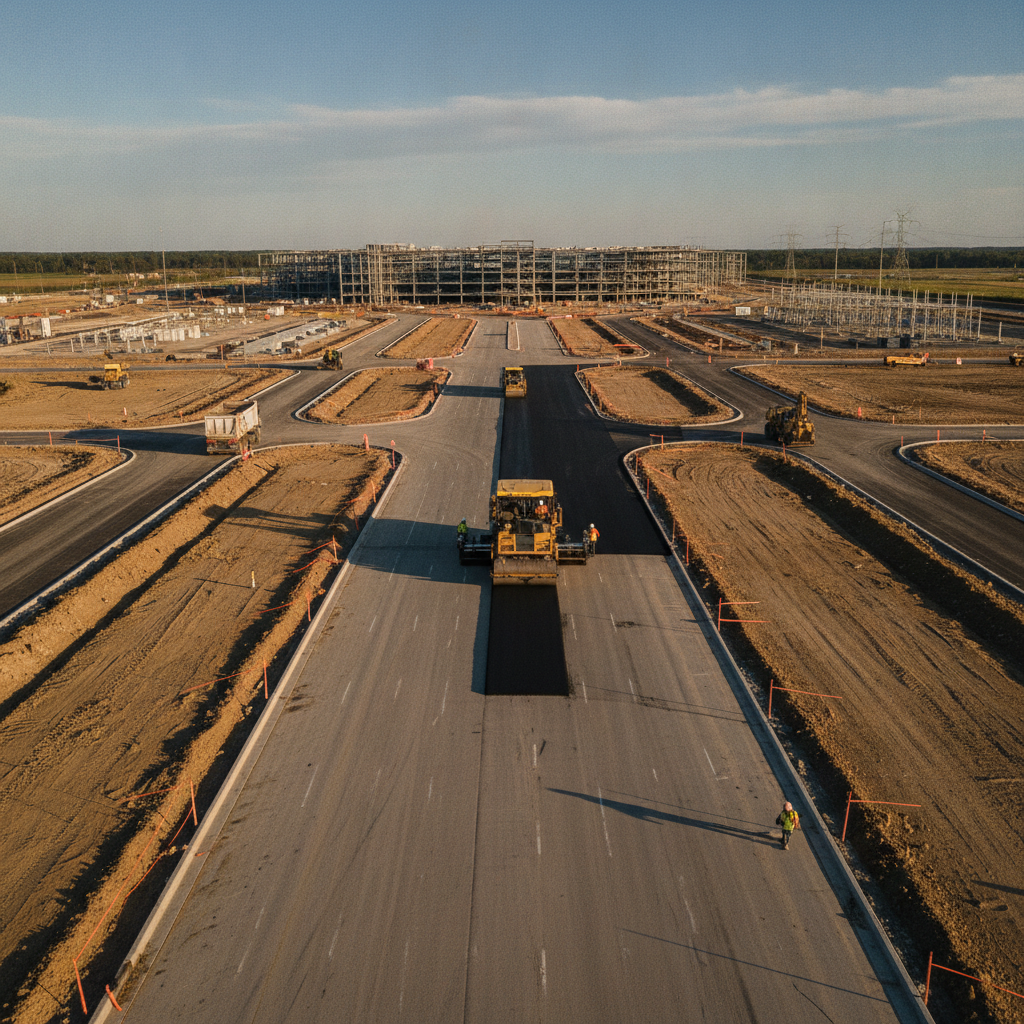
Establishing Legal Frontage and Permitted Access Points
A property’s ability to connect to the public road network is its most basic access right. Legal frontage refers to the portion of a property line that directly abuts a publicly maintained right-of-way. Without it, a property may be considered landlocked. However, simply having frontage is not enough. The developer must secure permits for one or more access points, often called curb cuts, from the governing transportation authority. The number, location, and design of these access points are strictly regulated to ensure traffic safety and maintain roadway capacity. The approval process often requires a detailed traffic impact analysis to model how the new facility will affect the surrounding road network. Engineers must perform a sight distance analysis to ensure drivers entering and exiting the site have clear visibility. Permitting requirements vary by jurisdiction, and every project team should confirm the applicable standards with the local, state, regional, and federal authorities that hold review authority over the site. These agencies will dictate everything from the width of the driveway and its turning radii to the need for deceleration lanes, all of which have significant impacts on the site development budget and schedule.
Navigating Ingress, Egress, and Cross-Access Easements
Comparison of Common Access and Easement Types
| Right/Easement Type | Primary Purpose | Key Civil Engineering Considerations |
|---|---|---|
| Public Right-of-Way Access | Connect the site to the public road network for primary ingress and egress. | Requires permits from transportation authorities; involves sight distance analysis, traffic studies, and design of curb cuts and turn lanes. |
| Ingress/Egress Easement | Provide access across an adjacent private property to reach a public road or another part of the site. | Must be legally recorded with a precise survey. Width and surface material must support intended traffic (e.g., fire trucks, construction vehicles). |
| Utility Easement | Allow utility providers to install and maintain infrastructure (power, fiber, water, sewer). | Creates no-build zones on the site. Requires extensive utility coordination to define routes and avoid conflicts with other site features. |
| Drainage Easement | Convey stormwater runoff across a property to a legal outfall. | Location and size are determined by hydrologic and hydraulic modeling. Critical for stormwater management compliance. |
| Cross-Access Agreement | Create a shared private road network between multiple properties. | Reduces curb cuts on public roads. Requires coordinated design and a legal agreement for shared maintenance costs and liability. |
| Temporary Construction Easement | Provide short-term access to an adjacent property for construction activities (e.g., grading, staging). | Has a specific expiration date. Must clearly define the area and permitted activities to avoid disputes with neighbors. |
While public road access is primary, private agreements are often necessary to create a functional site. An ingress and egress easement is a legal right that allows travel across a portion of another person’s property to access your own. This is common for sites set back from the main road or for creating secondary emergency access routes. These easements must be legally recorded and clearly define the width, location, and permitted use of the accessway. Ambiguities can lead to significant legal disputes later. For large data center campuses or business parks, cross-access agreements are a powerful tool. These agreements create a shared, interconnected private road network between multiple adjacent properties. This improves circulation, reduces the number of curb cuts on the main public road, and can be a requirement for master-planned developments. A successful cross-access agreement requires careful civil engineering to design shared infrastructure and a robust legal framework that outlines maintenance responsibilities, liability, and use restrictions for all parties involved in the land development.
The Critical Role of Utility and Drainage Easements
Data centers have an insatiable demand for power, fiber, and water. Securing the right to bring these services to the site is non-negotiable. A utility easement grants providers like electric, water, sewer, and telecommunications companies the legal right to install, maintain, and access their infrastructure on a portion of the private property. These easements function as dedicated corridors and are typically designated as no-build zones, directly influencing the site plan design and the usable area of the property. Early and proactive utility coordination is essential to identify the required easement widths and routes before finalizing the site layout. Similarly, drainage easements are crucial for managing stormwater runoff. A comprehensive drainage design may require conveying water across a neighboring property to a legal outfall, such as a public storm sewer or a natural waterway. This requires negotiating a drainage easement with the adjacent landowner. These easements must be precisely defined by a survey and legal description to ensure the long-term functionality of the stormwater management system and to comply with local and federal regulations like the Clean Water Act.
Right-of-Way Dedication and Roadway Improvement Obligations
During the permitting and entitlement process, it is common for the governing jurisdiction to require developers to contribute to public infrastructure upgrades. A right-of-way dedication is a requirement to convey a strip of private land to the government for public use, typically for future road widening or the installation of public utilities. This effectively reduces the net acreage of the development parcel and must be accounted for in the site design and financial pro forma. Beyond land dedication, developers are often obligated to fund and construct off-site roadway improvements. These can range from adding a simple turn lane to constructing new traffic signals, sidewalks, or even extending a public road. These requirements are identified during the agency review process and are often tied to the findings of a traffic impact study. A Professional Engineer must prepare detailed construction plans for these public improvements, which are then reviewed and approved by the transportation authority, adding another layer to the permit submittals.
Understanding Deed Restrictions and Covenants
Beyond public regulations, private agreements can impose significant limitations on development. Deed restrictions and Covenants, Conditions, and Restrictions (CC&Rs) are private controls placed on a property that limit its use. These are often found in master-planned industrial parks or are established when a larger parcel is subdivided. They can dictate building setbacks, architectural styles, exterior materials, landscaping requirements, and even prohibit certain types of operations. Thorough due diligence, including a detailed title search, is the only way to uncover these private restrictions. They are legally binding and can be more restrictive than the underlying public zoning compliance requirements. Ignoring a covenant can lead to legal action from a homeowners’ association or neighboring property owner, potentially halting construction. Identifying these constraints early allows the design team to incorporate them into the site engineering services from the outset.
How Access Limitations Constrain Site Layout and Construction Logistics
The cumulative effect of these rights and restrictions directly shapes the final site design. Easements for utilities and drainage create linear no-build zones that can fragment a property, dictating the building footprint and the location of critical infrastructure like generators, cooling towers, and substations. Limited access points can create bottlenecks for construction traffic, requiring a carefully phased logistics plan. The need for a temporary construction easement from a neighbor can become a critical path item if negotiations stall. A skilled civil engineering team models these constraints from day one. The site plan design must accommodate required roadway setbacks, dedicated utility corridors, and protected drainage paths while still providing efficient and secure circulation for both operational and construction vehicles. For example, the internal road network must be designed with adequate turning radii for tractor-trailers delivering equipment and for emergency vehicle access, all while avoiding the restricted easement areas. This complex puzzle requires a holistic approach to site development.
The RSP Engineers Approach to Access and Rights Analysis
At RSP Engineers, our process begins with rigorous due diligence. We conduct a thorough review of the title commitment, ALTA/NSPS Land Title Survey, and local zoning and land development codes to identify all recorded easements, covenants, and public access requirements. Our team engages with transportation agencies and utility providers early in the project lifecycle to understand their requirements for access, off-site improvements, and on-site easements. This proactive utility coordination and agency outreach minimizes surprises during the formal permitting process. We integrate these constraints directly into our site plan design, using them to inform the optimal layout for buildings, parking, stormwater management facilities, and utility infrastructure. Our expertise in drainage design and traffic engineering allows us to develop solutions that meet regulatory standards while maximizing the client’s usable land. We provide comprehensive support throughout the platting, zoning, and permit submittals process, ensuring that all necessary rights are legally secured before construction begins.
Common Issues in Data Center Access Planning
Even with careful planning, developers can encounter significant challenges. One common issue is the discovery of an old, unrecorded easement that is not documented in the title report but is physically evident on the land. Another frequent problem is underestimating the scope and cost of required off-site roadway improvements, which can dramatically impact the project budget. Conflicts between the proposed routes for different major utilities—such as high-voltage power and communications—can force significant redesigns if not identified early. Furthermore, securing necessary easements from adjacent property owners can be a difficult and time-consuming negotiation. A reluctant neighbor can delay the project for months, highlighting the importance of starting these discussions as early as possible. Finally, public opposition to a proposed access point can create political hurdles during the public hearing and approval process, requiring a well-prepared presentation and justification from the project’s Professional Engineer.
Partner with RSP for Your Mission-Critical Development
Navigating the complexities of property access, easements, and development rights requires a seasoned team of experts. RSP Engineers provides the comprehensive civil engineering and permitting services needed to secure a solid foundation for your data center project. Our nationwide experience allows us to manage intricate utility coordination, guide projects through complex regulatory approvals, and deliver an optimized site plan design that respects all constraints. From initial due diligence and feasibility studies to final construction documents and administration, we are your trusted partner in mission-critical site development.
Conclusion
For data center developers, access and development rights are not peripheral legal matters; they are central to the engineering and financial success of a project. A proactive, integrated approach that combines legal diligence with expert civil engineering is essential. By thoroughly investigating frontage, negotiating necessary easements, and planning for public improvement obligations, developers can mitigate significant risks. Securing these rights early in the process ensures that the final site development is buildable, permittable, and capable of meeting the demanding operational needs of a modern data center.
FAQs
-
A right-of-way is typically a strip of land owned by a public entity for public use, such as a road or public utility corridor. An easement is a legal right to use a portion of someone else’s private property for a specific purpose (e. g. , access, utilities, drainage) while the underlying ownership of the land does not change. Both are critical components of site development.
-
In some cases, public utility providers may have the power of eminent domain to acquire an easement necessary for providing public service, but this process is legally complex and involves compensation to the landowner. More commonly, easements are a negotiated condition of receiving service, especially for a large-scale user like a data center that requires new, dedicated utility infrastructure.
-
A traffic impact study analyzes the effect of your project’s traffic on the local road system. Its findings directly influence the design and permitting of your access points. The study may mandate the construction of turn lanes, traffic signals, or other improvements as a condition of approval, and its recommendations are a key part of the agency review.