
Data Center Liquefaction Assessment
Learn the critical steps of a liquefaction assessment for data center development, from CPT/SPT evaluation to mitigation strategies. RSP Engineers explains the geotechnical risks.
Understanding Liquefaction: The Geotechnical Risk to Mission-Critical Infrastructure
Liquefaction is a process where saturated, cohesionless soil—typically sand or silt—temporarily loses its strength and stiffness in response to an applied stress, such as earthquake shaking. The soil behaves like a liquid, unable to support structures. For a data center, which relies on absolute stability, the consequences are severe. The process begins when seismic waves increase the pore water pressure between soil particles, reducing the particle-to-particle contact and thus the soil’s shear strength. This can happen in seconds, transforming a seemingly solid foundation into a fluid-like substance. The primary ingredients for liquefaction are loose granular soils, a high groundwater table, and significant seismic shaking. While Florida is not known for high seismicity like California, the state’s geology is rich in the sandy soils and shallow water tables that are highly susceptible. Modern seismic design parameters require consideration of potential ground motions even in lower-risk zones, especially for critical facilities. A comprehensive Geotechnical soil report, initiated with a series of Soil boring test explorations, is the first step in quantifying this risk and ensuring the structural integrity of the proposed development.
Initial Site Screening and Seismic Hazard Analysis
Liquefaction Mitigation Options Comparison
| Mitigation Technique | Primary Mechanism | Suitability for Data Center Sites | Relative Cost & Impact |
|---|---|---|---|
| Vibro-Compaction | Densification of granular soils | Excellent for sandy sites; treats soil beneath shallow foundations. Requires sufficient clearance from existing structures. | Moderate cost; can be noisy and cause vibrations during installation. |
| Stone Columns / Aggregate Piers | Densification and drainage | Very effective; improves bearing capacity and reduces settlement. The drainage aspect helps dissipate pore pressure quickly. | Moderate to high cost; installation is relatively fast. |
| Deep Soil Mixing | Soil solidification/cementation | Creates a strong, non-liquefiable block of soil. Ideal for creating stable foundation pads and retaining structures. | High cost; provides a very robust solution with minimal long-term settlement. |
| Driven Piles (Steel, Concrete) | Bypass weak soils; load transfer | Common for heavy structures. Bypasses liquefiable layers entirely to bear on competent material. | High cost; installation involves significant noise and vibration. |
| Drilled Shafts / Caissons | Bypass weak soils; load transfer | High-capacity foundation for massive loads. Less vibration during installation compared to driven piles. | Very high cost; suitable for the most critical and heavily loaded structures. |
Before committing to a site, a preliminary screening for liquefaction susceptibility is a crucial due diligence step. This initial phase involves a desktop study using publicly available data to identify potential red flags. Our Geotechnical engineer team reviews geologic maps to identify deposits of loose, sandy, or silty soils, which are historically prone to liquefaction. We also analyze regional groundwater level data and review historical seismic activity records and USGS National Seismic Hazard Maps to determine the site-specific peak ground acceleration (PGA) and other relevant seismic parameters. This screening process helps categorize the site’s risk profile. A site with dense, well-graded soils and a deep water table may be quickly cleared, while a site with loose, saturated sands will require a more detailed investigation. This early analysis is vital for the overall site plan design, as it can influence building placement, foundation type, and even the viability of the site itself. Integrating this Geotechnical Engineering review early prevents costly surprises during the detailed design and permitting phases.
Field Investigation: The Role of SPT and CPT in Data Collection
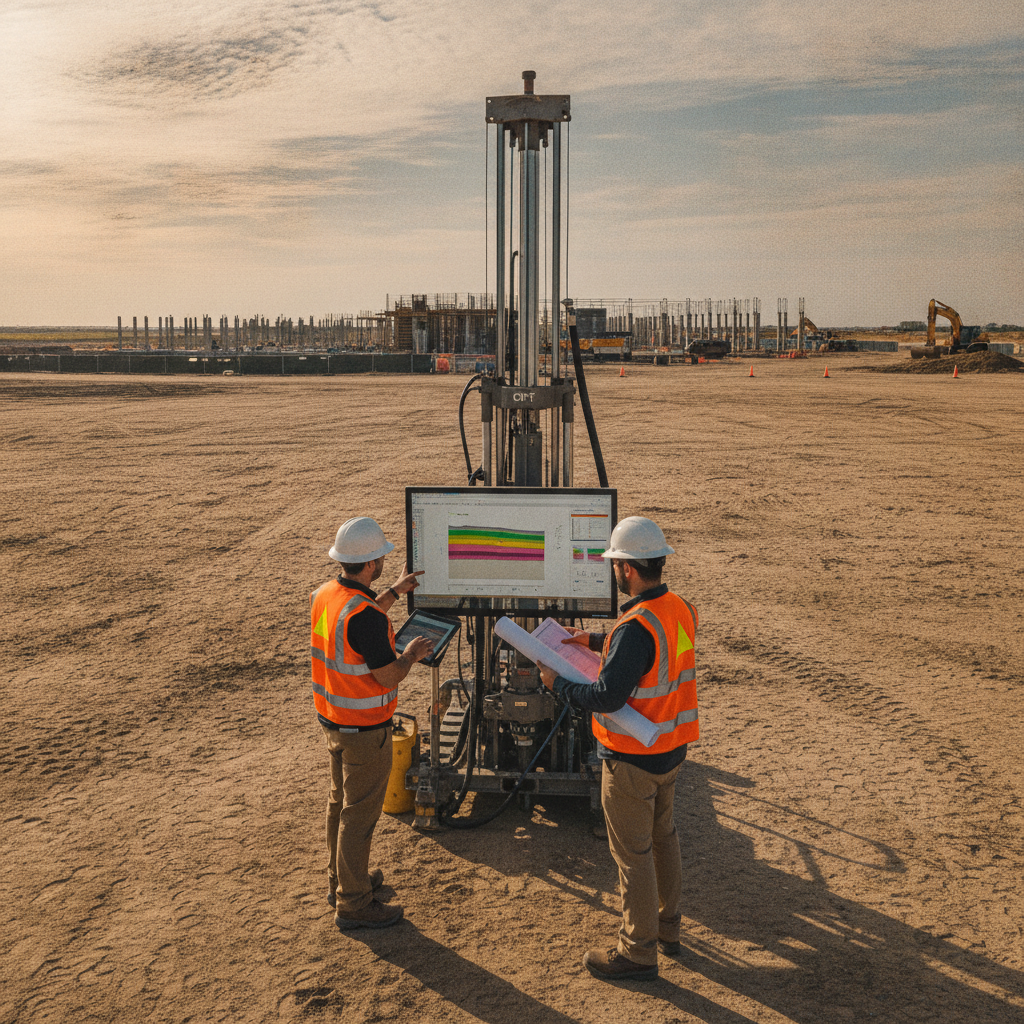
If the initial screening indicates a potential for liquefaction, a detailed subsurface investigation is required. This field program is designed to gather the specific soil data needed for a quantitative analysis. The two most common in-situ testing methods are the Standard Penetration Test (SPT) and the Cone Penetration Test (CPT). The SPT involves driving a split-spoon sampler into the ground to collect soil samples and measure the soil’s resistance to penetration (the ‘N-value’), which correlates to its density. This method provides physical samples for laboratory testing, allowing for confirmation of soil classification and grain size distribution. The CPT is a more modern and often preferred method, where an instrumented cone is pushed into the ground at a constant rate. It provides a continuous profile of soil behavior by measuring tip resistance, sleeve friction, and pore water pressure. This high-resolution data is extremely valuable for identifying thin, potentially liquefiable layers that an SPT might miss. The data from both SPT and CPT tests are the empirical backbone of the liquefaction analysis, providing the necessary inputs to evaluate the soil’s capacity to resist seismic loading and inform the foundation design.
The Core Analysis: Cyclic Stress Ratio (CSR) vs. Cyclic Resistance Ratio (CRR)
The heart of a liquefaction assessment is the comparison of seismic demand versus soil capacity. This is quantified using two key parameters: the Cyclic Stress Ratio (CSR) and the Cyclic Resistance Ratio (CRR). The CSR represents the seismic demand, or the level of shear stress induced in the soil by the design earthquake. It is calculated based on the peak ground acceleration, total and effective overburden stresses, and other factors. Essentially, CSR answers the question: How much stress will the earthquake place on the soil? The CRR, on the other hand, represents the soil’s capacity to resist liquefaction. It is an empirical value derived directly from the field data collected during the SPT or CPT investigation. The soil’s density (from SPT N-values) or its tip and sleeve resistance (from CPT data) are correlated to its ability to withstand cyclic loading without liquefying. The final step is to calculate the Factor of Safety against liquefaction (FS = CRR / CSR). An FS greater than 1.25 is typically considered safe, while a value less than 1.0 indicates that liquefaction is likely to occur, requiring mitigation. This analysis is a core component of the geotechnical soil report.
Evaluating the Consequences: Settlement, Lateral Spreading, and Bearing Capacity Loss
Identifying that a site is susceptible to liquefaction is only half the battle; the next step is to understand the consequences. If liquefaction is predicted, a Professional Engineer must evaluate the potential impacts on the data center structure and surrounding infrastructure. The most common consequence is post-liquefaction settlement, where the soil densifies after shaking, causing the ground surface and any structures on it to sink. This settlement can be differential, leading to tilting, cracking, and severe damage to the building and its sensitive equipment. Another major risk is lateral spreading, which occurs on or near gentle slopes or free faces (like a riverbank). Liquefied soil can flow downslope, pulling the ground apart and causing large fissures and horizontal displacement. This can sever critical underground utilities, including power, water, and fiber optic cables, and undermine foundations. Finally, liquefaction causes a near-total loss of bearing capacity for shallow foundations. A foundation that was perfectly adequate under static conditions could suddenly fail, leading to catastrophic structural collapse. These potential outcomes must be addressed in the civil engineering design.
Mitigation Strategies: From Ground Improvement to Deep Foundations
When a liquefaction assessment confirms a significant risk, it does not necessarily mean the site is unusable. Several proven engineering solutions can mitigate the hazard, allowing for safe construction. These strategies generally fall into two categories: improving the ground itself or bypassing the problematic soil layer with a deep foundation system. The selection of a mitigation technique depends on the soil profile, the severity of the risk, the type of structure, and project economics. Ground Improvement Techniques Ground improvement methods aim to densify the liquefiable soil, increase its permeability, or reinforce it. Vibro-compaction uses large vibratory probes to densify loose sands, increasing their resistance to liquefaction. Stone columns (or aggregate piers) serve a dual purpose: they densify the surrounding soil and create columns of highly permeable material that can rapidly dissipate excess pore water pressure during an earthquake. Deep soil mixing involves blending the soil with cement or other binders to create a solidified, non-liquefiable soil-cement matrix. These techniques are often highly effective for treating large areas as part of a comprehensive site development plan. Deep Foundation Systems In cases where ground improvement is not feasible or cost-effective, deep foundations can be used to transfer the building loads through the liquefiable layers to a deeper, stable bearing stratum. Driven piles (steel or precast concrete) or drilled shafts are installed to depths well below the liquefiable zones. The foundation design must account for not only the vertical loads but also the potential for lateral loads and downdrag forces that can occur as the liquefied soil settles around the piles. This approach requires close coordination between the Geotechnical engineer and the structural engineer to ensure a resilient and integrated design.
RSP Engineers’ Approach to Liquefaction Assessment
At RSP Engineers, we follow a systematic, phased approach to liquefaction assessment to provide our clients with clear, actionable insights for their mission-critical projects. Our process ensures that geotechnical risks are identified early and managed effectively throughout the design and construction lifecycle. We are one of the leading Civil Engineering Firms in Florida specializing in complex site challenges. Our process includes a desktop study and seismic hazard review to screen for potential risks, followed by a tailored subsurface investigation plan using CPT and/or SPT methods. We then perform a rigorous engineering analysis, calculating the Factor of Safety against liquefaction and modeling potential consequences like settlement. Finally, we deliver a comprehensive geotechnical soil report that not only presents our findings but also provides practical, cost-effective mitigation recommendations integrated with the overall site plan design and project goals. This proactive approach minimizes risk and helps ensure project success.
Common Challenges and Pitfalls in Liquefaction Studies
Even with established procedures, several challenges can compromise the accuracy and effectiveness of a liquefaction assessment. One common pitfall is an inadequate subsurface investigation, with too few or poorly located borings that fail to characterize the site’s variability. This can lead to a dangerously incomplete picture of the underlying risk. Another issue is the mischaracterization of the site’s groundwater conditions. The analysis must account for seasonal fluctuations and the highest likely groundwater level, not just the level on the day of testing. A critical oversight is failing to identify thin, interbedded layers of liquefiable soil within an otherwise stable profile. These seemingly minor layers can act as a failure plane and cause significant damage. Perhaps the most significant challenge is a lack of integration between the geotechnical findings and the civil and structural design teams. The geotechnical soil report is not a standalone document; its recommendations must be incorporated into the foundation design, utility layouts, and overall site development strategy from the very beginning to be effective.
Partner with RSP Engineers for Mission-Critical Geotechnical and Site Development
Protecting a multi-million dollar data center investment starts from the ground up. An expert liquefaction assessment is a non-negotiable step in ensuring the long-term resilience and operational continuity of your facility. The team at RSP Engineers provides comprehensive Geotechnical Engineering and site engineering services tailored to the unique demands of mission-critical projects. We navigate the complexities of subsurface investigation, seismic analysis, and mitigation design to deliver clear, data-driven solutions. From initial site due diligence and permitting support to detailed foundation design and construction administration, our Florida Licensed Engineers are ready to partner with you. We help you understand and mitigate geotechnical risks, ensuring your project is built on a foundation of certainty. Contact us today to discuss your data center project and learn how our expertise can safeguard your critical infrastructure.
Conclusion: Building Resilient Data Infrastructure on Solid Ground
In the world of data centers, stability is paramount. A thorough liquefaction assessment is a fundamental exercise in risk management, directly protecting the facility’s structural integrity and operational uptime. By systematically evaluating seismic hazards, conducting detailed subsurface investigations, and implementing appropriate mitigation strategies, developers can build with confidence, even on challenging sites. Proactive geotechnical engineering is not an expense; it is an investment in the long-term resilience of critical digital infrastructure. Integrating these findings early into the site plan design and construction management services ensures that the final product is secure, stable, and built to last.
FAQs
-
Yes. While Florida has low seismicity compared to the West Coast, the building codes still require seismic design considerations, especially for critical facilities. Florida’s geology, characterized by widespread loose sandy soils and high water tables, contains the primary ingredients for liquefaction. A moderate earthquake could trigger liquefaction in these susceptible soils, making a liquefaction assessment a prudent part of due diligence.
-
Addressing liquefaction potential early during the site selection and due diligence phase can actually save time. Identifying the risk upfront allows the design team to incorporate mitigation measures from the start. Discovering the problem late in the design process or, worse, during construction, can lead to significant delays, redesigns, and budget overruns related to permitting and construction.
-
Absolutely. A high liquefaction potential does not render a site undevelopable. It simply means that specific engineering measures are required to ensure the safety and stability of the structure. Solutions like ground improvement or deep foundations are routinely and successfully used to build critical facilities on challenging sites.