
Data Center Rock Coring Investigations
A technical guide for data center developers on rock coring investigations. Learn about RQD, core recovery, rock strength testing, and how it impacts excavation and foundation design.
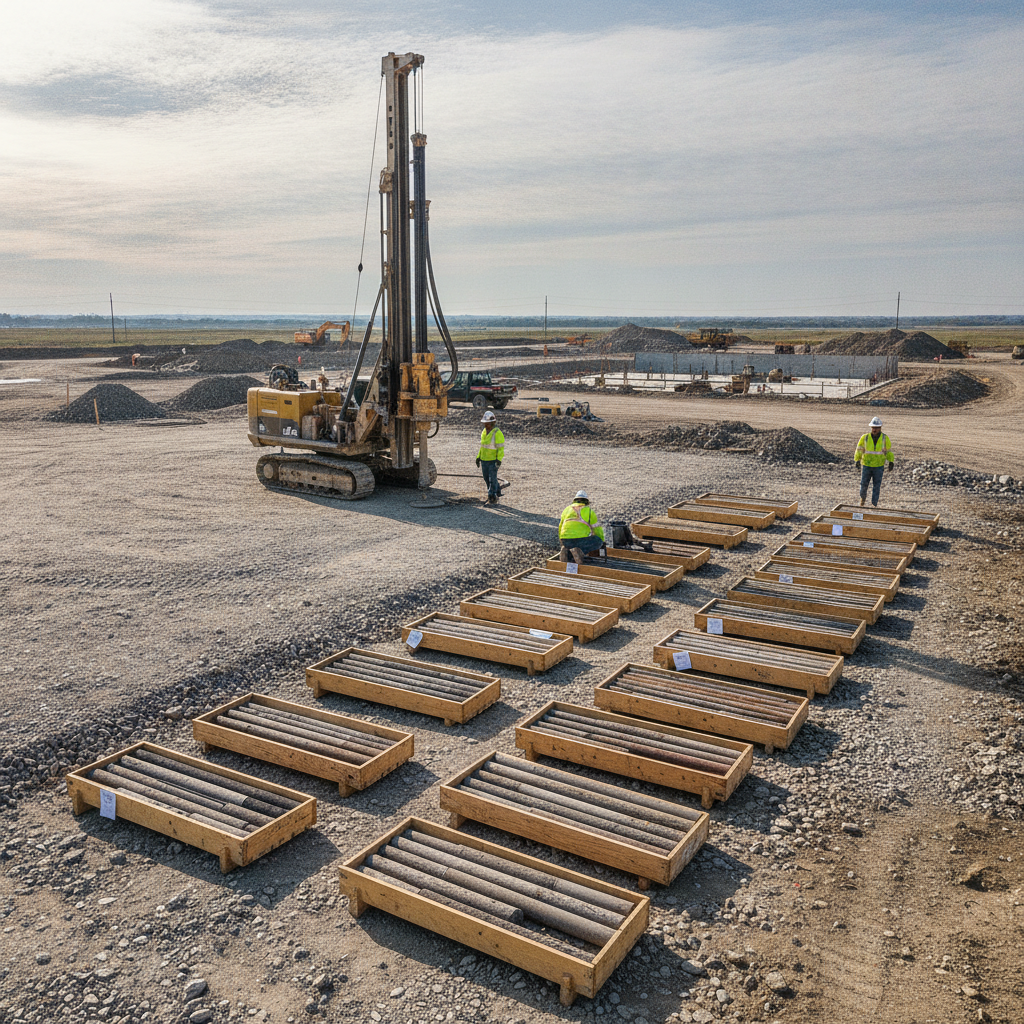
When a Standard Soil Boring Test Triggers Rock Coring
The decision to advance from soil borings to rock coring is not arbitrary; it’s a data-driven conclusion reached during the initial phase of a Geotechnical Engineering investigation. A standard Soil boring test using hollow stem augers and a Standard Penetration Test (SPT) sampler provides crucial information about overburden soils. However, certain indicators signal that rock will be a controlling factor in the design and construction of the data center. The primary trigger is ‘auger refusal,’ a point where the drill can no longer advance due to dense material. This is often accompanied by very high SPT N-values (blow counts), suggesting the presence of rock or rock-like material. A qualified Geotechnical engineer will correlate these field results with regional geological maps and data from sources like the Florida Geological Survey. In many parts of Florida, shallow limestone formations are common, making this transition from soil to rock investigation a frequent necessity. Ignoring these signs can lead to catastrophic budget overruns when construction crews encounter unexpected rock, halting progress and forcing costly changes to the site plan design and excavation strategy. Proactive rock coring is a critical risk mitigation step in the site development process.
The Mechanics of Rock Coring: Methods and Equipment
Rock Mass Characteristics and Excavation Implications
| Rock Mass Classification | Typical RQD Range | Primary Excavation Method | Foundation Suitability & Considerations |
|---|---|---|---|
| Massive / Intact Rock | 90-100% | Blasting required; very low rippability. | Excellent for high-capacity shallow or deep foundations. High excavation cost is the main constraint. |
| Blocky / Fractured Rock | 50-90% | Mechanical ripping with large dozers may be possible; blasting may be more efficient. | Good bearing capacity, but foundation design must account for discontinuities. Potential for differential settlement if not uniform. |
| Highly Fractured / Shattered Rock | 25-50% | Generally rippable with heavy equipment; excavation is easier but produces less stable trench walls. | Variable bearing capacity. May require over-excavation and replacement or ground improvement techniques. Increased scrutiny on utility trench stability. |
| Weathered / Decomposed Rock | 0-25% | Excavatable with standard heavy equipment (excavators, loaders). | Treated more like a dense soil. Lower bearing capacity. Foundation design must be based on soil mechanics principles. High potential for settlement. |
| Karstic / Voided Rock (e.g., Florida Limestone) | Variable | Excavation can be unpredictable. Probing ahead is critical to identify voids. | Significant risk. Requires specialized investigation (e.g., GPR) and foundation solutions like deep foundations (piles) or void grouting programs. |
Once the presence of rock is confirmed, the investigation shifts to specialized equipment designed to retrieve intact cylindrical samples. Unlike soil sampling, rock coring utilizes a rotating core barrel fitted with a diamond-impregnated drill bit that grinds away the rock to create a solid core. The choice of core barrel is critical for sample quality. Double-tube and triple-tube swivel-type core barrels are standard for most civil engineering applications because they protect the core from the erosive effects of drilling fluids and the torsional stresses of rotation. This maximizes the recovery of an undisturbed sample. The diameter of the core (commonly NQ or HQ sizes) is specified by the engineer based on the project requirements and anticipated rock quality. A larger diameter core provides a more representative sample for laboratory strength testing. The entire operation is meticulously documented, with the driller recording rates of penetration, changes in drilling pressure, and water loss—all of which provide indirect clues about the rock mass characteristics. This level of detail is essential for building an accurate subsurface model to inform the foundation design and overall site engineering services.
Core Recovery and Rock Quality Designation (RQD)
After a core run is completed, the retrieved rock sample is carefully extracted and analyzed for two fundamental metrics: Total Core Recovery (TCR) and Rock Quality Designation (RQD). TCR is the simplest measure: the total length of recovered core divided by the length of the core run, expressed as a percentage. It tells us how much of the rock was successfully captured. However, RQD provides a more nuanced assessment of rock mass quality. RQD is the percentage of the total core run length that is represented by intact core pieces 10 cm (approx. 4 inches) or longer. This simple measurement is a powerful indicator of the degree of fracturing and jointing in the rock mass. A high RQD (e.g., >90%) suggests solid, competent rock, while a low RQD (e.g., <50%) indicates a highly fractured and weak rock mass. This single value has profound implications for excavation methods, foundation bearing capacity, and the stability of trench walls for utility coordination. For data centers, where differential settlement is unacceptable, understanding the RQD profile across the site is a non-negotiable part of the preliminary civil engineering design process.
Classifying Rock Discontinuities and Weathering
While RQD is a vital index, a comprehensive Geotechnical soil report delves deeper into the structural features of the rock core. A Geotechnical engineer or engineering geologist meticulously logs the core, identifying and describing all discontinuities—natural breaks in the rock mass. These include joints, fractures, faults, and bedding planes. The log will detail their orientation (dip angle), spacing, roughness, and the nature of any infilling material (like clay or silt). The orientation of these features can control the stability of rock slopes and deep excavations for basements or utility vaults. Equally important is the classification of rock weathering. Rock is graded on a scale from fresh (unweathered) to completely weathered (residual soil). Weathering significantly reduces rock strength and can create zones of weakness within an otherwise competent rock mass. This detailed logging provides the qualitative context that numbers like RQD cannot capture alone, directly influencing decisions on foundation design, rippability of the rock, and the need for specialized shoring during utility trenching.
Mapping the Subsurface: Top-of-Rock Profiling
A single rock boring provides data for one point on the site. To be useful for a large data center campus, data from numerous borings must be synthesized to create a three-dimensional understanding of the subsurface. By plotting the elevation at which competent rock was encountered in each boring, engineers can generate a top-of-rock contour map. This profile is one of the most valuable deliverables from a Geotechnical Engineering investigation for a rocky site. It allows the Civil Engineers to visualize the rock surface across the entire property. This map is indispensable for the site plan design. It enables accurate estimates of rock excavation volumes, which is often one of the largest and most variable cost items in a site development budget. The profile helps optimize the building’s finished floor elevation to balance cut and fill volumes, minimize blasting, and strategically locate deep utilities. It is a critical tool for integrating the geotechnical findings with the broader land development strategy.
Laboratory Testing for Rock Strength and Properties
Field observations and classifications are supplemented with quantitative laboratory testing on select, representative core samples. The most common and important test is the Unconfined Compressive Strength (UCS) test. This test measures the maximum axial stress a rock core can withstand before failing, providing a direct measure of its strength. This value is a primary input for calculating the allowable bearing capacity for shallow and deep foundations, ensuring the foundation can support the massive static and dynamic loads of data center equipment. Other tests, such as Point Load testing, can be used to estimate rock strength quickly in the field or lab. The results from this testing program are crucial for the structural engineer and the Professional Engineer responsible for the foundation design. This data transforms the qualitative descriptions from the core log into the hard engineering parameters needed for safe and economical design, forming a cornerstone of the services provided by leading Civil Engineering Firms.
RSP Engineers’ Approach to Rock Coring Investigations
At RSP Engineers, we approach rock coring as a critical phase of risk management for mission-critical projects. Our process is systematic and tailored to the unique challenges of data center development. It begins with a thorough desktop study, reviewing geological maps and existing data to anticipate subsurface conditions. We then develop a site-specific exploration plan, strategically locating borings to accurately define the top-of-rock profile and identify any potential anomalies. Our experienced field personnel, including qualified Geotechnical engineer professionals, oversee the drilling operations to ensure high-quality sample recovery and accurate field logging. Once the cores are retrieved, we manage a comprehensive laboratory testing program to determine the key engineering properties of the rock. All this data is synthesized into a clear, concise Geotechnical soil report. This report doesn’t just present data; it provides actionable recommendations for foundation design, excavation methods, and site grading. We work collaboratively with the entire design team to ensure our findings are seamlessly integrated into the overall civil engineering and structural plans, providing a solid foundation for a successful project.
Common Issues in Rock Coring and Data Interpretation
Even with proper procedures, rock coring presents challenges. One common issue is ‘core loss’ in highly fractured or soft, weathered zones, where the rock disintegrates during drilling and is not recovered. This creates uncertainty in the subsurface profile. An experienced Geotechnical engineer can often interpret the cause of core loss from drilling parameters, but it remains a data gap. Another challenge is accurately identifying the ‘top of competent rock,’ as the transition from soil to weathered rock to solid rock can be gradual. Misinterpreting this boundary can have significant cost implications for excavation and foundation design. Furthermore, interpreting the data requires expertise. A high UCS value from a small, intact lab sample may not represent the behavior of the entire rock mass, which is governed by its discontinuities. This is why a holistic approach, combining RQD, discontinuity logging, and lab testing, is essential. Overlooking these nuances can lead to overly conservative (and expensive) designs or, worse, designs that fail to account for critical weaknesses in the rock mass, a risk that reputable Civil Engineering firms work diligently to avoid. Frequently Asked Questions How deep do you typically need to core for a data center project? The required coring depth is project-specific and determined by a Geotechnical engineer. It depends on the anticipated foundation loads, the depth of the rock, and local building codes. As a general rule, borings should extend deep enough to verify the nature of the rock stratum and ensure it has sufficient thickness and consistency. This often means coring at least 10 to 20 feet into competent rock below the proposed foundation bearing elevation. Can rock coring help reduce construction costs? Absolutely. While there is an upfront cost, a proper rock coring investigation is an investment in cost certainty. By providing accurate data on the top-of-rock, rippability, and strength, it allows for precise bids from excavation contractors and eliminates the risk of costly change orders and delays associated with encountering unexpected rock. It also enables a more efficient foundation design, potentially reducing concrete and steel quantities. What’s the difference between a standard soil boring and rock coring? A standard Soil boring test is designed for soil and very soft rock, typically using a hollow stem auger and a split-spoon sampler to collect disturbed or undisturbed soil samples. Rock coring is a distinct process that uses a rotating diamond bit and a core barrel to cut and retrieve a solid, cylindrical sample of hard rock. The equipment, methods, and the information obtained are fundamentally different and tailored to the material being investigated. Is RQD the only factor that matters for rock quality? No, RQD is a valuable index but it is not the whole story. It provides a quantitative measure of fracturing but doesn’t describe the rock’s strength, the nature of the joints, or its degree of weathering. A complete assessment by a qualified professional considers all these factors. For example, a rock mass with a moderate RQD but with strong, interlocking pieces can be more competent than one with a higher RQD but with weak, weathered joints. How does rock affect stormwater management design? Shallow, impermeable rock has a major impact on stormwater management. It severely limits or completely prevents the use of infiltration-based solutions like percolation ponds or exfiltration trenches, which are common in sandy soils. This forces the drainage design to rely entirely on surface storage and controlled release, often requiring larger, lined detention ponds and a more extensive network of pipes and structures to manage runoff, impacting the usable area of the site development.
Partner with RSP Engineers for Your Mission-Critical Site Development
Navigating the complexities of a data center site with challenging subsurface conditions requires a partner with deep technical expertise. At RSP Engineers, we provide comprehensive Geotechnical Engineering and site investigation services to de-risk your project from the ground down. Our team delivers actionable data that informs every stage of development, from initial feasibility and site plan design to final construction. We specialize in integrating geotechnical findings with practical civil engineering solutions for grading, drainage, and utility coordination. Don’t let subsurface uncertainty jeopardize your project’s budget and timeline. Contact RSP Engineers today to discuss how our expert analysis can provide the solid foundation your mission-critical facility demands.
Conclusion
A thorough rock coring investigation is not an optional expense in data center development on rocky sites; it is a fundamental component of risk management and sound engineering. The data derived from core samples directly influences critical project outcomes, including excavation costs, construction schedules, and long-term structural performance. By quantifying rock quality through RQD, classifying its structure, and testing its strength, developers can move forward with confidence. Investing in a detailed subsurface investigation led by an experienced civil engineering firm provides the clarity needed to design and build a resilient and cost-effective data center foundation.
FAQs
-
Data Center Rock Coring Investigations requires careful planning, qualified engineering, and compliance with the applicable codes and permits.
-
Getting Data Center Rock Coring Investigations right protects safety, supports regulatory compliance, and avoids costly redesigns or delays.
-
RSP Engineers provides licensed expertise and end-to-end support for Data Center Rock Coring Investigations, from early planning through permitting.