
Data Center Cone Penetration Testing (CPT) Guide
Learn how Cone Penetration Testing (CPT) provides critical soil data for data center development, including soil behavior, liquefaction risk, and foundation design parameters.
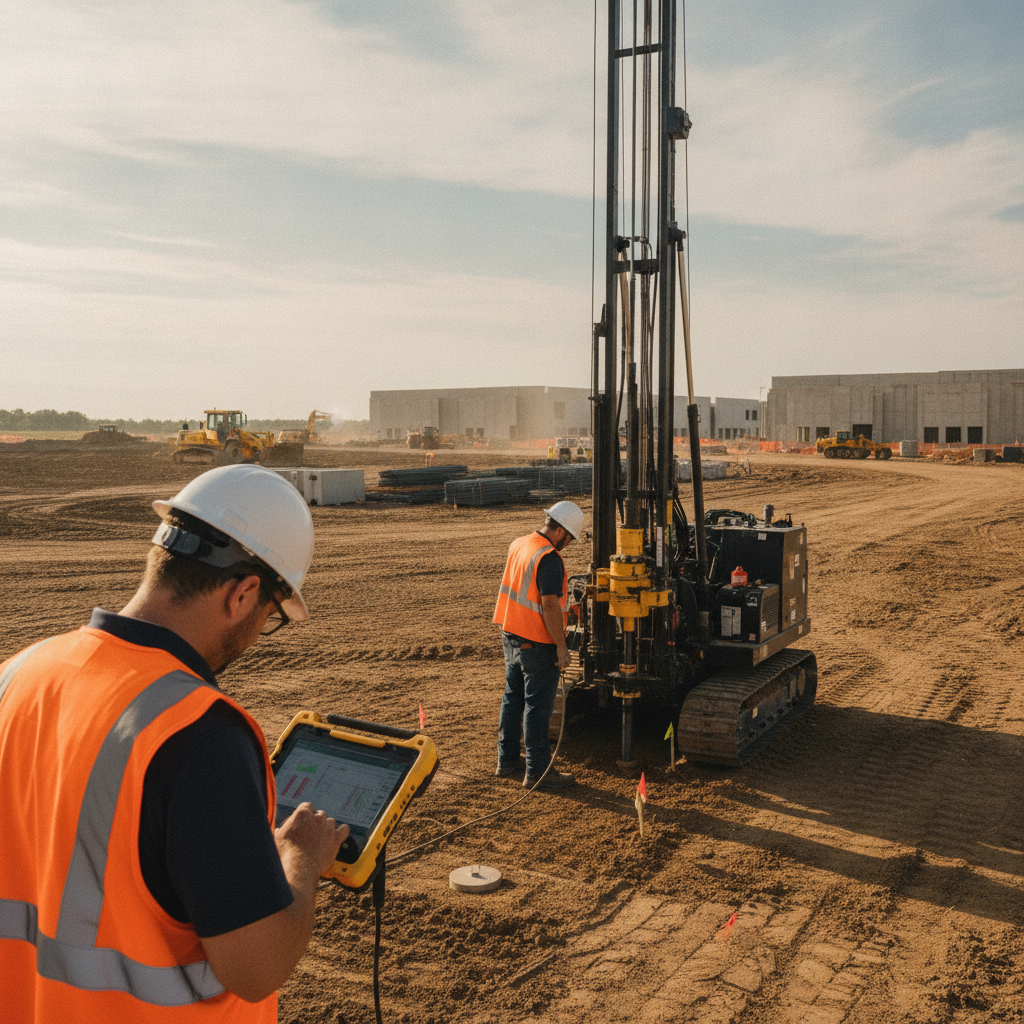
The Mechanics of Cone Penetration Testing
Cone Penetration Testing is an in-situ testing method used to determine the geotechnical engineering properties of soils. The process involves hydraulically pushing a cone-tipped probe into the ground at a constant rate of 2 cm/second. This instrumented cone is equipped with sensors that continuously measure three key parameters: tip resistance (qc), which is the force required to push the cone tip; sleeve friction (fs), the frictional force on the sleeve of the probe; and pore water pressure (u2), the water pressure generated as the probe advances. Unlike traditional methods that collect discrete samples, CPT provides a continuous data stream as the probe descends. This high-resolution profile is transmitted in real-time to a data acquisition system, allowing engineers to visualize soil stratigraphy with remarkable detail. This continuous data is crucial for identifying thin layers of weak or problematic soils that could be missed by other methods, a critical factor in designing foundations for heavy, vibration-sensitive data center structures. The entire process is managed by a qualified Geotechnical engineer to ensure data accuracy and proper interpretation.
Interpreting CPT Data for Soil Behavior Type (SBT)
CPT vs. SPT for Data Center Geotechnical Investigations
| Feature | Cone Penetration Testing (CPT) | Standard Penetration Test (SPT) |
|---|---|---|
| Data Resolution | Continuous, real-time data stream provides a high-resolution profile of soil layers. | Discrete data points, typically at 5-foot intervals, can miss thin critical layers. |
| Identification of Thin Layers | Excellent. Can detect weak or problematic seams just inches thick, crucial for preventing differential settlement. | Poor. Thin layers between test intervals are often missed entirely. |
| Soil Sampling | No physical samples are recovered; soil type is inferred from sensor data (SBT). | Recovers a disturbed physical sample suitable for visual classification and index property lab testing. |
| In-Situ Stress State | Less disturbance to the surrounding soil provides a more accurate measurement of in-situ conditions. | The dynamic driving process significantly disturbs the soil, altering its in-situ state. |
| Seismic Data (Vs) | Can be easily equipped with geophones (SCPT) to directly measure shear wave velocity for liquefaction analysis. | Requires separate, more complex downhole or crosshole seismic testing to obtain Vs data. |
| Speed and Cost-Effectiveness | Generally faster and more productive than drilling, allowing for more test locations and better site coverage. | Slower and more labor-intensive process, which can limit the number of test locations. |
A key aspect of CPT is that it does not retrieve physical soil samples. Instead, the collected data (qc, fs, u2) is used to interpret the Soil Behavior Type (SBT). By analyzing the relationship between these parameters, particularly the friction ratio (Rf)—the ratio of sleeve friction to tip resistance—engineers can classify the soil profile. For example, soft, fine-grained soils like clays will exhibit low tip resistance, high friction ratio, and significant pore pressure response. In contrast, dense, coarse-grained sands will show high tip resistance and a low friction ratio. This interpretation is fundamental for developing the geotechnical parameters needed for foundation design. The SBT classification helps engineers estimate soil density, shear strength, and consolidation characteristics. For a data center with extremely low tolerance for differential settlement, accurately identifying and characterizing compressible clay or loose sand layers is paramount. This data directly informs decisions on whether shallow foundations are feasible or if deep foundations or ground improvement techniques are required.
Continuous Profiling: The CPT Advantage Over Standard Penetration Tests (SPT)
The primary advantage of CPT over the conventional Standard Penetration Test (SPT), which is performed during a soil boring test, is its continuous data profile. SPT provides data at discrete intervals, typically every 5 feet, by driving a sampler into the soil and counting the blows. While this method yields a physical sample, it can easily miss thin, critical layers between test intervals. A 2-foot-thick layer of very soft clay, for instance, could be completely overlooked by SPT but would be clearly identified by CPT. For data centers, where uniform foundation support is essential to protect sensitive equipment, this level of detail is not a luxury—it’s a necessity. Undetected weak layers can lead to unacceptable differential settlement, causing structural distress, misaligned equipment, and potential operational failure. CPT’s continuous profiling provides the high-fidelity subsurface model needed to mitigate these risks, making it a superior tool for initial site characterization and a vital part of any comprehensive site engineering services package.
Seismic CPT (SCPT) for Dynamic Site Characterization
For data centers located in seismically active regions, or for facilities requiring an advanced level of risk assessment, Seismic CPT (SCPT) is an invaluable tool. SCPT enhances the standard CPT probe with one or more geophones. During pauses in the push, a seismic wave is generated at the surface, and the geophones measure the time it takes for the wave to travel to the probe. This allows for the direct measurement of shear wave velocity (Vs) through the soil profile. The shear wave velocity is a critical parameter for several key analyses. It is used for the seismic site classification as required by building codes like ASCE 7, which dictates the seismic design forces for the structure. Furthermore, Vs is a fundamental input for liquefaction analysis—a phenomenon where saturated, loose soils lose their strength during an earthquake. Identifying and mitigating liquefaction risk is a top priority for any mission-critical facility, and SCPT provides the direct, in-situ data needed for a reliable assessment.
Integrating CPT with Traditional Soil Borings
While CPT offers unparalleled resolution, it is not a complete replacement for traditional soil borings. The most effective geotechnical investigation programs leverage the strengths of both methods. CPT is used to quickly and cost-effectively characterize the overall site stratigraphy, identify critical layers, and select representative locations for targeted soil borings. The borings then provide the physical soil samples necessary for laboratory testing. This hybrid approach creates a powerful synergy. CPT provides the continuous “map” of the subsurface, and the soil boring test provides the “ground truth” with physical samples. Laboratory tests on these samples can confirm the CPT-based soil classification and provide definitive values for parameters like moisture content, plasticity (Atterberg limits), and shear strength. This integrated strategy, managed by experienced Civil Engineers, optimizes the investigation by maximizing data quality while managing costs, leading to a more reliable and robust Geotechnical soil report.
Limitations and Appropriate Applications of CPT
Despite its advantages, CPT is not suitable for all ground conditions. The primary limitation is its inability to penetrate very dense or coarse materials. The cone can be damaged or meet premature refusal in soils containing significant amounts of gravel, cobbles, or boulders. Similarly, it cannot penetrate solid bedrock. In these conditions, traditional drilling and rock coring methods are necessary to characterize the subsurface. Therefore, CPT is most effective in the sands, silts, and clays that are common across many development areas, including much of Florida. Understanding these limitations is key to designing an effective site investigation. A preliminary desktop study and site reconnaissance can help a Geotechnical engineer anticipate challenging ground conditions and design a program that correctly deploys CPT where it adds the most value, supplementing it with other methods as needed for a complete picture of the site development challenges.
RSP’s Process for Data Center Geotechnical Programs
At RSP Engineers, we approach data center geotechnical investigations with a rigorous, phased methodology. Our process begins with a thorough desktop study, reviewing geological maps, historical site data, and any existing reports. This informs the development of a site-specific investigation plan designed to address the unique challenges of a mission-critical facility. We champion a hybrid approach, strategically combining CPT soundings for broad site characterization with targeted soil borings for physical sampling and laboratory analysis. Our field operations are overseen by an experienced Professional Engineer to ensure the highest quality data collection. The raw CPT and laboratory data are then synthesized and interpreted by our geotechnical team to develop a comprehensive engineering model of the site. The final deliverable is a detailed Geotechnical soil report that provides clear recommendations for foundation design, earthwork, seismic considerations, and potential ground improvement measures, giving our clients the confidence to proceed with their site plan design and construction.
Common Issues in Data Center Site Investigations
Several common challenges can arise during a geotechnical investigation for a data center. One is the discovery of unexpected weak or compressible soils, such as organic deposits or undocumented fill, which can necessitate costly deep foundations or ground improvement. A high groundwater table is another frequent issue in Florida, impacting excavation, dewatering requirements, and foundation design, particularly for below-grade structures. Misinterpreting CPT data without the validation of physical samples from borings can also lead to flawed design assumptions. Another potential issue is encountering refusal on obstructions like boulders or old foundations, which can complicate both the investigation and subsequent construction. Proactively addressing these potential issues through a well-planned investigation is key to avoiding costly delays and change orders during the site development phase. A thorough program de-risks the project by identifying these problems early in the design process. Frequently Asked Questions (FAQ) How does CPT data influence foundation design for a data center? CPT data provides continuous soil strength and stiffness profiles, which are used to calculate foundation bearing capacity and predict both total and differential settlement. This information is critical for determining the appropriate foundation type—such as shallow rafts or deep piles—to ensure the structure remains stable and within the strict settlement tolerances required for data center operations. Can CPT replace soil borings entirely? No, they are best used as complementary tools. While CPT provides superior stratigraphic detail, it does not retrieve a physical sample. A soil boring test is necessary to collect samples for laboratory testing, which confirms soil classifications and provides precise measurements for parameters like moisture content, plasticity, and organic content. A comprehensive geotechnical investigation integrates both methods for the most reliable results. What is liquefaction potential and why is it critical for data centers? Liquefaction is a phenomenon where saturated, loose sandy soils temporarily lose their strength during an earthquake and behave like a liquid. This can cause catastrophic foundation failure. For a mission-critical facility like a data center, assessing this risk is vital. Seismic CPT (SCPT) is a primary tool used to evaluate liquefaction potential by measuring the soil’s shear wave velocity and density in-situ. How deep do you typically run CPT soundings for a data center project? The required depth depends on the anticipated building loads, the proposed foundation system, and the underlying soil profile. Typically, soundings must extend through all weak or compressible layers to a competent bearing stratum. For a large data center, this can often mean depths of 50 to 100 feet or more to ensure the zone of influence from the foundation loads is fully characterized. Does CPT help with stormwater design? Indirectly, yes. CPT data helps characterize the shallow soil stratigraphy, identifying the presence and thickness of sandy versus clayey layers. This information is crucial for estimating soil infiltration rates, which is a key parameter in modern stormwater management and drainage design, particularly for designing infiltration-based systems like retention ponds and exfiltration trenches common in Florida.
Your Foundation for Success Starts Here
Planning a mission-critical data center requires a geotechnical partner who understands the stakes. An inadequate site investigation can lead to costly construction overruns, long-term performance issues, and unacceptable risk. RSP Engineers provides comprehensive geotechnical investigation services, including advanced Cone Penetration Testing (CPT) and traditional soil boring test programs, to de-risk your project from the ground up. Our team of Florida Licensed Engineers delivers the data-driven insights you need for a robust and optimized foundation design. Contact us today to discuss your site development project and build with confidence.
Conclusion
Cone Penetration Testing is no longer a niche technique; it is an essential tool for the modern geotechnical investigation of data center sites. Its ability to provide continuous, real-time data offers a level of detail that is critical for identifying risks and optimizing foundation design for these high-value facilities. By integrating CPT with traditional soil borings, developers and their engineering teams can build a comprehensive subsurface model that minimizes uncertainty. Partnering with an experienced civil engineering firm like RSP Engineers ensures this powerful data is expertly interpreted and translated into a safe, reliable, and cost-effective site plan design.
FAQs
-
Data Center Cone Penetration Testing (CPT) Guide requires careful planning, qualified engineering, and compliance with the applicable codes and permits.
-
Getting Data Center Cone Penetration Testing (CPT) Guide right protects safety, supports regulatory compliance, and avoids costly redesigns or delays.
-
RSP Engineers provides licensed expertise and end-to-end support for Data Center Cone Penetration Testing (CPT) Guide, from early planning through permitting.