
Data Center Pile Foundation Design
A technical guide for developers on data center pile foundation design. Learn about pile types, geotechnical analysis, capacity, load testing, and Florida-specific considerations from RSP Engineers.
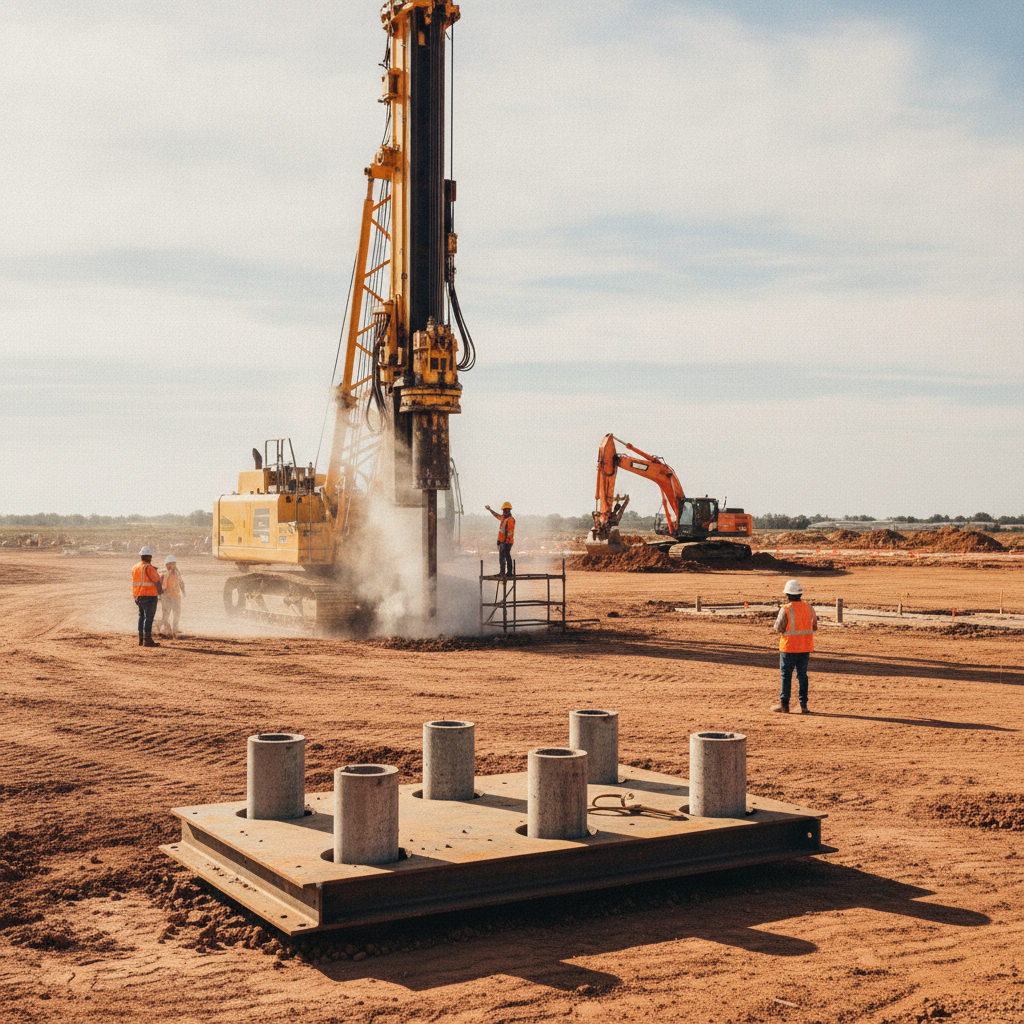
Geotechnical Investigation: The Foundation of Foundation Design
Before any design can begin, a comprehensive geotechnical investigation is paramount. This is the exploratory phase where engineers characterize the subsurface soil and groundwater conditions across the project site. The primary goal is to identify the soil strata, determine their engineering properties, and locate a suitable bearing layer that can support the data center’s concentrated loads. Without this data, any foundation design is pure speculation and carries unacceptable risk. A detailed Geotechnical soil report is the primary deliverable from this phase. Field exploration typically involves drilling a series of soil borings and conducting in-situ tests. The Standard Penetration Test (SPT) and Cone Penetration Test (CPT) are two of the most common methods used. SPT provides soil samples and a measure of soil density (N-value), while CPT provides continuous data on soil resistance. This information is critical for calculating the two primary components of pile capacity: end bearing and skin friction. The findings from the Geotechnical engineer directly influence the type, depth, and spacing of piles required, forming the basis for all subsequent site engineering services.
Pile Types and Selection Criteria for Data Centers
Pile Type Selection Matrix for Florida Data Centers
| Pile Type | Ideal Soil Conditions (Florida Specific) | Key Design Consideration | Installation Impact |
|---|---|---|---|
| Driven Precast Concrete | Deep sands over limestone or competent bearing stratum. Common in Central and South Florida. | High axial and lateral capacity. Requires careful analysis of driving stresses to prevent pile damage. | High noise and vibration. May require pre-drilling in dense upper layers. |
| Steel H-Pile | Variable soils with obstructions, boulders, or karst conditions where penetration is difficult. | Excellent for penetrating dense layers. Requires corrosion protection analysis, especially in coastal areas. | Moderate to high noise and vibration. Can be driven to high capacities. |
| Augercast (CFA) Pile | Urban infill sites or areas near existing structures sensitive to vibration. Sandy and clayey soils. | Pile integrity is paramount; requires continuous monitoring of grout pressure and volume. | Low vibration and noise. Produces soil spoils that require management. |
| Ductile Iron Pile | Sites with limited access or variable soils where a modular, driven system is beneficial. | Capacity is highly dependent on the grout-soil bond. A good option for moderate loads and underpinning. | Low to moderate vibration. Faster installation than traditional driven piles. |
| Helical Pile | Supporting ancillary structures like generator pads or communication towers. Not for main building loads. | Torque-to-capacity correlation must be calibrated with a load test. Susceptible to installation refusal on obstructions. | Very low site disturbance, minimal vibration. Rapid installation. |
Not all piles are created equal. The selection of a pile type is a critical decision based on the soil conditions, load requirements, site constraints, and project budget. Each system has distinct advantages and is suited for different applications. A Professional Engineer must weigh these factors carefully to specify the most effective and economical solution for the data center’s unique demands. Driven Piles (Precast Concrete & Steel) Driven piles are displacement piles, meaning they are forced into the ground, displacing soil. Precast concrete piles are extremely common in Florida due to their durability and high load capacity. Steel H-piles are also used, particularly when needing to penetrate dense layers or obstructions. The key advantage of driven piles is the quality control inherent in their off-site fabrication and the verification of capacity that occurs during installation via the driving record. Augercast Piles (Continuous Flight Auger) Augercast, or CFA, piles are installed by drilling into the ground with a hollow-stem continuous flight auger. As the auger is withdrawn, high-strength grout is pumped through the hollow stem to form the pile. A steel reinforcing cage is then lowered into the wet grout. This method is advantageous in urban or vibration-sensitive areas as it generates minimal noise and ground vibration compared to driven piles. However, it requires stringent quality control during installation to ensure pile integrity. Helical Piles Helical piles are screwed into the ground using hydraulic equipment. They consist of a central steel shaft with one or more helix-shaped bearing plates. They are excellent for lighter loads or sites with limited access, as the installation equipment is smaller. While less common for the main structure of a massive data center, they can be ideal for supporting ancillary equipment, utility platforms, or as part of a retrofit solution.
Understanding Pile Capacity: Skin Friction vs. End Bearing
A pile derives its ability to support a load from two fundamental mechanisms: end bearing and skin friction. End bearing is the resistance generated at the tip of the pile, where it rests on a dense or hard stratum like rock or very dense sand. It functions much like a simple column. Skin friction, or side friction, is the adhesive and frictional force that develops along the entire embedded length of the pile shaft as it interacts with the surrounding soil. The total ultimate capacity of a pile is the sum of these two components. The geotechnical analysis, based on SPT and CPT data, determines the relative contribution of each mechanism. In a soil profile with a very strong layer at a reasonable depth, piles might be designed primarily for end bearing. In more uniform, deep deposits of clay or sand, skin friction will be the dominant source of capacity. The final allowable design load is determined by applying a significant factor of safety to the calculated ultimate capacity, ensuring a robust design that accounts for uncertainties in soil properties and construction tolerances.
Pile Group Behavior and Pile Cap Design
In a data center project, piles are almost never used individually. Instead, they are installed in groups and connected at the surface by a large, reinforced concrete block known as a pile cap. The pile cap’s function is to distribute the massive, concentrated load from a building column evenly across the entire pile group. The design of the pile cap is a crucial structural engineering task that involves analyzing shear and bending moments to ensure it can transfer loads without failing. The behavior of a pile group is more complex than that of a single pile. The installation of multiple piles in close proximity can alter the soil stress and reduce the overall capacity compared to the sum of the individual pile capacities. This phenomenon is known as the group efficiency factor, which engineers must account for in the design. The spacing of piles is critical—typically at least three times the pile diameter—to minimize these negative interaction effects and ensure the foundation performs as a single, cohesive unit as part of the overall site plan design.
Addressing Lateral Loads and Seismic Considerations
Data centers must be designed to resist significant lateral loads from wind and, in certain zones, seismic events. Pile foundations play a critical role in transferring these horizontal forces safely into the ground. A vertical pile resists lateral load through a combination of shear and bending, mobilizing passive soil pressure near the ground surface. The pile’s stiffness, its connection to the pile cap, and the soil properties all influence its lateral capacity. For facilities with very high lateral loads, engineers may specify battered piles—piles driven at an angle—which are highly efficient at resisting horizontal forces. The design must also adhere to the stringent requirements of the Florida Building Code, which dictates the design loads and performance criteria for mission-critical facilities. A thorough analysis ensures the foundation system provides stability not just for gravity loads but for all potential loading scenarios, protecting the facility and its sensitive equipment from displacement or damage.
Pile Installation, Monitoring, and Quality Control
The success of a pile foundation hinges on proper installation and rigorous quality control. For driven piles, this process is monitored by a geotechnical engineer or an engineering technician who maintains a detailed driving record for every pile. This log tracks the number of hammer blows required to drive the pile each foot of depth. When the blow count reaches a predetermined value (the termination criteria), it provides a real-world confirmation that the pile has achieved the required bearing capacity. During installation, it is crucial to monitor for issues like pile heave (uplift of adjacent piles) and lateral displacement. Tolerances for pile location and verticality are extremely tight and must be verified continuously. For augercast piles, quality control involves monitoring grout volume, pressure, and taking regular samples for strength testing. This active oversight, a key part of construction administration, ensures that the foundation constructed in the field matches the design intent and will perform as expected for the life of the data center.
Process: RSP Engineers’ Approach to Pile Foundation Design
At RSP Engineers, we follow a systematic process to ensure foundation designs are safe, efficient, and constructible. Our approach integrates geotechnical insights with practical structural engineering to deliver reliable solutions for mission-critical facilities. Comprehensive Geotechnical Review: We begin by commissioning or thoroughly reviewing the Geotechnical soil report, collaborating with the Geotechnical engineer to understand the site’s opportunities and constraints. Integrated Foundation System Analysis: Our team analyzes the data center’s structural loads and performance requirements to select the optimal pile type and configuration. We model pile group behavior and design efficient pile caps. Detailed Construction Document Production: We produce a complete set of foundation plans and specifications, including pile layout, reinforcement details, installation criteria, and required testing protocols for the permit submittals. Permitting and Agency Coordination: We navigate the complex permitting process with local and state agencies, ensuring the design complies with the Florida Building Code and all relevant regulations. Construction Administration and Testing Oversight: We provide robust Construction Management Services, observing pile installation, reviewing driving records, and coordinating required load testing to verify the foundation’s as-built capacity.
Common Issues in Data Center Foundation Projects
Even with careful planning, deep foundation projects can encounter challenges. Anticipating these issues is key to keeping a project on schedule and within budget. Unexpected Subsurface Conditions: The soil boring test provides data at discrete locations, but unforeseen conditions like buried debris, old foundations, or solution voids in limestone can exist between borings, causing pile refusal or installation delays. Vibration and Noise Compliance: Pile driving, in particular, can exceed local noise and vibration ordinances, requiring expensive monitoring programs and potentially limiting work hours, impacting the construction schedule. Pile Installation Tolerances: Achieving the strict positional and vertical alignment tolerances for piles can be challenging. Out-of-tolerance piles may require costly remediation or redesign by the Professional Engineer. Utility Conflicts: Deep foundation elements can conflict with existing or proposed underground utilities. Thorough utility coordination and subsurface utility engineering (SUE) are essential to deconflict the site before installation begins.
Partner with RSP Engineers for Your Mission-Critical Foundation
A data center’s foundation is too critical to leave to chance. Success requires a deep understanding of geotechnical engineering, structural design, and the practical realities of construction in Florida’s unique geological environment. RSP Engineers provides the expert site engineering services needed to navigate these complexities. From initial site feasibility and Geotechnical analysis to final construction administration, our team ensures your digital infrastructure is built on a foundation of certainty. Contact us today to discuss your data center’s site development and foundation design needs.
Conclusion
The design and construction of a pile foundation for a data center is a sophisticated engineering endeavor that is fundamental to the facility’s long-term performance and reliability. It requires a meticulous process that begins with a thorough geotechnical investigation, moves through careful pile selection and capacity analysis, and concludes with rigorous construction administration and quality control. By understanding the interplay between soil mechanics, structural engineering, and construction methods, developers can ensure their critical assets are supported by a foundation designed for resilience. Ultimately, a successful project relies on the expertise of experienced Civil Engineers to translate complex subsurface data into a robust and efficient foundation system.
FAQs
-
Field verification is critical. The most common methods are Dynamic Load Testing (PDA), which uses sensors to measure pile performance during hammer strikes, and Static Load Testing, where a physical load is incrementally applied to a test pile. Additionally, Pile Integrity Testing (PIT) is often used to check for defects along the pile shaft.
-
The Geotechnical soil report, prepared by a Geotechnical engineer, provides the subsurface data, analysis, and recommendations for suitable foundation types and design parameters (e. g. , allowable pile capacity). The structural foundation plan, prepared by a structural or Civil Engineer near me, is the actual construction drawing that shows the specific pile type, size, location, reinforcement, and pile cap details based on those recommendations.
-
Absolutely. Existing underground utilities for water, sewer, gas, and communications are a major constraint. A comprehensive utility coordination effort is required to identify and map all existing lines. Piles cannot be installed through utilities, so the foundation layout must be adjusted, or utilities must be relocated, which can be a significant cost and schedule factor.