
Data Center Pavement Design
A technical guide to data center pavement design in Florida. Learn about rigid vs. flexible pavements, subgrade stabilization, drainage, and engineering for heavy vehicle loads with RSP Engineers.
Understanding the Unique Loading Demands of Data Center Campuses
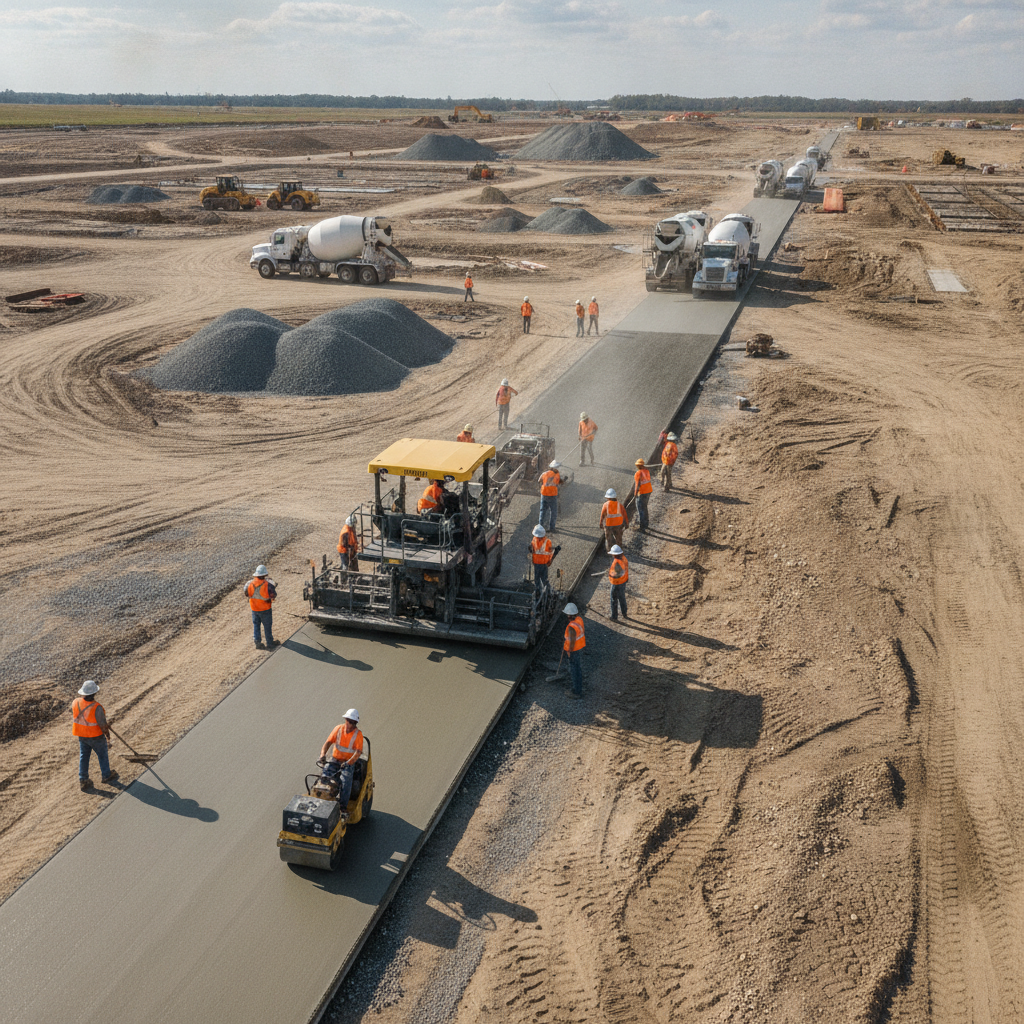
Data center sites are subjected to vehicle loads that far exceed those of typical commercial or industrial properties. The design must anticipate not only daily traffic but also the extreme loads imposed during construction, equipment installation, and emergency situations. These include semi-trucks delivering generators and chillers, concrete trucks for expansions, and fully-loaded fuel tankers for backup power systems. A key consideration is the weight of fire apparatus access, as modern ladder trucks can impose axle loads of over 24,000 pounds, requiring a pavement section designed for exceptional shear strength. Unlike a warehouse with predictable shipping schedules, a data center’s heaviest loads can be concentrated in specific areas, such as equipment pads and loading docks, where they remain static for extended periods. This requires a structural pavement design that resists deformation, punching shear, and long-term creep. Our engineering approach involves a detailed analysis of anticipated traffic, vehicle types, and load frequencies to develop a pavement section that ensures performance throughout the facility’s lifecycle, making it a core component of the mission-critical infrastructure.
Subgrade Evaluation and Stabilization: The Foundation of Durability
Pavement Type Comparison for Data Center Applications
| Application Area | Recommended Pavement Type | Key Design Considerations | Typical Lifespan (with maintenance) |
|---|---|---|---|
| Generator/Chiller Pads | Rigid (Reinforced Concrete) | Extreme static loads, vibration resistance, fuel/coolant spill resistance, thickened edge design. | 30-40+ years |
| Fuel/Loading Docks | Rigid (Reinforced Concrete) | High-impact loads, punching shear from trailer landing gear, heavy axle loads, joint dowel bars for load transfer. | 25-35 years |
| Primary Access Roads | Rigid (PCC) or Heavy-Duty Flexible (Asphalt) | Repetitive heavy truck traffic, fire apparatus access, turning radii, life-cycle cost. Asphalt requires a very robust subbase. | 20-30 years (Rigid), 15-20 years (Flexible) |
| Fire Access Lanes | Rigid (PCC) or Reinforced Turf | Must support maximum fire truck axle loads (e.g., 24,000 lbs), clear width requirements, turning radii, and grade limitations. | 30+ years |
| Employee Parking | Flexible (Asphalt) | Standard vehicle loads, ADA compliance for slopes and striping, integration with pedestrian walkways. | 15-20 years |
The long-term performance of any pavement system is fundamentally dependent on the strength and stability of the underlying soil, or subgrade. In Florida, engineers often contend with sandy soils, organic materials, and a high water table, all of which can compromise the load-bearing capacity of the native ground. A comprehensive geotechnical investigation is the mandatory first step, providing critical data on soil composition, density, and moisture content. This investigation yields key metrics like the California Bearing Ratio (CBR) or Resilient Modulus, which directly inform the pavement thickness calculations. Where the native subgrade is weak, soil stabilization becomes a cost-effective necessity. Techniques such as mixing cement or lime into the soil can dramatically increase its strength and stiffness, creating a solid platform for the pavement structure. In other cases, the use of geogrids or geotextile fabrics can help distribute loads more effectively and prevent the base material from migrating into the subgrade. Proper subgrade preparation, including compaction and grading, is essential for preventing differential settlement that can lead to pavement cracking and failure, especially under the unique Florida soil conditions.
Rigid vs. Flexible Pavement: A Critical Design Choice
The primary decision in pavement design for data centers is the choice between rigid and flexible systems. Flexible pavement (asphalt) consists of multiple layers of asphaltic concrete over an aggregate base. It is generally less expensive upfront and offers a smoother, quieter ride, making it suitable for employee parking lots and general access roads with lighter, transient traffic. However, it is more susceptible to deformation (rutting) under heavy, static loads and requires more frequent maintenance over its lifespan. Conversely, rigid pavement (PCC), made of Portland Cement Concrete, offers superior strength and durability. Its rigidity allows it to distribute concentrated loads over a much wider area of the subgrade, making it the ideal choice for generator pads, loading docks, and heavy equipment yards. While the initial construction cost is higher, its longer service life and lower maintenance needs often result in a more favorable life-cycle cost analysis. The final design for a data center campus typically employs a hybrid approach, strategically using each pavement type where its performance characteristics are best suited to the specific load distribution requirements.
Designing the Pavement Section: Base, Subbase, and Surface Course
A heavy-duty pavement system is a layered structure, with each component serving a distinct purpose. The overall thickness and material composition of this pavement section are engineered based on the subgrade strength and the anticipated traffic loads. The lowest layer, the prepared subgrade, is the foundation. Above it sits the subbase course, often composed of granular fill, which provides additional structural support, aids in drainage, and acts as a buffer against frost heave in colder climates. The aggregate base course is the primary load-distributing layer, typically constructed from dense-graded crushed stone like Florida limerock or recycled concrete. Its quality and compaction are critical to the pavement’s structural integrity. Finally, the surface course—either asphalt or concrete—provides the smooth, durable, and weather-resistant driving surface. The thickness of each layer is precisely calculated to ensure that stresses transferred to the subgrade remain well below its failure point. This layered approach is integral to achieving a resilient system and is a core part of the site’s overall drainage design.
Critical Details in Concrete Pavement: Jointing and Reinforcement
For rigid pavement areas, the design of joints is as important as the concrete’s thickness and strength. Concrete naturally expands and contracts with changes in temperature and moisture, and without proper jointing, this movement would cause uncontrolled, random cracking. A well-designed system of concrete jointing accommodates this movement in a controlled manner. Control joints (or contraction joints) are saw-cut into the slab to create weakened planes that encourage cracking to occur in a straight, predictable line. Expansion joints are used to separate slabs from buildings or other structures to allow for movement without creating compressive stress. In areas with heavy truck traffic, such as loading docks, ensuring load transfer efficiency across these joints is critical. This is achieved using steel dowel bars, which are smooth, round bars placed across transverse joints to transfer vertical loads from one slab to the next without restricting horizontal movement. Tie bars, which are deformed steel bars, are used across longitudinal joints to hold adjacent slabs together. This combination of jointing and steel reinforcement is essential for preventing faulting, spalling, and premature failure of the pavement.
Integrated Stormwater Management and Pavement Drainage
Effective drainage is non-negotiable for pavement longevity. Water that penetrates the pavement structure can weaken the subgrade and base layers, leading to rapid deterioration. A comprehensive stormwater management plan must be integrated directly into the pavement design. This begins with proper surface drainage, achieved by grading the pavement surface with a precise cross-slope (typically 2%) to direct water towards collection points like curb and gutter systems, catch basins, or trench drains. In addition to surface runoff, subsurface drainage may be necessary in areas with high groundwater or poorly draining soils. This can involve installing perforated pipes or edge drains along the pavement perimeter to intercept and carry away water that infiltrates the base course. For non-critical areas like overflow parking, permeable pavements can be considered as part of a low-impact development strategy, though they are generally not suitable for heavy-duty applications. Ultimately, the pavement grading plan is a foundational element of the site’s civil engineering drawings and is critical for securing stormwater permitting from agencies like the Water Management Districts in Florida.
RSP Engineers’ Approach to Data Center Pavement Design
At RSP Engineers, our process for designing data center pavement is systematic and data-driven, ensuring that the final product meets the stringent demands of mission-critical operations. We begin with a collaborative pre-design phase, working with the client to understand the full scope of operational loads, from construction phasing to long-term maintenance vehicle traffic. This is followed by a thorough geotechnical investigation to characterize the site’s soil and groundwater conditions, which forms the basis of our engineering calculations. Our civil engineering team then performs a detailed pavement analysis, modeling various load scenarios and comparing the life-cycle costs of different pavement sections. We produce a comprehensive set of construction documents that specify materials, thicknesses, jointing plans, and crucial grading for stormwater management. During construction, we provide construction administration services, including submittal reviews and on-site observation, to verify that the pavement is built in strict accordance with the design specifications, ensuring quality and long-term durability.
Common Issues and Costly Oversights in Pavement Design
Several common oversights can compromise the integrity and lifespan of data center pavement, leading to expensive repairs and operational disruptions. The most frequent issue is inadequate subgrade preparation, where insufficient compaction or failure to stabilize weak soils leads to settlement and premature pavement failure. Another costly mistake is underestimating the true weight and frequency of vehicle loads, particularly specialized delivery vehicles and emergency apparatus, resulting in a pavement section that is too thin and structurally deficient from day one. Poor drainage design is another critical failure point. If water is allowed to pond on the surface or saturate the base course, it will inevitably lead to potholes, cracking, and subgrade failure. Finally, improper jointing in concrete pavements—such as incorrect spacing or inadequate load transfer mechanisms—can cause spalling, faulting, and large-scale cracking that is difficult and expensive to repair. A proactive, engineering-led approach is the best way to avoid these preventable and costly issues.
Partner with RSP Engineers for Your Mission-Critical Site Development
Designing and engineering a data center campus requires a deep understanding of mission-critical requirements, from utility coordination to pavement performance. The success of your facility depends on a foundation that is as resilient as your digital infrastructure. The team at RSP Engineers provides the expert civil engineering services needed to deliver a robust and reliable site. We specialize in heavy-duty pavement design, integrated stormwater management, and navigating the complex permitting process in Florida. Don’t let an overlooked detail like pavement compromise your multi-million dollar investment. Let our team of experienced engineers provide the robust site design your project deserves. Contact us today to discuss your data center development project and learn how we can help ensure its success from the ground up.
Building a Resilient Foundation for Digital Infrastructure
In conclusion, the pavement at a data center is far more than a simple surface; it is a critical engineered asset essential for operational continuity. A successful design hinges on a thorough understanding of the unique load demands, careful geotechnical analysis, and an intelligent selection of materials. By focusing on a robust pavement design, integrated stormwater management, and meticulous construction administration, developers can ensure their facility is built on a foundation that is durable, reliable, and ready to support the demands of the digital age. Investing in expert civil engineering at the outset is the most effective way to guarantee long-term performance and protect the operational integrity of the entire campus.
FAQs
-
Data center pavement must support not only standard truck traffic but also extreme, concentrated loads from equipment like multi-ton generators, chillers, and fuel tankers. Furthermore, the requirement for 100% uptime means the pavement design must be exceptionally resilient to prevent any disruption to site access or operations, including for critical fire and emergency vehicles.
-
The geotechnical soil report is the foundation of the entire design. It provides essential data on the subgrade’s strength (CBR value), composition, and moisture levels. Without this information, engineers cannot accurately calculate the required thickness of the pavement layers, leading to a design that is either over-engineered and expensive or under-engineered and prone to failure.
-
Permeable pavements can be an effective tool for stormwater management in low-traffic areas like employee or visitor parking. However, they are generally not recommended for areas subjected to heavy truck traffic, such as loading docks or main access roads, as their structural capacity is lower than that of conventional asphalt or concrete systems.