
Data Center Mat Foundation Design
A technical guide to mat (raft) foundation design for data centers in Florida. Learn about soil-structure interaction, differential settlement control, and mass concrete challenges from RSP Engineers.
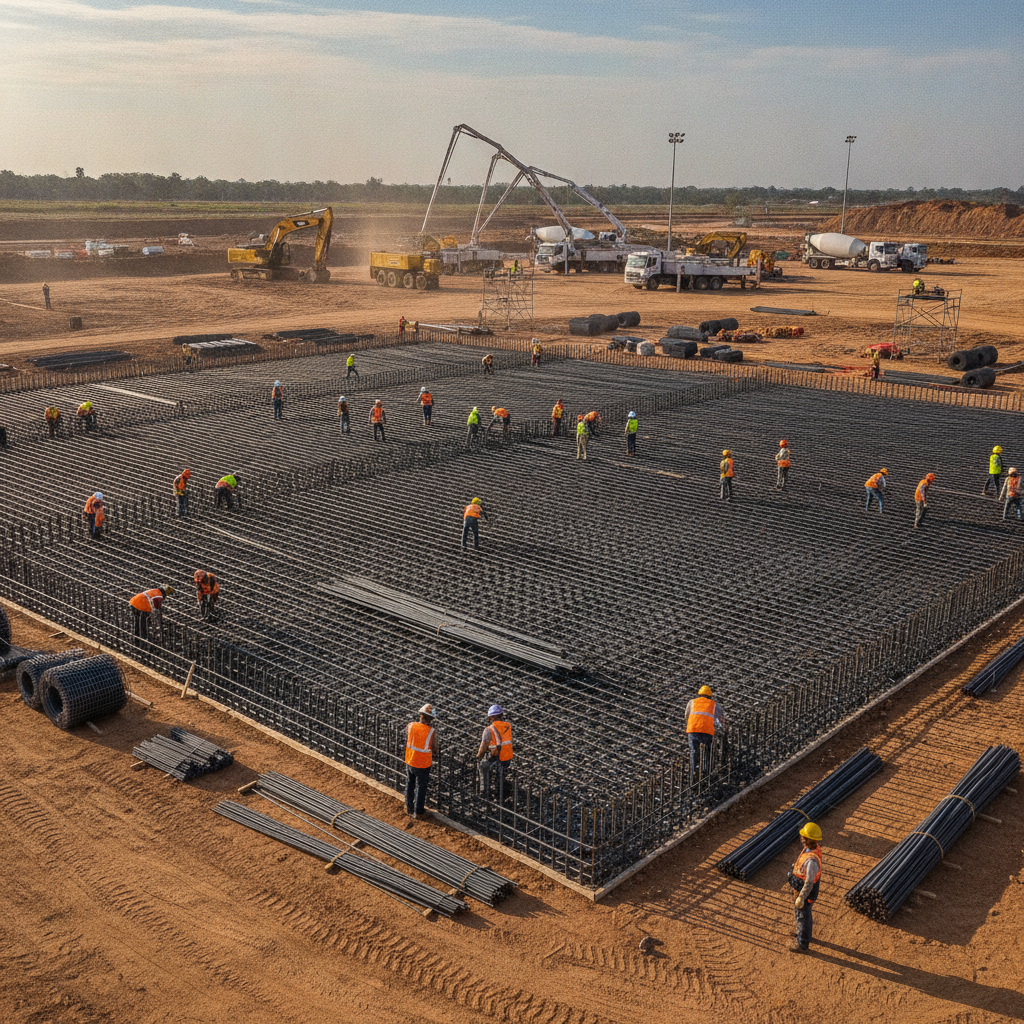
When to Choose a Mat Foundation Over Isolated Footings
The decision to use a mat foundation is driven by a combination of structural loads and subsurface soil conditions identified during the geotechnical investigation. While isolated spread footings are often sufficient for standard commercial structures, data centers present unique challenges. A mat is typically specified when the soil bearing capacity is low, meaning the soil cannot safely support the concentrated loads from individual columns. This is a common scenario in many parts of Florida, where sandy or organic soils are prevalent. Furthermore, if the building’s column loads are so high and spaced so closely that the required isolated footings would nearly touch or overlap, it becomes more practical and economical to pour a single mat. This approach simplifies formwork and construction sequencing. Most importantly, a mat foundation is the superior choice for controlling differential settlement, which is the uneven settling of a building’s foundation. For a data center, where even millimeters of uneven movement can compromise equipment and utility connections, the rigidity of a mat is a non-negotiable advantage. The initial site plan design must account for these geotechnical realities from day one.
Analyzing Soil-Structure Interaction and Subgrade Reaction
Foundation System Comparison: Isolated Footings vs. Mat Foundation
| Feature | Isolated Spread Footings | Mat (Raft) Foundation |
|---|---|---|
| Ideal Soil Conditions | High to moderate soil bearing capacity; uniform soil profile. | Low or variable soil bearing capacity; non-uniform soils with weak zones. |
| Load Distribution | Loads are concentrated directly under columns. | Loads are distributed uniformly across the entire building footprint. |
| Differential Settlement Control | More susceptible to differential settlement if soil conditions vary. | Excellent control; provides high rigidity to bridge weak spots and minimize uneven movement. |
| Construction Complexity | Involves multiple, separate excavations and concrete pours. Can be complex if footings are numerous and close together. | Requires a single large excavation and a massive, continuous concrete pour. Demands significant logistical planning. |
| Cost Implications | Generally lower cost for materials and labor on sites with good soil. | Higher initial material cost (concrete and steel) but can be more economical than deep foundations or extensive soil improvement. |
| Suitability for High Water Tables | Can be challenging; requires dewatering for each individual footing excavation. | Provides a continuous barrier against groundwater and its weight helps resist hydrostatic uplift. |
A mat foundation does not exist in isolation; it works as part of an integrated system with the underlying soil. This relationship is known as soil-structure interaction. To properly design the mat, engineers must quantify how the soil will deform under load, a property represented by the modulus of subgrade reaction (k). This value, derived from the Geotechnical soil report, indicates the soil’s stiffness and is a critical input for the structural analysis. It is not a single constant but can vary across the site, requiring careful modeling. Our engineers use sophisticated finite element analysis (FEA) software to model this interaction. The software treats the mat as a flexible plate resting on a series of springs, with each spring’s stiffness defined by the modulus of subgrade reaction. This allows us to predict soil pressures, foundation bending moments, and shear forces with high accuracy. This detailed analysis ensures the mat is designed efficiently, with adequate thickness and reinforcement only where needed, preventing over-design while guaranteeing performance and satisfying all Florida Building Code requirements.
Controlling Differential Settlement in Mission-Critical Facilities
For a data center, the primary enemy is differential settlement. If one part of the building settles more than another, it can twist the structural frame, crack walls, and, most critically, misalign server racks, damage sensitive fiber optic connections, and break rigid utility conduits. The consequences range from operational disruptions to catastrophic equipment failure. A rigid mat foundation is the most effective defense against this risk, especially on sites with variable soil profiles or pockets of weak, compressible soil. By creating a single, stiff structural element, the mat foundation forces the building to settle more uniformly. The inherent rigidity of the thick, heavily reinforced slab bridges over weaker soil zones and distributes loads to stronger areas. This minimizes angular distortion across the building footprint, protecting the sensitive equipment and infrastructure within. The design process involves setting strict tolerance limits for both total and differential settlement and then adjusting the mat’s thickness and reinforcement design until those performance criteria are met through analysis.
Key Drivers of Mat Thickness and Reinforcement Design
The two primary factors governing a mat’s thickness are punching shear and bending moments. Punching shear is the risk of a heavily loaded column punching through the concrete slab. The mat must be thick enough to resist this force at each column location, particularly for interior columns carrying significant roof and equipment loads. Bending moments, which are highest at the columns and across the center of the mat, also drive thickness and require substantial steel reinforcement. A typical data center mat foundation will have two layers of heavy reinforcing steel—one near the top surface and one near the bottom—running in both directions. The bottom steel resists the tension caused by upward soil pressure, while the top steel handles the tension from the downward column loads. The specific size, spacing, and grade of this rebar are determined by the finite element analysis. The overall concrete strength and mix design are also critical components, engineered to provide the necessary durability and structural capacity for a design life of 50 years or more.
Addressing Uplift and Buoyancy in Florida’s High Water Tables
A unique challenge in Florida civil engineering is the prevalence of high groundwater tables. For any structure with a basement or a deep foundation, groundwater can exert significant hydrostatic pressure, or uplift, on the bottom of the slab. A large, relatively lightweight structure could theoretically be lifted or become buoyant if this force is not properly counteracted. A mat foundation’s immense self-weight is a primary defense against these uplift forces. During the design phase, our Civil Engineers calculate the maximum potential uplift force based on the highest anticipated groundwater level, often determined by seasonal factors and local stormwater management data. The total weight of the mat foundation and the structure above it must be sufficient to overcome this force with a factor of safety. In some cases, temporary or permanent dewatering systems may be required during construction to keep the excavation dry and manage hydrostatic pressure until the building’s full dead load is in place.
Mass Concrete Pour Logistics: Thermal Control and Curing
Constructing a mat foundation involves placing a massive volume of concrete in a single, continuous operation, known as a mass concrete pour. This process presents significant logistical and technical challenges. As concrete cures, it generates a large amount of heat through an exothermic chemical reaction called the heat of hydration. If this heat is not managed, the temperature difference between the core of the slab and its surface can cause significant stress, leading to thermal cracking. To mitigate this, a detailed thermal control plan is essential. This often involves specifying a specialized concrete mix design that uses supplementary cementitious materials like fly ash or slag to reduce the heat generated. Other techniques include using chilled water in the mix, insulating the concrete surface after placement to allow for slow and even cooling, or even embedding cooling pipes within the slab for very large pours. Proper curing procedures, using curing compounds or wet blankets, are also critical to ensure the concrete reaches its full design strength and durability.
RSP Engineers’ Approach to Mat Foundation Design
At RSP Engineers, our process for designing data center mat foundations is comprehensive and collaborative. It begins with a deep dive into the client’s operational requirements and a thorough review of the Geotechnical soil report. We work closely with geotechnical specialists to ensure we have a complete understanding of the subsurface conditions. This initial phase of due diligence is critical for successful site development and risk mitigation. Our structural and civil teams then collaborate to develop an integrated design. Using advanced FEA modeling, we run multiple iterations to optimize the mat’s thickness, reinforcement, and subgrade preparation, balancing performance with cost-effectiveness. We meticulously coordinate the locations of all under-slab utilities, electrical conduits, and plumbing to ensure they are properly embedded without compromising structural integrity. This integrated approach extends through the permitting process, where we provide clear documentation to satisfy agency review, and into construction administration, where we observe the work to ensure it complies with the design intent.
Common Challenges and Pitfalls in Mat Foundation Projects
Even with a robust design, mat foundation projects can encounter challenges. One of the most common issues is an incomplete or inaccurate geotechnical investigation, which can lead to costly redesigns late in the process. Another frequent pitfall is poor coordination of under-slab infrastructure. Failing to properly locate and sleeve for future utility penetrations can result in expensive and risky core drilling through the finished foundation. During construction, the logistics of a mass concrete pour are a major hurdle. Any disruption to the concrete supply, pump failure, or sudden change in weather can jeopardize the entire pour. Finally, inadequate dewatering during excavation in areas with high groundwater can lead to soil instability and compromise the subgrade, affecting the long-term performance of the foundation. Careful planning and experienced Construction Management Services are essential to navigate these potential issues.
Partner with RSP Engineers for Your Mission-Critical Project
Designing a foundation for a mission-critical facility requires a deep understanding of structural engineering, geotechnical principles, and the unique operational demands of the data center industry. At RSP Engineers, we provide the expert civil engineering and structural design services needed to deliver stable, resilient, and cost-effective foundation solutions. From initial site development planning and geotechnical coordination to detailed reinforcement design and construction administration, our team is equipped to handle the complexities of your project. Don’t leave the stability of your critical infrastructure to chance. Contact us today to discuss how our team of Florida Licensed Engineers can support your next data center development. Let’s build the future of digital infrastructure on a solid foundation. Visit our website or contact our office to schedule a consultation.
Ensuring Long-Term Stability for Digital Infrastructure
In conclusion, a mat foundation is more than just a slab of concrete; it is a highly engineered system designed to provide a stable and unyielding base for the world’s most critical digital assets. Its ability to distribute immense loads, control differential settlement, and provide resilience against challenging soil and groundwater conditions makes it an indispensable tool in data center construction. The success of these projects hinges on a meticulous design process that fully integrates geotechnical data with advanced soil-structure interaction analysis. By investing in a robust and well-designed mat foundation, data center developers and operators can ensure the long-term structural integrity and operational uptime of their facilities. As a leading civil engineering firm near me, RSP Engineers is committed to delivering the engineering excellence required to meet these exacting standards, providing the bedrock for the technology of tomorrow.
FAQs
-
The Geotechnical soil report is the single most important document for foundation design. It provides critical data on soil bearing capacity, settlement potential, the presence of weak soil layers, and the depth of the water table. This information directly informs the modulus of subgrade reaction used in our structural models and determines whether a mat foundation is necessary in the first place.
-
While versatile, a mat foundation is not a universal solution. On sites with extremely poor, highly compressible soils like peat or organic muck, a mat may not be sufficient to control settlement. In such cases, a deep foundation system using piles or caissons might be required to transfer loads to a deeper, more competent soil layer. The choice is always driven by a site-specific geotechnical investigation.
-
The thickness can vary significantly based on column loads, soil conditions, and building size, but it typically ranges from 30 inches to 60 inches or more for large data centers. The final thickness is engineered to satisfy requirements for punching shear and bending capacity across the entire slab.