
Data Center Karst Terrain Engineering
A technical guide for data center developers on navigating the challenges of karst terrain in Florida, covering geotechnical investigations, foundation design, and stormwater management.
Understanding Karst Geology and Its Impact on Site Viability
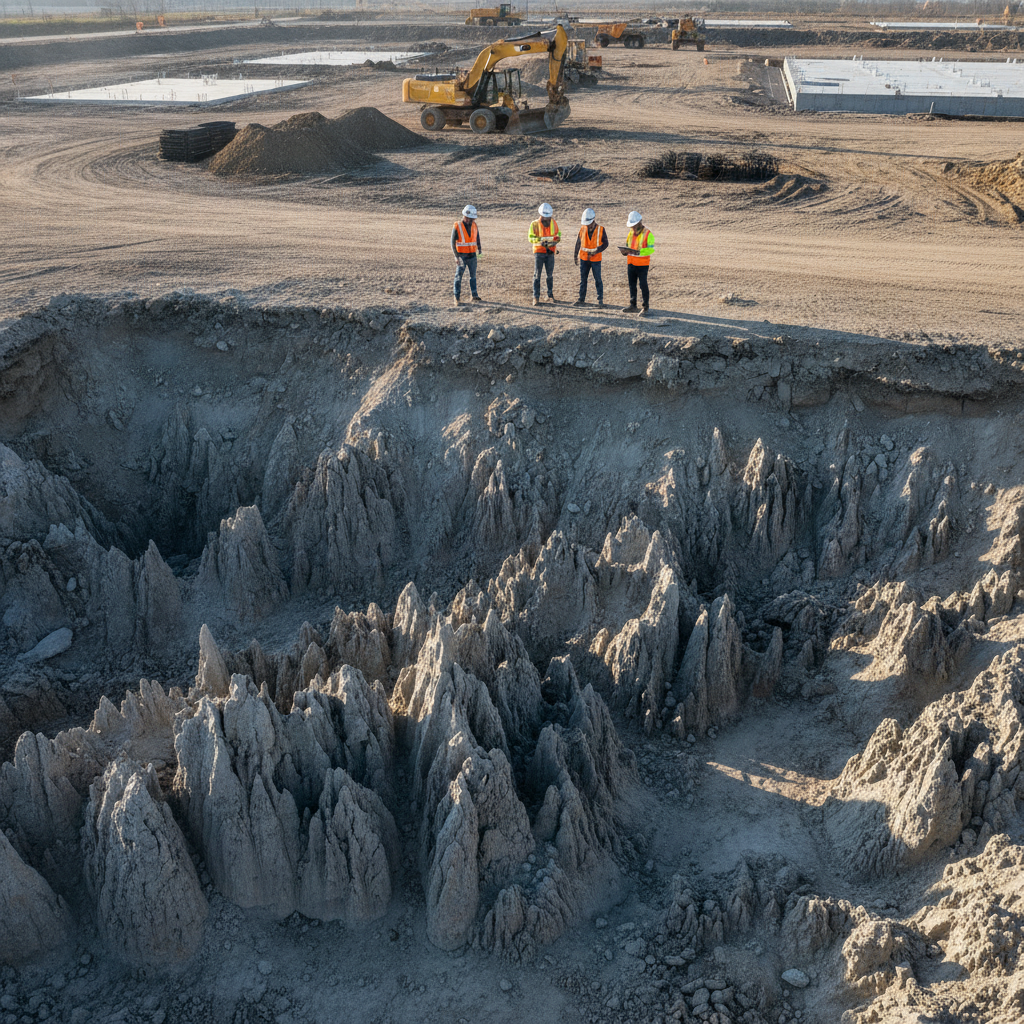
Karst is a landscape defined by what you can’t see. The slow dissolution of limestone by slightly acidic groundwater creates a network of underground conduits, voids, caves, and sinkholes. On the surface, this manifests as an extremely irregular bedrock profile known as pinnacled rock. Instead of a flat, predictable surface, the top of competent rock can vary by tens of feet over very short distances. This creates a significant risk of differential settlement, where different parts of a massive, heavy data center foundation settle at different rates, inducing catastrophic stress on the structure and its sensitive equipment. A critical component of this landscape is the epikarst—a transitional zone of highly weathered, fractured rock and soil directly above the more solid limestone. This zone is often soft, unpredictable, and capable of concealing deep voids. For a data center with zero tolerance for movement, building on or within the epikarst is not an option. A comprehensive geotechnical investigation is the only way to accurately map this subsurface topography and inform a viable foundation design, turning an unknown liability into a manageable engineering parameter.
Advanced Geotechnical Investigation Strategies for Karst Sites
Foundation Design Approaches in Karst Terrain
| Foundation Type | Primary Application | Key Considerations | Relative Cost |
|---|---|---|---|
| Shallow Spread Footings | Not recommended for data centers in karst. | Highly susceptible to differential settlement from voids and pinnacled rock. | Low (but inappropriate) |
| Over-Excavation & Structural Fill | Sites with shallow, moderately irregular rock. | Requires removal of all unsuitable soil and epikarst to create a uniform bearing surface. Can be cost-prohibitive if rock is deep. | Moderate to High |
| Mat Foundation | Spans minor irregularities and distributes load over a large area. | Requires extensive ground improvement (grouting) and a very thick, heavily reinforced slab. Still vulnerable to large-scale settlement. | High |
| Deep Foundations (Micropiles/Drilled Shafts) | The most common and reliable solution for significant top-of-rock variability. | Bypasses weak soils and epikarst to transfer loads directly to competent bedrock. Requires specialized contractors and rigorous quality control. | Very High |
| Compaction/Void Grouting | Used as a ground improvement technique to support mat foundations or stabilize specific zones. | Densifies loose soils and fills small to medium voids. Effectiveness must be verified with post-grouting testing. | Moderate to High |
Standard site development due diligence, such as a sparse grid of soil borings, is dangerously inadequate in karst terrain. A boring might hit solid rock, while just a few feet away, a deep, soil-filled void exists. To properly characterize a site, a multi-faceted approach is required. This begins with geophysical methods like Electrical Resistivity Imaging (ERI) or Ground Penetrating Radar (GPR), which can identify anomalies in the subsurface that suggest voids or significant changes in rock depth. These non-invasive surveys help guide a more targeted and cost-effective physical investigation. The physical investigation must involve a high-density boring program with continuous rock coring. This allows the Geotechnical engineer to physically inspect the rock quality, identify fracture patterns, and precisely map the top-of-rock variability. The data collected is used to create a detailed subsurface model and a comprehensive geotechnical soil report. This report is the foundational document for all subsequent structural and civil engineering design, providing the necessary data to select and engineer a foundation system that ensures long-term stability.
Foundation Design Solutions for Unpredictable Bedrock
With a detailed understanding of the subsurface, the engineering team can move away from conventional shallow foundations, which are unsuitable for karst sites. The goal is to transfer the massive loads of the data center past the unpredictable epikarst and onto competent, non-weathered bedrock. Several specialized foundation systems are considered, each with specific applications and cost implications. The selection depends entirely on the findings of the geotechnical investigation. Common solutions include deep foundations like micropiles or drilled shafts, which act as stilts drilled or driven down to stable rock, effectively bypassing the problematic upper layers. For areas with less severe, but still present, voids, ground improvement techniques such as compaction grouting can be used. This process involves injecting a stiff grout mixture into the soil to densify it and fill small voids. In some cases, a heavily reinforced mat foundation combined with targeted ground improvement can be designed to bridge smaller irregularities, but this requires extensive analysis to ensure it can handle any potential localized settlement.
Stormwater Management in a Closed-Basin Environment
Karst terrain profoundly influences surface hydrology. The lack of well-defined surface streams means that many karst areas are considered “closed basins,” where stormwater infiltrates directly into the subsurface. This presents a dual challenge for stormwater management. First, concentrating massive volumes of runoff from impervious data center roofs and parking lots into a single point, such as a dry well or sinkhole, can accelerate erosion and potentially trigger a collapse. Second, this direct connection to the aquifer creates a high risk of groundwater protection issues. Florida’s Water Management Districts (WMDs) heavily scrutinize designs that propose injection wells or direct discharge to karst features. The preferred approach involves creating large, lined retention pond designs that prevent infiltration and allow for controlled discharge or evaporation. This strategy isolates the managed stormwater from the sensitive aquifer system and avoids altering the delicate subterranean hydrology. This requires more land and a more complex permitting process but is essential for environmental compliance and long-term site stability.
Utility Coordination and Earthwork Challenges
The irregular bedrock surface that complicates foundation design also creates significant challenges for site utilities and earthwork. Excavating trenches for water, sewer, and critical power conduits can transition from simple soil digging to difficult rock excavation in a matter of feet. This unpredictability must be factored into the construction schedule and budget with a substantial contingency. Blasting may be required, which introduces its own set of permitting and safety protocols. Effective utility coordination during the initial site development phase is paramount. The design team must work to route utilities in corridors identified as having deeper soil cover, based on the geotechnical model. Furthermore, achieving a level building pad often requires a complex cut-and-fill operation. The variability in rock depth can lead to an imbalance where more rock must be excavated than anticipated, or more fill must be imported, both of which have major cost implications that require diligent construction administration to manage.
Permitting, Insurability, and Risk Mitigation
Developing a data center in karst terrain involves a higher level of scrutiny from all stakeholders. Permitting agencies, particularly the FDEP and local WMDs, will require extensive documentation proving that the design mitigates risks to groundwater and does not exacerbate sinkhole potential. A thorough geotechnical investigation and a conservative design are critical for a smooth agency review and successful permit submittal. The quality of the engineering analysis directly impacts the project’s approvability. Beyond regulatory hurdles, insurability is a major consideration. Underwriters for mission-critical facilities will conduct their own technical due diligence. They will demand a robust engineering design supported by comprehensive site data to provide coverage against risks like sinkhole activity and structural settlement. A well-documented process of risk mitigation, from initial site selection through foundation design and construction quality control, is essential to securing the necessary insurance for a high-value asset like a data center.
The RSP Engineers Approach to Karst Site Development
At RSP Engineers, we address the complexities of karst terrain with a systematic, risk-based methodology. Our process is designed to provide clarity and confidence from the earliest stages of project development. We begin with a thorough due diligence and feasibility study, combining historical data, geological maps, and preliminary geophysical surveys to identify potential red flags before significant capital is invested. This initial step informs a highly targeted and efficient plan for the next phase. Following feasibility, we manage a comprehensive site investigation, working with trusted geotechnical partners to deploy the right tools, from ERI to high-density rock coring. This data-rich approach allows for an integrated design process where our civil engineering team collaborates directly with structural and geotechnical engineers to optimize the site layout, grading, and foundation system. Finally, we provide dedicated support through permitting and construction, ensuring the design intent is executed flawlessly and navigating any unforeseen subsurface conditions with proactive construction support and clear communication.
Common Pitfalls in Karst Data Center Projects
Even with experienced teams, karst development has common stumbling blocks. The most frequent error is underestimating the scope and cost of the initial geotechnical investigation, leading to design changes and costly delays later. Another pitfall is relying on outdated geological data instead of site-specific testing. This can create a false sense of security and lead to improperly designed foundations. Failing to allocate a sufficient budget contingency for rock excavation and foundation systems is a recipe for financial distress. On the design side, creating a stormwater design that concentrates infiltration can actively degrade the site’s stability over time. Finally, a lack of seamless communication between the civil engineering, geotechnical, and structural teams can result in a disjointed design that fails to holistically address the site’s unique challenges, leading to costly change orders during construction. Frequently Asked Questions How early should we investigate for karst conditions? Karst potential should be a primary screening factor during site selection, even before an offer is made. A desktop geological review should be performed immediately. If the site is in a known karst area, a preliminary geophysical survey should be part of the initial due diligence to de-risk the investment before closing. Can we build a data center on a site with known sinkholes? It is generally inadvisable. While specific sinkhole features can be remediated through extensive engineering (like concrete plugging and grouting), the presence of existing sinkholes indicates highly active karst processes. This presents a significant long-term risk and insurability challenge for a zero-failure facility like a data center. A proper geotechnical investigation is needed to assess the viability. What is the biggest cost variable when developing in karst terrain? The foundation system is typically the largest variable. The difference between a site requiring minimal ground improvement and one requiring extensive deep foundations like micropiles can be millions of dollars. This is followed closely by the cost of mass rock excavation for site grading and utility installation. How does karst affect the environmental permitting process in Florida? It significantly increases scrutiny on stormwater management and groundwater protection. Your permit submittal must demonstrate that the design will not adversely affect water quality in the Floridan Aquifer or alter the local hydrogeology in a way that could induce sinkholes. This often requires more detailed modeling and a more robust, and typically more expensive, stormwater system. Are there specific areas in Florida more prone to challenging karst? Yes. While much of Florida is underlain by limestone, areas in the central and northern parts of the state, often referred to as the “sinkhole belt” (including parts of Hillsborough, Pasco, Hernando, and Marion counties), are particularly known for well-developed and active karst features, including pinnacled rock and frequent sinkhole occurrences.
Your Partner for Mission-Critical Site Development
Developing on Florida’s karst terrain demands a higher level of engineering expertise. The risks are significant, but they are manageable with a proactive, data-driven approach. If you are planning a data center or other mission-critical facility, don’t let subsurface uncertainty dictate your project’s success. Contact RSP Engineers today to leverage our expertise in complex site development, advanced geotechnical coordination, and resilient stormwater management to build your project on a foundation of confidence.
Conclusion
Successfully engineering a data center in karst terrain is a testament to the power of integrated, expert-led design. It transforms a landscape of hidden risks into a predictable and stable site through meticulous investigation and innovative engineering. The key is to embrace the complexity from day one, investing in a comprehensive geotechnical investigation to inform a resilient foundation and stormwater management strategy. With the right civil engineering partner, developers can confidently build the future of digital infrastructure on even the most challenging Florida ground.
FAQs
-
Data Center Karst Terrain Engineering requires careful planning, qualified engineering, and compliance with the applicable codes and permits.
-
Getting Data Center Karst Terrain Engineering right protects safety, supports regulatory compliance, and avoids costly redesigns or delays.
-
RSP Engineers provides licensed expertise and end-to-end support for Data Center Karst Terrain Engineering, from early planning through permitting.