
Data Center Bearing Capacity Analysis
A technical guide to soil bearing capacity analysis for data centers. Learn about ultimate vs. allowable pressure, failure modes, and foundation design for heavy equipment loads.
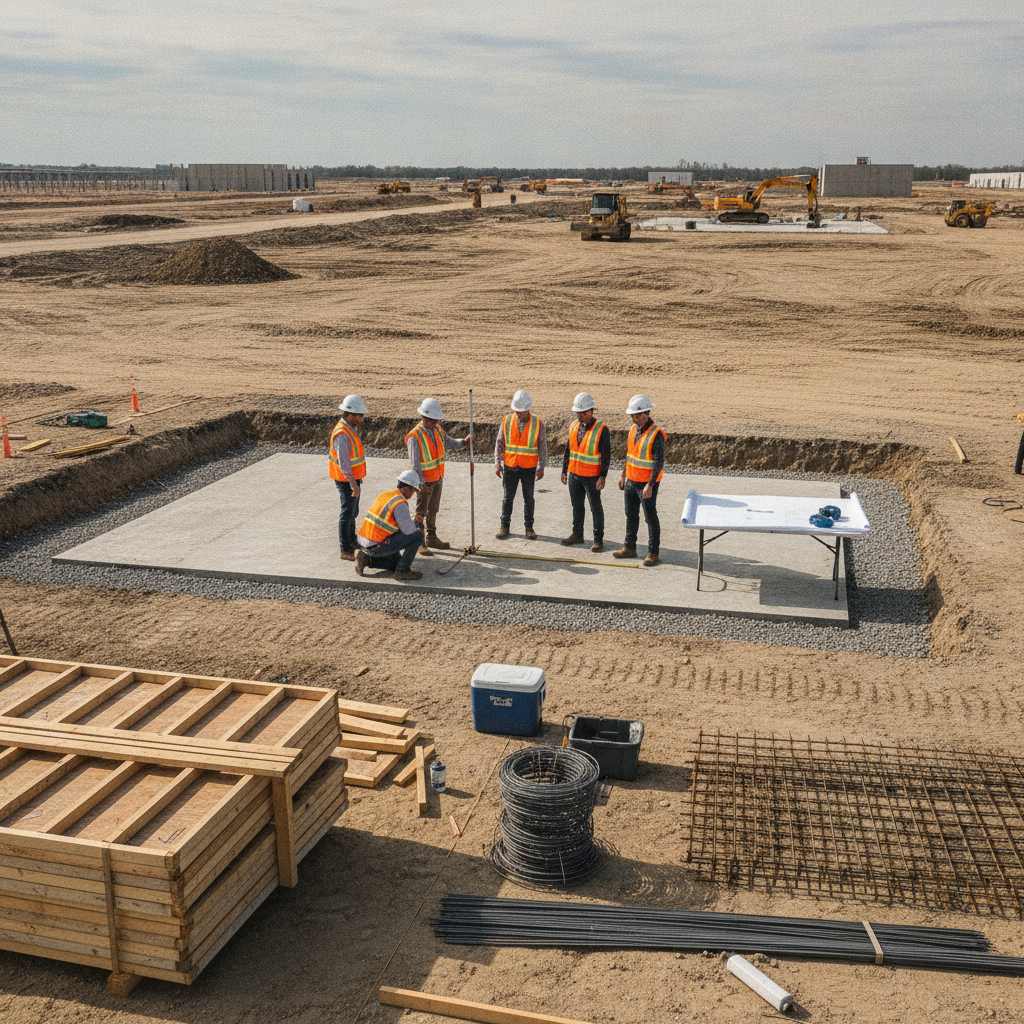
Ultimate vs. Allowable Bearing Capacity: The Factor of Safety
At the core of foundation design are two fundamental concepts: ultimate bearing capacity and allowable bearing capacity. The ultimate bearing capacity (q_ult) is the theoretical maximum pressure the soil can withstand before catastrophic failure occurs, such as shear failure. However, engineers never design to this limit. Instead, we work with the allowable bearing capacity (q_allow), which is the ultimate capacity divided by a crucial Factor of Safety (FS). For standard commercial buildings, an FS of 2.5 to 3.0 is common. For data centers, where the consequences of settlement or failure are severe, a more conservative FS is often required. This allowable pressure is the governing value used by structural engineers to size footings and foundations. It is not a guess; it is a calculated value derived from a comprehensive Geotechnical soil report, which analyzes data from field tests like the Standard Penetration Test (SPT). This conservative approach ensures that the applied structural loads remain well within the soil’s safe elastic limits, preventing both catastrophic failure and excessive long-term settlement that could damage sensitive equipment and connections.
Critical Factors Influencing Soil Bearing Capacity
Allowable Bearing Pressure Impact on Foundation Design
| Allowable Bearing Pressure (psf) | Typical Florida Soil Condition | Example Footing Size (for 200-kip load) | Foundation System Implications |
|---|---|---|---|
| < 2,000 | Loose sands, organic silts, soft clays | 10' x 10' or larger | Requires significant ground improvement (e.g., vibro-compaction, stone columns) or deep foundations (piles). High risk of settlement. |
| 2,000 - 3,500 | Medium-dense sands, firm clays | 8' x 8' | Standard shallow spread footings are viable, but sizes can be large. Differential settlement analysis is critical. |
| 3,500 - 5,000 | Dense to very dense sands, stiff clays | 6.5' x 6.5' | Ideal for conventional spread footings. More efficient design with smaller footings and less excavation. |
| > 5,000 | Very dense sands with shell, limestone (limerock) | 5.5' x 5.5' or smaller | Excellent foundation support. Allows for smaller, more economical footings. Mat foundations become highly effective. |
| Variable / Stratified | Layered sands and clays | Varies by location | Requires careful placement of footings to bear on competent strata. May require a mix of foundation types or over-excavation and replacement. |
The bearing capacity of a soil is not a single, fixed number; it is a dynamic property influenced by several interconnected factors. A thorough analysis, typically led by a Geotechnical engineer, must account for the unique conditions of a specific site. Overlooking any of these variables can lead to inaccurate assumptions and a compromised foundation design. Key influencers include the soil’s intrinsic properties—such as its classification (clay, sand, silt), cohesion, and internal friction angle—which are determined through laboratory analysis of samples from a Soil boring test. The geometry of the foundation itself, specifically the footing width and its depth below the ground surface, also plays a significant role. Furthermore, the position of the groundwater table is critical; a high water table can significantly reduce the effective stress in the soil, thereby lowering its bearing capacity. All these factors must be synthesized to develop a reliable site plan design.
Common Bearing Capacity Failure Modes
When the load applied to a foundation exceeds the soil’s ultimate bearing capacity, a shear failure occurs. Understanding the potential failure modes is essential for designing resilient foundations. The type of failure is largely dependent on the soil’s density and compressibility. A comprehensive geotechnical investigation is the primary tool for identifying the site’s susceptibility to these issues. There are three primary modes of bearing capacity failure. General Shear Failure is a sudden, catastrophic failure common in dense sands or stiff clays, where a well-defined failure surface extends to the ground surface. Local Shear Failure involves significant settlement and bulging of the ground surface adjacent to the footing, often seen in medium-dense soils. Finally, Punching Shear Failure occurs in loose, highly compressible soils, where the footing punches vertically into the ground with minimal surface evidence. Preventing these requires a design based on a robust Soil Test program and accurate soil characterization.
Analyzing Concentrated Loads from Data Center Equipment
Data centers are unlike typical commercial structures due to their extreme load densities. A standard office building might have a uniform live load of 50-100 pounds per square foot (psf). In contrast, a data hall can have equipment loads from server racks, Power Distribution Units (PDUs), and Uninterruptible Power Supply (UPS) systems that create concentrated loads exceeding 1,000 psf in specific areas. This requires a much more granular approach to foundation design and analysis. These heavy, concentrated loads must be traced through the structural slab and into the footings and underlying soil. The analysis cannot simply be averaged over a large area. Instead, the civil engineering team must work closely with the structural engineer to map out these load paths and ensure that the foundation system, whether it’s isolated spread footings or a mat foundation, can distribute these pressures without exceeding the allowable bearing capacity at any point. This often results in thickened slabs and strategically placed footings directly beneath major equipment zones.
The Geotechnical Investigation Process for Data Centers
A successful data center project begins with a phased and thorough geotechnical investigation. This process is not a formality for permitting; it is a critical risk-mitigation activity that informs the entire site development strategy. The investigation provides the foundational data upon which all structural and civil design decisions are based, directly impacting project costs, schedule, and long-term viability. The process starts with a preliminary site assessment and progresses to a detailed field exploration program, which includes numerous soil borings to determine the subsurface stratigraphy. During this phase, in-situ tests like the Standard Penetration Test (SPT) are performed, and soil samples are collected for laboratory testing. These tests determine key parameters like soil strength, compressibility, and permeability. The findings are compiled into a comprehensive Geotechnical soil report, which provides the allowable bearing capacity, settlement estimates, and recommendations for foundation design and site preparation.
Integrating Bearing Capacity into Slab-on-Grade Design
The structural slab in a data hall is a critical component that must support immense equipment loads without deflection or cracking. Its design is directly tied to the properties of the underlying soil, specifically the modulus of subgrade reaction (k-value), which is a measure of the soil’s stiffness and is provided in the Geotechnical soil report. A low k-value indicates a soft subgrade that will require a thicker, more heavily reinforced slab to distribute loads effectively. For data centers, this often leads to the design of a robust structural slab, sometimes 8 to 12 inches thick with multiple layers of rebar. In areas with extremely heavy equipment, the slab may be further thickened to act as a localized mat foundation. Proper subgrade preparation, including achieving the specified compaction percentage, is non-negotiable. This ensures the slab is uniformly supported and minimizes the risk of differential settlement, which could disrupt sensitive server alignments and network connections.
Our Approach to Geotechnical and Foundation Design Integration
At RSP Engineers, we view the geotechnical analysis not as a separate discipline but as an integral part of the overall civil engineering and site development process. Our approach is collaborative from day one. We facilitate early engagement between the client, the Geotechnical engineer, and our structural design partners to ensure the site’s opportunities and constraints are understood before significant design investment is made. Our team of experienced engineers meticulously reviews the Geotechnical soil report, translating its technical data into actionable design parameters for the site plan design. We focus on creating an integrated design where the foundation system, grading, drainage design, and utility layouts work in harmony. This proactive coordination minimizes surprises during construction, streamlines the permitting process with agencies, and ultimately delivers a more resilient and cost-effective foundation system for the mission-critical facility.
Common Challenges in Data Center Foundation Design
Even with a thorough plan, data center foundation projects can encounter challenges, particularly in Florida’s unique geological environment. One of the most common issues is encountering unforeseen subsurface conditions, such as pockets of organic material or a perched water table that wasn’t identified in the initial borings. This can necessitate costly over-excavation and replacement with engineered fill, impacting both budget and schedule. A robust Soil boring test program can help minimize this risk. Another significant challenge is managing differential settlement. A data center has heavily loaded areas (the data hall) immediately adjacent to lightly loaded areas (offices or support spaces). Designing a foundation system that accommodates this without causing cracking or structural stress requires careful analysis. Furthermore, dewatering for foundation excavation can be a major undertaking in Florida, requiring specific permitting and a well-designed system to manage groundwater without compromising the stability of adjacent soils.
Partner with RSP for Your Mission-Critical Facility
The success of your data center hinges on a foundation built with precision and foresight. Navigating the complexities of geotechnical analysis, foundation design, and agency permitting requires a partner with proven expertise in large-scale site development. RSP Engineers provides comprehensive site engineering services, from initial due diligence and geotechnical coordination to final construction administration. Our team ensures that your foundation design is optimized for your site’s specific soil conditions and your facility’s unique loading demands. We manage the critical path of geotechnical coordination to deliver a stable, reliable, and cost-effective solution. Contact us today to discuss how we can support the foundation of your next mission-critical project.
Conclusion
The bearing capacity analysis for a data center is far more than a preliminary calculation; it is the foundational element that guarantees the structure’s long-term performance and security. A design that meticulously accounts for soil mechanics, concentrated equipment loads, and potential failure modes is essential. Achieving this requires a seamless integration of Geotechnical Engineering, structural engineering, and expert civil engineering. By prioritizing a thorough investigation and conservative design principles, developers can mitigate significant risks and ensure their critical infrastructure is built on solid ground.
FAQs
-
For mission-critical data centers, a minimum Factor of Safety (FS) of 3. 0 is standard practice for foundation design. In cases with variable soil conditions or particularly sensitive equipment, a higher FS may be specified by the Geotechnical engineer to provide additional assurance against settlement and bearing failure.
-
A high groundwater table reduces the effective stress within the soil, which can significantly lower its bearing capacity. During Florida’s rainy season, saturated soils have less strength. Foundation designs must account for the highest anticipated groundwater level, not just the level on the day of the Soil Test, to ensure year-round stability.
-
Yes, various ground improvement techniques can increase a site’s allowable bearing capacity. Methods like deep dynamic compaction, vibro-compaction, or the installation of stone columns can densify loose granular soils. For poor soils, over-excavation and replacement with engineered fill is also a common strategy. The feasibility of these methods is evaluated during the geotechnical investigation.