
Comparing Flood Mitigation Alternatives for Data Center Sites
Explore key flood mitigation alternatives for data center development, including site elevation, perimeter protection, and enhanced drainage. A guide for developers and engineers on cost, permitting,
Understanding Flood Risk for Mission-Critical Facilities
The foundation of any flood mitigation plan is a thorough understanding of the site’s specific risks. The primary tool for this is the Federal Emergency Management Agency (FEMA) Flood Insurance Rate Map (FIRM), which delineates Special Flood Hazard Areas (SFHAs). These maps identify the Base Flood Elevation (BFE), which is the elevation that floodwaters are estimated to have a 1% chance of reaching or exceeding in any given year. A civil engineering analysis will determine the relationship between existing ground elevations and the BFE to quantify the site’s vulnerability. However, relying solely on FIRMs can be misleading. These maps are periodically updated and may not reflect recent changes in land use, weather patterns, or future conditions. Furthermore, they primarily address riverine and coastal flooding, often overlooking localized pluvial flooding caused by intense rainfall overwhelming local drainage design. For a data center, which demands a higher standard of protection, a forward-looking analysis incorporating climate projections and detailed hydrologic and hydraulic (H&H) modeling is crucial for true risk management and resilient site plan design.
Mitigation Strategy 1: Site Elevation with Engineered Fill
Comparison of Data Center Flood Mitigation Strategies
| Mitigation Strategy | Typical Relative Cost | Permitting Complexity | Operational Reliability | Key Considerations |
|---|---|---|---|---|
| Site Elevation (Fill) | High | High | Very High (Passive) | Requires extensive earthwork, geotechnical analysis, and potential compensatory storage. |
| Structural Elevation | Medium-High | Medium | High (Passive) | Impacts building architecture and access. Best for isolating specific structures. |
| Perimeter Walls/Berms | High | Medium-High | High (Active/Passive) | Requires interior drainage/pumping system and long-term maintenance plan. |
| On-Site Relocation | Low | Low | Very High (Passive) | Dependent on having a large enough parcel with suitable high ground. |
| Enhanced Stormwater System | Medium | Medium | Medium-High | Primarily addresses rainfall-induced flooding, not large-scale riverine or coastal events. |
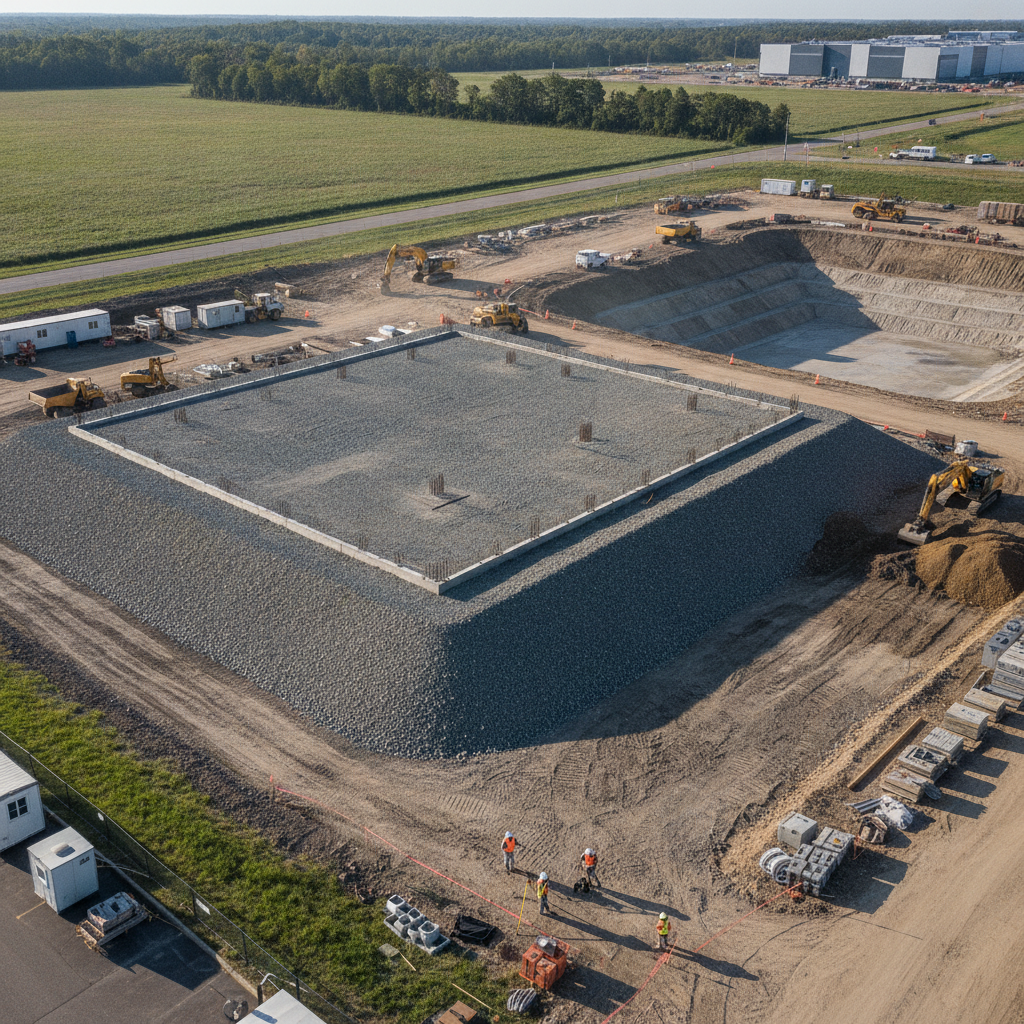
One of the most direct methods to protect a facility is to raise the finished floor elevation above the anticipated flood level. This is typically achieved by importing and compacting large quantities of engineered fill to create an elevated building pad or raise the entire developable area. This approach provides robust, passive protection, effectively removing the structure from the floodplain. The primary benefit is its permanence; once constructed, it requires minimal ongoing maintenance and is not dependent on human intervention or mechanical systems during a flood event. Despite its effectiveness, this strategy has significant implications. The cost of importing, placing, and compacting fill can be substantial, especially for large sites. A thorough Geotechnical Engineering investigation is required to ensure the underlying soils can support the new load without excessive settlement. Furthermore, placing fill within a designated floodplain can impact flood storage capacity and conveyance, potentially increasing flood risk for adjacent properties. Permitting requirements for fill placement vary by jurisdiction, and every project team should confirm the applicable standards with the local, state, regional, and federal authorities that hold review authority over the site. Many agencies require compensatory storage calculations and a “No-Rise” certification, demonstrating that the project will not adversely impact upstream or downstream flood elevations, which adds complexity to the permitting process.
Mitigation Strategy 2: Structural Elevation and Floodproofing
When raising the entire site with fill is not feasible due to cost, soil conditions, or site constraints, an alternative is to elevate the structure and critical equipment itself. This can involve constructing the data hall on a raised first floor, supported by columns or a flood-resistant foundation, or placing essential equipment like generators and cooling systems on elevated platforms. This method isolates critical assets while allowing floodwaters to pass underneath the structure, minimizing obstruction to flood flows. This approach is often combined with floodproofing techniques. Dry floodproofing involves making the building envelope below the flood protection elevation watertight using reinforced walls, sealed penetrations, and flood gates. Wet floodproofing, conversely, allows floodwaters to enter non-critical areas of the building to equalize hydrostatic pressure, preventing structural damage. The choice between these methods depends on the building’s design and use. Both require specialized architectural and structural engineering to ensure building code compliance and long-term performance. This strategy is particularly useful for retrofitting existing facilities or for sites where zoning compliance limits extensive earthwork.
Mitigation Strategy 3: Perimeter Protection Systems
Another effective strategy is to create a protective barrier around the facility or the entire site. This can be accomplished with permanent structures like concrete floodwalls or earthen berms (levees). These systems are designed to a specific protection elevation, often with several feet of freeboard above the BFE, creating a dry island for the data center to operate within during a flood event. This approach protects not only the building but also surrounding infrastructure like parking lots, loading docks, and utility yards. The design of perimeter systems requires careful civil engineering to ensure structural stability under hydrostatic load and to prevent seepage. A critical component is an interior drainage design plan. A perimeter wall will trap rainwater within the protected area, so a robust system of collection inlets, pipes, and a pump station is necessary to discharge this interior stormwater. The reliability of the pump station, including redundant power sources, is a key consideration for mission-critical facilities. These systems also require a long-term inspection and maintenance plan to ensure their integrity over time.
Mitigation Strategy 4: On-Site Relocation and Building Envelope Adjustment
For larger parcels with varied topography, one of the most cost-effective strategies can be intelligent site plan design. Instead of fighting the site’s natural characteristics, this approach involves leveraging them. A detailed topographic survey and environmental constraints analysis can identify the highest and most defensible portions of the property. By strategically locating the data center building and critical infrastructure on this high ground, developers can often avoid or significantly reduce the need for more expensive mitigation measures. This strategy involves optimizing the layout to keep the building envelope, primary access roads, and utility feeds out of flood-prone areas. While this may seem straightforward, it requires a holistic approach to land development, balancing flood avoidance with other critical factors like internal circulation, security perimeters, utility connection points, and future expansion plans. Early-stage collaboration between the developer and the civil engineering team is essential to identify these opportunities before significant design effort is invested in a suboptimal layout.
Mitigation Strategy 5: Enhanced Stormwater Management and Conveyance
While often associated with regulatory compliance, a site’s stormwater management system can be a powerful flood mitigation tool, particularly for pluvial (rainfall-induced) flooding. By designing oversized detention or retention basins, culverts, and conveyance channels, a site can safely manage extreme rainfall events that might otherwise cause localized flooding, even if the site is outside a FEMA-mapped floodplain. This proactive approach enhances the site’s overall resilience. This strategy focuses on controlling the volume and rate of stormwater runoff generated on-site. Techniques can include creating additional storage capacity in wet or dry ponds, using underground detention systems to save space, and ensuring that all conveyance structures are sized for storms exceeding typical design standards. Effective utility coordination is also key, ensuring that downstream public drainage systems have the capacity to accept the site’s discharge without causing off-site impacts. This method is a critical component of a layered defense, addressing a different type of flood risk than riverine or coastal events.
The RSP Engineers Approach to Flood Risk Analysis
At RSP Engineers, our process begins with a comprehensive Flood Risk and Resilience Assessment during the due diligence phase. We integrate FEMA data, local floodplain studies, climate projections, and detailed site-specific information to build a complete risk profile. Our team of Civil Engineers utilizes advanced hydrologic and hydraulic modeling software to simulate various flood scenarios and quantify the potential impacts on the proposed development. We then work collaboratively with the client and design team to evaluate the full spectrum of mitigation alternatives. Our analysis weighs the capital cost, long-term operational expenses, permitting timeline, and overall resilience of each option. We present a clear, data-driven comparison, allowing our clients to make informed decisions that align with their risk tolerance and business objectives. Our expertise in navigating the agency review process ensures that the chosen strategy is not only effective but also permittable, streamlining the path from design to construction.
Common Issues and Design Challenges
Implementing flood mitigation for data centers presents several common challenges. A primary issue is balancing earthwork; minimizing the import or export of soil by strategically using cut from one area as fill in another can yield significant cost savings. Another challenge is managing off-site drainage impacts. Any change to a site’s topography or drainage patterns must be carefully analyzed to ensure it doesn’t create or worsen flooding on neighboring properties, which is a common focus during permit submittals. Utility coordination is also a critical hurdle. Electrical duct banks, fiber optic lines, and water/sewer mains must all be protected from flood damage. This may require relocating utilities, encasing them in concrete, or designing sealed manholes and vaults. Finally, designers must consider secondary risks. For example, even if a site is protected from surface water, prolonged flooding can lead to elevated groundwater levels, creating hydrostatic pressure on foundations and underground infrastructure. A holistic design addresses all potential pathways for water intrusion. Frequently Asked Questions (FAQ) How high above the Base Flood Elevation (BFE) should we build? Most local and federal guidelines require a minimum of 1 to 3 feet of “freeboard” (building the lowest floor above the BFE). However, for mission-critical facilities like data centers, a more conservative freeboard of 3 to 5 feet or more is often recommended to account for wave action, model inaccuracies, and future climate conditions. The final decision should be based on a site-specific risk assessment. Can we combine different flood mitigation strategies? Absolutely. A layered, or “defense-in-depth,” approach is often the most resilient. For example, a project might use engineered fill to elevate the main data hall (Strategy 1) while also constructing a perimeter berm to protect the broader campus (Strategy 3) and enhancing the on-site stormwater management system (Strategy 5). What is ‘compensatory storage’ and when is it required? When fill is placed within a designated floodplain, it displaces volume that was previously available to store floodwater. Many regulatory agencies require developers to create an equivalent volume of storage elsewhere on the site, typically by excavating a basin, to ensure the project doesn’t reduce the floodplain’s overall storage capacity. This is a key part of achieving a “No-Rise” certification for land development. How does a ‘No-Rise’ certification affect our design? A “No-Rise” certification is a technical demonstration, supported by hydraulic modeling, proving that a project will not cause any increase in the Base Flood Elevation on other properties. This is a common requirement for development within a regulatory floodway. Achieving this certification often dictates the project’s layout, the amount of fill allowed, and the design of structures like bridges or culverts, making it a critical part of the civil engineering design process. What kind of long-term maintenance do flood protection systems require? Passive systems like engineered fill require minimal maintenance. However, active systems like perimeter walls and pump stations require regular inspections to check for cracks, erosion, and operational readiness. A formal Operations and Maintenance (O&M) plan is essential for ensuring the reliability of any flood protection system that has active components.
Your Partner in Mission-Critical Site Development
Selecting and designing the right flood mitigation strategy is a high-stakes decision that directly impacts the long-term viability and resilience of your data center investment. The complexities of hydraulic modeling, regulatory permitting, and value engineering require a partner with deep expertise in mission-critical site development. The team at RSP Engineers provides the comprehensive civil engineering and permitting support needed to navigate these challenges successfully. From initial due diligence to final construction, we help you build with confidence.
Conclusion
There is no single best solution for data center flood mitigation. The optimal strategy is a carefully engineered response to a site’s specific flood risks, the developer’s risk tolerance, and the project’s budget. By elevating sites with fill, deploying perimeter protection, enhancing stormwater management systems, or using intelligent site layouts, developers can significantly improve the resilience of their facilities. Ultimately, early and thorough civil engineering analysis is the key to protecting these vital assets from one of nature’s most powerful threats and ensuring continuous operation.
FAQs
-
Comparing Flood Mitigation Alternatives for Data Center Sites requires careful planning, qualified engineering, and compliance with the applicable codes and permits.
-
Getting Comparing Flood Mitigation Alternatives for Data Center Sites right protects safety, supports regulatory compliance, and avoids costly redesigns or delays.
-
RSP Engineers provides licensed expertise and end-to-end support for Comparing Flood Mitigation Alternatives for Data Center Sites, from early planning through permitting.