
Common Access Design Problems on Data Center Sites
Explore common data center access design problems, from insufficient gate stacking to tight turning radii. Learn civil engineering solutions for safe, efficient site circulation.
The Critical Importance of Entrance Stacking and Queue Analysis
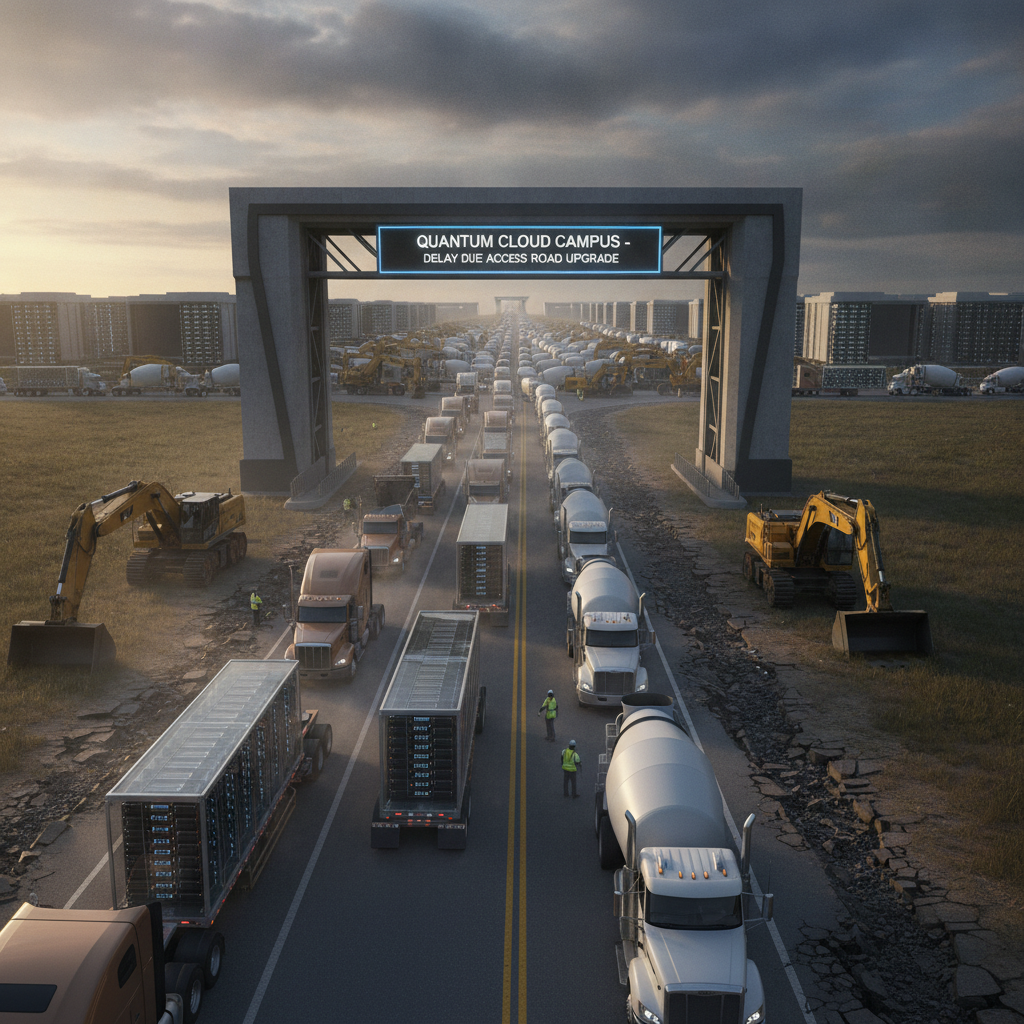
One of the most visible access design failures occurs at the site entrance. Insufficient stacking distance—the length of roadway available for vehicles to queue at a gate or security checkpoint without obstructing other traffic—is a frequent problem. When a data center’s security protocols require several minutes per vehicle for check-in, a queue can quickly form. Without adequate stacking space, this queue will spill backward onto the public road, creating a serious safety hazard and drawing unwanted attention from the local roadway authority. Effective civil engineering for a data center entrance involves a detailed queue analysis. This analysis models vehicle arrival rates, security processing times, and peak traffic hours for both employees and delivery trucks. By using industry-standard data, such as ITE trip generation rates, and customizing them for the specific operational profile of the facility, engineers can accurately size the required queuing lanes. The design must account for separate queues for pre-approved staff and one-time visitors or deliveries, ensuring that access control points enhance security without crippling traffic flow.
Designing Turning Radii for Real-World Delivery Vehicles
Comparison of Common Access Design Flaws and Solutions
| Design Flaw | Typical Consequence | Civil Engineering Solution |
|---|---|---|
| Insufficient Gate Stacking | Traffic backup onto public roads, safety hazards, agency violations. | Conduct a detailed queue analysis based on security processing times and peak traffic volumes to design adequate stacking lane length. |
| Inadequate Turning Radii | Trucks off-tracking onto curbs and landscaping, damaged infrastructure, stuck vehicles. | Use vehicle turning simulation software with the correct design vehicle (e.g., WB-67) to verify all internal intersection and access point geometries. |
| Undersized Pavement Section | Premature pavement failure (rutting, cracking) in high-traffic areas, costly repairs, operational disruption. | Perform a geotechnical investigation and design site-specific heavy-duty and standard-duty pavement sections based on projected traffic loads (ESALs). |
| Blocked Emergency Access | Delayed emergency response, fire code violations, potential for catastrophic loss. | Coordinate design with the local fire marshal early; ensure access roads meet width, grade, and load requirements; integrate approved rapid-access systems with security features. |
| No Truck Turnaround | Large trucks forced to back out of long dead-end drives, creating safety risks and delays. | Design and incorporate appropriately sized cul-de-sacs, hammerhead turnarounds, or loop roads at the end of all non-connecting service drives. |
Data center construction and operation rely on a steady stream of oversized vehicles, from semi-trucks (like the WB-67 design vehicle) delivering IT hardware to lowboy trailers transporting massive generators and concrete trucks for expansion projects. A common mistake is designing internal roadways and intersections with turning radii suitable only for passenger cars. When a large truck attempts to navigate a turn that is too tight, the result is often off-tracking, where the rear wheels cut inside the path of the front wheels. This can lead to damaged curbs, destroyed landscaping, and compromised utility structures. To prevent this, the civil engineering design must be based on the largest, least maneuverable vehicle that will ever need to access the site. Modern design practices utilize vehicle turning templates and simulation software to model the path of these large vehicles through every critical intersection and loading dock approach. This ensures that the designed geometry provides adequate clearance, preventing costly infrastructure damage and ensuring that critical equipment deliveries are never delayed or prevented by an impassable turn.
Engineering Pavement Sections for Heavy-Duty Loads
Not all pavement is created equal. A frequent and expensive error on large industrial sites is the application of a single, standard-duty pavement design across the entire campus. While this may suffice for employee parking areas, it will inevitably fail under the concentrated, heavy loads of delivery trucks, construction equipment, and service vehicles. Pavement failure, including rutting, cracking, and potholes, creates safety hazards and requires disruptive and expensive repairs. A robust pavement strategy begins with a thorough geotechnical investigation to understand the underlying soil conditions. Based on the findings in the Geotechnical soil report, a Professional Engineer designs specific pavement sections for different use areas. Primary haul routes, loading dock aprons, and equipment yards require a heavy-duty section engineered to withstand high volumes of traffic and heavy axle loads. The design considers factors like the material’s structural number and projected Equivalent Single Axle Loads (ESALs) to ensure a lifespan that matches the facility’s operational needs. Often, this means specifying thicker asphalt or aggregate layers or utilizing rigid concrete pavement in the highest-stress areas.
Planning for Emergency Vehicle and Fire Apparatus Access
Ensuring unimpeded access for emergency responders is a non-negotiable requirement of site design. This goes beyond simply providing a road; it involves meeting stringent geometric and structural standards for fire apparatus access. These roads must have a minimum width, a maximum grade, and turning radii sufficient for the largest ladder trucks used by the local fire department. Furthermore, the road and any underlying utilities must be designed to support the immense weight of a fully loaded fire engine. A critical point of conflict often arises between security and emergency access. While anti-ram bollards, secure gates, and other physical barriers are essential for data center security, they must not impede first responders. Fire code and emergency vehicle access requirements vary by jurisdiction, and it is essential for the project team to confirm all applicable standards with the local fire marshal and other authorities that hold review authority over the site. Early coordination with the authority having jurisdiction is crucial to developing a design that integrates security needs with rapid-access solutions like Knox boxes or automatic gate operators that are approved for emergency use.
Eliminating Dead-Ends with Functional Turnaround Design
Dead-end service drives are a logistical trap for large trucks. A driver who mistakenly enters a long, narrow drive with no way to turn around is faced with the dangerous and time-consuming task of backing out, often for hundreds of feet. This scenario creates a significant safety risk and operational bottleneck. Every service drive that does not connect back to the main site circulation network must terminate in a functional, pre-planned turnaround. Common solutions for these dead-end drives include a standard cul-de-sac, a hammerhead (T-shaped or Y-shaped) turnaround, or a loop road. The choice depends on available space and the specific design vehicle. A hammerhead turnaround is often more space-efficient but requires a three-point turn, while a cul-de-sac or loop road allows a vehicle to turn around in a single, continuous movement. The geometry of any turnaround must be verified using turning simulation software to ensure the design vehicle can navigate it easily and safely.
Proactive Haul Route Planning and Agency Coordination
A data center’s traffic impact extends beyond its property lines, especially during construction. The constant movement of heavy trucks carrying soil, aggregate, and materials can strain public roads and disrupt the surrounding community. Proactive planning of a designated haul route is a critical part of the land development process and is often required as part of the permit submittals. This process involves early and frequent agency coordination with local and state transportation departments. The project team must identify a route that avoids weight-restricted bridges, residential areas, and other sensitive locations. The authorities may require a pre-construction survey of the route to document existing conditions, and the developer may need to post a bond to cover potential damages to public infrastructure. Establishing an approved haul route before construction begins prevents costly delays, potential fines, and friction with the local community and regulatory agencies.
The RSP Engineers Approach to Data Center Site Access
At RSP Engineers, we treat site access and circulation as a core component of mission-critical design. Our process begins during the earliest stages of due diligence, where we identify the true design vehicles for both construction and long-term operations. We utilize advanced traffic modeling and vehicle simulation software to validate every aspect of the site layout, from entrance stacking to loading dock access. Our team of experienced Civil Engineers prioritizes early and continuous coordination with all reviewing agencies—including transportation departments and fire marshals—to de-risk the permitting process. We believe that a successful design is one that seamlessly integrates the demands of security, operations, and emergency response into a safe, efficient, and resilient site.
Common Pitfalls in Site Circulation Design
Even with the best intentions, project teams can fall into several common traps. A primary pitfall is designing for opening-day operations while neglecting the intense demands of the construction phase, which often involves heavier vehicles and different traffic patterns. Another frequent issue arises when security and civil design teams work in silos; a security plan that specifies impassable barriers without consulting on emergency access needs is a recipe for redesign. Finally, underestimating agency review timelines for traffic impact studies and haul route approvals can lead to significant project delays. Proactive, integrated design is the only effective countermeasure to these challenges.
Partner with RSP for Your Mission-Critical Site Development
Navigating the complexities of data center site design requires specialized expertise. The team at RSP Engineers provides comprehensive site engineering services to ensure your facility is built on a foundation of safety, efficiency, and compliance. Contact us today to discuss your project’s unique challenges. Our experts in site plan design, utility coordination, and regulatory permitting are ready to guide you from initial concept through construction, ensuring your access and circulation systems support your mission-critical goals.
Conclusion: Building a Foundation for Operational Excellence
Effective site access and circulation design is a fundamental investment in a data center’s long-term success. By addressing potential issues like gate stacking, truck turning radii, and pavement loading proactively, developers can avoid costly rework, enhance operational efficiency, and ensure a safe environment for employees and visitors. Success hinges on experienced civil engineering, a deep understanding of both construction and operational logistics, and a commitment to early and thorough agency review. Ultimately, a well-designed site is the physical foundation for operational excellence in the demanding world of mission-critical facilities.
FAQs
-
The design vehicle is the largest and least maneuverable vehicle that is reasonably anticipated to use a facility. For data centers, this is often a WB-67 semi-truck or a lowboy trailer carrying a generator. Using the correct design vehicle is critical for engineering elements like turning radii and intersection geometry to prevent trucks from getting stuck or damaging site infrastructure.
-
As early as possible. Initial contact should be made during the conceptual or schematic design phase. Bringing the fire marshal into the process early allows their requirements for emergency vehicle access roads, fire hydrant locations, and turnaround dimensions to be incorporated into the core site plan design, avoiding costly revisions later in the permitting process.
-
Sometimes, but it requires careful planning and approval from the authority having jurisdiction. If bollards are used, they must be removable or retractable and paired with an approved rapid-access system (like a Knox box key switch) that allows immediate entry for emergency responders. The specific solution must be reviewed and accepted by the local fire department.