
Choosing Foundation Types for Data Center Buildings
Explore the critical factors in selecting a foundation for data centers. Learn how geotechnical conditions, structural loads, and settlement tolerance guide the choice between shallow, mat, and deep f
The Critical Role of Geotechnical Investigation
Every sound foundation design begins below the ground. A comprehensive Geotechnical investigation is non-negotiable for data center projects, providing the essential data needed to understand the site’s subsurface characteristics. This investigation, summarized in a Geotechnical soil report, typically involves a series of soil boring tests to collect samples at various depths. Laboratory testing of these samples determines critical parameters like soil classification, strength, density, and compressibility. The report provides the engineering team with a clear picture of the soil stratigraphy, identifies the depth and quality of competent bearing layers, and pinpoints the location of the groundwater table. It also assesses potential geohazards such as expansive clays, collapsible soils, or liquefaction potential in seismic areas. This information is the primary driver for determining whether a cost-effective shallow foundation is feasible or if a more robust and expensive deep foundation system is required for proper site development.
Analyzing Structural Loads and Settlement Tolerances
Data Center Foundation System Comparison
| Foundation Type | Ideal Subsurface Conditions | Key Advantages | Primary Challenges |
|---|---|---|---|
| Isolated Spread Footings | High bearing capacity soils near the surface; low groundwater table. | Cost-effective; rapid construction; simple design. | High sensitivity to differential settlement; unsuitable for weak or variable soils. |
| Mat / Raft Foundation | Moderate bearing capacity soils; need to minimize differential settlement. | Excellent load distribution; superior rigidity and settlement control. | Higher material cost (concrete/steel); requires careful utility coordination under the slab. |
| Driven Piles | Weak upper soils overlying a dense bearing layer; resistance to uplift forces needed. | High load capacity; can be tested for capacity during installation; rapid installation. | Noise and vibration during installation; potential for damage in dense or rocky soils. |
| Drilled Shafts (Caissons) | Deep competent bearing stratum; very high axial or lateral loads. | Extremely high load capacity; minimal vibration during installation; adaptable to variable soil profiles. | Slower construction process; requires specialized equipment; susceptible to groundwater issues during drilling. |
| Auger-Cast Piles | Variable soils where vibration is a concern; moderate to high load requirements. | Low vibration installation; cost-effective for its capacity; adaptable to site conditions. | Requires specialized quality control during installation; generates significant soil spoils for disposal. |
Data centers impose unique and substantial loads on their foundations. The structural design must account for immense dead loads from the building itself, heavy equipment like UPS systems, battery racks, and computer room air handlers (CRAHs), plus significant live loads. Furthermore, the design must resist transient environmental forces, including wind, snow, and seismic loads. The structural engineer of record is responsible for calculating these loads in accordance with the project’s governing building codes and standards, such as ASCE 7, Minimum Design Loads for Buildings and Other Structures . Because design requirements for environmental loads like wind and seismic activity vary by jurisdiction, every project team must confirm the applicable standards with the local, state, regional, and federal authorities that hold review authority over the site. Beyond pure strength, the paramount concern for a data center is minimizing differential settlement. Even minor variations in settlement across the foundation slab can warp the structure, misalign equipment, and damage sensitive fiber optic connections. The foundation system must be designed to create a rigid, stable platform that settles uniformly under the building’s immense weight, ensuring operational continuity and protecting the owner’s investment.
Evaluating Shallow Foundation Systems
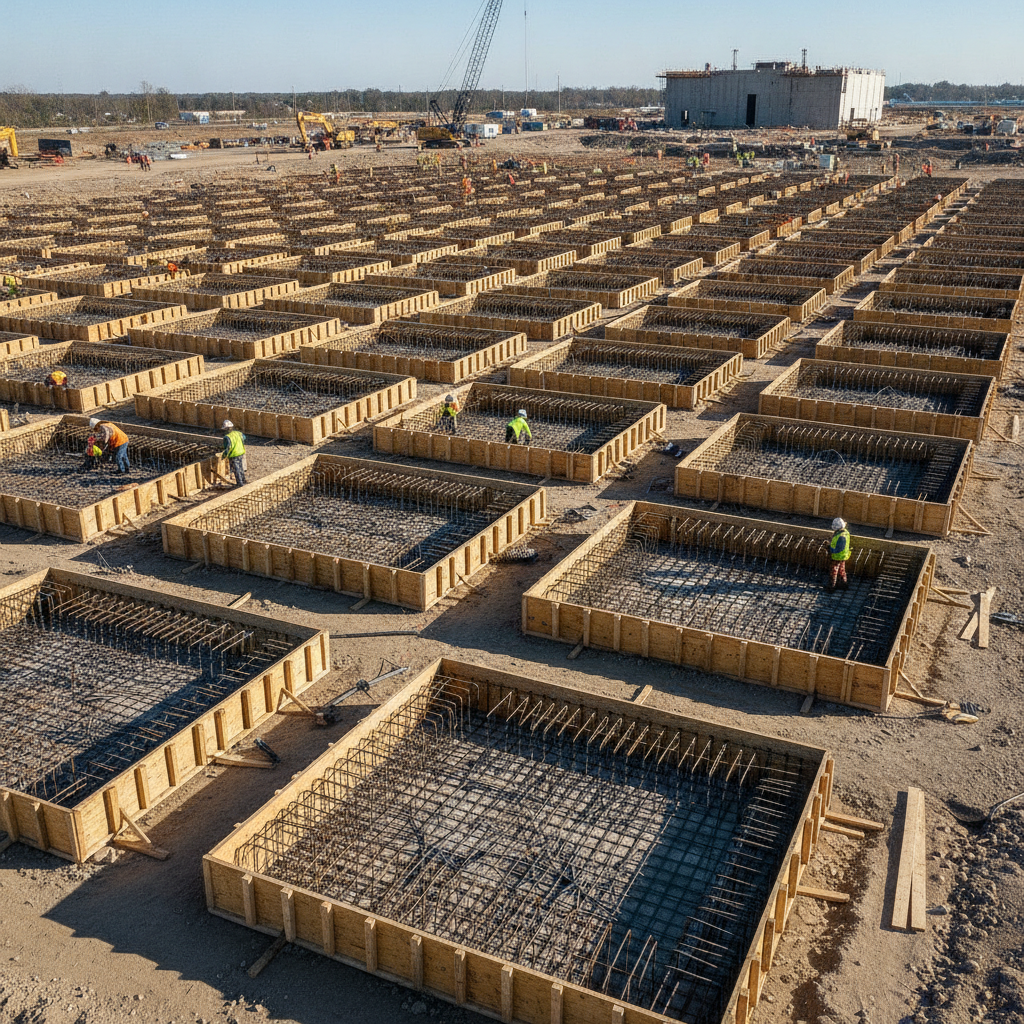
Shallow foundations are systems that transfer building loads to the earth at a shallow depth, typically where the foundation depth is less than its width. Common types include isolated spread footings under columns and continuous strip footings under walls. These systems are generally the most cost-effective solution when the Geotechnical soil report confirms the presence of strong, stable soils with adequate bearing capacity near the ground surface. They are relatively simple to construct, requiring standard excavation, formwork, and concrete placement. However, their suitability is entirely dependent on the subsurface conditions. If the upper soils are weak, compressible, or variable, shallow footings can lead to unacceptable total and differential settlement. A civil engineering team must also ensure that the site plan design includes proper grading and drainage design to prevent water from compromising the bearing soils beneath these footings, which could lead to settlement issues over time.
Understanding Mat and Raft Foundations
When soil conditions are less than ideal or structural loads are exceptionally high and concentrated, a mat or raft foundation is often the preferred solution. A mat foundation is a large, continuous, reinforced concrete slab that extends under the entire building footprint. This design distributes the total building load over a very large area, reducing the bearing pressure on the underlying soil. This load distribution is highly effective at minimizing differential settlement, making it an excellent choice for data centers. While more expensive than isolated footings due to the significant volume of concrete and reinforcing steel, a mat foundation provides superior rigidity and settlement control. The design and construction require careful coordination, including managing a large, monolithic concrete pour and integrating under-slab utilities and stormwater management components. The structural analysis for a mat foundation is also more complex, often requiring finite element analysis (FEA) to model soil-structure interaction accurately.
When Deep Foundation Systems Are Necessary
In cases of very poor surface soils, high groundwater tables, or exceptionally heavy structural loads, a deep foundation system is required. These systems bypass the weak upper soil layers and transfer the building loads to a competent bearing stratum of soil or rock located deep below the surface. Common deep foundation types include driven piles (steel, concrete, or timber), drilled shafts (caissons), and auger-cast piles. The selection of a specific deep foundation type depends on the Geotechnical findings, load requirements, site constraints, and local construction practices. Deep foundations offer the highest load-carrying capacity and the best control over settlement. However, they are also the most expensive and complex foundation type, adding significant time and cost to the project schedule. Their installation often requires specialized equipment and contractors. The decision to use a deep foundation system is a critical one, made when the Geotechnical engineer determines that shallow systems cannot provide the required performance and stability for the mission-critical facility.
The RSP Engineers Foundation Selection Process
At RSP Engineers, our approach to foundation design is collaborative and data-driven. The process begins with a thorough review of the client’s operational requirements and the project’s Geotechnical soil report. We work in close partnership with the structural engineer of record and the architectural team to develop a foundation strategy that balances performance, cost, and constructability. Our site engineering services integrate the foundation design with the overall site plan design, ensuring seamless coordination with grading, drainage, and utilities. Our process includes a detailed constructability review to identify potential challenges before they impact the schedule. We perform value engineering analyses to compare the life-cycle costs of different foundation systems, helping clients make informed decisions. Throughout the design and permitting phases, we serve as a central point of coordination, ensuring that the foundation plan aligns with all other aspects of the land development project, from stormwater management to utility service entrances.
Common Issues and Mitigation Strategies
Even with careful planning, data center foundation projects can encounter challenges. One common issue is discovering that actual subsurface conditions differ from what was indicated in the Geotechnical report, requiring rapid design modifications. Proactive mitigation involves commissioning a sufficiently detailed geotechnical investigation upfront, with enough borings to characterize the site properly. Groundwater management during excavation is another frequent challenge, especially for mat foundations or basements. This can be addressed with robust dewatering plans and waterproofing designs. Long-term settlement, even when minimized, must be monitored. Our construction administration services include reviewing submittals, observing construction, and ensuring the foundation is built in strict accordance with the design documents and building code compliance, which helps mitigate these risks from the outset.
Partner with RSP Engineers for Mission-Critical Foundation Design
Selecting and designing the right foundation for a data center requires specialized expertise and a deep understanding of the interplay between geotechnical, structural, and civil engineering principles. RSP Engineers provides the comprehensive site engineering services needed to navigate this complex process. Our team excels at utility coordination, stormwater management, and integrating foundation design into a cohesive site development plan. We guide clients from initial site assessment and permitting through construction, ensuring the final product is stable, resilient, and built to last. Contact us today to discuss your next mission-critical project.
Conclusion: A Foundation for Digital Infrastructure
The foundation of a data center is far more than just concrete and steel; it is the critical element that ensures the facility’s long-term structural integrity and operational uptime. The choice between shallow, mat, and deep systems is a calculated decision based on a rigorous analysis of the Geotechnical conditions, structural loads, and stringent settlement criteria. A successful outcome depends on a collaborative approach, bringing together expertise in Geotechnical Engineering, structural design, and comprehensive civil engineering to create a foundation that can reliably support the digital world.
FAQs
-
The Geotechnical soil report is the single most important document for foundation selection. It dictates the allowable soil bearing capacity, identifies the depth of stable soil or rock, and warns of risks like high groundwater or expansive soils. This data directly determines whether a simple shallow foundation is viable or if a more complex mat or deep foundation system is necessary to support the structure safely.
-
Differential settlement is the uneven settlement of a building’s foundation. For a data center, this is a critical failure point. Uneven movement can crack floor slabs, misalign structural frames, damage sensitive IT equipment, and sever utility and fiber optic connections. Therefore, the primary goal of a data center foundation design is to create an extremely rigid platform that minimizes this risk.
-
Absolutely. Shallow foundations are typically the fastest and least expensive option. Mat foundations require more materials and time for forming and curing. Deep foundations, such as drilled shafts or piles, are the most costly and time-consuming, as they require specialized equipment and add a significant phase to the construction schedule. The choice has a direct and substantial impact on the overall project budget and timeline.