
Arizona Data Center Desert Soils
A technical guide for data center developers on Arizona’s challenging desert soils, including collapsible soils, caliche, and expansive clays. Learn mitigation strategies from expert civil engineers.
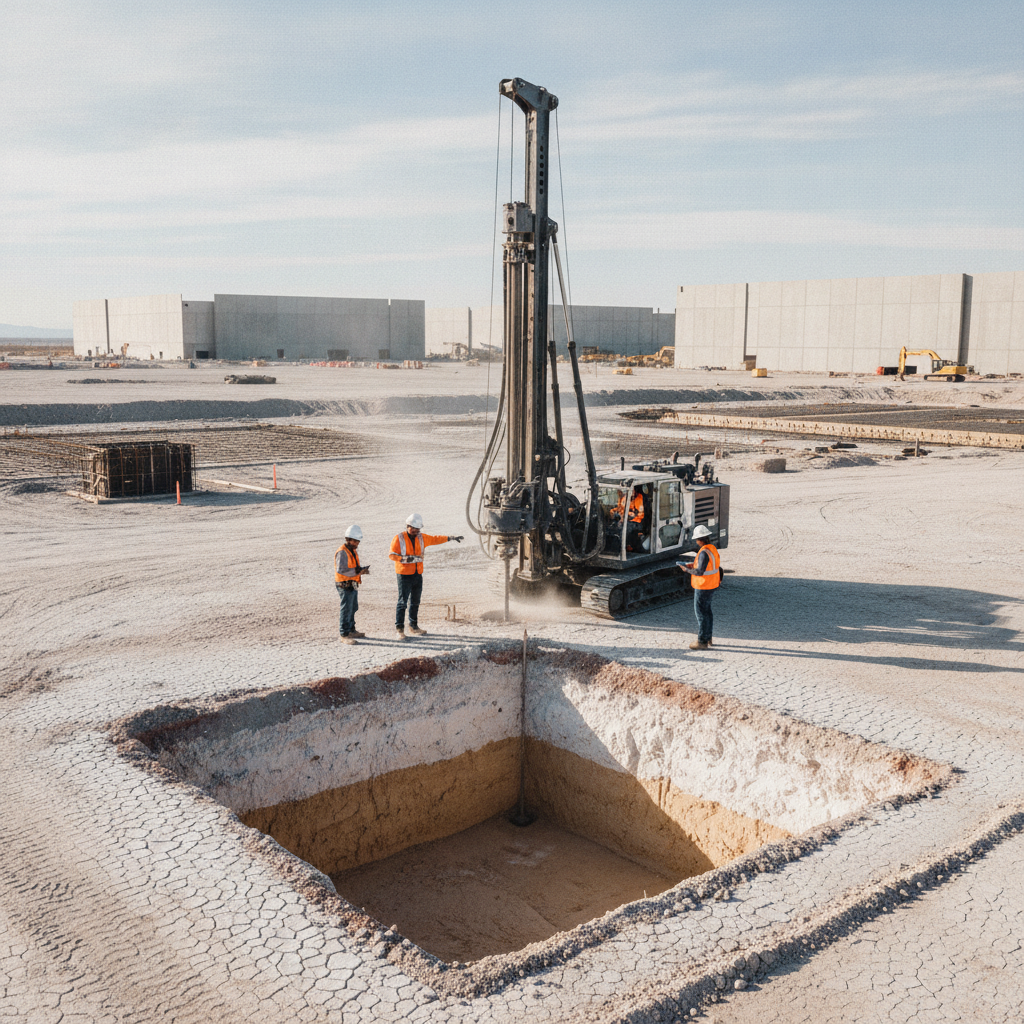
Understanding Collapsible Soils and Hydro-Collapse Risk
One of the most significant threats in Arizona’s desert environment is the presence of collapsible soils. These are typically low-density, uncemented silts and sands with a porous, honeycomb-like structure. In their dry, natural state, they can exhibit deceptively high bearing strength. The danger emerges with the introduction of water from sources like utility leaks, irrigation, or changes in surface drainage design. This triggers a phenomenon known as hydro-collapse, where the soil structure rapidly breaks down, causing abrupt and often differential settlement of the ground surface. For a data center, where server racks require perfectly level floors and infrastructure connections are rigid, unexpected settlement is unacceptable. A minor water line break could lead to significant structural damage. A thorough Geotechnical soil report is essential to identify the depth and extent of these soils. The investigation must include specialized laboratory testing to quantify the site’s collapse potential, providing the critical data needed to design an effective ground improvement strategy and protect the multi-million dollar investment resting on top of it.
The Caliche Challenge: Excavation and Foundation Design
Mitigation Strategies for Arizona Desert Soil Conditions
| Geotechnical Hazard | Primary Risk to Data Centers | Common Mitigation Strategy |
|---|---|---|
| Collapsible Soils | Sudden, differential settlement upon wetting; foundation and slab failure. | Pre-wetting/hydro-compaction, deep dynamic compaction, or overexcavation and replacement with engineered fill. |
| Hard Caliche Layers | Slow, costly excavation; utility trenching delays; differential foundation support. | Heavy-duty ripping, rock trenchers, or controlled blasting; foundation design to bear on or bypass the layer. |
| Low In-Situ Moisture | Failure to achieve required soil compaction; long-term settlement of fill. | Systematic moisture conditioning of soil lifts using water trucks prior to and during compaction. |
| Expansive Clays | Cyclical heave and settlement causing slab and foundation damage. | Overexcavation and replacement, moisture control barriers, chemical stabilization, or structural slab design. |
| Earth Fissures | Large-scale ground tearing and subsidence due to groundwater withdrawal. | Thorough site selection and fissure mapping; establishing a building setback from known fissures. |
| Variable Bedrock Depth | Uneven foundation support leading to differential settlement and structural stress. | Deep foundation systems (drilled piers, micropiles) to transfer loads to competent, deeper strata. |
Caliche is a soil layer in which particles are cemented together by calcium carbonate, forming a substance that can range in consistency from firm soil to rock-hard conglomerate. While its high bearing capacity can sometimes be advantageous for foundations, its presence more often presents a major construction obstacle. Excavating caliche is notoriously difficult and expensive, often requiring heavy-duty ripping equipment or even blasting, which introduces its own set of permitting and safety complexities. This significantly impacts schedules and budgets for utility trenching, foundation excavation, and overall site development. A qualified Geotechnical engineer must characterize the caliche’s depth, thickness, and hardness through rigorous field testing, including the use of a Soil boring test. This information directly influences foundation design choices. For instance, a project might shift from shallow foundations to a deep foundation system to bypass a thick caliche layer. Furthermore, the variable nature of caliche can create differential support conditions, a risk that must be mitigated through careful site plan design and ground preparation. The challenges faced by a Geotechnical engineer in Arizona are vastly different from those encountered by Land Development companies in Texas, where deep expansive clays are often the dominant concern.
Low Moisture Content and Soil Compaction Difficulties
The arid climate that makes Arizona attractive also creates challenges for earthwork. Native desert soils often have an extremely low in-situ moisture content, far below what is required for effective compaction. During site grading, achieving the specified soil density—typically 95% of the maximum dry density determined by a Proctor test—is impossible without adding significant amounts of water. This process, known as moisture conditioning, is a critical step in the site engineering services scope. The logistical and financial implications are substantial. Large quantities of water must be sourced and transported to the site, an increasingly complex issue in a water-conscious region. The water must be applied uniformly to massive volumes of soil, requiring a fleet of water trucks and careful management. Without proper moisture conditioning, the compacted fill will not achieve the required strength and stability, leaving the facility’s slabs and foundations vulnerable to future settlement. This is a critical quality control checkpoint during the construction administration phase.
Identifying and Mitigating Expansive Clays in Basin Areas
While Arizona is known for its granular desert soils, certain basins and ancient lakebed areas contain significant deposits of expansive clays. These soils, rich in minerals like montmorillonite, exhibit a dramatic shrink-swell behavior with changes in moisture content. During dry periods, they shrink and crack; when wet, they can swell with enough force to lift foundations and crack concrete slabs. This cyclical movement is a severe threat to the stability of a data center’s sensitive infrastructure. Identifying these hidden clay layers is a primary objective of the geotechnical investigation. Soil borings and laboratory tests, such as Atterberg limits and swell potential tests, are used to map their location and quantify their potential for movement. Mitigation strategies are intensive and may include overexcavation and replacement with non-expansive fill, chemical stabilization with lime or cement, or designing structurally suspended slabs and robust foundations that can resist or isolate the structure from soil movement. Proper identification is key, as the mitigation approach for expansive clays is fundamentally different from that for collapsible soils.
Advanced Ground Improvement for Mission-Critical Sites
For high-density data center projects with stringent settlement tolerances, standard mitigation may not be sufficient. Advanced ground improvement techniques are often employed to enhance soil properties and ensure long-term performance. These methods go beyond simple excavation and replacement to fundamentally alter the engineering characteristics of the subsurface. Techniques like deep dynamic compaction (DDC), which involves repeatedly dropping a heavy weight to densify granular soils at depth, can be highly effective for treating collapsible soils across a large footprint. Another common method is the installation of aggregate piers or geopiers. This process involves drilling holes and ramming crushed stone into them, creating stiff, high-density columns that reinforce the surrounding soil, increase bearing capacity, and control settlement. For sites with particularly poor conditions, vibro-compaction or deep soil mixing may be specified by the Geotechnical engineer. Selecting the right technique requires a deep understanding of the site’s soil profile, the structural loads of the data center, and the project’s performance requirements.
RSP Engineers’ Approach to Desert Geotechnical Challenges
At RSP Engineers, our process for tackling Arizona’s complex geotechnical landscape is systematic and data-driven, ensuring no critical factor is overlooked. We provide comprehensive Construction Management Services tailored to the unique demands of mission-critical facilities. Our approach is designed to de-risk your project from site selection through construction. First, we conduct a thorough due diligence and feasibility study, reviewing geological maps and performing preliminary borings to identify major risks early. This is followed by a detailed geotechnical investigation, where our team of Florida Licensed Engineers and local partners execute a comprehensive plan of soil borings, test pits, and advanced laboratory analysis. The findings are compiled into a definitive Geotechnical soil report that provides clear, actionable recommendations for earthwork, foundation design, and necessary ground improvement. During construction, we provide quality assurance testing and observation to verify that all earthwork and foundation installation meets the project’s stringent design specifications.
Common Pitfalls in Arizona Site Development
Even with a plan, developers can encounter costly issues during site development in Arizona. A primary pitfall is underestimating the time and cost associated with caliche excavation. A budget based on common earthwork can be shattered when rock-hard layers are encountered, leading to significant change orders and schedule delays. Another frequent issue is an inadequate plan for water sourcing and application for moisture conditioning, which can bring compaction operations to a halt. Perhaps the most critical error is skimping on the initial investigation. Relying on too few soil borings can leave large areas of the site uncharacterized, creating the risk of discovering unexpected conditions like a pocket of expansive clay or a deep collapsible soil profile after construction has begun. A robust upfront investment in a comprehensive Soil Test program, guided by an experienced Civil Engineer near me, is the most effective insurance against costly surprises during the build-out phase.
Partner with RSP Engineers for Your Arizona Data Center Project
Navigating the complexities of Arizona’s desert soils requires specialized expertise and a proactive, engineering-led approach. The success of your mission-critical facility depends on a foundation that is designed and built to withstand these unique geotechnical challenges. RSP Engineers provides the expert geotechnical investigation, robust foundation design, and diligent construction oversight needed to deliver a resilient and reliable project. While our experience extends to major projects like site development Orlando, our principles of rigorous analysis apply to every unique geological environment. Don’t let subsurface risks derail your project timeline and budget. Connect with our team of experts to discuss your site selection and development needs.
Building a Resilient Foundation in the Desert
In conclusion, while Arizona offers compelling advantages for data center development, its geology demands respect and expert analysis. The primary challenges—collapsible soils, hard caliche, and moisture-deficient soils—are manageable, but only with a thorough, upfront geotechnical investigation and a carefully engineered mitigation plan. Proactive ground improvement and diligent quality control during construction are not optional expenses; they are essential investments in the long-term stability and operational uptime of the facility. Partnering with an experienced Professional Engineer ensures that the foundation of your digital infrastructure is as solid as the rock beneath it, safeguarding your assets for decades to come.
FAQs
-
The required depth of overexcavation and replacement depends on the thickness of the collapsible soil layer and the anticipated structural loads. A typical recommendation for a large data center might be to remove and recompact the upper 10 to 15 feet of soil, but this must be determined by a site-specific geotechnical investigation.
-
If the caliche layer is competent, continuous, and at a suitable depth, it can serve as an excellent bearing stratum for foundations. The challenge, as identified by a Geotechnical engineer, is its variability. A detailed drilling program is needed to confirm its consistency across the entire building footprint before it can be relied upon for structural support.
-
The cost premium can vary widely. Mitigating deep collapsible soils with ground improvement or dealing with extensive, hard caliche can increase site work costs by 20% to 50% or more compared to a site with ideal soil conditions. This is why early geotechnical assessment is crucial for accurate pro forma modeling.