
Understanding Concurrency Reviews in Florida: A Guide for Developers
A detailed guide for developers on navigating Florida’s concurrency review process. Learn about public facility capacity, transportation analysis, and permitting.
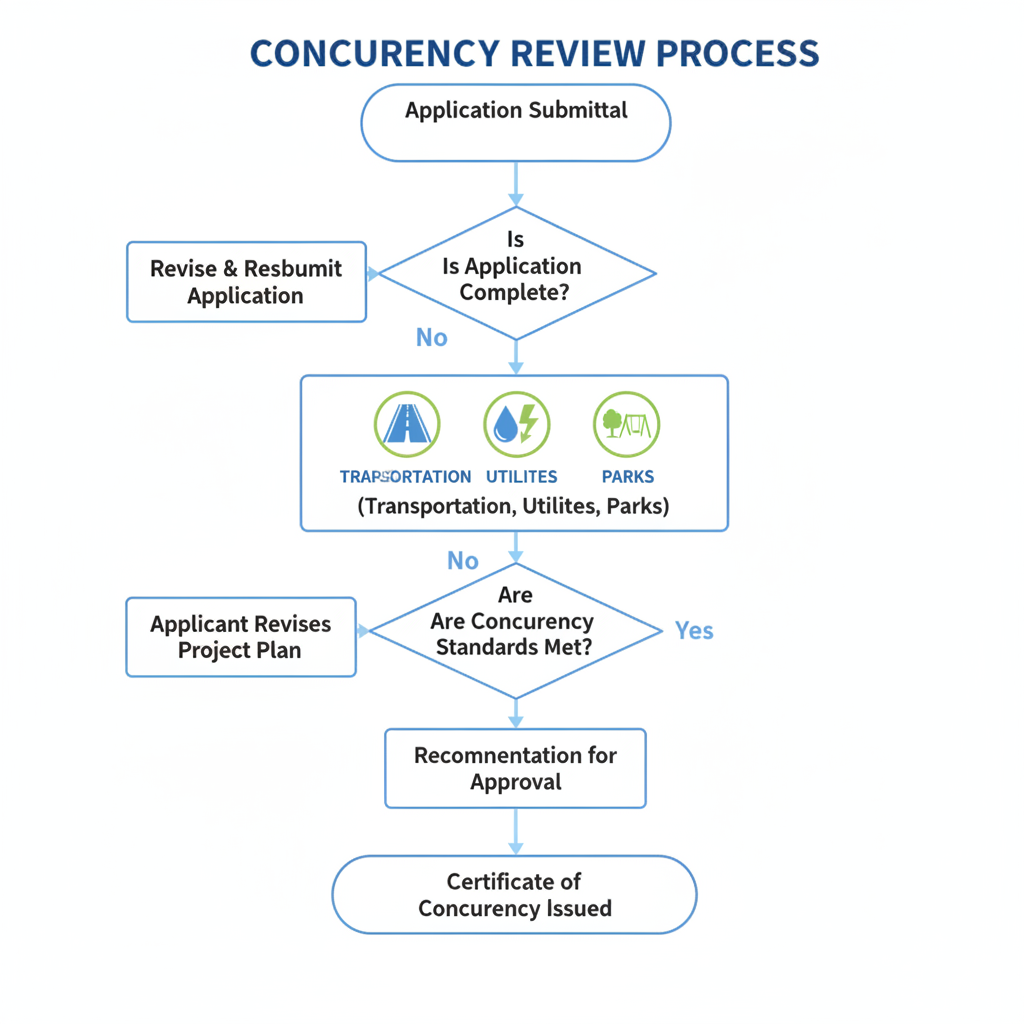
The Foundation of Concurrency: Florida’s Growth Management Act
Concurrency is a direct result of Florida’s Growth Management Act, which mandates that new development cannot proceed unless public infrastructure is available to handle the increased demand. The core principle is that development should not outpace the capacity of public services, ensuring that new projects do not degrade the established Level of Service (LOS) for existing residents. Each local government’s comprehensive plan outlines these LOS standards for various public facilities. This “pay-as-you-go” framework requires developers to prove that their project’s impact is accounted for. The review is a formal verification by local government agencies that adequate public facility capacity exists or will be in place by the time the development’s impacts occur. This review is a prerequisite for obtaining development orders and is a critical early-stage hurdle in the land development process.
Core Components of a Concurrency Review
Concurrency Review Requirements by Facility Type
| Facility Type | Key Metric / Standard | Typical Documentation Required |
|---|---|---|
| Transportation | Roadway Level of Service (LOS) | Traffic Impact Study (TIS/TIA), trip generation calculations, intersection analysis |
| Potable Water | Gallons Per Day (GPD) demand vs. available plant capacity | Utility provider capacity reservation letter, demand calculations, utility plans |
| Sanitary Sewer | Gallons Per Day (GPD) effluent vs. available treatment capacity | Utility provider capacity reservation letter, effluent calculations, lift station design (if needed) |
| Stormwater Management | Pre- vs. Post-development discharge rates; water quality treatment | Drainage report, stormwater pollution prevention plan (SWPPP), pond siting analysis |
| Parks & Recreation | Acres of parkland per 1,000 residents (or similar local standard) | Impact fee calculations, proof of land dedication, or fee-in-lieu payment |
| Solid Waste | Pounds or tons per day vs. landfill/facility capacity | Letter of service availability from the solid waste authority, projected waste generation data |
A concurrency review is a multi-faceted assessment that examines a project’s impact on a range of public facilities. While transportation is often the most scrutinized element, a comprehensive review covers several key areas. The specific requirements can vary by jurisdiction, but they generally include assessments for potable water, sanitary sewer, solid waste, drainage, and parks and recreation. Each component requires a separate analysis to demonstrate sufficient capacity. For example, a potable water capacity review involves confirming with the local utility provider that they can supply the projected demand of the new development without compromising service to existing customers. Similarly, the sanitary sewer systems must be able to handle the additional effluent. A thorough stormwater management plan is also critical, as the review ensures the project’s drainage design complies with local and state regulations and does not negatively impact downstream properties or regional water bodies.
Transportation Concurrency: Analyzing Traffic Impact
Transportation concurrency is frequently the most challenging aspect of the review process. Its purpose is to ensure that the local roadway network can absorb the new traffic generated by a development without falling below the adopted Level of Service (LOS) standards. The primary tool for this analysis is the Traffic Impact Study (TIS), also known as a Transportation Impact Analysis (TIA). This detailed report is prepared by a qualified transportation engineer. The TIS calculates the number of new vehicle trips the project will generate (trip generation) and distributes them onto the surrounding road network. It then analyzes key intersections and road segments to determine the project’s impact on traffic flow and roadway capacity. If the study shows that the development will degrade the LOS below acceptable levels, mitigation measures are required. These can range from restriping intersections and upgrading traffic signals to constructing new turn lanes or contributing funds for larger, planned roadway improvements.
Utility and Public Facility Capacity Assessment
Beyond roads, a project must prove it has access to adequate utility services. This part of the concurrency review focuses on securing commitments from service providers. Developers must engage in proactive utility coordination with local water, sewer, and solid waste departments. The key piece of evidence is typically a capacity reservation letter from the utility provider, which formally states that they have the system capacity to serve the proposed development. This process often involves submitting detailed utility plans and demand calculations prepared by a civil engineering firm. The utility provider reviews these against their master utility plan and existing infrastructure loads. Securing these letters early is crucial, as a lack of available capacity can force a project redesign or require the developer to fund costly off-site utility extensions or system upgrades as part of a developer agreement.
Navigating the Concurrency Application and Review Process
The concurrency application is a formal package submitted to the local planning or community development department. This package consolidates all the necessary studies, capacity reservation letters, and engineering plans required to demonstrate compliance. A complete and accurate submittal is critical to avoid delays. The application is then routed for agency review to various internal departments, including public works, transportation, utilities, and parks and recreation. Each department reviews the portion of the application relevant to their purview and provides comments. The role of your civil engineering consultant is to manage this process, respond to agency comments, and provide any requested clarifications or revisions. This iterative process of permit submittals and responses continues until all departments are satisfied that the project meets all concurrency requirements for site development.
Concurrency Determination: Outcomes and Next Steps
After all agency reviews are complete, the local government will issue a formal concurrency determination. There are three primary outcomes. The best-case scenario is the issuance of a Certificate of Concurrency, which reserves the necessary public facility capacity for the project for a specified period. A conditional approval may be granted, requiring the developer to enter into a developer agreement to construct or fund specific infrastructure improvements before a final certificate is issued. If capacity is unavailable and mitigation is not feasible, the application may be denied. In cases where a project’s impact can be addressed through financial contributions, jurisdictions often use a proportionate fair-share program. This allows a developer to pay for their share of the cost of future infrastructure improvements needed to accommodate their project. Understanding these potential outcomes and mitigation strategies is vital for project planning and budgeting.
How RSP Engineers Manages the Concurrency Process
At RSP Engineers, we treat concurrency not as a bureaucratic hurdle but as a strategic component of the overall project plan. Our process begins with thorough due diligence during the feasibility phase to identify potential concurrency issues before significant capital is invested. We conduct preliminary capacity inquiries and model potential traffic impacts to inform the initial site plan design. This proactive approach allows us to identify potential red flags early and develop a clear strategy for compliance. Our team excels at proactive utility coordination, establishing communication with agency staff early in the design process. We prepare comprehensive and defensible reports, including robust Traffic Impact Studies and detailed drainage analyses, that anticipate reviewer comments. By presenting a clear and well-documented case for compliance, we streamline the agency review process, reduce requests for additional information, and help secure a timely and positive concurrency determination for our clients.
Common Pitfalls in Florida Concurrency Reviews
Even experienced developers can encounter challenges during concurrency review. One common pitfall is relying on outdated traffic data or an incomplete TIS, which can trigger extensive agency review comments and requests for restudy. Another issue is underestimating the time and cost associated with required off-site improvements, such as roadway modifications or utility line extensions. These can significantly impact the project’s budget and timeline. Failing to secure utility capacity reservation letters before submitting the concurrency application is another frequent mistake that leads to an incomplete submittal and immediate delays. Finally, a lack of familiarity with a specific jurisdiction’s interpretation of its comprehensive plan or land development code can lead to missteps in demonstrating zoning compliance. Avoiding these pitfalls requires diligent preparation and expert guidance from a civil engineering firm near me that is well-versed in local regulations.
Partner with RSP Engineers for Your Florida Development Project
Navigating Florida’s concurrency requirements demands technical expertise and a deep understanding of local regulations. The team at RSP Engineers provides the expert guidance needed to successfully manage this critical phase of your project. We specialize in comprehensive site development services, from initial due diligence and feasibility studies to final permitting and construction administration. Our services include preparing detailed traffic studies, negotiating with utility providers, and designing effective stormwater management systems. Don’t let concurrency challenges derail your project. Contact RSP Engineers today to discuss how our team of Florida Licensed Engineers can help you achieve a successful outcome and keep your development on track.
Conclusion: Concurrency as a Critical Path Item
In Florida, concurrency is more than a regulatory checkbox; it is a foundational element of the state’s growth management framework that directly impacts a project’s viability. A successful concurrency review requires a proactive, integrated approach that combines diligent research, precise engineering, and strategic communication with regulatory agencies. Understanding the requirements for transportation, utilities, and other public facilities is a critical path item for any Florida land development project. By partnering with an experienced civil engineering firm, developers can confidently navigate the complexities of the review process, mitigate risks, and ensure their project aligns with the local comprehensive plan. Proper planning for concurrency is a key investment in a smooth and successful development timeline.
FAQs
-
If a project fails because of inadequate capacity, the developer has a few options. They can choose to wait until the necessary public improvements are completed by the municipality, or they can enter into a developer agreement to fund or construct the improvements themselves. This often involves negotiating a proportionate fair-share contribution to address the project’s specific impact.
-
The validity period for a Certificate of Concurrency varies by jurisdiction but is typically between one and five years. It is crucial to understand this timeframe, as the developer must obtain a building permit or commence construction within that window to keep the capacity reservation active. If it expires, a new concurrency review is required.
-
In some limited cases, such as for certain types of affordable housing, de minimis projects with very small impacts, or development within specific redevelopment districts, concurrency requirements may be modified or waived. However, these exceptions are rare and explicitly defined in the local government’s comprehensive plan or land development code.