
Noise Studies for Data Center Development Approvals
Learn the critical role of noise studies in data center development. Our guide covers ambient monitoring, acoustic modeling, mitigation strategies, and navigating local ordinance compliance nationwide
Characterizing Primary Noise Sources at Data Center Facilities
Understanding a data center’s acoustic profile begins with identifying its primary noise sources. Unlike typical commercial buildings, data centers house a concentration of high-powered mechanical and electrical equipment operating 24/7. The most significant contributors are typically backup generators, which are tested regularly and run during power outages, producing substantial low-frequency noise. Equally important are the massive chiller plants and cooling towers required to dissipate the immense heat generated by servers. These systems are often the dominant source of continuous, ambient noise. Other sources, such as rooftop air handling units (AHUs), exhaust fans, and electrical transformers, also contribute to the facility’s overall acoustic signature. A thorough noise study involves quantifying the sound power level of each piece of equipment, typically using manufacturer-provided data. This data serves as the primary input for predictive modeling and is critical for designing effective mitigation strategies as part of the overall site development plan.
Establishing Baseline Conditions with Ambient Sound Monitoring
Typical Noise Ordinance Limits by Zoning District
| Zoning District Type | Typical Daytime Limit (dBA) | Typical Nighttime Limit (dBA) | Key Engineering Considerations |
|---|---|---|---|
| Residential / Sensitive Receptor | 50 - 60 dBA | 40 - 50 dBA | Requires most stringent mitigation, such as full enclosures, high-performance barriers, and careful equipment selection. |
| Commercial / Mixed-Use | 60 - 70 dBA | 50 - 60 dBA | Often requires strategic site layout and acoustic barriers. Generator testing schedules may need to be restricted to daytime hours. |
| Industrial / Manufacturing | 70 - 80 dBA | 65 - 75 dBA | Generally more permissive, but property line limits still apply. Mitigation may focus on specific high-noise sources near shared boundaries. |
| Rural / Agricultural | 50 - 60 dBA | 40 - 50 dBA | Lower ambient background noise means data center noise can be more perceptible. Limits are often similar to residential zones. |
| Overlay / Special Purpose District | Varies | Varies | These districts may have unique, project-specific noise performance standards that supersede base zoning. Requires careful code review. |
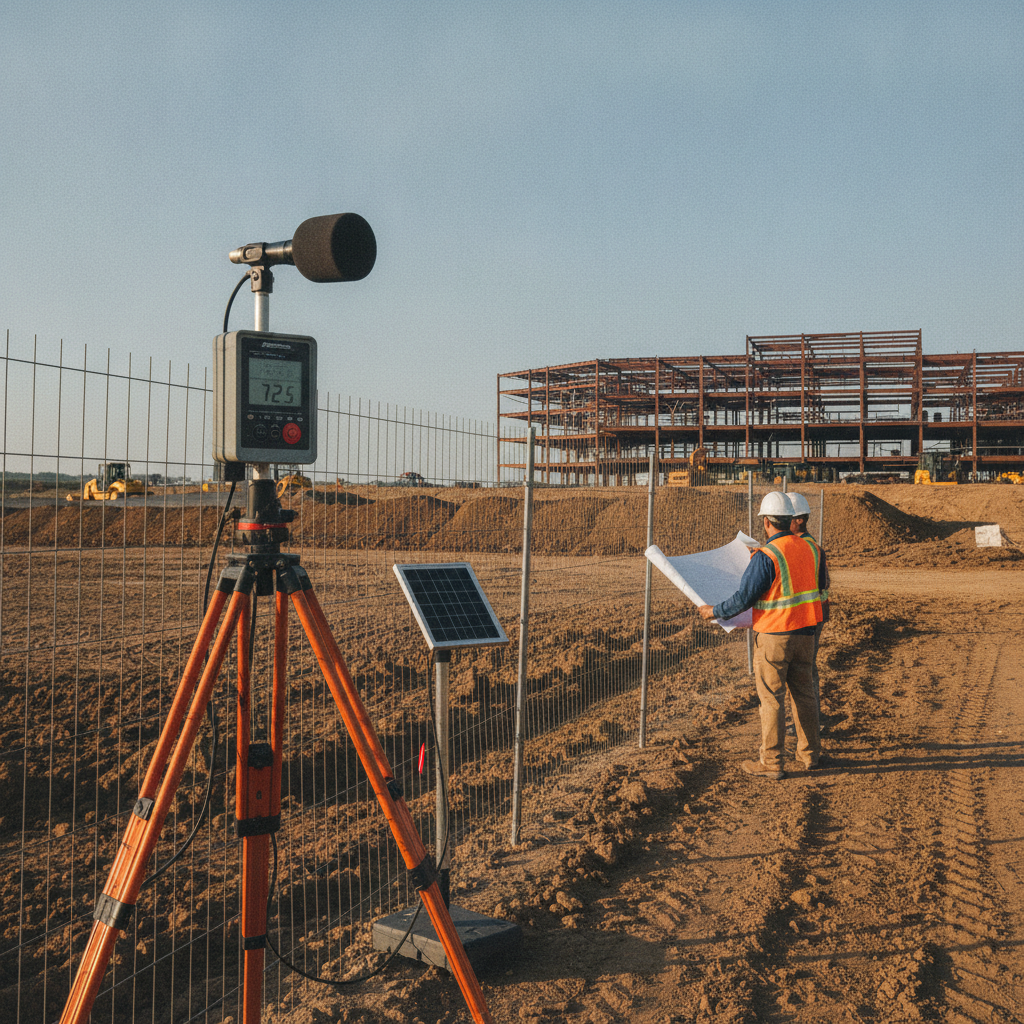
Before assessing the potential impact of a new data center, it is crucial to understand the existing acoustic environment. This is achieved through ambient sound monitoring, a process that involves placing specialized sound level meters at strategic locations around the proposed site, particularly at property lines and near the closest sensitive receptors (e.g., residences, schools, or parks). This monitoring typically runs for a continuous period, often 24 to 72 hours, to capture the full range of background noise levels, including quieter nighttime periods. The data collected establishes a baseline against which the future noise from the data center will be measured. It helps distinguish pre-existing noise from the new facility’s contribution and is a critical component of the report submitted to regulatory agencies. The placement of sound level meters is a strategic decision guided by the project’s layout and the surrounding land uses, ensuring the study accurately reflects conditions at the most sensitive property lines.
Regulatory Frameworks and Local Noise Ordinance Compliance
Navigating the regulatory landscape is a core challenge in data center permitting. Most local governments enforce noise ordinances that establish quantitative limits on sound levels at a facility’s property line. These limits are a key aspect of zoning compliance and are designed to protect public welfare. The permissible sound levels are often tiered, with stricter limits during nighttime hours (e.g., 10 PM to 7 AM) and for properties adjacent to residential zones compared to those near industrial or commercial areas. Permitting requirements vary by jurisdiction, and every project team should confirm the applicable standards with the local, state, regional, and federal authorities that hold review authority over the site. A comprehensive noise study must directly address the specific criteria set forth by the authority having jurisdiction. The final report demonstrates, through data and modeling, how the proposed facility will comply with all applicable noise ordinances, which is a prerequisite for obtaining site plan and building permit approvals.
Predictive Acoustic Modeling and Sound Propagation Analysis
Once equipment noise data and ambient background levels are established, engineers use sophisticated acoustic modeling software to predict future sound levels. This process simulates how sound will travel from the data center’s sources to the surrounding community. The model accounts for numerous factors, including the sound power of each generator and chiller, the proposed locations of equipment on the site, and the influence of topography and existing structures. This is a critical part of the site plan design process. The model’s output is often a visual contour map, showing projected decibel levels across the property and into neighboring areas. This sound propagation analysis allows the project team to identify potential areas of non-compliance before construction begins. It is an essential tool for evaluating the effectiveness of proposed mitigation measures and for demonstrating to regulators that the project has been designed to respect the acoustic environment of its sensitive receptors.
Engineering Noise Mitigation and Abatement Strategies
If predictive modeling indicates that noise levels will exceed ordinance limits, the civil engineering and design team must implement mitigation measures. There is a wide array of effective noise mitigation strategies available. The most common solution is the construction of acoustic barriers, or sound walls, strategically placed between noise sources and sensitive property lines. The height, location, and material of these walls are determined by the acoustic model to achieve the necessary sound reduction. For extremely loud sources like backup generators, equipment enclosures provide a higher level of attenuation. These are essentially buildings constructed around the equipment. Other strategies include specifying quieter models of chillers and fans during the procurement process, orienting buildings to shield noisy equipment yards, and optimizing the overall site development layout to maximize distance between sources and receptors. A combination of these techniques is often required to achieve full compliance.
Post-Construction Verification and Compliance Testing
The noise study process does not end with the issuance of a permit. Many jurisdictions require post-construction verification to confirm the data center operates in compliance with the approved plan and local ordinances. This involves conducting sound level measurements after the facility is commissioned and fully operational. The testing protocol typically mirrors the initial ambient study, with measurements taken at the same locations to allow for a direct comparison of pre- and post-development conditions. This compliance testing validates the accuracy of the predictive model and the effectiveness of the installed mitigation measures. If the facility is found to exceed permitted noise levels, additional abatement measures may be required. Successfully passing this final check is often a condition for receiving a final certificate of occupancy and is crucial for demonstrating that the project meets its permit conditions and respects the as-built conditions.
How RSP Engineers Manages the Noise Study and Permitting Process
At RSP Engineers, we integrate noise analysis directly into our civil engineering and land development workflow. Our process begins with a thorough review of local noise ordinances and a site feasibility assessment to identify potential acoustic challenges early. We coordinate closely with the client, architect, and equipment vendors to gather accurate sound data for all planned machinery. Our team then conducts comprehensive ambient monitoring and develops a detailed predictive acoustic model. We use this model to guide the site plan design, recommending effective and cost-efficient mitigation strategies. The final noise study report is a clear, defensible document prepared for permit submittals and presentations to planning boards and zoning commissions. Throughout the agency review process, we serve as the client’s advocate, addressing technical questions and ensuring a smooth path to approval.
Common Challenges in Data Center Noise Assessments
Even with a robust process, data center noise studies can present several challenges. One common issue is accounting for the cumulative impact of phased development on a large campus, where future buildings will add to the overall noise profile. Another challenge is accurately modeling complex topography, where hills and valleys can either block or amplify sound in unexpected ways. Sometimes, the manufacturer’s equipment data may be preliminary, requiring conservative assumptions in the initial model. Furthermore, regulatory uncertainty can be a factor, as some jurisdictions are still developing specific policies for mission-critical facilities. Finally, value engineering efforts during later design stages can sometimes lead to changes in equipment or site layout, requiring the acoustic model to be updated to ensure compliance is maintained. Proactive communication between all members of the development team is key to overcoming these hurdles.
Your Partner for Mission-Critical Site Development
Navigating the technical and regulatory complexities of data center development requires a deep understanding of acoustics and local requirements. The team at RSP Engineers provides expert guidance on all aspects of site development, from initial due diligence and acoustic analysis to final permitting and construction support. We help clients anticipate challenges, design compliant and community-friendly facilities, and achieve their project goals on schedule.
Conclusion
A professional noise study is an indispensable component of any successful data center project. It is not merely a box to check for a permit but a critical design tool that informs site layout, equipment selection, and mitigation strategies. By proactively managing a facility’s acoustic impact through detailed analysis and expert civil engineering, developers can ensure zoning compliance, build trust with the surrounding community, and streamline the path to securing all necessary land development approvals.
FAQs
-
The first step is a thorough review of the local noise ordinances and zoning code to understand the specific sound level limits that apply to the project site. This is followed by collecting equipment specifications and conducting ambient sound monitoring to establish a baseline.
-
If the model predicts an exceedance, the engineering team will recommend specific noise mitigation strategies. This could include installing acoustic barriers, specifying quieter equipment, constructing equipment enclosures, or adjusting the site layout. The model is then re-run to verify the effectiveness of these solutions before finalizing the design.
-
Yes, absolutely. The noise generated during periodic testing of backup generators is a primary concern for regulators. The noise study must model this scenario and often includes recommendations for the timing and duration of tests to minimize community impact, such as restricting them to daytime hours on weekdays.