
Navigating the Maze: Who Approves Site Plans in Florida?
A detailed guide from Florida civil engineers on the multiple agencies that approve site plans, including local, state (WMD, FDEP, FDOT), and federal bodies.
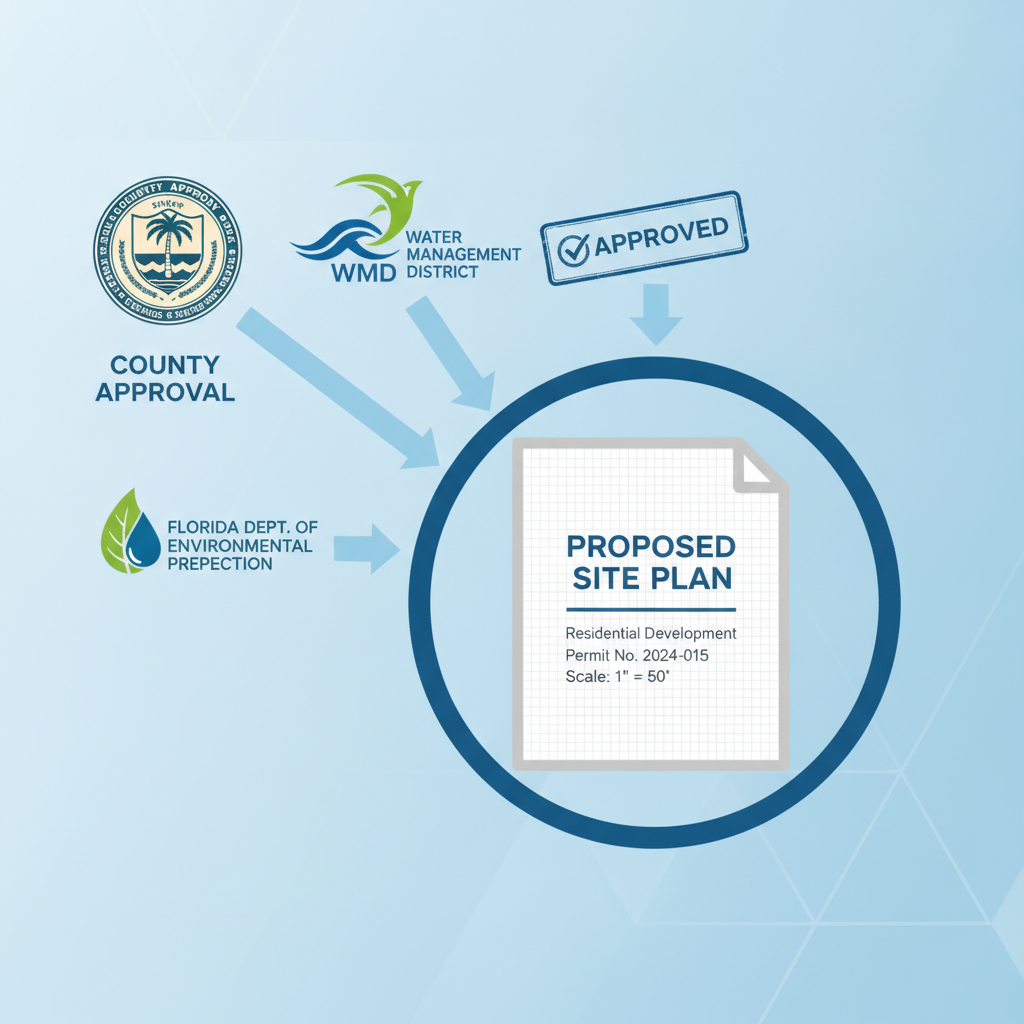
The Central Role of Local Government: City and County Review Boards
The first and most significant hurdle for any site plan is the local municipality—either the city or the county where the project is located. These agencies are primarily concerned with how a project fits into the community’s fabric and existing infrastructure. The Planning and Zoning Department is the gatekeeper, responsible for verifying that the proposed development adheres to the local Comprehensive Plan and the Land Development Code (LDC). Their review is a critical first step that confirms fundamental project parameters. Reviewers at this level meticulously check for zoning compliance, ensuring the proposed land use is permitted in that specific district. They analyze everything from building setbacks and height restrictions to parking requirements, landscaping buffers, and architectural standards. A project that fails to meet these foundational requirements will not proceed to technical review. This is why early-stage due diligence, guided by a knowledgeable Professional Engineer, is crucial to confirm a project’s viability before significant capital is invested in detailed design.
Public Works and Engineering Department Scrutiny
Florida Site Plan Review Agency Matrix
| Agency / Department | Primary Jurisdiction | Key Review Items |
|---|---|---|
| City/County Planning & Zoning | Local Land Use & Aesthetics | Zoning compliance, setbacks, density, parking, landscaping, architectural standards. |
| City/County Public Works / Engineering | Local Infrastructure & Services | Drainage design, utility connections (water/sewer), traffic circulation, right-of-way improvements. |
| Water Management District (WMD) | Regional Water Resources & Wetlands | Stormwater management (quantity/quality), floodplain impacts, wetland delineation and mitigation, ERP issuance. |
| Florida Dept. of Environmental Protection (FDEP) | State Environmental Regulations | NPDES permits, protected species, coastal construction, contaminated site remediation. |
| Florida Dept. of Transportation (FDOT) | State Highway System | Driveway connection permits, access management, turn lane requirements, right-of-way use. |
| County Health Department (DOH) | Public Health & Sanitation | On-site sewage treatment (septic systems), private well setbacks, public water system connections. |
| U.S. Army Corps of Engineers (USACE) | Federal Navigable Waters & Wetlands | Dredge and fill permits (Section 404) for impacts to Waters of the United States (WOTUS). |
Once a project clears the initial zoning review, the site plan undergoes a rigorous technical evaluation by the local Public Works or Engineering Department. This is where the core infrastructure design is scrutinized. These departments are tasked with ensuring the development will not negatively impact public services and that all new infrastructure is designed to municipal standards. Their approval is contingent on a robust and compliant site engineering services plan. Key areas of focus include utility coordination, where engineers must demonstrate adequate connections to public water, sewer, and reuse systems. The department will review pipe sizes, connection points, and capacity calculations to prevent strain on existing networks. Equally important is drainage design and its impact on public right-of-ways. Reviewers will analyze how the site’s stormwater is collected and discharged, ensuring it doesn’t create flooding or erosion issues downstream. Finally, they assess traffic impacts, reviewing plans for access points, internal circulation, and any required off-site improvements like turn lanes, which often require a detailed traffic impact analysis.
State-Level Oversight: The Water Management Districts (WMDs)
Florida’s unique hydrology places enormous importance on water resources, a responsibility managed by five regional Water Management Districts (WMDs). For nearly all significant development projects, securing an Environmental Resource Permit (ERP) from the governing WMD is mandatory. The WMDs (such as the South Florida Water Management District or the St. Johns River Water Management District) are concerned with the broader environmental impacts of a project, focusing on water quantity, water quality, and wetland protection. The WMD review of a stormwater management system is incredibly detailed. Engineers must prove through complex hydrological modeling that the post-development runoff from the site will not exceed pre-development levels, a concept known as ‘no adverse impact.’ This often requires the design of sophisticated retention or detention ponds. Furthermore, the design must include measures for water quality treatment to remove pollutants before stormwater is discharged off-site. The WMD also has jurisdiction over wetlands, and any proposed impacts typically require extensive justification and a comprehensive environmental mitigation plan.
Environmental Compliance: The Florida Department of Environmental Protection (FDEP)
While the WMDs handle most stormwater and wetland permitting, the Florida Department of Environmental Protection (FDEP) retains oversight on specific environmental issues. FDEP’s role often comes into play for larger, more complex projects, particularly those with significant industrial components or those located in sensitive ecological areas. Their jurisdiction can sometimes overlap with the WMDs, requiring careful coordination between Civil Engineering firms and regulatory agencies. FDEP is the primary agency for managing the National Pollutant Discharge Elimination System (NPDES) permit program for construction activities, which is required for sites disturbing one or more acres of land. They also take the lead on issues related to contaminated sites, coastal construction, and impacts on threatened and endangered species. If a project involves activities like dredging in sovereign submerged lands or requires specific air or waste permits, FDEP approval is a critical path item that must be addressed early in the permitting process.
When the Florida Department of Transportation (FDOT) Gets Involved
If a development project directly abuts a state-maintained roadway, the Florida Department of Transportation (FDOT) becomes a key reviewing agency. FDOT’s primary mission is to maintain the safety and operational efficiency of the state highway system. Any proposed connection to or modification of an FDOT right-of-way requires a specific permit, and their standards are notoriously stringent. This is a critical component of roadway engineering for commercial and large residential projects. The most common trigger for FDOT review is the need for a driveway connection permit. FDOT engineers will analyze the proposed access point based on strict access management standards, which dictate the spacing and design of driveways to minimize traffic conflicts. For larger projects that generate significant traffic, FDOT may require the developer to construct auxiliary improvements, such as deceleration or turn lanes, based on a detailed turn lane warrant analysis. This process often involves extensive traffic modeling and coordination to ensure the project does not degrade the highway’s level of service.
Specialized Reviews: Health Departments and Utility Authorities
Beyond the primary civil and environmental agencies, site plans often require approval from more specialized bodies. The Florida Department of Health (DOH), typically at the county level, has jurisdiction over projects utilizing on-site septic systems or those connecting to public drinking water systems. For projects not served by central sewer, a DOH permit for the septic system design is a prerequisite for a building permit. They also review plans for potential impacts to private wells and ensure proper setbacks are maintained. In many regions, water and sewer services are provided by independent utility authorities rather than the city or county. In these cases, a separate review and approval process is required to confirm utility capacity and compliance with the authority’s specific standards. This involves submitting detailed plans for water mains, sewer lines, and potentially lift station designs. Securing a capacity availability letter from the utility provider is a critical early step in the site development process.
RSP Engineers’ Approach to Navigating Agency Reviews
At RSP Engineers, we treat the permitting process not as a final step, but as an integral part of the design process from day one. Our approach is built on proactive communication and strategic coordination. We begin every project with comprehensive due diligence to identify all potential reviewing agencies and their specific requirements. This includes analyzing zoning codes, environmental databases, and utility maps to create a clear regulatory roadmap. We are a team of Florida Licensed Engineers dedicated to precision and foresight. We strongly advocate for pre-application meetings with key agency staff. These meetings allow us to present the project concept, receive early feedback, and identify potential red flags before committing to a final design. This collaborative approach builds rapport with reviewers and often streamlines the formal review process. Our permit submittals are meticulously prepared to be complete and clear, anticipating reviewer questions and providing robust supporting documentation, from drainage calculations to traffic studies. When comments are received, we address them systematically and professionally, facilitating a path to approval.
Common Pitfalls in the Florida Site Plan Approval Process
Even with careful planning, developers can encounter obstacles during the site plan review. One of the most common issues is receiving conflicting agency requirements, where one agency’s request (e.g., a wider landscape buffer) conflicts with another’s (e.g., a required stormwater pond location). Resolving these requires negotiation and creative design solutions. Another frequent pitfall is an incomplete initial submittal, which can lead to an immediate rejection and weeks of delay. This often stems from missing information, such as an inadequate Geotechnical soil report needed to validate infiltration rates for a pond. Unforeseen site constraints, such as the discovery of jurisdictional wetlands or protected species not identified during initial due diligence, can halt a project entirely. Similarly, assuming adequate utility capacity is available without written confirmation can lead to costly off-site improvements being required late in the process. An experienced civil engineer mitigates these risks by conducting thorough upfront research and maintaining open lines of communication with all reviewing bodies throughout the design and permitting lifecycle.
Streamline Your Florida Site Plan Approval with RSP Engineers
The complexity of Florida’s regulatory environment demands an engineering partner who is not only a technical expert but also a skilled navigator of the approvals process. If you are planning a project and find yourself searching for a ‘Civil Engineer near me’ or ‘Drainage engineer near me’, look no further. RSP Engineers provides comprehensive site engineering services, from initial due diligence and conceptual layout to final agency approvals and Construction Management Services. Our team has extensive experience working with municipalities, WMDs, and state agencies across Florida, including in major markets like Tampa, Jacksonville, and Orlando. Don’t let regulatory hurdles derail your project. Partner with a team that understands the nuances of zoning compliance, stormwater management, and utility coordination in Florida. Contact RSP Engineers today to discuss your project and learn how we can guide your site plan to a successful approval.
Your Partner in Florida Land Development
Understanding who approves a site plan in Florida is the first step toward a successful development project. The process is a collaborative but demanding marathon involving numerous stakeholders, each with a critical role. Success hinges on a meticulously prepared plan that anticipates and addresses the requirements of every reviewing agency. As one of the leading Civil Engineering firms in the state, RSP Engineers provides the expertise and strategic guidance necessary to manage this complexity. By entrusting your project to our team, you gain a partner dedicated to achieving your goals while satisfying the intricate demands of site development in Florida. We manage the details of permitting and agency review so you can focus on the bigger picture. From initial concept to final construction, we are committed to turning your vision into a fully approved and buildable reality.
FAQs
-
The timeline varies dramatically based on project complexity and jurisdiction, but it typically ranges from 6 to 18 months. A simple commercial site plan in a municipality with an efficient review process might take 6-9 months, while a large, complex project involving multiple state and federal agencies could easily take over a year. The completeness of the initial permit submittals is the single biggest factor developers can control to expedite the process.
-
A zoning review is the initial check to ensure the proposed use, density, and building placement comply with the local Land Development Code. It’s a pass/fail test of the project’s basic concept. The technical site plan review is a much more detailed analysis of the engineering design, including stormwater management, utilities, traffic, and life-safety systems, conducted by various engineering departments.
-
Most likely, yes. The thresholds for requiring an Environmental Resource Permit (ERP) from a WMD are quite low. Generally, any project that involves the creation of more than 4,000 square feet of impervious surface or impacts a wetland will trigger the need for an ERP. It is a common misconception that only large projects require WMD oversight.