
Navigating Stormwater Modeling Requirements in Miami-Dade County
A detailed guide by RSP Engineers on Miami-Dade County’s unique stormwater modeling requirements, covering criteria, software, permitting, and common challenges for developers.
Core Regulatory Framework: DERM and SFWMD Jurisdiction
The primary regulatory authority for stormwater in Miami-Dade is the county’s own Department of Environmental Resources Management (DERM). While the South Florida Water Management District (SFWMD) issues the overarching Environmental Resource Permit (ERP) for the region, DERM’s criteria are typically more restrictive and take precedence for projects within the county. This dual-agency review process requires a coordinated approach to ensure all standards are met. DERM’s focus is on mitigating localized flooding, protecting groundwater quality (as the Biscayne Aquifer is the primary source of drinking water), and preserving coastal ecosystems. Their review scrutinizes every aspect of the drainage design, from the initial hydrologic calculations to the final construction plans. A key aspect of the DERM review is ensuring that post-development runoff does not exceed pre-development conditions, a standard that requires sophisticated water quantity control and often innovative engineering solutions.
Understanding Miami-Dade’s Unique Design Storm Criteria
Miami-Dade Stormwater Design Criteria Comparison
| Design Criterion | Typical Single-Family / Small Site | Multifamily / Large Commercial Site |
|---|---|---|
| Primary Design Storm (Quantity) | 25-year, 3-day storm event | 100-year, 3-day storm event |
| Water Quality Treatment | First 1 inch of runoff or 2.5 inches over impervious area | Retention of the first 1 inch of runoff, plus additional criteria based on land use and zoning |
| Minimum Freeboard | 1.0 foot between control elevation and overlying pavement/slab | 1.0 to 2.0 feet, depending on system type and proximity to structures |
| Groundwater Separation | Minimum 1.0 foot separation from system bottom to seasonal high water table | Minimum 2.0 feet separation required for most systems to ensure proper function and treatment |
| Required Modeling Software | Simplified methods may be acceptable for very small sites, but ICPR is preferred | ICPR or other pre-approved H&H modeling software is mandatory |
| Sea-Level Rise Consideration | Required for properties in coastal high-hazard areas | Required for all major projects, impacting outfall design and minimum finished floor elevations |
A cornerstone of Miami-Dade’s regulations is its specific design storm event criteria. While many Florida areas design for a 25-year/1-day storm, Miami-Dade requires analysis for more intense, longer-duration events, such as the 25-year/3-day and 100-year/3-day storms. This extended duration is critical for modeling the slow-draining nature of the region’s soils and the influence of sustained high groundwater levels during the wet season. Furthermore, engineers must incorporate future-ready considerations into their models. This includes accounting for sea-level rise projections, which can significantly impact outfall performance and the required elevation of control structures. The model must also demonstrate that the system can function effectively with a high groundwater table elevation, a constant challenge in South Florida. These stringent requirements ensure that new developments are resilient and do not exacerbate flooding in surrounding communities.
Approved Hydrologic and Hydraulic (H&H) Modeling Software
To demonstrate compliance, Miami-Dade County requires the use of specific, approved hydrologic and hydraulic (H&H) modeling software. The most commonly accepted program is the Interconnected Channel and Pond Routing (ICPR) model. This software is particularly well-suited for South Florida’s unique conditions, as it can effectively simulate the complex interactions between surface water, groundwater, and the highly permeable karst geology of the region. The choice of software is not trivial; the reviewing agency must be able to replicate the engineer’s results. Using unapproved software will lead to an immediate rejection of the permit submittal. A proficient civil engineering firm will not only be expert users of ICPR software but will also understand how to accurately represent site features like exfiltration trenches, French drains, and control structures within the model to reflect real-world performance.
Key Parameters for Accurate Stormwater Models
The accuracy of a stormwater model is entirely dependent on the quality of its input data. In Miami-Dade, several parameters are critical for a successful submittal. The runoff curve number (CN), which represents a site’s permeability, must be carefully selected based on soil types and proposed ground cover. The time of concentration (Tc), or the time it takes for runoff to travel from the most distant point of a drainage area to the outlet, must be calculated using accepted methodologies. Perhaps most critical in this region is the exfiltration rate. Due to the reliance on systems that percolate water into the ground, such as exfiltration trenches, an accurate infiltration rate is paramount. This data must be derived from a site-specific geotechnical investigation, including soil borings and percolation tests. An assumed or inaccurate rate is a common reason for agency comments and can lead to significant redesigns. The model must also precisely define the specifications of all drainage design control structures.
Water Quality vs. Water Quantity: A Dual Mandate
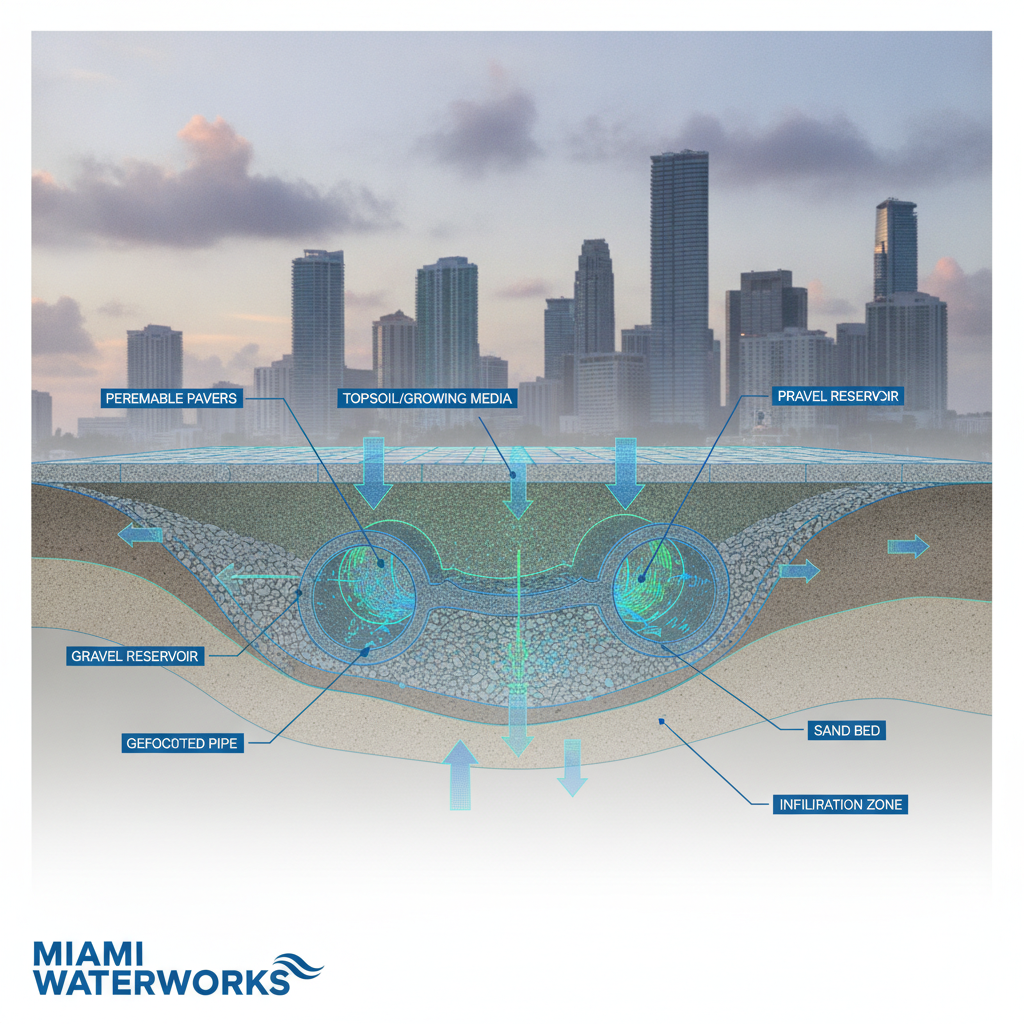
Stormwater management in Miami-Dade serves two equally important purposes: flood prevention (water quantity) and pollutant removal (water quality). The design must demonstrate that the post-development peak discharge rate and volume do not exceed pre-development conditions. This often requires significant on-site storage, typically in underground systems like exfiltration trenches or vaults due to high land values. Simultaneously, the system must provide a high degree of water quality treatment. This involves implementing Best Management Practices (BMPs) designed to remove pollutants like sediments, nutrients, and heavy metals before the stormwater is discharged or percolates into the aquifer. The design must meet specific targets for pollutant load reduction, particularly for Total Suspended Solids (TSS) and nutrients like phosphorus and nitrogen. This dual mandate requires a carefully integrated design that balances storage capacity with effective treatment mechanisms.
The Critical Role of Geotechnical Data in Modeling
In Miami-Dade’s porous limestone environment, a stormwater model without solid geotechnical backing is purely theoretical. A thorough geotechnical investigation is non-negotiable. This process involves conducting a Soil boring test to determine the soil stratigraphy, identify the seasonal high groundwater table, and assess the permeability of the underlying soil and rock. The findings are compiled into a comprehensive Geotechnical soil report. This report provides the essential data for the civil engineering team to calculate reliable infiltration rates for the H&H model. Without an accurate, field-verified percolation rate from a percolation testing program, the proposed stormwater management system’s performance cannot be proven to the satisfaction of DERM. Investing in a quality Geotechnical engineer at the outset of a project is critical to avoid costly delays and redesigns during the permitting phase.
RSP Engineers’ Approach to Miami-Dade Stormwater Permitting
At RSP Engineers, we employ a systematic approach to navigate Miami-Dade’s complex stormwater permitting process. Our process begins with a thorough due diligence and site assessment to identify potential constraints, such as high groundwater, soil contamination, or existing easements. We then coordinate closely with a qualified Geotechnical engineer to obtain the necessary soil data. This allows us to build a preliminary H&H model that accurately reflects site conditions. Armed with a viable preliminary design, we often recommend a pre-application meeting with DERM and/or SFWMD staff. This proactive step helps identify potential agency concerns early, saving time and money. Following this, we finalize the drainage design and prepare a comprehensive permit application package, including detailed calculations, plans, and the completed stormwater model. Our team manages the entire submittal process, responds to agency comments efficiently, and provides support through final permit issuance and into the construction administration phase.
Common Pitfalls in Miami-Dade Stormwater Submittals
Even experienced developers can encounter issues with stormwater permit applications in Miami-Dade. Some of the most common pitfalls include: Underestimating the Seasonal High Water Table: Using outdated or incomplete data can lead to a system design that fails in practice. A site-specific analysis is crucial. Incorrect Model Parameters: Using default or generic values for curve numbers, infiltration rates, or control structure coefficients is a red flag for reviewers. Ignoring Sea-Level Rise: Failing to project future tailwater conditions can result in an undersized system that won’t meet long-term resiliency standards. Inadequate Geotechnical Data: Submitting a model without a supporting Geotechnical soil report is a primary cause for application rejection or significant delays. Poorly Documented Calculations: Permit applications must be clear, concise, and reproducible. Reviewers need to follow the engineer’s logic and calculations with ease.
Partner with RSP Engineers for Your Miami-Dade Project
Successfully navigating the complexities of Miami-Dade’s stormwater regulations requires deep local expertise and technical precision. The team at RSP Engineers has a proven track record of designing compliant, efficient, and resilient stormwater management systems for a wide range of projects. We provide comprehensive site engineering services, from initial feasibility studies to final permit acquisition. Let our experts handle the challenges of Miami-Dade stormwater modeling, DERM permitting, and utility coordination so you can focus on bringing your development vision to life. Contact us today to discuss your project’s specific needs.
Achieving Compliant and Resilient Stormwater Design
In conclusion, meeting Miami-Dade’s stormwater requirements is a complex but achievable task with the right expertise. A successful project depends on a deep understanding of local regulations, precise stormwater modeling, and a design that is grounded in thorough geotechnical analysis. Adherence to the county’s unique drainage design criteria is not just about securing a permit; it’s about creating a sustainable and resilient development that protects both property and the environment. Partnering with an experienced civil engineering firm is the most effective way to ensure your project meets these demanding standards from day one.
FAQs
-
Miami-Dade’s rules are stricter due to its unique environmental vulnerabilities, including a very low ground elevation, a highly porous limestone aquifer that is the primary source of drinking water, and direct proximity to sensitive coastal ecosystems like Biscayne Bay. The stringent drainage design criteria are necessary to prevent flooding and protect water quality.
-
The SFWMD issues an Environmental Resource Permit (ERP), which is a state-level permit covering impacts to wetlands and surface waters, including stormwater management. DERM issues a local permit that specifically addresses Miami-Dade’s more rigorous county-level criteria for flood control and water quality. For most projects, you will need to satisfy both agencies, with DERM’s requirements often being the controlling factor in the design.
-
Sea-level rise impacts the ‘tailwater’ condition, which is the water level at the point where your stormwater system discharges. A higher tailwater reduces the system’s ability to drain by gravity. Your stormwater modeling must account for future sea-level rise projections to ensure the system will function properly throughout its design life, which may require higher site elevations or the use of pump systems.