
Navigating Florida’s ADA Parking Requirements: A Civil Engineering Guide
A detailed guide by RSP Engineers on Florida’s ADA and FBC accessibility requirements for parking lots, covering stall design, accessible routes, stormwater integration, and permitting.
Core Principles of ADA and the Florida Building Code, Accessibility
Navigating accessibility standards in Florida requires understanding the interplay between two primary documents: the federal ADA Standards for Accessible Design and the Florida Building Code (FBC), Accessibility. While the FBC largely adopts the ADA standards, it often includes more stringent or specific requirements that take precedence for projects within the state. It is a common misconception that federal compliance alone is sufficient; Florida-specific amendments must be followed. For existing facilities, the concept of readily achievable barrier removal is critical. This provision requires property owners to remove architectural barriers in existing facilities when it is “easily accomplishable and able to be carried out without much difficulty or expense.” This can be triggered by alterations, renovations, or even a change in tenancy. For new construction, there is no ambiguity: full compliance is mandatory. A thorough site assessment by a qualified Professional Engineer is the first step in identifying and planning for these obligations.
Calculating Required Accessible Parking Spaces
Comparison of Standard vs. Van-Accessible Parking Stall Requirements
| Feature | Standard Accessible Stall | Van-Accessible Stall |
|---|---|---|
| Minimum Stall Width | 8 feet (9 feet recommended by FBC) | 11 feet (or 8 feet if aisle is 8 feet wide) |
| Access Aisle Width | Minimum 5 feet wide | Minimum 8 feet wide |
| Vertical Clearance | Standard vehicle clearance | Minimum 98 inches for the stall and vehicular route |
| Required Signage | International Symbol of Accessibility | Symbol of Accessibility plus “VAN ACCESSIBLE” text |
| Location Priority | Must be on the shortest accessible route to an entrance | Must be on the shortest accessible route to an entrance |
The first step in parking lot design is determining the correct number and type of accessible spaces. This is not a discretionary choice but a calculation based on the total number of parking spaces provided in the lot or garage. The FBC, Accessibility provides a clear table that dictates the minimum number of accessible spaces required. For example, a lot with 1 to 25 spaces must have at least one accessible space, while a lot with 51 to 75 spaces requires three. Beyond the total count, the regulations also specify the number of those spaces that must be van-accessible spaces. At least one of every six accessible parking spaces (or fraction of six) must be a van-accessible space. These spaces feature a wider access aisle to accommodate vehicle-mounted lifts. This precise accessible parking ratio is a frequent point of review during the permitting process, and errors in this calculation can halt a site plan design approval.
Design Specifications for Accessible Stalls and Access Aisles
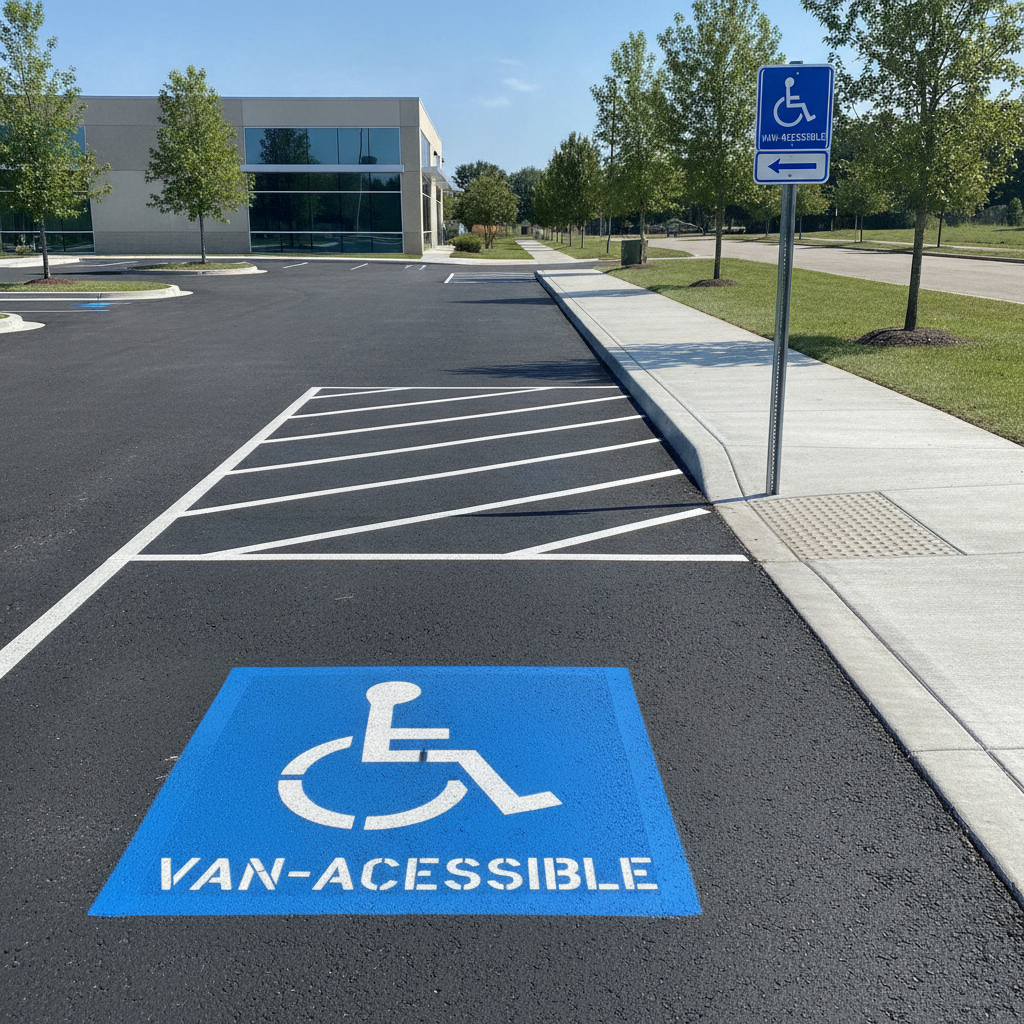
The physical design of accessible parking stalls is highly detailed. A standard accessible car space must be a minimum of 8 feet wide, but the FBC encourages a 9-foot width. Van-accessible spaces must be at least 11 feet wide, or 8 feet wide if they are provided with an adjacent 8-foot-wide access aisle. The access aisle itself is a critical component, providing room for individuals to deploy lifts and maneuver wheelchairs. These aisles must be marked to prohibit parking and must be level with the parking space. Signage and markings are equally important. Each accessible space must be identified with a sign displaying the international symbol of accessibility, mounted so the bottom of the sign is at least 60 inches above the ground. Van-accessible spaces require additional signage indicating them as such. All pavement markings for stalls and access aisles must be clearly defined, and the access aisle is typically marked with diagonal stripes to discourage parking.
Accessible Route and Path of Travel Requirements
An accessible parking space is useless without a compliant path to the building entrance. The design of this accessible route is a primary focus of civil engineering for ADA compliance. The entire path of travel, from the parking space to the facility entrance, must be free of obstructions and meet strict slope requirements. The maximum running slope (the slope in the direction of travel) cannot exceed 1:20 (5%), and the cross-slope (the slope perpendicular to the direction of travel) cannot exceed 1:48 (2%). This path must be at least 36 inches wide and constructed of a firm, stable, and slip-resistant surface. Where the accessible route crosses a curb, a curb ramp must be provided. The design of these ramps is also highly regulated, with specific requirements for slope, side flares, and landings. These geometric constraints heavily influence the site’s overall grading and drainage design, requiring careful planning to achieve compliance.
Integrating Stormwater Management with ADA Compliance
One of the most challenging aspects of accessible design in Florida is integrating it with stormwater management. The state’s intense rainfall necessitates robust drainage systems, but these systems cannot create barriers for individuals with disabilities. For example, placing a curb inlet or trench drain directly in the middle of an accessible route can violate compliance standards by creating an uneven surface or a tripping hazard. The 2% maximum cross-slope rule for the path of travel directly impacts how sheet flow is managed across parking lots and sidewalks. Effective civil engineering solves this by carefully grading the site to direct water away from accessible routes or by using strategically placed drainage structures that do not obstruct the path of travel. This might involve using shallow swales adjacent to sidewalks or installing area inlets outside the required accessible path. This integration is a key part of the agency review process, as municipalities will scrutinize plans to ensure drainage features do not compromise accessibility.
Permitting and Agency Review for Accessibility
All new construction and substantial alteration projects require permitting from the local municipality or county. During this process, the site plan is reviewed for compliance with all applicable codes, including zoning, land development regulations, and, critically, the FBC, Accessibility. Plan reviewers will meticulously check parking calculations, stall dimensions, signage details, and the entire accessible path of travel, including all slopes and curb ramp details. Any deviation from the code will result in review comments that must be addressed before a permit is issued. This is a common source of project delays. Experienced Civil Engineering firms anticipate these review comments by submitting a thorough and compliant site development plan from the start. In some cases, projects may also require review by other agencies, such as the Florida Department of Transportation (FDOT) if the project connects to a state road, adding another layer of compliance oversight.
RSP Engineers’ Approach to Integrated Accessibility Design
At RSP Engineers, we treat accessibility compliance as an integral part of the entire site development process, not a final checklist. Our approach begins with a comprehensive review of the project’s specific needs and the applicable local and state codes. We incorporate ADA and FBC requirements into the earliest stages of the site plan design, ensuring that grading, drainage, and utility layouts all support a fully compliant and functional accessible environment. Our process involves close coordination with architects, landscape architects, and developers to create a cohesive plan. By proactively addressing potential issues related to slope, path of travel, and stormwater management, we minimize the risk of costly review comments and construction-phase changes. This integrated approach ensures that the final built environment is not only compliant but also safe and welcoming for all users, which is the ultimate goal for successful Civil Engineering firms.
Common Pitfalls in Florida Parking Lot Accessibility Design
Even with the best intentions, mistakes in accessibility design are common. One of the most frequent issues we see is incorrect slopes. Achieving a cross-slope of 2% or less on the accessible path of travel requires precise grading and is often overlooked. Another common pitfall is improperly designed curb ramps, which may have slopes that are too steep or lack the required level landings at the top and bottom. Signage is another area prone to error, particularly incorrect mounting height or missing van-accessible designations. During construction, vigilant construction administration is essential to ensure the design is executed correctly. For example, a layer of asphalt overlay applied during repaving can slightly alter the finished elevations, throwing carefully designed slopes out of compliance. This is why post-construction as-built surveys are so important for verifying that the final product meets all ADA compliance standards and avoids future liability for the property owner.
Ensure Your Project is Compliant from Day One
Navigating the complexities of ADA and FBC accessibility standards requires specialized expertise. The team at RSP Engineers provides the detailed civil engineering services needed to ensure your project is designed and permitted correctly from the start. We manage every aspect of site development, from initial zoning compliance analysis to final construction oversight. Don’t let accessibility issues become a source of delays and liability. Contact us today to discuss how our expertise in ADA compliance and Florida’s unique regulatory environment can benefit your next project.
Conclusion: Accessibility as a Cornerstone of Good Site Design
In conclusion, achieving full accessibility compliance in a Florida parking lot is a complex but essential task. It goes far beyond paint and signs, touching on the core disciplines of civil engineering, including grading, drainage design, and utility coordination. A proactive, integrated approach not only ensures compliance with the law but also creates a safer, more equitable environment for all users. By prioritizing ADA compliance as a fundamental component of site plan design, developers and property owners can mitigate risk, avoid costly rework, and deliver a superior final product.
FAQs
-
The federal ADA sets the national baseline for accessibility. The Florida Building Code (FBC), Accessibility, incorporates the ADA standards but also includes state-specific amendments that are often more stringent. For any project in Florida, you must comply with the FBC, which may have different requirements for features like signage or the number of accessible spaces in certain medical facilities.
-
It depends. If you are not making any alterations, you are required to remove barriers to the extent that it is “readily achievable.” However, if you alter your parking lot—such as by restriping, resurfacing, or reconfiguring it—you will likely trigger the requirement to bring the altered elements, including parking spaces and the path of travel, up to current ADA compliance standards.
-
Repaving is considered an alteration and can significantly impact compliance. An asphalt overlay adds thickness, which can change the slope of parking stalls and accessible routes, potentially making them non-compliant. It can also create a lip at curb ramps. Any repaving project should include a plan to maintain or restore all required accessible route slopes and transitions.