
Mastering Underground Utility Coordination for Florida Data Center Construction
A guide by RSP Engineers on the complexities of underground utility coordination for data center construction in Florida, covering power, fiber, water, and permitting.
The High-Stakes Nature of Data Center Utility Infrastructure
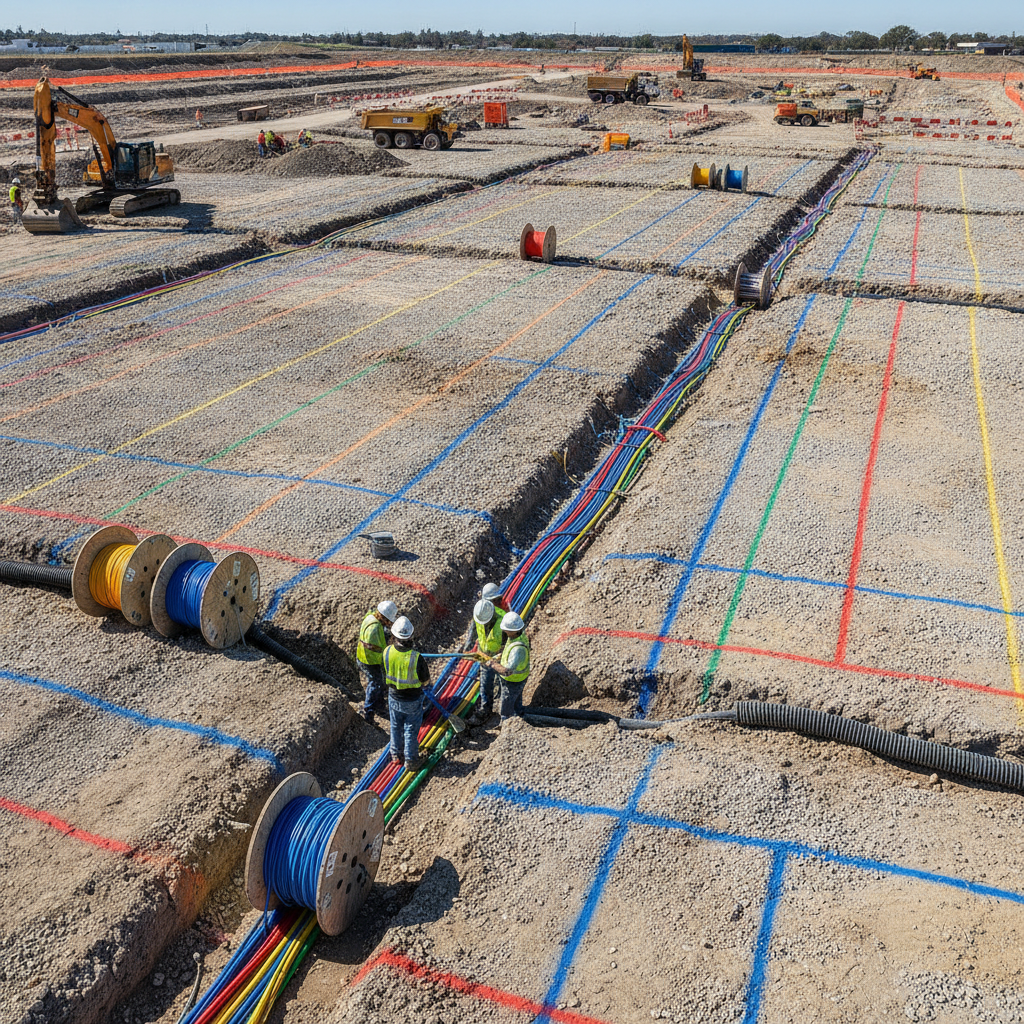
Unlike a typical commercial building, a data center’s utility needs are defined by massive scale and an absolute requirement for redundancy. The concept of ‘N+1’ or ‘2N’ redundancy, which ensures backup systems are in place, extends to the external utility infrastructure. A data center cannot tolerate a single point of failure. This means the civil engineering design must incorporate fully redundant and physically separate utility feeds, particularly for power and fiber optics. A single backhoe strike taking out a conduit cannot be allowed to cause an outage. The power demand alone is staggering, often requiring dedicated substations and multiple, high-voltage feeds from different parts of the electrical grid. Similarly, low-latency connectivity demands diverse and redundant fiber optic infrastructure from multiple carriers, entering the property from different directions. This level of mission-critical facility design places immense pressure on the initial site development phase, where every utility pathway must be meticulously planned to ensure both separation and accessibility for future maintenance.
Navigating Florida’s Unique Subsurface Challenges
Data Center Utility Requirements and Coordination Matrix
| Utility Type | Key Requirement for Data Centers | Primary Coordination Challenge | Typical Permitting Authority |
|---|---|---|---|
| Electrical Power | Dual, redundant feeds from separate substations (2N); high capacity (20-100+ MW). | Long lead times for transformers/switchgear; complex easement acquisition; load letter approval. | Power Utility Provider, Local Municipality |
| Fiber Optic | Diverse, physically separate pathways from multiple carriers; low-latency connections. | Identifying and contracting with multiple carriers; securing diverse right-of-way access. | Local Municipality, County, FDOT |
| Potable/Cooling Water | High-capacity, reliable supply for cooling systems (if applicable) and domestic use. | Verifying municipal system capacity; potential for off-site main extensions. | Local Utility Department, Health Dept. |
| Sanitary Sewer | Sufficient capacity for domestic wastewater and potential industrial discharge from cooling towers. | Capacity analysis and reservation; pretreatment requirements for industrial discharge. | Local Utility Department, FDEP |
| Storm Drainage | Compliance with Water Management District rules for water quality and quantity control. | Designing large-scale retention/detention systems; avoiding conflicts with other utilities. | Water Management District, Local Municipality |
Executing complex underground work in Florida presents distinct environmental hurdles. The state’s notoriously high water table requires extensive dewatering strategies during construction to keep trenches dry and stable. This not only adds cost but also requires specific permits and careful management to avoid impacting adjacent properties. Furthermore, Florida’s sandy soils can affect trench wall stability and the choice of backfill material needed to protect sensitive utility conduits. A thorough geotechnical investigation is non-negotiable. A Geotechnical engineer will perform a Soil boring test to identify soil composition, groundwater levels, and the presence of rock or organic materials. In some regions, the risk of karst topography (sinkholes) must be assessed. The findings from the geotechnical soil report directly influence the drainage design, foundation engineering, and the methods for utility installation. Overlooking these subsurface conditions can lead to failed inspections, damaged infrastructure, and long-term settlement issues.
Critical Path: Power and Fiber Optic Coordination
The longest lead items in data center development are often the power and fiber connections. Coordinating with major power providers like FPL, Duke Energy, or TECO is a project in itself. Securing dual power feeds from separate substations involves complex negotiations, detailed load calculations, and extensive easement acquisitions. The design and procurement of high-capacity switchgear and transformers can take 12-18 months or more, making early engagement with the utility provider a critical path activity. Simultaneously, achieving true diverse fiber routing requires identifying multiple telecommunication providers and mapping their existing networks relative to the site. The goal is to establish at least two separate entry points for fiber conduits, with the pathways physically separated throughout their route to the building. This process involves securing utility easements, coordinating directional boring under existing infrastructure, and ensuring that the design complies with each carrier’s specific technical standards. Effective utility coordination is the only way to manage these parallel, high-stakes efforts.
Water, Sewer, and Stormwater Management Integration
While power and fiber get the spotlight, water and wastewater systems are equally critical. Many modern data centers utilize water-based cooling systems, requiring a substantial and reliable process water supply. This may necessitate the upsizing of municipal water mains and the installation of large-diameter service lines. The corresponding wastewater discharge, which may be classified as industrial wastewater discharge, requires careful coordination with local utility authorities to ensure their system has adequate capacity. In Florida, stormwater management is a primary focus of any site plan review. Due to the large impervious areas created by the building and parking lots, a sophisticated drainage design is required to manage runoff and meet the stringent requirements of the local Water Management District. This often involves designing large retention or detention ponds and obtaining an Environmental Resource Permit (ERP). The stormwater system must be designed in concert with the underground utility network to avoid conflicts and ensure proper grading and flow.
The Role of Subsurface Utility Engineering (SUE) in Risk Mitigation
One of the greatest risks in any large-scale construction project is striking an existing underground utility. The consequences range from service outages to catastrophic explosions. To mitigate this, a proactive approach using Subsurface Utility Engineering (SUE) is essential. SUE is a formal engineering practice that goes far beyond the standard ‘Call 811’ service. It involves a systematic process of designating, locating, and mapping existing underground infrastructure to a verified level of accuracy. By engaging a SUE provider early, the design team can work with reliable data, routing new utilities to avoid conflicts with existing ones. This process, which can include geophysical methods and vacuum excavation for as-built verification, is critical for creating an accurate composite utility plan. Investing in SUE upfront significantly reduces construction risk, prevents costly project delays from utility strikes, and enhances site safety for all personnel.
Permitting and Agency Coordination: A Complex Web
The path to construction is paved with permits. For a data center, the number of required approvals can be extensive, involving a host of different entities. The site plan design must undergo rigorous agency review from the local city or county planning, zoning, and engineering departments. Additionally, separate utility permits are often required for connections to public water, sewer, and reuse systems. If the project impacts a state road, Florida Department of Transportation (FDOT) permits for right-of-way permitting will be necessary. The stormwater management system requires a permit from one of Florida’s Water Management Districts (e.g., SFWMD, SWFWMD). Each agency has its own set of codes, technical standards, and review timelines. A successful project requires a civil engineering firm with deep experience in navigating these agencies, managing multiple permit submittals simultaneously, and fostering clear communication to resolve review comments efficiently.
RSP’s Proactive Utility Coordination Process
At RSP Engineers, we approach utility coordination as a foundational, proactive discipline, not a reactive task. Our process begins during the due diligence phase, where we conduct preliminary research on utility availability and capacity to inform site selection. Once a project begins, we immediately initiate a comprehensive Subsurface Utility Engineering (SUE) investigation to establish a reliable baseline of existing conditions. This data is used to create a composite utility plan, a master document that vertically and horizontally separates all proposed utilities to prevent clashes. A key part of our strategy is hosting regular, structured coordination meetings with representatives from every utility provider—power, telecom, water, gas, and sewer. These meetings, guided by our Professional Engineer team, facilitate real-time problem-solving and ensure all parties are aligned on routing, scheduling, and technical specifications. This hands-on management of the permit submittal and review process minimizes delays and ensures that the final design is not only compliant but also constructible and reliable, providing top-tier site engineering services.
Common Pitfalls in Data Center Utility Design
Even with a solid plan, several common issues can derail a data center project. One of the most frequent is the discovery of unrecorded private utilities on-site, which can force last-minute, costly redesigns. Another major hurdle is navigating conflicting technical standards between different utility providers, where the requirements for separation or conduit material may differ. The extremely long lead times for critical electrical equipment like transformers and switchgear are a constant challenge, and failure to order them early enough can stall a project for months. Finally, delays in securing off-site easements for new utility lines are a frequent source of frustration. Negotiating with multiple private landowners or public agencies can be a slow and unpredictable process. A successful project requires a team that can anticipate these pitfalls and build contingency plans into the project schedule and design from day one, leveraging deep experience in zoning compliance and land rights acquisition.
Partner with RSP Engineers for Mission-Critical Site Development
Successfully launching a data center in Florida requires an engineering partner who understands the immense complexity and high stakes of underground infrastructure. At RSP Engineers, our team specializes in the intricate process of utility coordination for mission-critical projects. We manage the entire lifecycle, from initial due diligence and site plan design to navigating the complex web of agency review and securing all necessary permits. Our proactive approach to stormwater management and utility design mitigates risk and keeps your project on schedule. Don’t leave the foundation of your digital infrastructure to chance. Contact RSP Engineers today to discuss how our expertise can ensure the success of your next data center development.
Conclusion: Building a Resilient Foundation for Digital Infrastructure
In the world of data centers, resilience is paramount. That resilience begins with a meticulously planned and executed underground utility network. For developers in Florida, success depends on a deep understanding of the state’s unique geological and regulatory environment, a proactive approach to utility coordination, and an unwavering focus on redundancy. By prioritizing early engagement with utility providers, investing in thorough Subsurface Utility Engineering, and partnering with an experienced civil engineering firm, you can build a robust and reliable foundation. This strategic approach to underground utility design and a comprehensive permitting strategy are the essential first steps in powering the future of digital infrastructure. Related Articles Navigating Florida’s ERP Permitting for Large-Scale Developments The Civil Engineer’s Role in Achieving Data Center Uptime Site Selection Analysis for Industrial and Mission-Critical Facilities
FAQs
-
Utility coordination should begin during the site selection and due diligence phase, even before land acquisition. Early engagement allows you to verify that the site can be serviced with the required capacity and redundancy for power and fiber, which are the most critical and longest lead-time items. This initial analysis is a core part of a proper site development feasibility study.
-
The primary differences are scale and redundancy. A data center requires exponentially more power and connectivity. The design must incorporate dual power feeds and diverse fiber routing to eliminate single points of failure, a level of resilience not typically required for standard commercial projects. The entire utility coordination process is therefore far more complex and critical to the project’s success.
-
Florida’s high water table necessitates active dewatering of trenches during construction to ensure a dry and stable environment for laying pipes and conduits. It can also affect the buoyancy of underground structures and requires careful selection of backfill materials and potential concrete encasement to protect the utility conduits and prevent them from shifting over time.