
Data Center Utility Easements: A Florida Civil Engineering Guide to Design, Planning, and Permitting
A guide for developers on the civil engineering challenges of data center utility easements in Florida, covering design, utility coordination, permitting, and stormwater management.
The Unique Utility Demands of Modern Data Centers
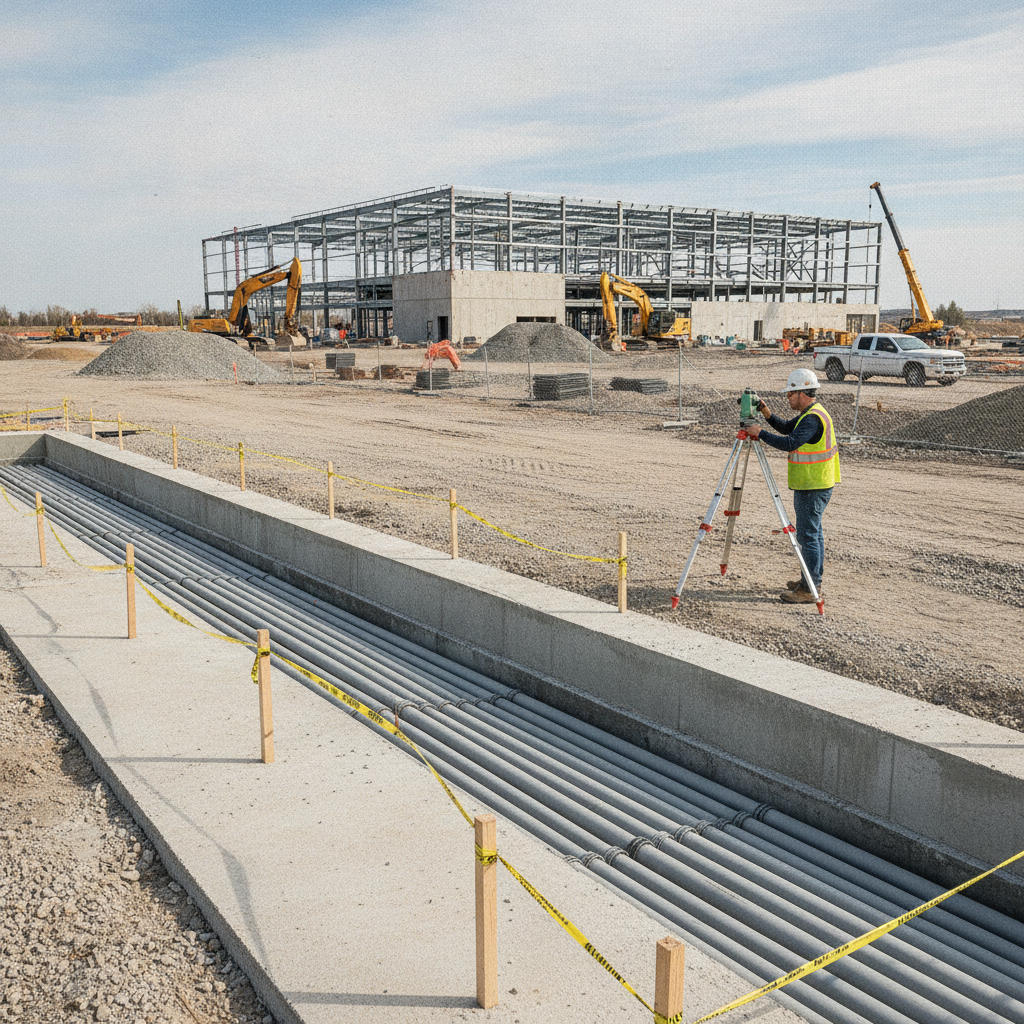
The scale of utility demand for a data center is orders of magnitude greater than for other commercial facilities. The primary driver is power; a single hyperscale data center can require more electricity than a small city. This necessitates not just one, but often two or more independent, high-voltage feeds from separate substations to ensure N+1 or 2N redundancy. The civil engineering challenge involves designing corridors for these massive electrical duct banks, which must be carefully routed to avoid conflicts and maintain required separation distances. This level of utility coordination begins long before a shovel ever hits the ground. Beyond power, data connectivity is paramount. This means securing easements for multiple, physically separate fiber optic routes from different providers to create true path diversity. A single backhoe cutting the wrong line cannot be allowed to take the facility offline. Furthermore, water is a critical utility for cooling systems, often requiring large-diameter potable or reclaimed water lines. The associated sanitary sewer and drainage design must accommodate significant discharge volumes. Each of these utilities requires a dedicated, legally defensible easement, making the overall site development process incredibly complex.
Defining and Negotiating Utility Easements
Key Utility Easement Negotiation Points for Data Centers
| Easement Type | Key Design Consideration | Common Permitting Agency (Florida) |
|---|---|---|
| Electrical Power (Primary/Redundant) | Minimum 20-30 ft. width; separation from other utilities; specific turning radii for high-voltage cables; duct bank design. | Local Municipality/County; Water Management District (if wetlands impacted). |
| Fiber Optic (Diverse Paths) | Separate physical routes from power; avoid 90-degree bends; strategic vault placement for splicing; multiple provider access. | Local Municipality/County (Right-of-Way Permit); FDOT (if crossing state roads). |
| Potable Water & Sanitary Sewer | Sufficient depth to avoid conflicts; proper slope for gravity sewer; backflow prevention; coordination with local utility department standards. | Florida Department of Environmental Protection (FDEP); Local Utility Authority. |
| Reclaimed Water (for Cooling) | Large diameter piping; pressure considerations; cross-connection control to prevent contamination of potable systems. | FDEP; Local Utility Authority; Water Management District. |
| Storm Drainage Easements | Sufficient width for maintenance access (e.g., V-ditch or pipe cleaning); alignment with natural flow paths; outfall design. | Water Management District (ERP); Local Municipality/County. |
A utility easement is a legal right that grants a utility provider the authority to install, operate, and maintain its infrastructure on a piece of private property. For data centers, these are rarely simple, off-the-shelf agreements. They are complex legal instruments that must be negotiated with precision. The process begins with a thorough title search and boundary survey to identify any existing encumbrances that could conflict with proposed utility routes. The civil engineering team works to prepare detailed legal descriptions and sketches (exhibits) that clearly define the horizontal and vertical limits of the proposed easement. Negotiations with utility providers like FPL, Duke Energy, TECO, and major telecom carriers are a critical step. These discussions define the terms of the easement, including width, depth restrictions, maintenance access rights, and any restrictions on the property owner’s use of the easement area. A poorly worded easement can severely limit future expansion or site modifications. Therefore, a proactive approach to utility coordination, involving both legal counsel and experienced engineers, is essential to securing favorable terms that protect the long-term viability of the data center asset.
Civil Engineering Design for Utility Corridors
Designing the physical path for data center utilities is a sophisticated exercise in subsurface utility engineering (SUE) and site logistics. The goal is to create a dedicated utility corridor that accommodates multiple large-scale services efficiently and safely. This involves designing concrete-encased duct bank systems for power and fiber, ensuring mandated separation between high-voltage electrical lines and sensitive communication cables to prevent electromagnetic interference (EMI). The design must also account for bending radii of large cables and provide strategically placed vaults for pulling and splicing. The site plan design must integrate these corridors with the overall site layout, including building footprints, parking lots, security perimeters, and landscaping. A key consideration is the interaction with the site’s drainage design. Utility trenches can intercept and redirect subsurface water flow, and the design must incorporate measures like trench dams or underdrains to prevent unintended hydrological consequences. All of this work must be documented in detailed construction plans that serve as the blueprint for both the utility providers and the site contractor, ensuring a seamless installation process during the construction administration phase.
Navigating Florida’s Permitting Labyrinth for Easements
Securing the necessary permits for utility easements in Florida involves a multi-agency approach. The specific requirements depend on the project’s location and the nature of the land being crossed. If an easement crosses wetlands or impacts surface water flows, an Environmental Resource Permit (ERP) from the regional Water Management District (e.g., SFWMD, SWFWMD) will be required. This involves detailed environmental assessments and a robust stormwater management plan to mitigate any impacts. For easements that cross public rights-of-way, permits are needed from the controlling government entity, which could be a city, a county, or the Florida Department of Transportation (FDOT). Each agency has its own set of standards for utility placement, depth of cover, and restoration of public infrastructure. The permit submittals must include detailed engineering drawings, traffic control plans, and proof of insurance. Successful agency review hinges on complete, accurate applications and a proactive communication strategy to address reviewer comments swiftly.
Stormwater Management and Drainage Implications
The extensive trenching required for data center utility corridors can have significant impacts on a site’s hydrology. These long, linear excavations can act as French drains, intercepting and channeling groundwater and surface runoff in unintended ways. An effective stormwater management plan must account for this. The civil engineering design may need to include trench plugs at regular intervals to prevent the creation of subsurface flow paths that could undermine foundations or starve wetland areas of necessary water. Furthermore, the backfilled trenches can experience settlement over time, creating depressions on the surface that disrupt sheet flow and create ponding issues. The drainage design must anticipate this, potentially incorporating shallow swales or collection inlets along the easement corridors to maintain positive drainage across the site. During construction, a comprehensive Stormwater Pollution Prevention Plan (SWPPP) is required to manage erosion and sediment control, ensuring that trenching activities do not pollute adjacent waterways, a key component of the permitting process.
Integrating Easements with Site Security and ADA Compliance
Data centers are high-security facilities, and utility easements must be designed in a way that does not compromise the security perimeter. Easements often need to cross fence lines, requiring carefully designed access gates that can be used by utility personnel without creating a security vulnerability. The location of manholes, vaults, and other access points must be coordinated with security camera placement and patrol routes. This requires close collaboration between the civil engineering team and the project’s security consultant. At the same time, site elements must adhere to the Americans with Disabilities Act (ADA). Utility hardware such as manhole lids, valve boxes, and pull boxes cannot be located within a required accessible path of travel if their presence would create a non-compliant surface. The design must ensure that all pedestrian pathways, including those that may cross a utility easement, maintain proper slope, cross-slope, and surface integrity to meet ADA compliance standards. This attention to detail is critical for avoiding costly rework and ensuring a safe, accessible site for all personnel.
Our Process: A Strategic Approach to Easement Acquisition
At RSP Engineers, we approach data center utility easements with a strategic, multi-phase process. It begins with comprehensive due diligence, including ALTA/NSPS Land Title Surveys, subsurface utility mapping, and early outreach to utility providers to confirm capacity and routing options. We then develop a preliminary site plan design that optimizes the layout of utility corridors while minimizing environmental and construction impacts. Our team manages the entire utility coordination process, from initial application to final agreement execution. We prepare and submit all permit submittals to the relevant local, state, and federal agencies, and we actively manage the agency review process to secure approvals on schedule. During construction, we provide construction administration services to ensure the infrastructure is installed precisely according to plan.
Common Issues and Costly Pitfalls
Even with careful planning, data center easement projects can encounter obstacles. One of the most common is discovering unrecorded or incorrectly located existing utilities during excavation, which can cause significant delays and require costly redesigns. Protracted negotiations with utility providers or adjacent landowners can also stall a project’s timeline. In Florida, unexpected environmental issues, such as discovering protected species or culturally significant artifacts within a proposed easement, can trigger additional studies and complex permitting requirements. Finally, ambiguous language in an easement agreement can lead to future disputes over maintenance responsibilities or restrictions on the property owner’s use of the land, impacting the site’s long-term operational flexibility.
Your Partner for Mission-Critical Site Development
Successfully navigating the complexities of data center utility easements requires a civil engineering partner with specialized experience in mission-critical facilities. The team at RSP Engineers provides the expert guidance needed to manage every stage of the process, from initial due diligence and site plan design to complex utility coordination and multi-agency permitting. We understand the unique demands of the Florida regulatory environment and work proactively to de-risk your project and keep it on schedule. Contact us to discuss how our site engineering services can support your next data center development.
Conclusion
Utility easements are far more than just lines on a drawing; they are the foundational legal and physical infrastructure that enables a data center to function. For developers in Florida, a successful project hinges on a strategic approach that integrates legal expertise, meticulous civil engineering design, and a deep understanding of the state’s intricate permitting landscape. By prioritizing early and thorough utility coordination and planning for future expansion, developers can secure the robust, reliable, and redundant services necessary to support their mission-critical operations for decades to come.
FAQs
-
A public utility easement is dedicated to a government or quasi-government entity for public services like water, sewer, or drainage. A private utility easement is granted to a specific company, such as an electric or communications provider. Data center projects involve extensive negotiation of private utility easements with multiple providers to ensure service redundancy and competition.
-
The width varies based on the utility. A primary power easement with large duct banks may require a width of 30 feet or more, while a single fiber optic line may only need 10 feet. The final width is determined by the civil engineering design, which must account for construction workspace, required separation between utilities, and future maintenance access.
-
Sometimes, but it requires careful planning. Co-location is often governed by utility provider standards and safety codes, which mandate minimum separation distances. For example, high-voltage power lines and fiber optic cables must be separated to prevent interference. A comprehensive utility coordination plan is essential for designing a shared utility corridor.