
Data Center Stormwater Systems: Civil Engineering Best Practices for Florida Projects
A guide to civil engineering best practices for data center stormwater management in Florida. Learn about flood risk, permitting, and designing resilient drainage systems.
Unique Stormwater Challenges of Data Center Sites
Data center developments present a unique set of constraints for civil engineering design. Unlike typical commercial sites, they feature extremely high impervious surface ratios due to massive building footprints, extensive paving for service access, and large pads for generators and cooling equipment. This concentration of non-porous surfaces generates significant stormwater runoff volume and peak flow rates, which must be managed meticulously to prevent on-site and off-site flooding. The operational standard of 100% uptime means there is zero tolerance for ponding or flooding near critical infrastructure. Furthermore, the site’s security and operational needs heavily influence the drainage design. High-security fencing, access control points, and required setbacks can create barriers to conventional drainage paths. The layout must also accommodate redundant utility corridors for power and fiber, which often compete for space with stormwater conveyance systems. The heat rejection from cooling systems can also impact water quality, as discharged water may have elevated temperatures or contain treatment chemicals, requiring special considerations during the permitting process with Florida’s Water Management Districts (WMDs).
Integrating Stormwater Management with Site Security and Redundancy
Stormwater Management System Comparison for Data Centers
| System Type | Key Design Consideration | Suitability for Data Centers | Florida Permitting Note |
|---|---|---|---|
| Surface Detention Pond | Large land footprint; potential security/safety issue. | Low. Consumes valuable real estate needed for building, equipment, or expansion. | Standard ERP review process, but land use is inefficient for this application. |
| Underground Detention Vault | High upfront cost; structural load capacity; maintenance access. | High. Maximizes usable land area by placing storage under parking or non-critical areas. | Requires detailed structural plans and a robust maintenance plan as part of the permit submittals. |
| Permeable Pavement System | Requires specific subgrade conditions; long-term maintenance to prevent clogging. | Moderate. Best suited for employee parking areas, not heavy truck traffic zones. | WMDs often require pre-treatment and may limit infiltration credit depending on soil and water table conditions. |
| Bioretention / Rain Gardens | Aesthetic benefits; requires specific plant media and underdrains. | Low to Moderate. Can be used in non-critical landscape areas but offers limited volume control for large impervious sites. | Viewed favorably for water quality but must be part of a larger, comprehensive stormwater management system. |
| Exfiltration Trench | High infiltration rates required; sensitive to high water table. | Moderate. Effective in sandy soils but can be limited by Florida's high seasonal water table. | Requires extensive Geotechnical Engineering data to prove feasibility and receive full credit from agencies. |
A successful data center design harmonizes stormwater management with the facility’s physical security and operational redundancy. The goal is to create a system that is both effective and unobtrusive. For example, surface stormwater ponds, while common in other developments, may be undesirable as they can consume valuable land and interfere with security perimeters or future expansion plans. This often pushes the design towards underground detention systems, which preserve surface area for critical infrastructure. The placement of every drainage component must be carefully planned. Storm sewer lines cannot conflict with underground duct banks carrying primary and redundant power feeds. Catch basins and manholes must be located away from sensitive equipment areas and main access routes. The site development plan must show a clear separation and protection of critical utilities from potential water intrusion. This requires extensive utility coordination and the use of advanced modeling to simulate how the site will perform under extreme storm conditions, ensuring that all redundant systems remain isolated and protected.
Advanced Water Quality Treatment for Data Center Runoff
Meeting Florida’s stringent water quality standards is a key component of the Environmental Resource Permit (ERP) process. Data center sites can introduce specific pollutants into stormwater runoff that require advanced treatment. Runoff from parking lots, loading docks, and service areas can carry hydrocarbons, while potential diesel spills from backup generators pose a significant environmental risk. Runoff from metallic roofs or HVAC cooling towers can also contribute to heavy metal loading. A standard wet detention pond may not be sufficient to address these concerns. Best practices often involve a multi-stage treatment train approach. This can include upstream devices like hydrodynamic separators or media filters to capture sediment and oils before the runoff reaches the primary stormwater management facility. For sites with limited space, specialized cartridge filtration systems can be integrated into underground vaults. The drainage design must not only meet the net improvement criteria for nutrient loading but also demonstrate a robust plan for spill containment, especially around fuel storage and delivery areas, to satisfy agency review requirements.
Flood Risk Mitigation and Extreme Weather Resiliency
For a mission-critical facility, designing to the minimum code-required storm event (e.g., the 100-year storm) is often insufficient. True resiliency demands a more conservative approach. We recommend evaluating the site’s vulnerability to more extreme events, such as the 200-year or 500-year storm, and incorporating additional freeboard into the design. This includes setting finished floor elevations for all critical buildings and equipment pads well above the projected Base Flood Elevation (BFE) and the site’s own modeled flood levels. A thorough site development plan will include a detailed flood study. This proactive approach may involve creating subtle but effective flood barriers, such as raised service roads or strategically graded berms that direct extreme flows away from the main data hall and utility yards. For sites located in or near a Special Flood Hazard Area, a Letter of Map Revision (LOMR) may be necessary to reflect the protective measures built into the site. This level of flood risk mitigation is a critical part of due diligence and is essential for securing project financing and insurance for high-value assets like data centers.
The Role of Underground Detention and Infiltration Systems
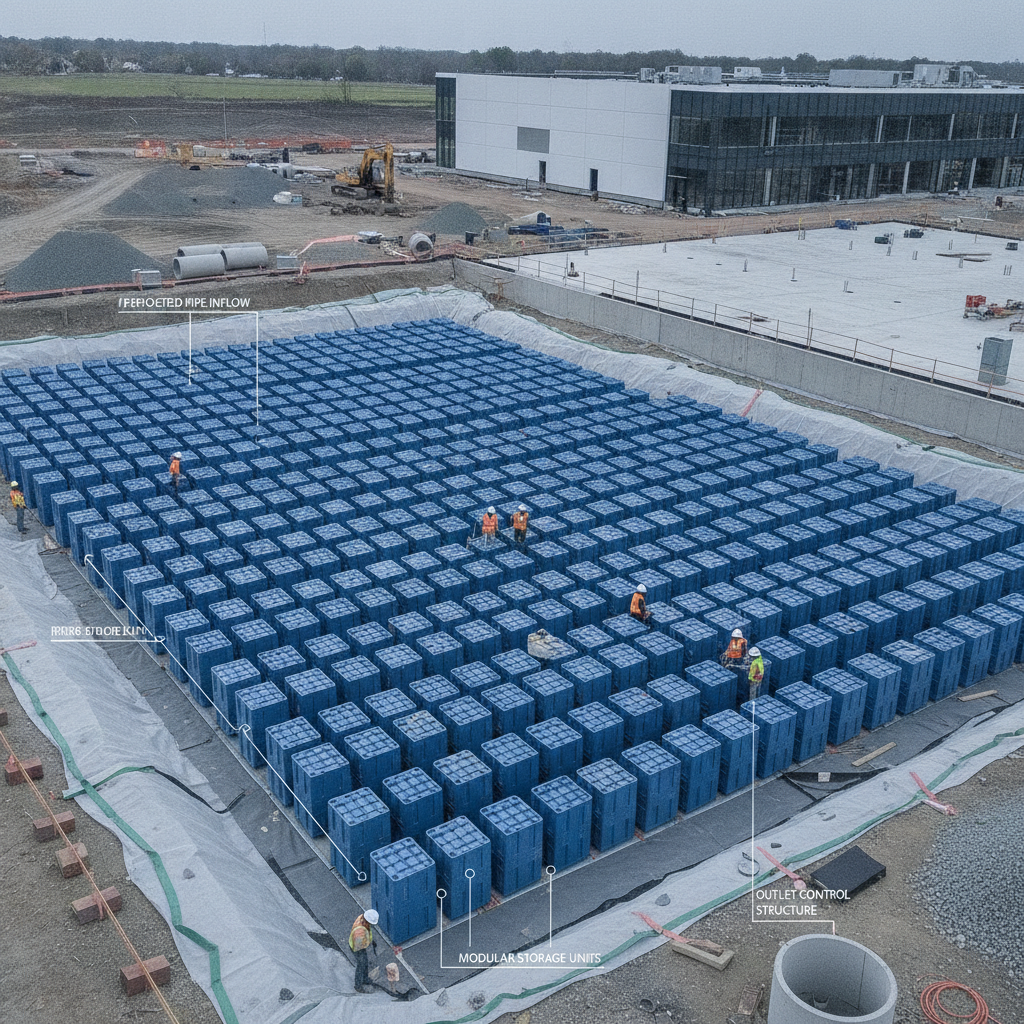
Maximizing usable land is a primary driver for data center developers. Traditional surface ponds can consume a significant portion of a property, limiting space for the building, cooling infrastructure, and future expansion. Consequently, underground detention and infiltration systems have become a preferred solution in civil engineering for these sites. These systems, which can consist of large concrete vaults, modular plastic chambers, or large-diameter pipes, store stormwater runoff beneath parking lots or other paved areas. While they offer significant space-saving advantages, underground systems require careful design and analysis. A thorough Geotechnical Engineering investigation, including soil borings and permeability testing, is essential to determine if the native soils are suitable for infiltration. The structural design must support heavy service vehicle loads, and a detailed long-term maintenance plan is critical for ensuring functionality. The permitting process for these systems requires clear documentation of storage volume, water quality treatment mechanisms, and maintenance access points to gain approval from regulatory agencies.
Permitting Complexities with Florida’s Water Management Districts
Navigating the permitting process for a data center in Florida requires specialized expertise. The project will almost certainly require an Individual Environmental Resource Permit (ERP) from the governing Water Management District (WMD), such as the South Florida Water Management District (SFWMD) or the St. Johns River Water Management District (SJRWMD). This is a rigorous review process that scrutinizes every aspect of the stormwater management system, from flood control calculations to water quality treatment and environmental impacts. The permit application must demonstrate with detailed hydrologic and hydraulic modeling that the project will not cause adverse water quality, flooding, or environmental impacts to downstream properties or water bodies. Given the high value and critical nature of the facility, agency reviewers will pay close attention to the design’s redundancy and resiliency features. The permit submittals must be comprehensive and meticulously prepared to avoid lengthy requests for additional information (RAIs) that can delay the project timeline. Early engagement with WMD staff is a best practice to align on design criteria and expectations.
Our Process: Engineering for Mission-Critical Certainty
At RSP Engineers, our approach to data center site design is rooted in a deep understanding of their mission-critical nature. We begin with a comprehensive due diligence and site feasibility study, identifying all potential risks related to flooding, utilities, and permitting. Our team then develops a highly detailed and integrated site development plan where the stormwater management system is designed in concert with security, utility, and logistical requirements. We utilize advanced 2D and 3D modeling to simulate extreme weather performance and ensure the design provides the required level of protection. We manage the entire permitting lifecycle, from pre-application meetings with WMDs and local municipalities to the final permit issuance. Our deep experience with Florida’s regulatory environment allows us to anticipate agency concerns and prepare thorough, defensible applications that minimize review cycles. During construction, we provide rigorous construction administration and oversight to ensure the system is built exactly as designed, protecting the integrity and long-term resiliency of the facility.
Common Issues and How to Avoid Them
Several common pitfalls can compromise a data center’s stormwater system. One of the most frequent is underestimating the total impervious area, especially when accounting for future expansion phases. This can lead to an undersized system that fails during a major storm. Another critical issue is late-stage utility coordination, where conflicts arise between newly routed fiber conduits and primary storm drains, forcing costly redesigns. Value engineering, if not managed carefully, can also be a problem; substituting specified materials or eliminating redundant components to cut costs can introduce long-term vulnerabilities. To avoid these issues, it is essential to engage an experienced civil engineering team early in the process. A master plan that accounts for all future phases ensures the initial infrastructure is sized correctly. Implementing a formal Subsurface Utility Engineering (SUE) program can identify and resolve utility conflicts before they impact construction. Finally, maintaining design intent throughout the value engineering process is key to ensuring that cost-saving measures do not compromise the core requirements of resiliency and redundancy.
Your Partner for Mission-Critical Site Development
Designing and permitting a data center in Florida requires a specialized skill set that goes beyond conventional commercial site design. The success of your project depends on a civil engineering partner who understands the stakes. At RSP Engineers, we have the expertise to navigate complex permitting, design resilient stormwater management systems, and ensure your critical infrastructure is protected. From initial due diligence to final construction, we provide the engineering certainty you need. Contact RSP Engineers today to discuss your data center project’s unique site development challenges and learn how we can help you build a secure and resilient facility.
Conclusion
In conclusion, the stormwater management system for a data center is not a standard utility; it is a core component of the facility’s overall resiliency strategy. The design must account for high impervious coverage, integrate seamlessly with security and utility infrastructure, and meet Florida’s rigorous environmental regulations. By prioritizing advanced solutions like underground detention, designing for extreme weather events, and engaging in a proactive permitting strategy, developers can protect their assets and ensure the long-term operational integrity of their mission-critical facilities. A successful outcome hinges on a sophisticated and forward-thinking civil engineering approach.
FAQs
-
While technically possible, standard ponds are often impractical for data centers due to their large land footprint, which conflicts with the need to maximize space for the building, equipment, and security buffers. Furthermore, open bodies of water can present security concerns. Therefore, underground detention is often the preferred solution to preserve valuable surface real estate.
-
The biggest challenge is demonstrating compliance with both water quality and water quantity (flood control) regulations within a constrained site. The high percentage of impervious surfaces generates significant runoff that must be treated and attenuated. The Environmental Resource Permit (ERP) application must provide robust modeling and documentation to prove no adverse off-site impacts, a high bar for such intensive developments.
-
Data center cooling systems can produce a constant discharge of ‘blowdown’ water, which is often warm and may contain water treatment chemicals. This discharge cannot simply be routed into the standard stormwater management system without analysis. It may require a separate National Pollutant Discharge Elimination System (NPDES) permit, pre-treatment, or a dedicated cooling pond, all of which must be coordinated with the overall drainage design.