
A Civil Engineer’s Guide to Data Center Fiber Infrastructure Planning
A comprehensive guide for data center developers on planning resilient and redundant fiber infrastructure. Learn about diverse entrances, MMRs, permitting, and site development with RSP Engineers.
The Strategic Imperative: Why Physical Fiber Infrastructure is Mission-Critical
Data center connectivity is defined by its physical resilience. A single backhoe severing a conduit, a flooded handhole, or a poorly planned street crossing can trigger a catastrophic outage. The core objective of fiber infrastructure planning is to eliminate single points of failure. This requires a deep understanding of route diversity, which means creating multiple, physically separate paths for fiber cables to enter and exit the site. This is not just about having two cables; it’s about ensuring those cables are not vulnerable to the same physical event. From a civil engineering perspective, this involves detailed site analysis to identify potential risks and opportunities. We analyze existing utility corridors, public rights-of-way, property line setbacks, and potential construction conflicts. Effective planning ensures that the design of stormwater management systems, access roads, and building foundations complements, rather than complicates, the fiber pathways. This proactive approach during the initial site plan design phase is fundamental to achieving the coveted “five nines” (99.999%) of availability that tenants demand.
Designing for Redundancy: Diverse Fiber Entrances and Pathways
Fiber Route Diversity Strategy Comparison
| Diversity Strategy | Key Characteristics | Primary Benefit | Civil Engineering & Permitting Considerations |
|---|---|---|---|
| Dual Lateral Entrances | Two separate conduit banks entering the property from different directions, often from the same public right-of-way. | Protects against a single backhoe cut or manhole failure on the property itself. | Requires careful utility coordination within the site. Permitting is typically straightforward if contained within the project boundary. |
| True Diverse Carrier Routes | Two or more laterals connecting to completely separate carrier backbone routes in different public streets. | Highest level of resilience; protects against a major disruption in a public right-of-way. | Complex permitting with multiple jurisdictions (e.g., county and FDOT). Requires extensive carrier negotiation and right-of-way investigation. |
| Tri-verse or Quad-verse Paths | Three or four physically separate entrances, often required for hyperscale or federal government tenants. | Extreme fault tolerance, meeting the most stringent uptime requirements. | Significant site development challenge. Requires extensive land area and complex routing to avoid pathway conflicts. Greatly increases permitting complexity and cost. |
| Aerial vs. Buried Diversity | One route is underground, while a secondary route utilizes aerial utility poles. | Protection against different types of physical threats (e.g., excavation vs. storm damage to poles). | Aerial routes are often less desirable due to vulnerability in Florida's hurricane-prone climate. Requires agreements with utility pole owners and specific zoning compliance. |
| Long-Haul Route Diversity | Ensuring that the fiber routes leaving the local area connect to different long-haul networks in separate geographic corridors. | Protects against a regional fiber cut or network hub failure miles away from the data center. | Primarily a carrier network planning issue, but the civil engineer must provide the physical on-site infrastructure to connect to these diverse long-haul access points. |
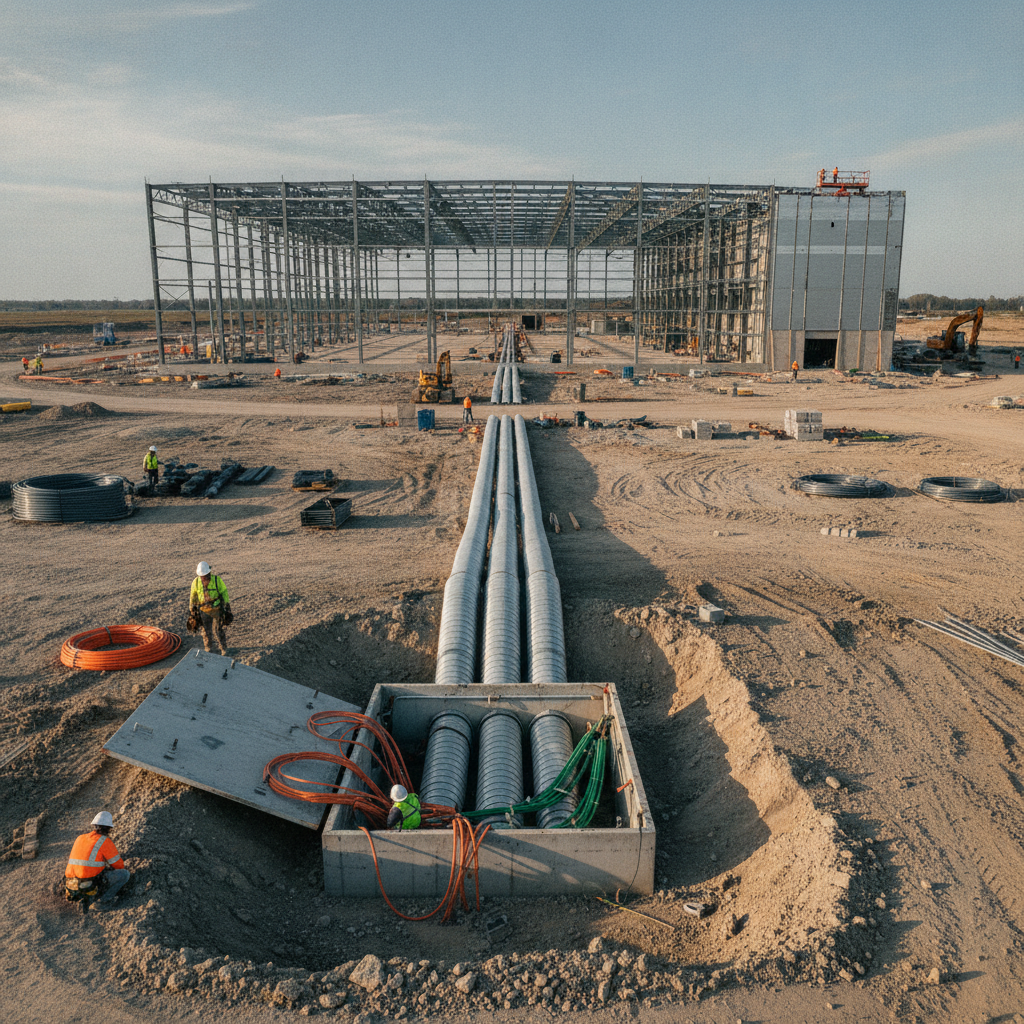
True redundancy is achieved through physical separation. The primary goal is to design at least two, and often three or four, completely separate fiber entrance facilities. These entrances should approach the building from different directions—for example, one from the north side of the property and one from the south. This strategy minimizes the risk of a single incident, like a major road construction project or a localized disaster, taking down all connectivity. The design of these pathways involves careful civil engineering. We specify the depth and separation of conduit banks, the type of conduit material, and the placement of tracer wires for future location. The routes must be planned to avoid conflicts with other critical utilities like water, sewer, and high-voltage power. Furthermore, the design must account for the site’s drainage design, ensuring that vaults and handholes are not placed in low points where water could accumulate and compromise the infrastructure. This level of detailed site development planning is crucial for long-term operational integrity.
The Meet-Me Room (MMR): The Central Nervous System of Connectivity
All external fiber pathways ultimately terminate in the Meet-Me Room (MMR). This secure, access-controlled space is the central hub where multiple telecommunications carriers connect to the data center’s internal network. The civil engineer’s role is to ensure the physical pathways from the property line to the MMR are secure, direct, and scalable. This includes designing the conduit penetrations through the data center’s foundation walls and establishing clear, protected pathways within the building to the MMR. The design must anticipate future needs. We often recommend installing additional “dark” conduits during initial construction. This provides spare capacity for future carriers or increased bandwidth needs without requiring costly and disruptive excavation later. The coordination between the civil engineering firm, the architect, and the network design team is paramount to ensure the MMR is positioned optimally within the building layout and that the external utility coordination aligns perfectly with the internal infrastructure plan.
Underground Infrastructure: Conduits, Vaults, and Handholes
The unseen components of fiber infrastructure are the most critical. The system consists of a network of conduits, innerducts, vaults, and handholes that protect the fragile fiber optic cables. Conduits are typically high-density polyethylene (HDPE) or PVC pipes, often encased in concrete for added protection, especially at road crossings. Innerducts are smaller, flexible tubes placed inside the main conduits to subdivide the space and make pulling individual cables easier. Vaults and handholes are strategically placed access points that allow for pulling, splicing, and maintaining the fiber. The selection and placement of these structures are key civil engineering tasks. We consider factors like pulling distances (typically no more than 500-600 feet between access points), potential for vehicle loading, and integration with the site’s overall drainage design. Proper installation and sealing are critical to prevent water and debris intrusion, which is a common cause of network failure. This meticulous attention to detail during the site development phase protects the long-term investment.
Carrier Coordination and Right-of-Way Permitting
Designing the infrastructure is only half the battle; getting it approved and built is the other. This process involves intensive utility coordination with multiple fiber carriers, local municipalities, county public works departments, and potentially the Florida Department of Transportation (FDOT). Each entity has its own set of standards, review timelines, and permitting requirements for working in the public right-of-way. Our role as the civil engineering lead is to manage these complex interactions. We prepare detailed permit submittals that include traffic control plans, utility crossing details, and restoration plans. Proactive communication and a deep understanding of the agency review process are essential to keep the project on schedule. Delays in securing right-of-way permits can have a significant cascading effect on the overall data center construction timeline.
Our Process: Integrating Fiber Planning from Day One
At RSP Engineers, we embed fiber infrastructure planning into our comprehensive site development process. Our approach begins during due diligence, where we assess the availability and diversity of existing carrier fiber in the vicinity of a potential site. We then develop a conceptual utility plan that incorporates redundant pathways, considering site constraints and opportunities. This early-stage analysis informs the overall site layout, ensuring that fiber routes are protected and optimized. As the design progresses, we produce detailed construction documents for all underground infrastructure, manage the multi-agency permitting process, and provide construction administration services to ensure the installation meets the exacting standards required for mission-critical facilities.
Common Issues in Data Center Fiber Development
Even with careful planning, challenges can arise. One of the most common issues is discovering inaccurate or incomplete records of existing underground utilities, which can lead to costly design changes and construction delays. Another frequent problem is underestimating the timelines for agency review and permitting for work in public rights-of-way, especially when multiple jurisdictions are involved. Finally, value engineering that reduces the separation of diverse pathways or eliminates spare conduits can save money upfront but introduces significant long-term risk and limits future scalability. A seasoned civil engineering firm can help navigate these pitfalls through thorough due diligence and experience-based design recommendations.
Your Partner in Mission-Critical Site Development
Planning and executing a resilient fiber infrastructure strategy requires a specialized skill set that bridges the gap between telecommunications and land development. At RSP Engineers, our team provides the expert civil engineering and permitting services needed to navigate this complex process. From initial due diligence and site plan design to intricate utility coordination and construction oversight, we ensure your data center’s connectivity foundation is secure, scalable, and built to last. Don’t let your most critical infrastructure be an afterthought. Contact RSP Engineers today to discuss how we can support your next mission-critical project in Florida.
Conclusion
A data center’s value is directly tied to its connectivity. A well-designed and properly installed physical fiber infrastructure is the bedrock of that connectivity, providing the resilience and scalability necessary to compete in a demanding market. By prioritizing route diversity, engaging in meticulous utility coordination, and integrating these plans into the overall site development strategy from the outset, developers can mitigate significant operational risks. Partnering with an experienced civil engineering firm is the key to successfully navigating the design, permitting, and construction of this mission-critical asset.
FAQs
-
Fiber planning should begin during the initial site selection and due diligence phase. Understanding the availability and diversity of existing carrier networks is a critical factor in determining a site’s viability. Integrating the physical pathway design into the initial site plan design prevents costly rework and ensures the layout accommodates true redundancy.
-
The most common mistake is creating “false diversity,” where two fiber pathways run in the same trench or cross at the same point, creating a single point of failure. Another is failing to install sufficient spare conduits for future growth, which forces expensive and disruptive retrofits. Finally, not engaging in thorough utility coordination early on can lead to major conflicts and permitting delays.
-
Florida’s sandy soils and high water table require specific engineering solutions. We often specify dewatering during construction and ensure all vaults and conduit entry points are properly sealed to prevent water infiltration. The drainage design for the entire site must be integrated with the utility plan to direct water away from critical infrastructure and prevent long-term submersion of vaults and handholes.