
Data Center Sanitary Sewer Planning: A Guide to Utility Coordination in Florida
Expert guide from RSP Engineers on sanitary sewer planning for Florida data centers. Learn about capacity analysis, utility coordination, permitting, and avoiding common pitfalls.
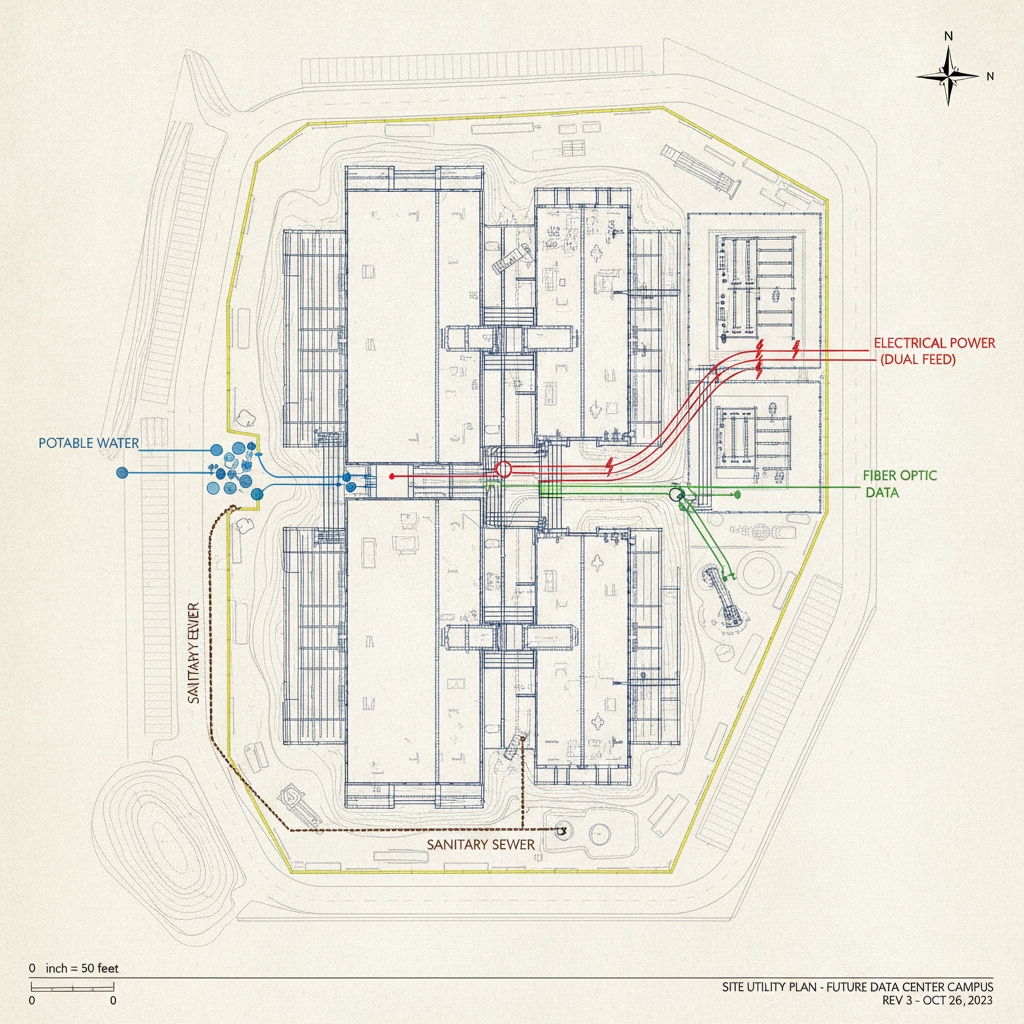
Calculating Peak Sanitary Sewer Demand for Data Centers
The first step in any sanitary sewer design is accurately projecting the demand. For data centers, this calculation is less about the building’s square footage and more about its operational headcount. The primary sources of wastewater are restrooms and small kitchenettes or break rooms. The analysis must focus on peak daily flow, which typically corresponds to shift changes. We meticulously calculate demand based on projected employee counts per shift, applying standard fixture unit counts as mandated by the Florida Building Code. This initial sewer capacity analysis is a critical document for discussions with the local utility authority. It must be defensible and based on realistic operational assumptions. Overestimating demand can lead to unnecessarily oversized infrastructure and higher impact fees, while underestimating it can result in a permit denial or the discovery that the existing municipal system cannot support the project. This analysis forms the basis of the engineering report submitted during the permitting process and must align with local and state (FDEP) regulations.
The Critical Role of Early Utility Coordination
Key Utility Coordination Milestones for Data Center Projects
| Milestone | Key Actions & Deliverables | Typical Timeline (from Project Start) |
|---|---|---|
| Initial Feasibility & Due Diligence | Identify utility providers. Submit initial inquiry to verify service availability. Review municipal utility master plans. | 0-2 Months |
| Preliminary Engineering & Capacity Request | Develop peak sanitary flow calculations. Submit formal capacity request letter to the utility authority. Hold initial coordination meetings. | 2-4 Months |
| Secure Will-Serve / Capacity Reservation | Receive formal confirmation of capacity from the utility. Execute any required developer or service agreements. Pay initial impact fees. | 4-6 Months |
| Final Design & Permitting | Complete construction drawings for on-site and off-site sewer infrastructure. Prepare and submit all required permit submittals to local, county, and state agencies (FDEP). | 6-10 Months |
| Agency Review & Comment Resolution | Respond to technical comments from all reviewing agencies. Revise drawings and reports as needed to secure approvals. | 10-14 Months |
| Pre-Construction Coordination | Finalize connection details with utility inspectors. Coordinate construction sequencing with other utility contractors (power, fiber, water). | 14-16 Months |
Effective utility coordination must begin during the due diligence phase, long before detailed design commences. For a data center project in Florida, identifying the local utility provider and initiating contact is one of the first calls a Civil Engineer near me should make. The goal is to obtain a capacity reservation letter or a will-serve letter, which confirms the municipality has adequate capacity in its collection and treatment systems to handle the project’s projected flow. This often requires submitting the preliminary demand calculations for agency review. This early engagement helps uncover potential red flags, such as downstream capacity limitations in the public main, moratoriums on new connections, or requirements for the developer to fund off-site system upgrades. We work to establish a clear point of connection (POC), verify invert elevations and pipe materials of existing infrastructure, and understand the utility’s specific design standards and permit submittals process. This proactive communication, documented in a master utility plan, prevents major surprises that could derail a project schedule and budget.
Navigating Florida’s Permitting Maze for Sewer Connections
Securing the necessary permits for a new sewer connection in Florida involves multiple agencies and a structured application process. The primary approval typically comes from the local city or county utility department, which issues the utility connection permit. However, depending on the projected flow rate and the nature of the connection, review and approval from the Florida Department of Environmental Protection (FDEP) may also be required. For a data center generating over 2,000 gallons per day, an FDEP permitting application is standard. Furthermore, if the sewer line must cross public rights-of-way, a right-of-way (ROW) permit from the controlling transportation authority is necessary. Each of these permits requires a detailed set of construction drawings, engineering calculations, and supporting documents. As one of the leading Civil Engineering Firms in the region, our team manages the entire permitting lifecycle, from application preparation and submittal to responding to agency comments and securing final approvals, ensuring full zoning compliance and adherence to all technical codes.
Design Considerations for On-Site Sewer Infrastructure
The on-site sewer system must be robust and reliable. The design choice between a gravity sewer system and a force main system depends entirely on site topography and the elevation of the public sewer connection point. If the site cannot drain by gravity, a duplex lift station design is required. For a mission-critical facility like a data center, this lift station must be designed with redundancy, including dual pumps, an independent power source (generator connection), and a telemetry system for remote monitoring and alarms. Material selection is also crucial for long-term durability. We specify appropriate pipe materials (e.g., PVC, ductile iron) based on depth, soil conditions, and traffic loading. The design must also carefully lay out cleanouts for maintenance access and establish clear utility easement requirements to protect the infrastructure from future construction. Every aspect of the on-site drainage design and sewer layout is planned to ensure functionality and prevent operational disruptions.
Integrating Sewer Design with Other Critical Utilities
A data center site is a complex web of underground utilities. Power duct banks, fiber optic conduits, chilled water loops for cooling, and domestic water lines all compete for limited space. A primary role of the civil engineer is to conduct a thorough utility conflict analysis to ensure these systems can coexist without interference. The sanitary sewer, which is often the deepest utility due to its reliance on gravity, typically sets the baseline for vertical separations. We develop composite utility drawings that overlay all proposed infrastructure, allowing us to identify and resolve clashes during the design phase, not during construction when they are expensive to fix. In complex sites, we may recommend subsurface utility engineering (SUE) to accurately locate existing utilities before finalizing the design. This integrated approach to site development is fundamental to mitigating construction risks and delivering a well-coordinated project.
Stormwater Management and Its Impact on Sewer Planning
While separate systems, sanitary sewer and stormwater management infrastructure are intrinsically linked through site grading. The location of large retention or detention ponds, swales, and underground exfiltration systems dictates much of the available land for other uses. The drainage design must be developed in concert with the utility plan to ensure that sewer lines are not routed through areas designated for stormwater treatment or conveyance. Proper site grading is essential to provide positive flow for both surface runoff and the gravity sewer system. The elevations required for the stormwater conveyance network can constrain the available depth and slope for sanitary lines. Our team models these systems concurrently, ensuring the overall site plan is efficient, compliant with NPDES permits, and avoids conflicts between the two critical infrastructure systems. This holistic view is a hallmark of quality civil engineering.
Our Process: A Proactive Approach to Utility Planning
At RSP Engineers, we embed utility planning into every stage of the project lifecycle. Our process begins with comprehensive due diligence to identify all potential utility constraints and opportunities before a client commits to a site. We then move to system modeling and analysis, creating detailed calculations and reports that form the foundation of our discussions with municipal agencies. Our team manages all aspects of agency coordination, acting as the single point of contact to streamline communication and accelerate approvals. During the design phase, we utilize integrated 3D modeling to create a conflict-free site plan design where sanitary sewer, stormwater, power, and communications infrastructure work in harmony. We shepherd the project through the complexities of permitting, leveraging our strong relationships with Florida’s regulatory bodies. Finally, we provide Construction Management Services and administration support to ensure the design is executed flawlessly in the field, verifying that all connections are made to the utility’s standards and the project’s specifications.
Common Pitfalls in Data Center Sewer Design
Even with careful planning, several common issues can arise. One of the most frequent is underestimating the lead time for utility provider approvals and off-site improvements, which can take much longer than standard site permits. Another pitfall is discovering downstream capacity issues in the municipal system late in the design process, forcing a costly redesign or the need for developer-funded upgrades. Failing to account for future phases of a data center campus can also lead to undersized infrastructure that cannot support planned expansion. Other challenges include encountering unforeseen rock or poor soil conditions during trenching, which can be mitigated with a thorough Geotechnical soil report. Finally, a lack of coordination between the civil engineer and the MEP (Mechanical, Electrical, Plumbing) engineer regarding internal plumbing and connection points can cause significant rework. A proactive and experienced team anticipates these issues and builds contingencies into the project plan.
Partner with RSP Engineers for Your Data Center Development
The success of a data center project hinges on the flawless execution of its underlying infrastructure. At RSP Engineers, we provide the expert site engineering services needed to navigate the complexities of sanitary sewer planning and utility coordination in Florida. Our team of Florida Licensed Engineers has a proven track record of delivering robust, reliable, and permit-ready designs for mission-critical facilities. From initial capacity analysis and FDEP permitting to integrated utility design and construction administration, we are your trusted partner in building the foundation for your digital infrastructure. Contact us today to discuss your project’s unique requirements.
Conclusion: Strategic Sewer Planning is Non-Negotiable
In the world of data center development, no detail is too small. While sanitary sewer may not have the same prominence as multi-megawatt power feeds, it is a critical utility that requires meticulous planning, early coordination, and expert design. A failure in this system can halt construction, delay certificates of occupancy, and create long-term operational headaches. By prioritizing strategic utility infrastructure planning as a core component of the overall project, developers can mitigate significant risks. Ultimately, a well-executed sewer strategy, guided by experienced civil engineering professionals, is fundamental to ensuring a data center’s project viability and long-term success in the competitive Florida market.
FAQs
-
The biggest challenge is often confirming adequate downstream capacity in the existing municipal infrastructure. Many utility systems in rapidly growing areas of Florida are already near their limit. Securing a capacity reservation letter early is the most critical step to mitigate the risk of your project being delayed or requiring expensive, developer-funded off-site main extensions or upgrades.
-
While most modern data centers use closed-loop chilled water systems, some cooling tower designs generate blowdown water that must be discharged. This discharge is often routed to the sanitary sewer system and must be factored into the peak daily flow calculations. The water’s chemical composition must also be evaluated to ensure it complies with the utility’s wastewater discharge regulations.
-
Yes, private lift stations are quite common. Due to the large, flat nature of many ideal data center sites, achieving gravity flow to a distant or shallow public sewer main is often not feasible. A properly designed duplex lift station design provides the necessary reliability for these mission-critical facilities.