
Hurricane Rainfall Planning for Data Center Developments
Expert civil engineering strategies for data center development, focusing on extreme hurricane rainfall planning, stormwater management, and site resilience to ensure uptime.
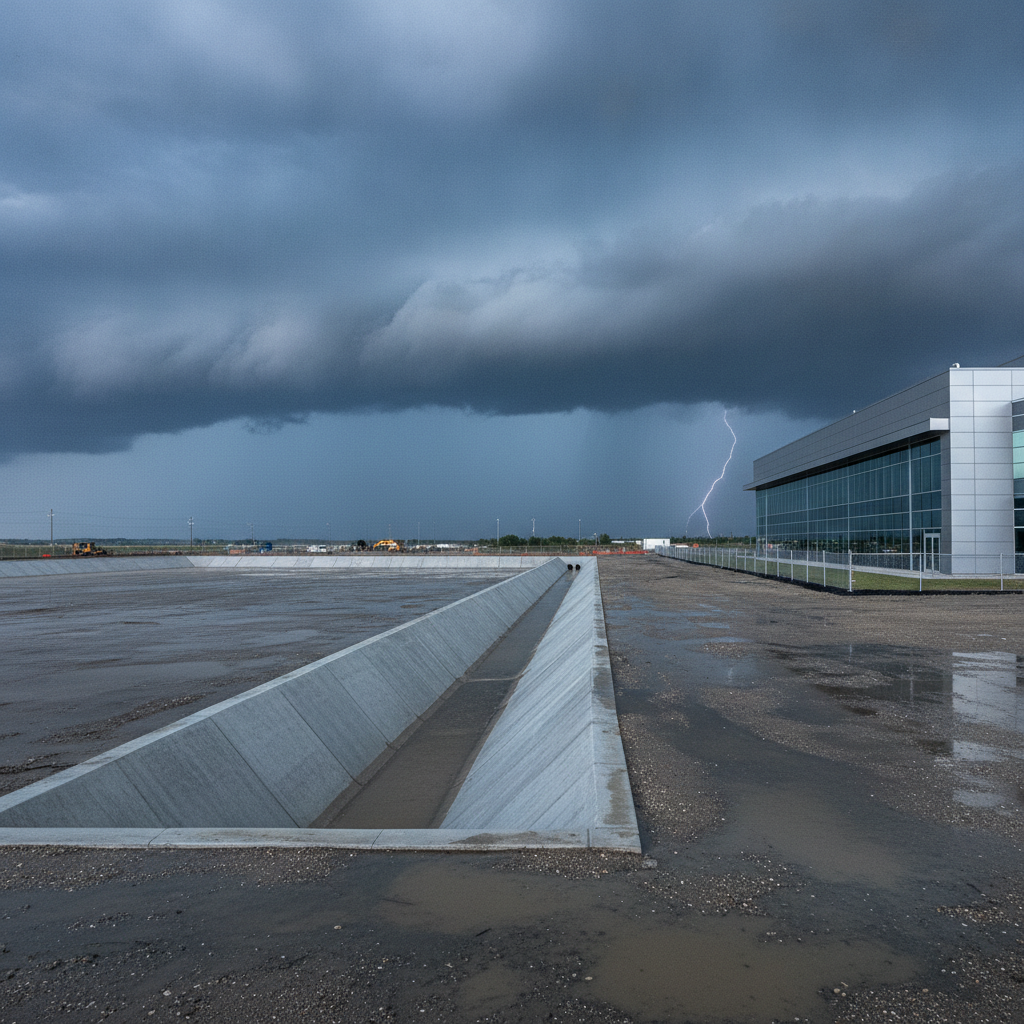
Beyond Standard Design Storms: Modeling Extreme Rainfall Events
Most commercial land development projects are designed to handle a specific design storm, such as a 25-year or 100-year, 24-hour rainfall event. These standards, derived from historical data like NOAA Atlas 14, are sufficient for typical development but fall short when planning for hurricanes. A slow-moving tropical system can deliver rainfall totals that far exceed a 100-year event, often over a period of 48 to 72 hours. This prolonged duration is a key differentiator that requires a more sophisticated hydrologic modeling approach. Our engineering analysis for data centers often involves evaluating more extreme scenarios, such as a 500-year storm or even site-specific Probable Maximum Precipitation (PMP) studies. We analyze not just the peak intensity but the total volume of water the site must manage. This includes accounting for saturated antecedent conditions, where the ground is already waterlogged from previous rainfall, drastically reducing infiltration and converting nearly all subsequent rain into surface runoff. This comprehensive modeling forms the basis of a resilient drainage design that can handle sustained, catastrophic rainfall.
Sizing Conveyance and Storage Systems with a Factor of Safety
Key Design Considerations for Extreme Rainfall Scenarios
| Design Parameter | Standard Commercial Design Approach | Resilient Data Center Design Approach |
|---|---|---|
| Governing Design Storm | Typically 25-year or 100-year, 24-hour event per local code. | 500-year or greater event, analyzed over 48-72 hours. |
| Antecedent Conditions | Often modeled with average or dry soil conditions. | Assumes fully saturated soil conditions, maximizing runoff. |
| Conveyance Sizing | Sized for the code-required storm with minimal freeboard. | Significantly oversized pipes, channels, and culverts with redundancy. |
| Storage Volume | Designed to meet water quality and peak discharge rate regulations. | Maximized volume to handle prolonged rainfall without overwhelming the system. |
| Overland Relief | Often an afterthought; may not be formally designed. | Engineered, predictable overland flow paths to protect critical assets. |
| Critical Equipment Elevation | Set above the 100-year flood elevation as defined by FEMA flood maps. | Elevated well above the 500-year flood level plus additional freeboard. |
| Erosion Control | Standard measures designed for typical storm events. | Hardened, robust measures (e.g., turf reinforcement mats, riprap) for high-velocity flows. |
A forward-thinking drainage design for a data center must incorporate significant capacity and redundancy. This means upsizing all components of the stormwater system, from pipes and culverts to channels and inlets. The goal is to move massive volumes of water efficiently away from critical infrastructure without system failure. The permitting requirements for stormwater systems vary by jurisdiction, and every project team should confirm the applicable standards with the local, state, regional, and federal authorities that hold review authority over the site. However, for mission-critical facilities, we recommend designing well beyond minimum code requirements. On-site storage, such as detention or retention ponds, must also be oversized to handle the immense runoff volume generated during a hurricane. These basins are engineered not only for capacity but also for controlled, safe discharge into downstream systems, preventing negative impacts on adjacent properties. The design must consider multi-day storm events, ensuring the system has the capacity to store water from consecutive bands of heavy rain without being overwhelmed. This conservative approach to civil engineering provides a critical buffer against unpredictable storm behavior.
Designing Resilient Overland Flow Paths and Emergency Spillways
Even the most robustly designed primary stormwater system can be exceeded in a true catastrophic event. Acknowledging this possibility is a cornerstone of resilient site development. The engineering plan must include carefully designed overland flow paths—designated routes for excess water to travel across the site safely without flooding buildings or critical equipment areas. This involves meticulous site grading to direct water towards less sensitive areas, such as parking lots or landscape buffers, and ultimately to a safe discharge point. For detention and retention ponds, an engineered emergency spillway is non-negotiable. This structure is designed to activate only when the pond reaches a critical water level, providing a controlled release point that prevents catastrophic dam or berm failure. The spillway and downstream channel must be armored with materials like riprap or articulated concrete blocks to prevent the severe erosion that high-velocity flows can cause. These secondary systems are a facility’s last line of defense, turning a potential disaster into a manageable event.
Protecting Critical Infrastructure and Equipment
The ultimate goal of hurricane rainfall planning is to keep the data center dry and operational. The civil engineering design directly supports this by establishing safe building elevations. All critical infrastructure—including the data hall’s finished floor, primary switchgear, backup generators, and bulk fuel storage tanks—must be elevated significantly above the projected 500-year flood elevation, including an additional margin of safety known as freeboard. This elevation is determined through detailed hydraulic modeling of the site and surrounding area. Beyond elevation, the design may incorporate physical barriers. This can include permanent flood walls, deployable flood gates at key access points, and enhanced waterproofing for all subterranean utility conduits. Every potential water intrusion point must be identified and mitigated. This level of infrastructure protection is essential for facilities where even a minor, localized flood could trigger a catastrophic, region-wide outage.
Erosion and Sediment Control During Active Storm Seasons
For data centers under construction during a region’s storm season, the risk of massive erosion is exceptionally high. A partially constructed site is vulnerable, and a significant rainfall event can wash away soils, undermine foundations, and cause sediment to clog downstream drainage systems, leading to regulatory violations under the NPDES permit program. A robust Stormwater Pollution Prevention Plan (SWPPP) is critical, but it must be enhanced for hurricane conditions. This involves specifying and correctly installing heavy-duty erosion control measures, such as reinforced silt fences, erosion control blankets on all slopes, and stabilized construction entrances. Construction phasing becomes a key strategy, aiming to stabilize large areas with vegetation or permanent cover as quickly as possible. Proactive measures, like pre-storm inspections and reinforcement of controls, are essential components of construction administration to prevent costly project delays and environmental damage.
Our Process: A Proactive Approach to Mission-Critical Site Design
At RSP Engineers, we approach data center site design with a focus on proactive risk mitigation. Our process begins with a comprehensive due diligence and site feasibility study, identifying potential hydrologic hazards early. We then develop advanced hydrologic and hydraulic models to simulate extreme rainfall scenarios, allowing us to design a stormwater management system with the necessary resilience. Our team handles all aspects of zoning compliance and agency permitting, ensuring the design meets all regulatory standards while exceeding them for operational safety. Throughout construction, we provide rigorous construction administration and inspection services to verify that the engineered systems are built exactly as designed, safeguarding the client’s investment and ensuring long-term facility uptime.
Common Issues in Data Center Stormwater Design
Several common pitfalls can compromise a data center’s resilience to extreme rainfall. A primary issue is underestimating the total rainfall volume and duration from tropical systems, leading to undersized infrastructure. Another is failing to plan for the failure of the primary drainage system by neglecting to design safe overland flow paths. Poor utility coordination can also create vulnerabilities, where underground utility trenches inadvertently become conduits for floodwaters. Finally, ignoring off-site and future upstream development can lead to unexpected increases in runoff, overwhelming a system that was adequate at the time of its design. A thorough civil engineering analysis must account for these external factors.
Partner with RSP Engineers for Resilient Data Center Development
Protecting your mission-critical facility from extreme weather requires more than just meeting minimum code. It demands a specialized, forward-thinking approach to civil engineering and site design. The team at RSP Engineers has the expertise to guide your project from initial due diligence and permitting through final construction. We deliver robust stormwater management solutions, resilient site grading, and comprehensive utility coordination to ensure your data center is built for maximum uptime and long-term resilience. Contact us to discuss how we can safeguard your investment.
Conclusion: Building for Uptime and Resilience
In the context of data center development, planning for hurricane-level rainfall is a non-negotiable aspect of risk management. Moving beyond standard design storms to engineer comprehensive, multi-layered stormwater management systems is essential for protecting assets and guaranteeing operational continuity. Through advanced modeling, conservative sizing, and the design of redundant flow paths, a resilient site can be achieved. A successful project hinges on expert civil engineering, a deep understanding of extreme weather hydrology, and a commitment to building beyond the code to ensure the highest level of site development resilience.
FAQs
-
While local regulations provide a minimum baseline (e. g. , 100-year storm), for mission-critical facilities we recommend a risk-based approach. This involves analyzing more extreme events, like the 500-year storm, and considering the operational and financial cost of downtime. The final design storm criteria are typically set in collaboration with the client and their insurance provider to align with the facility’s risk tolerance.
-
A Geotechnical Engineering investigation is crucial. It determines soil infiltration rates, which directly impacts the volume of runoff the stormwater management system must handle. It also identifies the presence of high groundwater tables, which can be exacerbated by prolonged rain and affect foundation design and the performance of underground infrastructure. A thorough geotechnical soil report is a foundational element of a resilient site design.
-
Yes, the primary federal regulations fall under the Clean Water Act, specifically the National Pollutant Discharge Elimination System (NPDES) program. This program regulates stormwater discharges from construction activities and from the completed industrial site. Additional federal considerations may include compliance with FEMA floodplain development standards if the site is located within or near a mapped Special Flood Hazard Area.